GFCI outlet & voltage testers
A basic electrical tester is for homeowners, buyers, landlords and home inspectors who want a quick, low-risk read on whether outlets are wired correctly and whether GFCI protection actually works. The short answer: a plug-in outlet or GFCI tester checks the wiring at a receptacle and trips GFCI protection on demand, and a non-contact voltage tester warns you that a wire or device may still be live. Neither one replaces a licensed electrician, and this page explains what each tool can and cannot tell you. The product buttons below go to Amazon, where you can check the live price and current availability.
Plug-in outlet testers: what the three lights mean
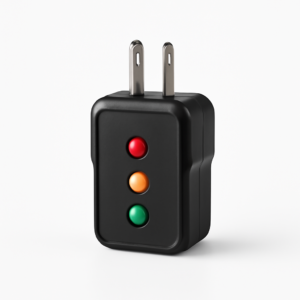
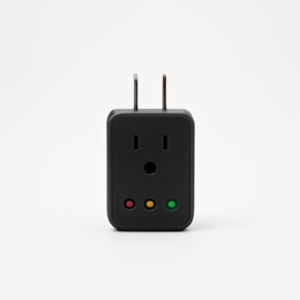
A plug-in outlet tester, also sold as a receptacle tester, is the most common tool in this category. It plugs into a standard three-slot outlet and lights up in a pattern that corresponds to a wiring condition. The legend printed on the tester body translates each pattern, and the usual readings are:
- Correct. Hot, neutral and ground are connected where the tester expects them.
- Open ground. The ground slot is not connected to anything the tester can detect. This is common in older homes where three-prong outlets were installed on two-wire circuits. The guide to what open ground means on an outlet tester walks through the usual causes.
- Open neutral or open hot. A conductor is disconnected, often from a loose connection at the outlet or upstream.
- Hot/neutral reversed (reversed polarity). The outlet still powers devices, but the switch in a lamp or appliance may interrupt the wrong conductor.
- Hot/ground reversed. A more serious miswire that calls for an electrician promptly.
What a plug-in tester cannot detect
Outlet testers are screening tools with real blind spots. A "correct" reading does not prove the circuit has a proper equipment ground. The classic example is a bootleg ground, where someone jumps the neutral to the ground screw at the outlet. A three-light tester typically reads that outlet as correct even though there is no true ground path. Testers also cannot measure the quality of a connection, detect a high-resistance ground, identify a shared neutral, spot a loose backstab connection that heats under load, or tell you whether the wire gauge matches the breaker. Reading the legend correctly matters too, and the outlet tester guide and receptacle tester guide cover the patterns in more detail.
GFCI testers and GFCI protection
A GFCI (ground-fault circuit interrupter) cuts power when it senses current leaking to ground, such as through a person touching a faulty appliance near water. Most plug-in outlet testers sold for home use add a GFCI test button, which deliberately leaks a small current from hot to ground to make the protecting device trip.
Test button vs tester trip
The TEST button built into a GFCI outlet or breaker checks the device's own internal circuit. A plug-in GFCI tester checks the protection from the outlet you plug into, which is useful for confirming that a downstream outlet is actually protected by a GFCI somewhere else on the circuit. The catch: a plug-in tester creates its fault through the ground conductor, so on an ungrounded outlet it may not trip a GFCI that is working correctly. In that case the GFCI's own TEST button is the better check. Manufacturers generally recommend pressing the TEST button monthly, then resetting it. The GFCI tester guide and the GFCI outlet tester guide explain both methods.
Where GFCI protection is usually required
Requirements come from the National Electrical Code edition your jurisdiction has adopted, and each new edition has tended to expand the list. In broad terms, current codes call for GFCI protection in kitchens (countertop outlets and, in newer editions, more), bathrooms, garages and accessory buildings, outdoors, unfinished basements and crawl spaces, laundry areas and near sinks. Older homes were built to older rules and are not automatically required to be updated, but adding GFCI protection in wet areas is a common inspection recommendation. Your local building department can confirm which edition applies.
Non-contact voltage testers: useful, with one big rule
A non-contact voltage tester (NCVT), often shaped like a thick pen, senses the electric field around an energized conductor and beeps or lights up when the tip is near it. It is the quickest way to check whether an outlet, switch, fixture or cord may be live before you touch it. The guides to voltage testers and the electrical voltage tester cover the general types.
The rule that matters most: always verify the tester on a known live source, then test the target, then test the live source again. This "live-dead-live" habit catches a dead battery or a failed sensor. Non-contact testers can give false negatives when a wire is shielded, inside metal conduit or armored cable, behind a thick cover plate, or when the tester is held at the wrong angle. They can also give false positives from induced voltage on a disconnected wire running next to a live one. A silent NCVT is a reason to keep checking, not proof that a circuit is safe to work on. Some models offer dual sensitivity ranges for picking out low-voltage wiring; the Klein non-contact voltage tester buyer guide describes that feature.
When you need a multimeter instead
Plug-in testers and NCVTs answer yes-or-no questions. A digital multimeter answers "how much." It is the right tool when you need an actual voltage reading (for example, a low-voltage complaint), want to check continuity on a cord or switch with the power off, measure resistance, or test a 240-volt circuit that a standard outlet tester will not plug into. A multimeter requires probing live terminals, so it carries more risk and more room for user error. The digital voltage tester guide explains the middle ground between pen testers and full meters.
Safety basics and CAT ratings
- Turn off the breaker before removing a cover plate or touching any conductor, then confirm the circuit is dead with a tester you have just verified on a live source.
- CAT ratings describe how well a meter or tester withstands voltage spikes. In simple terms, CAT II covers plug-in loads and outlet circuits, CAT III covers fixed building wiring such as the panel and feeders, and CAT IV covers the utility service entrance. Higher categories and higher voltage numbers mean more protection. For household work, a tool rated CAT III 600V or higher is a common recommendation.
- Inspect the tool. Cracked housings, worn leads and weak batteries are reasons to replace or service the tester.
- Know when to stop. Testing is fine for a homeowner. Opening panels, replacing devices on aluminum or old cloth-insulated wiring, or fixing any fault a tester finds is work for a licensed electrician.
What home inspectors use these testers for
Home inspection standards of practice generally call for testing a representative number of receptacles and checking GFCI devices where they are expected. In practice, inspectors plug a tester into accessible outlets room by room, trip GFCIs in kitchens, baths, garages and outdoors, and note open grounds, reversed polarity and non-functioning GFCIs for the report. An NCVT helps them check for unexpected voltage on things like doorbell transformers or fixtures. Infrared cameras are sometimes added to spot hot connections, as described in the infrared thermography electrical inspection guide. Inspectors report what they find; they do not repair it.
| Tool | What it checks | Best for | Key limitation |
|---|---|---|---|
| Plug-in outlet tester | Common wiring faults via light patterns | Quick room-by-room checks | Cannot detect bootleg grounds or connection quality |
| GFCI outlet tester | Wiring faults plus a GFCI trip test | Confirming downstream outlets are protected | May not trip a GFCI on an ungrounded outlet |
| Non-contact voltage tester | Presence of AC voltage near a conductor | Checking if a device may be live | False negatives with shielded wire or dead battery |
| Digital multimeter | Voltage, continuity, resistance | Measuring values and 240-volt circuits | Requires probing live terminals; more user skill |
Our picks in this category
The Southwire 40140N GFCI Tester is a plug-in receptacle tester with indicator lights for common wiring faults and a GFCI trip button.
The Fluke 1AC-A1-II VoltAlert is a pen-style non-contact voltage tester from a long-established test-equipment brand, commonly carried by electricians and inspectors.
The Sperry GFI6302 Outlet Tester is a plug-in outlet and GFCI tester with a printed light-pattern legend for reading results at a glance.
The Klein NCVT-3 Non-Contact Voltage Tester is a pen-style tester that adds a dual sensitivity range and a built-in flashlight for dim spaces.
The Klein Tools RT250 GFCI Receptacle Tester is a plug-in tester that pairs the usual fault indicators and GFCI trip with a small display for reading line voltage.
Related guides
For a broader look at how wiring is evaluated during a sale, start with the electrical inspection guide. Owners of older homes should also read about aluminum wiring and knob and tube wiring, two wiring types where outlet testers give limited information and an electrician's evaluation matters more.
For more on GFCI checks specifically, see the GFCI receptacle tester guide. Brand-specific pages include the Klein voltage tester guide and the Klein Tools voltage tester guide. The wider kit is covered on the home inspection tools page.
References
Frequently asked questions
What does an outlet tester check?
A plug-in outlet tester checks whether hot, neutral and ground are connected where it expects them and shows the result as a light pattern. It flags common faults such as open ground, open neutral, open hot and reversed polarity. It cannot judge connection quality or prove that the ground is a true equipment ground.
Can an outlet tester detect a bootleg ground?
Usually not. A bootleg ground, where the neutral is jumped to the ground screw at the outlet, typically reads as correct on a standard three-light tester. Confirming a true ground path requires further testing by an electrician.
How often should a GFCI be tested?
Manufacturers generally recommend pressing the TEST button on a GFCI outlet or breaker monthly, confirming power cuts off, then pressing RESET. A GFCI that will not trip or will not reset should be replaced by a qualified electrician.
Why did my GFCI tester not trip the GFCI?
Plug-in GFCI testers create a fault through the ground conductor. On an ungrounded outlet, such as a GFCI installed on a two-wire circuit, the tester may not trip a GFCI that works correctly. Use the GFCI's own TEST button in that case, and have an electrician check if it still fails.
Is a non-contact voltage tester enough to know a wire is dead?
No. Non-contact testers can miss voltage on shielded or armored cable or when the battery is weak. Turn off the breaker, check the tester on a known live source, test the target, then recheck the live source. Any repair work beyond testing belongs to a licensed electrician.
5 products

Gear picks you can trust
Tied to our guides
Each product maps to a topic we cover in depth — radon, mold, lead, moisture, electrical and thermal inspection — so you know what the tool is for before you buy.
Short list on purpose
No endless catalog. We list the kinds of kits and meters we’d point a homeowner or new inspector to, not every model on the market.
No extra cost
Buttons open Amazon, where you check the live price and buy. As an Amazon Associate we earn from qualifying purchases, at no cost to you.
Frequently asked
- Do you sell these products?
- No. We’re a guide-first site — every button takes you to Amazon to complete the purchase there.
- Why don’t you show prices?
- Amazon prices change constantly, so we send you to the live listing rather than show a number that may be out of date.
- Is a DIY kit a substitute for a professional inspection?
- For screening, often yes. For real-estate transactions, remediation clearance or anything health-critical, use a certified professional — our guides explain when.