Asbestos in Concrete: Slabs, Transite and Mastics

Homeowners planning to drill a basement slab, grind an old garage floor, or cut through a foundation wall often ask about asbestos in concrete. The short answer is reassuring but comes with important exceptions. Ordinary poured concrete, the mix of cement, sand, gravel and water used for slabs, footings and sidewalks, is generally not considered an asbestos product. The risk usually sits in materials that look like concrete or sit on top of it: asbestos-cement products often called transite, black floor-tile adhesives, old coatings, and some patching and leveling compounds. Because none of these can be confirmed by eye, the safe approach is to identify likely suspects, test before disturbing them, and use wet, low-dust methods when work is unavoidable. This guide summarizes EPA and OSHA guidance current as of 2026. Consult your physician about health concerns and an accredited asbestos professional for sampling and removal decisions.
Part of our Asbestos in the Home guide — start there for the full picture →
Is this mold, asbestos, or water damage? Get a free instant screen
Upload a clear photo of the suspect area. You'll get an instant AI screening opinion and what to do next. This is screening guidance, not a professional determination.
Screening guidance only. AI can be wrong. Confirm asbestos, mold type, or lead with lab testing or a licensed professional before acting.
Is Ordinary Concrete an Asbestos Product?
Standard structural concrete was not typically manufactured with asbestos as an ingredient. Asbestos fibers were valued for reinforcement and heat resistance in thin, manufactured cement products, where they let factories produce lightweight sheets, pipes and shingles. A thick poured slab gets its strength from aggregate and, where needed, steel reinforcement, so adding asbestos offered little benefit. That is why most testing laboratories and abatement contractors treat plain poured concrete as a low-likelihood material.
Low likelihood is not zero, though. A few situations can change the picture:
- Additives and specialty mixes. Some older specialty products, such as certain patching cements, fireproofing mixes or decorative toppings, may have contained asbestos. These are thin layers applied to a slab rather than the slab itself.
- Naturally occurring asbestos in aggregate. In some regions, rock used for aggregate can contain naturally occurring asbestos minerals. This is location-specific and uncommon in typical residential concrete, but it is one reason a lab result, not an assumption, settles the question.
- Contamination. Debris from asbestos-containing materials, such as pipe insulation fragments, can sit on or be embedded in the surface of an old basement floor.
The EPA’s overview of where asbestos is found lists asbestos cement products, roofing and siding shingles, vinyl floor tiles and the backing and adhesives used with vinyl flooring, and textured paint and patching compounds, along with cement sheets around wood-burning stoves. Those categories map closely onto the concrete-adjacent materials homeowners actually run into. For background on the fiber type most often used in these products, see our guide to chrysotile asbestos.
Asbestos-Cement Products: The Real Concern
Asbestos-cement, sometimes sold under the name transite, is a manufactured composite of portland cement reinforced with asbestos fibers. It looks and feels like concrete, which is exactly why it causes confusion. It was made into thin, rigid products that were durable, fire resistant and inexpensive, and many remain in homes built in the mid-twentieth century. Our overview of asbestos-cement covers the material in depth. Common forms include:
Siding Shingles
Rectangular shingles with a slightly textured or wood-grain face, often with nail holes near the bottom edge, were widely used on houses from roughly the 1920s into the 1970s. They are hard and brittle and tend to crack or chip at the corners. The guide to asbestos siding explains identification and management options.
Pipes
Asbestos-cement pipe was used for water mains, sewer laterals, storm drains and some vent applications. A gray pipe that looks like concrete but is too thin-walled for poured concrete may be this material. See asbestos-cement pipe for what to expect if a sewer scope or excavation finds it.
Flat and Corrugated Panels
Flat sheets were used as wallboard in utility areas, heat shields behind stoves, soffits and exterior panels. Corrugated sheets appeared on sheds, carports and agricultural buildings.
Flue and Vent Pipes
Gray cement-like flue pipe connecting older furnaces or water heaters to a chimney is a classic asbestos-cement suspect, especially in homes that have not had heating equipment replaced in decades.
Roofing
Asbestos-cement roofing shingles and slates, often in diamond or rectangular shapes, were installed on some older homes and outbuildings.
Asbestos-cement is generally considered non-friable when intact, meaning it does not crumble under hand pressure, so it tends to hold its fibers while in good condition. The risk rises sharply when the material is broken, sanded, sawn, drilled or weathered to the point that its surface becomes powdery.
Best Asbestos Test Kit: our top 3 picks
| Product | Best for | Key features | Price | Buy |
|---|---|---|---|---|
| Seeml Labs Asbestos Inspector in a Box | Verifiable lab accreditation |
| $22.00as of Nov 5, 2026 2:42 pm GMT+0000 | Buy now →Check current price |
| SLGi 1-Pack (5 Day) | Single sample with return postage |
| $35.00as of Nov 5, 2026 1:36 pm GMT+0000 | Buy now →Check current price |
| Asbestos-Sampling.com 2-Sample | Type and percentage in the result |
| $59.95as of Nov 5, 2026 1:36 pm GMT+0000 | Buy now →Check current price |


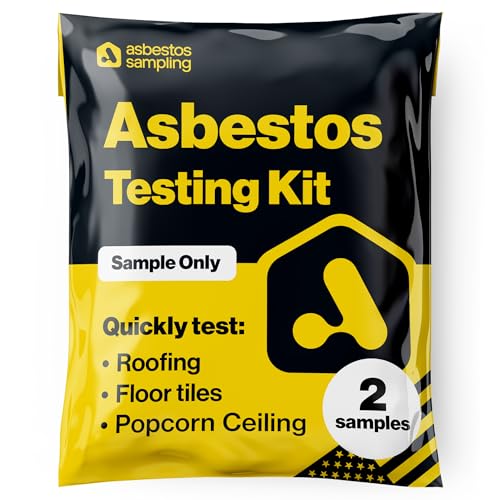
Prices are Amazon’s listed prices as of the time shown and change often; check Amazon for today’s price. As an Amazon Associate we earn from qualifying purchases.
Mastics, Coatings and Patching Compounds on Concrete Floors
For most homeowners, the more likely asbestos source on a concrete floor is not the slab but what was glued or troweled onto it.
Black floor adhesive. Old vinyl and asphalt tiles, often in 9-inch squares, were commonly set in black asphalt-based adhesive, frequently called cutback mastic. Both the tiles and the adhesive are frequent asbestos suspects. When tiles are pulled up, a black residue often remains bonded to the slab. That residue may contain asbestos, so scraping, grinding or sanding it dry is a poor idea. The EPA lists vinyl floor tiles and the backing and adhesives on vinyl sheet flooring among places asbestos may be found.
Sheet flooring backing. Older sheet vinyl sometimes had a felt-like backing that could contain asbestos. When the flooring is torn up, fragments of backing stay stuck to the concrete.
Coatings and paints. Some older floor coatings, sealers and textured paints may have contained asbestos. These are less predictable than floor tile adhesive, and testing is the only way to know.
Patching and leveling compounds. Patching compounds used to fill cracks or level slabs before flooring went down are another suspect. The EPA names textured paint and patching compounds among asbestos-containing materials, and while its example refers to walls and ceilings, older floor patches deserve the same caution until tested.
OSHA’s construction asbestos standard treats removal of floor tile and sheeting, and of construction mastics, as a defined class of asbestos work and sets specific practices for removing vinyl and asphalt flooring in older buildings, including wet methods for scraping residual adhesive and backing and a prohibition on dry sweeping. Those rules apply to employers and workers, not homeowners, but they show how seriously regulators treat these materials.
Likelihood Table: Concrete and Concrete-Adjacent Materials
The table gives general, hedged likelihoods based on how these products were typically made. It is not a substitute for testing. A “low” rating does not mean a material is safe to grind or cut without precautions.
| Material | Asbestos likelihood (general, hedged) | Notes |
|---|---|---|
| Plain poured concrete slab or footing | Generally low | Not typically made with asbestos; regional aggregate or surface contamination are exceptions |
| Concrete block (CMU) | Generally low | Mortar and parging are less predictable; test if old and disturbed |
| Asbestos-cement siding shingles | Higher in older homes | Brittle; avoid breaking, sanding or power washing aggressively |
| Asbestos-cement (transite) pipe | Higher in older systems | Found in some water, sewer and flue applications |
| Flat or corrugated cement panels | Moderate to higher in older buildings | Common near stoves, in sheds and soffits |
| Black adhesive under old floor tiles | Moderate to higher | Do not grind or sand dry; test before removal |
| 9-inch vinyl or asphalt floor tiles | Moderate to higher | Leave intact or cover; test before removal |
| Floor patching or leveling compounds | Uncertain; varies by product and age | Test before grinding or chipping |
| Old floor coatings and textured paints | Uncertain | Lab analysis needed |
Why You Can’t Confirm Asbestos by Looking
A gray, cement-like material might be harmless concrete, fiber cement made with cellulose, or asbestos-cement. A black stain on a basement floor might be old adhesive with asbestos or a newer product without it. The EPA states that, generally, a material cannot be identified as asbestos-containing simply by looking at it unless it is labeled, and that when in doubt, it should be treated as if it contains asbestos and left alone. OSHA adds that the fibers associated with health risks are too small to be seen with the naked eye.
Age and context help narrow the odds. Homes built before roughly 1980 are more likely to contain asbestos products, and OSHA’s construction standard uses buildings constructed no later than 1980 as the threshold for presuming certain materials contain asbestos unless shown otherwise. Still, newer homes can contain older salvaged materials, and older homes may have had materials replaced. Only a laboratory can give a definitive answer.
Some clues raise suspicion and justify testing before work begins:
- Thin, rigid, gray panels or pipes that look like concrete but are much thinner than a poured product.
- Siding shingles with a repeating embossed texture and exposed nail holes.
- Black, tar-like residue on a slab where tiles were removed.
- Small square tiles in a basement or utility room, especially in muted colors.
- A flue pipe of gray cement-like material on older heating equipment.
Cutting, Drilling or Grinding: Safer Practices
Asbestos fibers are released mainly when materials are disturbed. The EPA notes that asbestos-containing materials may release fibers when they are disturbed, damaged, removed improperly, repaired, cut, torn, sanded, sawed, drilled or scraped, and its homeowner guidance specifically says not to saw, sand, scrape or drill holes in asbestos-containing materials, and not to dust, sweep or vacuum debris that may contain asbestos. Its guidance on flooring says not to sand or try to level asbestos flooring or its backing, and that installing new flooring over old asbestos flooring is preferable when possible.
For a plain concrete slab that has been tested or is clearly modern, ordinary silica dust precautions apply. Concrete dust contains crystalline silica, which is a separate respiratory hazard, so wet cutting and dust extraction are good practice regardless of asbestos.
For suspect materials, the practical sequence is:
- Stop and test first. If a project would cut, drill or grind a suspect material, get it sampled before starting.
- Choose methods that do not disturb the material. Covering old tile with new flooring, or routing a new pipe or anchor to avoid an asbestos-cement panel, is often the safest path.
- Use wet methods if disturbance is unavoidable. OSHA’s construction standard requires employers to use wet methods or wetting agents to control exposure during handling, cutting and removal, unless wetting is infeasible. Dry power tools are the main source of high exposure.
- Avoid power tools on asbestos-cement. Abrasive saws and grinders can turn the material into fine dust. Professionals typically use hand tools and keep the material as intact as possible.
- Hire accredited professionals for removal and major repair. The EPA recommends that removal and major repair be done by people trained and qualified in handling asbestos, and highly recommends that sampling and minor repair also be done by an accredited professional.
Respiratory protection is part of professional practice. Our guide to masks for asbestos removal explains respirator classes, though a mask alone does not make dry grinding safe. For intact materials that will stay in place, sealing can sometimes reduce fiber release; see the guide to asbestos encapsulation paint for where that approach fits and where it does not.
Testing Options and Reading Results
There are two main ways to get a material tested.
Professional sampling. An accredited asbestos inspector collects samples, documents locations and sends them to an accredited lab. This is the approach the EPA recommends, noting that sampling done incorrectly can be more hazardous than leaving the material alone. It is also the best option before a renovation that will disturb several materials, because the inspector can plan which materials need sampling.
Home test kits. Mail-in kits let a homeowner collect a small sample and send it to a lab. They are widely sold at hardware stores and online. If you go this route, wet the material first, wear a respirator and disposable gloves, take only a small piece, seal the sample immediately, and patch the sampled spot. Our review of asbestos home testing kits compares what different kits include, and the asbestos test kit shop lists current options.
Lab reports usually name the method, list the asbestos types found, and give an estimated percentage. Under OSHA’s construction standard, an asbestos-containing material is one with more than one percent asbestos, but materials below that threshold can still release fibers when disturbed. The guide to asbestos test results explains how to read reports and what “trace” or “none detected” means in practice.
Test results are also useful for real estate. A buyer who sees transite siding or black floor adhesive in a listing can ask the seller for prior test results, request testing during the inspection period, or factor removal costs into an offer.
Where to Look in Front Range Homes
Housing stock along the Colorado Front Range spans early twentieth-century brick bungalows in Denver and Pueblo, postwar ranch homes in Lakewood, Aurora and Colorado Springs, and newer subdivisions in the northern suburbs. The concrete-adjacent materials worth checking differ by era and by room.
Basements and utility rooms. Many older basements were finished with small square floor tiles over the slab, often in brown, green, gray or speckled patterns. When owners later installed carpet or laminate, the tiles were frequently left in place underneath. A homeowner pulling up carpet may find tile, black adhesive, or both. Utility rooms may also hold an asbestos-cement flue pipe, cement board behind an old boiler or furnace, and remnants of pipe insulation on the floor.
Garages. Garage slabs are usually plain concrete, but older garages sometimes have asbestos-cement panels on walls near a water heater or as fire separation, and some floors carry old paints or coatings of unknown composition.
Exteriors. Asbestos-cement siding shingles turn up on some older homes in established neighborhoods, sometimes hidden under later vinyl or aluminum siding. Removing the newer layer can expose and damage the older shingles underneath, so plan for that possibility before a residing project.
Underground lines. A sewer scope sometimes reveals a lateral made of asbestos-cement pipe, particularly in neighborhoods built during the decades when that pipe was common. Intact buried pipe is generally not a direct exposure risk, but cutting or breaking it during a repair is a different matter, and contractors handling it should follow appropriate practices.
Around wood stoves and fireplaces. The EPA lists walls and floors around wood-burning stoves protected with asbestos paper, millboard or cement sheets among places asbestos may be found. Older hearth pads and stove surrounds deserve a test before removal.
A general home inspection may note suspect materials, but most home inspectors do not sample or identify asbestos. If a report says “possible asbestos-containing material,” treat that as a prompt for testing rather than a confirmation.
Removal Costs, Contracts and Real Estate
When a suspect material near concrete tests positive and the planned work cannot avoid it, removal by an accredited contractor is usually the path forward. Costs depend on the material, the square footage, access, containment needs, disposal requirements and local regulations, so quotes vary widely. Floor tile and mastic removal over a large basement slab tends to involve more labor than taking down a few intact asbestos-cement panels, because the adhesive is bonded to the concrete and must be removed with wet, non-abrasive methods or specialized chemical removers.
A few practical points help keep projects predictable:
- Get the survey before the bid. Contractors price more accurately when they have lab results for each material in the work area.
- Confirm permits and notifications. State and local agencies may require notification before certain asbestos work. In Colorado, the state health department regulates asbestos work, so ask the contractor how they handle notification and disposal.
- Plan clearance. Ask whether the contract includes post-removal visual inspection or air clearance testing before other trades return.
- Sequence the trades. Asbestos removal should happen before flooring installers, plumbers or electricians start cutting into the area.
In a home purchase, suspect materials on or around concrete are usually treated as a negotiation item rather than a deal-breaker. A buyer can ask for testing during the inspection period, request that the seller provide prior lab results, or use removal quotes to request a credit. Intact asbestos-cement siding or covered floor tile may need no immediate action at all, which can make a credit or simple documentation more sensible than a removal demand.
Managing Asbestos Around Concrete Over Time
If testing confirms asbestos in a material near or on concrete, removal is not always required. The EPA advises that asbestos-containing material in good condition that will not be disturbed is generally best left alone, and that homeowners should check it periodically for wear, tears or water damage. Practical management steps include:
- Leave intact asbestos-cement siding or panels in place, and avoid pressure washing or abrasive cleaning that could erode the surface.
- Cover old floor tile and adhesive with new flooring rather than tearing it out, when the floor height allows.
- Keep a written record of tested materials and results with the home’s documents, so future contractors know what they are dealing with.
- Avoid dry sweeping or vacuuming debris in areas with damaged material. The guide to asbestos cleaning covers safer cleanup practices.
- Plan renovations so that asbestos-containing materials are either avoided or removed by accredited professionals before other work begins.
For broader context on asbestos in other home materials, see was asbestos used in drywall, the asbestos hub, and the asbestos and lead section, which together cover identification, testing, removal costs and regulations.
References
- Learn About Asbestos — U.S. Environmental Protection Agency
- Protect Your Family from Exposures to Asbestos — U.S. Environmental Protection Agency
- Asbestos Overview — Occupational Safety and Health Administration
- 29 CFR 1926.1101: Asbestos in Construction — Occupational Safety and Health Administration
Frequently asked questions
Does concrete contain asbestos?
Ordinary poured concrete is generally not an asbestos product. The concern is asbestos-cement (transite) siding, pipe and panels, plus adhesives, coatings and patching compounds applied to concrete floors. Only lab testing can confirm.
Is it safe to drill into an old concrete basement floor?
A plain slab is usually low risk for asbestos, though silica dust is still a hazard, so use wet methods and dust control. If the floor has old tile, black adhesive or patching, test those materials before drilling through them.
How can asbestos-cement be told apart from concrete?
Asbestos-cement is usually thin and manufactured, as in siding shingles, pipes, flue pipes and flat or corrugated panels, while poured concrete is thick and cast in place. Looks are not proof, so send a sample to an accredited lab.
Does black mastic on a concrete floor contain asbestos?
Old black floor-tile adhesive often does, but not always. Do not grind or sand it dry. Test it, and if it contains asbestos, cover it with new flooring or hire an accredited contractor for removal.
Are home asbestos test kits reliable for concrete materials?
Mail-in kits use accredited labs and can give a useful answer for a single material when the sample is taken carefully. For renovation planning or several suspect materials, an accredited asbestos inspector is the better choice.
Planning to cut, drill or resurface an older Front Range slab and unsure what is on it? Ask us about testing before the work starts.