Best Ice Melt for Concrete (2026): 6 Picks Compared

Choosing the best ice melt for concrete is about protecting a surface that freeze-thaw cycles already punish. Front Range driveways, walks and steps can freeze and thaw again and again in a single winter as sunny afternoons follow cold nights, and every cycle drives water and dissolved salt into the surface. That is how concrete scales and flakes. The ice melt you choose matters, but so does how much you use, whether the concrete is new or sealed, and whether you shovel the slush off afterward. Below are six picks compared on what each listing says about chemistry, working temperature, application rate and concrete age, plus pet and plant notes where the listings make them. For the broader category, including bulk rock salt and fast-acting blends, see our main best ice melt roundup.
Part of our Structure & Exterior guide — start there for the full picture →
As an Amazon Associate we earn from qualifying purchases.
How we compared: we compared 13 current Amazon listings returned for ice melt for concrete, on what each states: active ingredients, lowest working temperature, application rate, concrete-age or sealing warnings, and pet, plant and metal claims. Several listings are different bag sizes of the same product. We did not test any product on concrete. “Safe for concrete” is the manufacturers’ wording, not a verified result. Prices and availability change, so check the current listing before buying.
Quick picks: the best ice melts for concrete
| Product | Best for | Key features | Price | Buy |
|---|---|---|---|---|
| Safe Paw | Best overall for concrete |
| $84.95as of Nov 11, 2026 6:53 am GMT+0000 | Buy now →Check current price |
| PawMedica Magnesium Chloride | Chloride melt that works colder |
| $26.99as of Nov 11, 2026 6:53 am GMT+0000 | Buy now →Check current price |
| AquaDoc Calcium Chloride | Extreme cold on cured concrete |
| $31.99as of Nov 11, 2026 6:53 am GMT+0000 | Buy now →Check current price |
| Snow Joe CMA Pellets | CMA blend, visible coverage |
| $28.97as of Nov 11, 2026 6:53 am GMT+0000 | Buy now →Check current price |
| Maple99 20 lb | Stated application rate |
| $23.99as of Nov 11, 2026 6:53 am GMT+0000 | Buy now →Check current price |
| Partners Premium Ice Melt | Large driveways, cold nights |
| $44.60as of Nov 11, 2026 6:53 am GMT+0000 | Buy now →Check current price |
Prices are Amazon’s listed prices as of the time shown and change often; check Amazon for today’s price. As an Amazon Associate we earn from qualifying purchases.
The 6 picks, compared listing by listing
1. Safe Paw — Best Overall Ice Melt for Concrete

Salt- and chloride-free granular deicer with CMA, an amide core and traction grit, melting down to -2 F.
Check price on Amazon$84.95 as of Nov 11, 2026 6:53 am GMT+0000 — prices change; see Amazon for current price.Why we like it
- Only listing stating 100% salt- and chloride-free
- Built-in grit adds traction underfoot
- Listing claims no pitting or staining on concrete
- States coverage per pound
| Specification | Details |
|---|---|
| Ingredients | Calcium magnesium acetate with a crystalline amide core; traction grit |
| Chloride content | Stated as 100% salt and chloride free |
| Working temperature | Melts down to -2°F |
| Coverage | About 100 sq ft per pound |
| Surface claims | Non-corrosive and non-conductive; avoids pitting and staining on concrete, pavers, asphalt and wood, per listing |
| Size | 35 lb container (35.5 lb listed) |
Safe Paw — CMA + amide core, salt- and chloride-free, traction grit, melts to -2 F, about 100 sq ft per lb, 35 lb
The Only Listing That Claims to Be Completely Chloride-Free
Chloride salts are the main concern for concrete. Lab research summarized in a peer-reviewed review notes that deicing salts interact with concrete during freeze-thaw cycles and can cause surface scaling, and a separate study found that concentrated calcium and magnesium chloride can form a damaging compound inside concrete. Of the 13 listings, Safe Paw is the only one that describes itself as 100 percent salt- and chloride-free. Several others contain CMA, a chloride-free deicer, but blend it with salts or do not say what else is inside.
It also adds grit to every granule, which helps on steps where the goal is traction as much as melting, and it is one of only three listings that give an application rate, about 100 square feet per pound.
The trade-off is cold-weather performance. Safe Paw lists a working temperature of -2°F, the warmest limit on the shelf. On the coldest Front Range nights, it will work more slowly or not at all, so shovel first and use it as a traction-and-melt layer rather than an ice breaker. Grit also needs sweeping up in spring. This product is also in our parent roundup; here it ranks first because of its chloride-free claim.
Pros
- Salt- and chloride-free per listing
- Traction grit for steps
- Stated coverage per pound
Cons
- Works only to -2°F
- Grit tracks and must be swept
- Slower than chloride melts
Check Safe Paw price on Amazon
2. PawMedica Magnesium Chloride — Best Chloride Melt for Colder Nights

Magnesium chloride ice melt rated to -15 F, for concrete, asphalt, stone and brick when applied as directed, 8 lb.
Check price on Amazon$26.99 as of Nov 11, 2026 6:53 am GMT+0000 — prices change; see Amazon for current price.Why we like it
- Names a single active ingredient
- Works to -15°F, far colder than CMA
- Listing claims gentler on paws than rock salt
- Made in the USA
| Specification | Details |
|---|---|
| Ingredient | Magnesium chloride |
| Working temperature | Down to -15°F |
| Surfaces | Concrete, asphalt, stone and brick when applied as directed |
| Pet claim | Gentler on dog paws than harsh rock salt, per listing |
| Application rate | Not stated |
| Size / origin | 8 lb; made in USA |
PawMedica IMMC8LB — magnesium chloride, works to -15 F, concrete/asphalt/stone/brick as directed, 8 lb, USA
The Only Magnesium Chloride Product on the Shelf
Three chloride types show up across these 13 listings: sodium chloride (rock salt and solar salt), calcium chloride (AquaDoc) and magnesium chloride. PawMedica is the only listing built on magnesium chloride. The EPA describes magnesium chloride as considered safer than sodium chloride for the environment, while noting it takes about twice as much to cover the same area.
For concrete, the picture is more nuanced. Research on concrete exposed to concentrated calcium and magnesium chloride found damage from a compound called calcium oxychloride, which is why “safer for the environment” does not automatically mean “safer for concrete.” The practical response is to use a thin layer, shovel the slush off quickly, and keep chloride melts off concrete that is new, unsealed or already flaking.
The listing’s pet claim is comparative, gentler than harsh rock salt, not a statement that it is harmless. The 8 lb container covers steps and a walk; a long driveway needs several. No application rate is given.
Pros
- Single named ingredient
- Works to -15°F
- Easy-to-handle 8 lb size
Cons
- Still a chloride salt
- No application rate stated
- Small size for driveways
Check PawMedica Magnesium Chloride price on Amazon
3. AquaDoc Calcium Chloride — Best for Extreme Cold on Cured Concrete

Calcium chloride flakes that melt to -25 F, with an explicit warning against new, unsealed or flaking concrete.
Check price on Amazon$31.99 as of Nov 11, 2026 6:53 am GMT+0000 — prices change; see Amazon for current price.Why we like it
- Only listing warning off concrete under 12 months
- Works to -25°F, the coldest rating here
- Flakes spread thin and resist clumping
- Clear notes on surfaces and pets
| Specification | Details |
|---|---|
| Ingredient | Calcium chloride flakes |
| Working temperature | Down to -25°F (-32°C) |
| Concrete guidance | For fully cured, sealed concrete; not for concrete under 12 months old, unsealed or flaking |
| Other surfaces | Keep off painted or stained surfaces, wood decks and indoor floors |
| Pets | Not formulated for pets; wipe paws, per listing |
| Size | 10 lb resealable pail; made in USA |
AquaDoc calcium chloride — flakes, melts to -25 F, cured and sealed concrete only, not under 12 months, 10 lb pail
The Only Listing That Warns Against New, Unsealed or Flaking Concrete
Many bags on this shelf say “safe for concrete” or “safer for concrete.” AquaDoc’s 10 lb listing is the only one that states the limits: it is meant for fully cured, sealed concrete used as directed, and not for concrete under 12 months old, unsealed or already flaking. That candor is the reason it makes this list despite being a chloride.
When you need it, nothing here works colder. A -25°F rating ties Snow Joe’s Blue Heat (and AquaDoc’s own 8 lb bag) for the coldest on the shelf, and calcium chloride releases heat as it dissolves, so a thin layer cuts through ice in minutes on a sub-zero morning. AquaDoc’s guidance to pretreat before a storm and sweep up residue after melting is good practice for any product.
The listing is also honest about pets: calcium chloride is “not formulated for pets,” so wipe paws after walks. The 8 lb AquaDoc listing on the same shelf is the same formula without these detailed warnings. This product is also in our parent roundup.
Pros
- Explicit concrete-age and sealing warnings
- Coldest working temperature
- A thin layer goes a long way
Cons
- Chloride; not for new or unsealed concrete
- Not formulated for pets
- 10 lb pail is small for driveways
Check AquaDoc Calcium Chloride price on Amazon
4. Snow Joe CMA Pellets — Best CMA Blend With Visible Coverage

Green-coated pellets blending calcium magnesium acetate, sodium chloride and fertilizer, in a 20 lb bag.
Check price on Amazon$28.97 as of Nov 11, 2026 6:53 am GMT+0000 — prices change; see Amazon for current price.Why we like it
- CMA lowers the salt share of the blend
- Green coating shows where you have spread
- Manageable 20 lb bag
- Listing says crystals do not track indoors
| Specification | Details |
|---|---|
| Ingredients | Calcium magnesium acetate, sodium chloride and fertilizer blend; proportions not stated |
| Form | Green-coated pellets |
| Working temperature | Not stated |
| Uses | Driveways, sidewalks and roofs, per listing |
| Application rate | Not stated |
| Size | 20 lb bag (listed weight field shows 0 lb, a data error) |
Snow Joe AZ-20-PET — CMA + sodium chloride + fertilizer pellets, green-coated, 20 lb bag
The Only Listing That Discloses a Fertilizer Component
Four listings on this shelf mention calcium magnesium acetate: Safe Paw, Snow Joe’s Enviro Blend in two sizes, and this pellet blend. This one is the most transparent about what else is in the bag, naming sodium chloride and a fertilizer alongside the CMA. No other listing on the shelf discloses a fertilizer.
That honesty cuts both ways. A CMA share means less chloride per pound than straight rock salt, and the green coating shows where you have spread so you are less likely to overapply. But the listing does not identify the fertilizer or give proportions. Before using it on new or decorative concrete, read the bag for the fertilizer type, and keep it off any surface the manufacturer excludes.
It also leaves out a working temperature and an application rate. Use it as a moderate-cold melt for walks and drives, shovel first, and sweep up leftovers.
Pros
- Discloses its blend components
- Green coating prevents overuse
- Easy 20 lb bag
Cons
- Fertilizer type not identified
- No working temperature stated
- Contains sodium chloride
Check Snow Joe CMA Pellets price on Amazon
5. Maple99 20 lb — Best for a Stated Application Rate
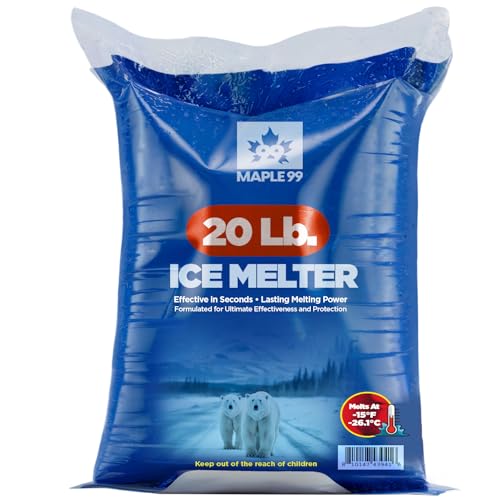
Ice melt described as less corrosive to concrete, applied at 2–4 oz per square yard, working down to -15 F.
Check price on Amazon$23.99 as of Nov 11, 2026 6:53 am GMT+0000 — prices change; see Amazon for current price.Why we like it
- States 2 to 4 ounces per square yard
- Works down to -15°F
- Encourages pretreating before snowfall
- Shaker or bag application
| Specification | Details |
|---|---|
| Ingredients | Not stated; described as less corrosive to concrete than traditional ice melt |
| Application rate | 2–4 oz per square yard |
| Working temperature | Down to -15°F |
| Use | Spread before snowfall to prevent bonding; follow bag instructions |
| Surfaces | Driveways, sidewalks, steps, balconies, patios, walkways |
| Size | 20 lb bag |
Maple99 8018 — 20 lb, 2–4 oz per sq yd, works to -15 F, described as less corrosive to concrete
One of Two Listings That Give a Rate per Square Yard
Overapplication is the most common way homeowners hurt their own concrete. Only two listings on this shelf give a rate per area in ounces: this Maple99 20 lb bag and Maple99’s pet-safe pail, both at 2 to 4 ounces per square yard. Safe Paw states coverage per pound. A square yard is 9 square feet, so a 4 by 25 foot walk, about 11 square yards, needs roughly 22 to 44 ounces, under 3 pounds.
The listing also pushes the right habit: spread a thin layer before snowfall so ice does not bond, then shovel. That uses less product than melting packed ice after the fact.
The weakness is transparency. The listing never names its ingredients, only that it is less corrosive to concrete than traditional ice melt. Maple99’s 35 lb pet pail, from the same brand, identifies solar salt, which is sodium chloride; check this bag’s label before using it on new or decorative concrete.
Pros
- Clear application rate
- Works to -15°F
- Pretreatment guidance
Cons
- Ingredients not named
- “Less corrosive” not quantified
- No concrete-age guidance
Check Maple99 20 lb Ice Melt price on Amazon
6. Partners Premium Ice Melt — Best for Large Driveways on Cold Nights

Blue-tinted 50 lb ice melt rated to -20 F, described as gentler on concrete than rock salt, with anti-caking agents.
Check price on Amazon$44.60 as of Nov 11, 2026 6:53 am GMT+0000 — prices change; see Amazon for current price.Why we like it
- Works to -20°F
- 50 lb bag for long driveways
- Anti-caking agents spread evenly
- Blue tint shows coverage
| Specification | Details |
|---|---|
| Ingredients | Not stated; described as gentler on concrete than rock salt |
| Working temperature | Down to -20°F |
| Application | Hand or mechanical spreader; anti-caking agents |
| Residue | Listing says no greasy residue and reduced tracking |
| Application rate | Not stated |
| Size / origin | 50 lb bag; made in USA |
Partners PIM50 — 50 lb blue-tinted ice melt, works to -20 F, anti-caking, described as gentler on concrete than rock salt
The Coldest Rating Among the 50 lb Bags
Three 50 lb bags appear on this shelf: Partners, Snow Joe’s Enviro Blend and Snow Joe’s Blue Heat. Blue Heat claims -25°F but is our parent roundup’s pick; Enviro Blend claims -10°F. Partners sits between at -20°F, making it the cold-weather bulk option here for a long driveway, with anti-caking agents that suit a broadcast spreader.
The blue tint helps you see coverage, which matters at bulk quantities where it is easy to throw far more than needed.
Like the Maple99, the listing does not name its ingredients, only that it is gentler on concrete than rock salt. Without a rate, borrow Maple99’s 2 to 4 ounces per square yard as a starting point and follow the bag. Keep it off concrete under a year old.
Pros
- Works to -20°F
- Bulk 50 lb size
- Spreads evenly
Cons
- Ingredients not named
- No application rate
- No pet or plant claims
Check Partners Premium Ice Melt price on Amazon
Listings we left out
Three products on the shelf did not make the cut for concrete specifically. Home and Country’s 45 lb pail is coarse rock salt, sodium chloride, with no concrete guidance and no stated working temperature. Maple99’s 50 lb bag claims a “safety-max” formula that prevents refreezing but names no ingredients and gives no application rate, and its 35 lb pet pail is solar salt. Rock salt is cheap and works, but it is the deicer the EPA associates with corrosion of vehicles, bridges and roads, and it offers nothing extra for a driveway you want to keep.
How ice melt damages concrete
Concrete does not usually fail because ice melt “eats” it. It fails at the surface when salty water soaks into the top layer and freezes and thaws repeatedly. A peer-reviewed review of freeze-thaw research describes surface scaling and internal cracking as the prevalent damage modes for concrete pavement, and notes that deicing salts change the freezing behavior of the water in concrete’s pores and can increase expansion pressure. The same review explains why air-entrained concrete resists frost better: tiny closed air bubbles relieve that pressure.
Chemistry adds a second mechanism. A study on concrete exposed to concentrated calcium and magnesium chloride found damage from calcium oxychloride, a compound that forms when those salts react with the cement paste. Damage dropped as air content and supplementary materials such as fly ash or slag increased. In other words, well-made, air-entrained, sealed concrete tolerates deicers far better than weak, unsealed or poorly finished concrete.
New concrete: the first winter
AquaDoc is the only listing on this shelf that warns against using its product on concrete less than 12 months old, but the caution is worth applying to every deicer. New concrete has not finished developing its strength and surface, and it may not have been sealed yet.
- For the first winter, rely on prompt shoveling and sand or grit for traction rather than chemical melt.
- If you must use a melt, pick a chloride-free product such as Safe Paw, use the thinnest layer that works, and shovel the slush off.
- Ask the contractor when the slab can be sealed and follow their schedule; our guide to concrete sealer explains penetrating and film-forming types.
Using any ice melt with less damage
- Shovel first. Melt is for the thin layer left after shoveling, not for 4 inches of snow.
- Pretreat thinly. A light layer before a storm keeps ice from bonding, so less product is needed.
- Measure. Use a stated rate, such as Maple99’s 2 to 4 ounces per square yard, as a ceiling.
- Remove the slush. Brine left sitting on the surface is what soaks in and freezes; push it off the slab once the ice breaks.
- Sweep up leftovers. Undissolved granules keep working into the surface and wash into plant beds.
- Keep it off steps’ edges and joints. Corners, nosings and expansion joints are where water collects and scaling starts.
Traction matters as much as melting. The CDC reports that falls among adults 65 and older caused over 43,000 deaths in 2024, the leading cause of injury death for that group. On steps used by older family members, a gritty, chloride-free product plus handrails beats a fast melt that leaves a wet, refreezing surface.
Pets, plants and runoff
The EPA notes that excess road salt accumulates along roadsides, killing roadside plants, and that high chloride levels in surface water are toxic to some fish, insects and amphibians. The same page describes calcium chloride and magnesium chloride as safer for the environment than sodium chloride, though more expensive and, for magnesium chloride, needed at about twice the amount. The lesson for a homeowner is the same as for a highway department: use less, and keep it off lawns and planting beds along the driveway.
Pet claims on these listings are the manufacturers’ own and are mostly comparative, “gentler than rock salt” or “safer for paws.” AquaDoc says plainly that calcium chloride is not formulated for pets. Whatever you use, wiping paws after walks is a sensible habit, and a veterinarian is the right source for a pet that licks or limps after contact.
When the concrete is already damaged
If the surface is flaking, pitted or exposing aggregate, no ice melt is truly safe on it. Scaling usually gets worse each winter once it starts. Small areas can be repaired with a concrete patch, larger worn surfaces may suit concrete resurfacing, and cracks should be filled before winter with a concrete crack filler so water does not get in. Steps with crumbling nosings are also a trip hazard; see our guide to concrete steps.
Spalling that goes deeper than the surface, slabs that heave or tilt toward the house, or cracks that grow each year can point to drainage or soil problems rather than ice melt. Our structure and exterior inspection hub explains what an inspector looks at. Buying a Front Range home with a worn driveway or crumbling steps? Contact us to connect with a vetted local inspector.
Frequently asked questions
What ice melt is safest for concrete?
A chloride-free product such as calcium magnesium acetate is generally the gentlest choice, and Safe Paw is the only listing here describing itself as fully salt- and chloride-free. Any product does less harm when applied thinly, after shoveling, with the slush removed. Well-sealed, air-entrained concrete resists damage best.
Can you put ice melt on new concrete?
It is best avoided for the first year. AquaDoc's listing warns against using its calcium chloride on concrete under 12 months old, unsealed or flaking. For a new slab's first winter, shovel promptly and use sand or grit for traction.
Is calcium chloride or magnesium chloride better for concrete?
Both work colder than rock salt, and the EPA describes both as safer for the environment than sodium chloride. Research has found that concentrated calcium and magnesium chloride can form a compound that damages concrete, so use either sparingly and remove the brine after it melts the ice.
How much ice melt should I use on a driveway?
Follow the bag. Maple99 lists 2 to 4 ounces per square yard, and Safe Paw lists about 100 square feet per pound. Shovel first, apply a thin even layer, and do not try to melt deep snow with chemicals.
Why is my concrete flaking after winter?
Flaking, called scaling, happens when salty water soaks into the surface and freezes and thaws repeatedly. Weak or unsealed surfaces and heavy deicer use make it worse. Repair the damaged areas, seal the concrete, and switch to less product or a chloride-free melt.
References
- Winter Is Coming! And With It, Tons of Salt on Our Roads — U.S. Environmental Protection Agency
- Impact of Freeze-Thaw Cycles on the Long-Term Performance of Concrete Pavement and Related Improvement Measures: A Review — National Library of Medicine (PubMed Central)
- Durability of Concretes Exposed to High Concentrations of CaCl2 and MgCl2 — National Library of Medicine (PubMed Central)
- About Older Adult Fall Prevention — Centers for Disease Control and Prevention