Water Heater Tripping the Breaker: Causes and Fixes
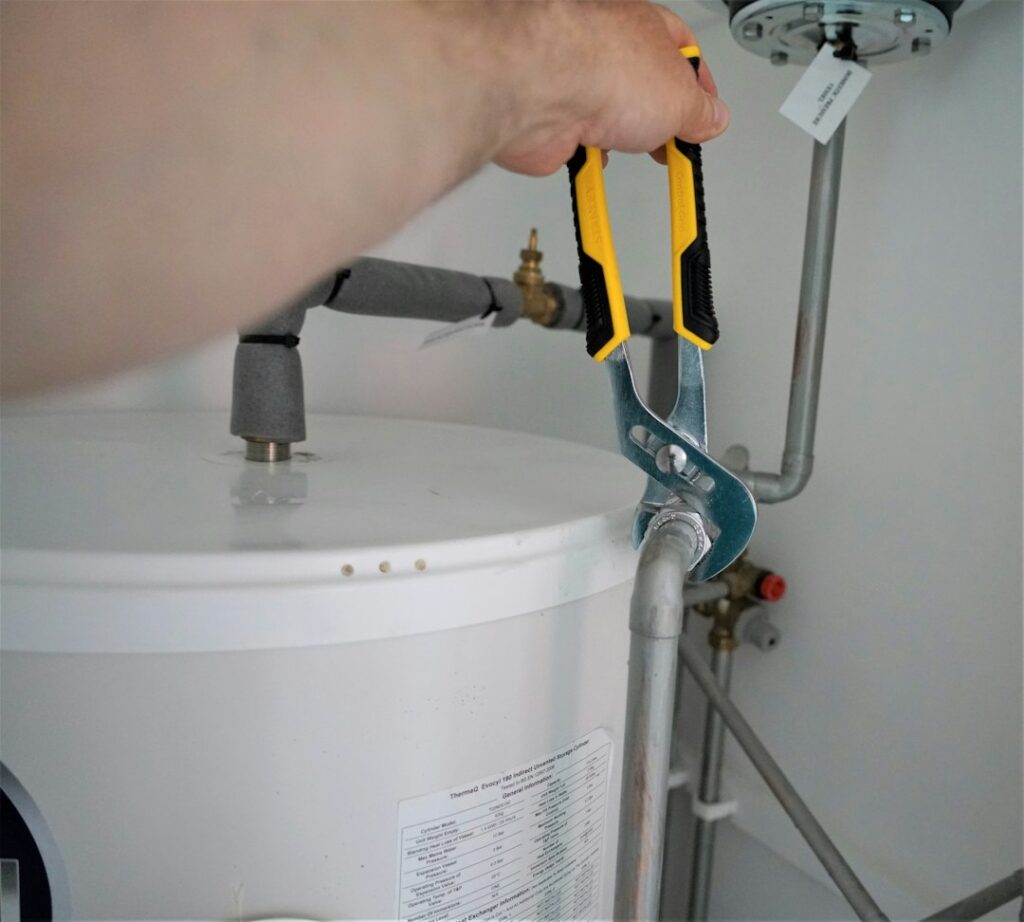
An electric water heater that trips its breaker usually announces itself the same way: a lukewarm shower, then a cold one, then a trip to the panel to find the double-pole breaker flipped off. Reset it and the heater may run for an hour, a day or a week before it happens again. When a water heater keeps tripping breaker after breaker reset, the cause is almost always one of a handful of faults, most often a heating element that has shorted to the tank, damaged wiring at the terminals or a failing thermostat. This guide explains how each fault happens, how a tripped breaker differs from the heater’s own high-limit cutoff, how professionals test elements, why sediment burns out lower elements, what changes with heat pump models and how to weigh repair against replacement. Electric water heaters run on 240 volts, so the safety section comes before any testing advice.
Part of our Plumbing & Water guide — start there for the full picture →
Why Does My Water Heater Keep Tripping the Breaker?
A breaker trips when it senses more current than the circuit is rated for, or a direct short. On a standard electric tank heater, the usual culprits are:
- A heating element shorted to ground. The sheath of an element cracks or corrodes, water reaches the internal coil, and current leaks to the tank. This is the most common cause of repeated trips.
- Damaged wiring or loose terminals. Loose screws on the element or thermostat terminals heat up, scorch insulation and can arc or short.
- A failed thermostat. A thermostat with welded or shorted contacts can energize both elements at once or create a short inside the control.
- An undersized breaker or wire. If the circuit was never sized for the heater, or a higher-wattage element was installed later, normal operation can overload it.
- A failing breaker. Breakers wear out too, especially ones that have tripped many times or show heat damage.
The pattern of the trip is a useful clue. A breaker that trips instantly when reset points to a dead short, usually an element or wiring. A breaker that trips after the heater has run for a while suggests overheating at a loose connection or an overloaded circuit. And if the breaker stays on but you still have no hot water, the problem may be the heater’s own high-limit switch, not the breaker at all.
Breaker Trip vs. High-Limit Trip: Know the Difference
Most residential electric tank heaters have two separate safety cutoffs, and homeowners often confuse them.
The Circuit Breaker
The breaker in your electrical panel protects the wiring. On most electric water heaters, it is a double-pole breaker, two handles tied together, because the heater runs on 240 volts. When it trips, the heater loses all power. The breaker does not care why the current spiked, only that it did.
The High-Limit Switch (ECO)
Behind the upper access panel, usually above the upper thermostat, sits a high-limit switch, often called the ECO (energy cut-off), with a red reset button. It shuts off the heating elements if the water inside the tank gets dangerously hot. When it trips, the breaker stays on but the heater stops heating.
A high-limit trip usually points to a thermostat stuck closed, an element that keeps heating because of a short, or a loose connection overheating the switch itself. Pressing the red button may restore hot water, but a heater that trips its high-limit repeatedly has an underlying fault. Many technicians treat a repeat high-limit trip as a reason to test both thermostats and both elements.
Some faults trip both. A grounded element can overheat water and trip the high-limit, then later short hard enough to trip the breaker. That is why a diagnosis should look at the whole heater rather than whichever safety device tripped last.
Safety First: 240 Volts and Stored Hot Water
Electric water heaters combine two hazards: 240-volt power and a tank full of water that may be near scalding temperature. Before anyone opens an access panel:
- Turn off the breaker for the water heater, and if a local disconnect switch is mounted near the heater, turn that off too.
- Verify the power is off with a tester you have checked on a known-live circuit. A non-contact tester is a first check. A multimeter set to AC voltage, used by someone trained to use it, confirms there is no voltage across the terminals and from each terminal to the tank.
- Lock or label the panel so nobody resets the breaker while work is underway.
- Assume insulation and wiring may be damaged. Scorched wires near the terminals are a sign to stop and call an electrician.
The lockout/tagout idea comes from workplace safety. OSHA’s page on controlling hazardous energy describes lockout/tagout practices as procedures that disable equipment to prevent the release of hazardous energy during servicing and maintenance. The OSHA standard is written for employers, not homeowners, but the principle carries over: de-energize, verify and keep it off until the job is done.
The National Fire Protection Association’s home electrical safety guidance lists frequent problems with blowing fuses or tripping circuit breakers among the reasons to call a qualified electrician, and it recommends having electrical work done by one. Replacing an element is within reach for some experienced homeowners, but anything involving the supply wiring, the breaker or the panel is electrician territory. Our guide to a breaker that keeps tripping covers the panel side of the problem in more depth.
Heating Element Failures and How They Are Tested
Most residential electric tank heaters have an upper and a lower element, each controlled by its own thermostat. On typical two-element models, only one element heats at a time. Elements commonly carry ratings stamped on the flange, such as 3,500, 4,500 or 5,500 watts at 240 volts, though models vary.
Shorted to Ground
An element is a resistance coil packed inside a metal sheath. When the sheath cracks, often from age, scale or overheating, water seeps in and current finds a path to the tank, which is grounded. That is a ground fault, and it can trip the breaker immediately or intermittently as the element heats and expands.
Open Element
An element can also burn through and go open, meaning no current flows. An open element does not trip a breaker. It just stops heating, so you get less hot water or none. It is still worth knowing because a heater can have one shorted element and one open element at the same time.
How Testing Works
With power confirmed off and the wires disconnected from the element, a technician typically runs two checks with a multimeter:
- Resistance across the two element terminals. A healthy element reads a specific resistance based on its wattage and voltage. As a rough guide, many common 240-volt residential elements fall somewhere in the range of about 10 to 17 ohms. A reading of zero or near zero suggests a short, while an infinite or “OL” reading suggests an open element. Check the element’s rating and the manufacturer’s data rather than relying on a single number.
- Continuity from each terminal to the tank or element flange. There should be no continuity. Any reading here indicates the element is grounded and should be replaced.
These are general descriptions, not step-by-step instructions, and readings can vary by meter and model. If you are not comfortable using a meter on a 240-volt appliance, leave testing to a professional. For background on meter and tester types, see our guide to the electrical voltage tester.
Dry Firing
One avoidable way to destroy an element is to power it before the tank is full. An element energized in air can burn out within moments. After draining or replacing a tank, technicians commonly open a hot water faucet until water flows steadily, which shows the tank is full, before restoring power.
Wiring, Terminal and Thermostat Problems
Not every trip comes from an element. Behind each access panel are terminal screws, wiring and a thermostat, all packed under insulation in a warm, sometimes damp space.
Loose terminals. A loose screw at an element or thermostat terminal creates resistance and heat. Over time the wire end darkens, insulation becomes brittle and the connection may arc. Melted plastic on the thermostat or a browned terminal block points here. An electrician will usually cut back to clean wire, replace damaged parts and tighten connections to the manufacturer’s specification.
Supply wiring damage. The cable from the panel to the heater can be damaged where it enters the heater’s junction box, by a loose cable clamp, a rodent or past plumbing work. Damaged supply wiring needs an electrician.
Thermostat failure. Thermostats can stick closed, keeping an element on until the high-limit trips, or develop internal shorts. A thermostat that is discolored or does not click between elements as the water heats may be suspect. Thermostats and elements are often replaced together on older heaters.
Undersized breaker or wire. A heater’s nameplate lists its voltage and wattage, and many installation manuals specify a minimum circuit size. If someone installed a higher-wattage element than the original, or the circuit was undersized from the start, the breaker may be doing its job correctly. The fix is to match the element to the circuit, or have an electrician resize the circuit, never to install a bigger breaker on the same wire.
If the heater sits in a home with known wiring issues, such as aluminum branch circuits, mention that to the electrician. A related symptom elsewhere in the house is an outlet that suddenly goes dead, which our sibling guide on an outlet that stopped working walks through.
Sediment and Lower Element Burnout
Minerals in water settle to the bottom of the tank as scale and sediment. On electric heaters, the lower element sits close to that layer. As sediment builds, it can bury the element, insulating it from the water so the sheath runs much hotter than designed. That overheating shortens element life and can crack the sheath, leading to the ground fault that trips the breaker.
Signs of heavy sediment include popping or rumbling sounds, reduced hot water capacity and repeated lower-element failures. Many Front Range water supplies are moderately hard, and homes on private wells can see more mineral content, so sediment is a common contributor in older tanks.
Manufacturers commonly recommend periodic flushing, often annually, though it depends on water quality. Low-watt-density elements, which spread heat over more surface area, are sometimes chosen as replacements in hard-water areas. On an old tank that has never been flushed, a first flush can stir up debris and occasionally cause a drain valve to leak, so some owners prefer to have it done during a service visit. Our guide to water heater inspection covers what technicians look for beyond the electrical side.
Heat Pump Water Heaters and Breaker Trips
Heat pump water heaters, also called hybrid electric water heaters, use a compressor to move heat from the surrounding air into the water. They usually also contain at least one electric resistance element for backup. ENERGY STAR notes that heat pump water heaters should be installed in spaces that stay between 40 and 90 degrees Fahrenheit year-round, and that in colder conditions with colder incoming water, they may temporarily switch to a back-up standard electric mode to keep up with demand.
That matters for troubleshooting. A hybrid unit that trips its breaker may have the same element or wiring faults as a standard tank heater, but it can also have compressor, fan or control-board problems. Many models display error codes, and the manufacturer’s manual often explains them. Because the electronics are more complex, diagnosis typically goes to a technician familiar with the brand. Front Range basements and garages that drop below 40 degrees in winter can push a hybrid unit into resistance mode, which increases electrical load.
For a broader look at how these units work and where they fit, see our guide to the heat pump water heater.
Repair or Replace? Typical Costs
Most breaker-tripping problems on electric tank heaters are repairable. The repair-or-replace question usually comes down to the heater’s age, the tank’s condition and how many parts have failed.
| Repair | Rough cost range | Notes |
|---|---|---|
| Replacement heating element (part only) | About $20 to $60 | Varies by wattage and density. |
| Element replaced by a plumber or technician | About $150 to $400 | Includes draining and refilling the tank. |
| Thermostat or high-limit replacement | About $150 to $350 | Often paired with an element replacement. |
| Electrician repair of wiring or breaker | About $150 to $500 | More if the circuit must be resized. |
| New standard electric tank, installed | Often about $1,000 to $2,500 | Depends on size, access and code upgrades. |
| Heat pump water heater, installed | Often several thousand dollars | Rebates and tax credits may offset part of the cost. |
These are rough industry estimates, not quotes. Prices vary by market, access and local permit requirements.
Replacement starts to make sense when the tank is leaking, when the heater is past roughly the typical tank life many manufacturers cite, or when several components have failed. A heater with heavy sediment may keep burning through lower elements no matter how many are replaced. Our guide to water heater replacement cost breaks down tank, tankless and heat pump pricing.
What Home Inspectors Look At
Under the American Society of Home Inspectors (ASHI) Standard of Practice, the plumbing portion of an inspection includes water heating equipment, and the inspector describes it including the energy source. The electrical portion covers overcurrent protection devices, among other items. The standard does not require inspectors to measure amperage, voltage or impedance, so an inspection will not diagnose an intermittent element short.
What an inspector may note is a heater near the end of its typical life, corrosion or leaks, missing discharge piping on the relief valve, scorched wiring visible at the heater, or a breaker that appears mismatched. If the seller mentions trips, ask for repair records. Buyers comparing inspectors can start with our guide to hiring a home inspector.
References
- Electrical Safety in the Home: Safety Tips — National Fire Protection Association
- Control of Hazardous Energy (Lockout/Tagout) — Occupational Safety and Health Administration
- Heat Pump Water Heaters: Buying Guidance — ENERGY STAR
- ASHI Standard of Practice for Home Inspections — American Society of Home Inspectors
Frequently asked questions
Why does my water heater keep tripping the breaker?
The most common cause is a heating element whose sheath has cracked and shorted to the tank. Loose or burned terminal wiring, a failed thermostat, an undersized circuit or a worn breaker can also cause repeated trips. Turn the breaker off and have the heater tested.
Can a bad heating element trip a breaker?
Yes. When an element is shorted internally or grounded to the tank, it can draw excessive current or leak current to ground, tripping the breaker immediately or intermittently. An open element usually does not trip the breaker but stops heating.
What is the red reset button on my water heater?
It is the high-limit switch, often called the ECO. It cuts power to the elements if the water overheats, while the breaker stays on. Repeated high-limit trips usually point to a failed thermostat, a shorted element or a loose connection.
Is it safe to keep resetting the water heater breaker?
No. A breaker that trips repeatedly is signaling a fault. Resetting it over and over can let damaged wiring or a grounded element keep overheating. Leave it off and have a technician or electrician diagnose the cause.
How much does it cost to fix a water heater that trips the breaker?
As a rough estimate, an element or thermostat replacement often runs about $150 to $400 with labor, and electrical repairs to wiring or the breaker can run more. A new installed electric tank often costs about $1,000 to $2,500.
If a pre-purchase inspection flagged an aging electric water heater or scorched wiring at the tank on a Front Range home, contact us and we can help you find a qualified inspector to take a closer look.