Why Does My GFCI Keep Tripping? Causes and Safe Fixes
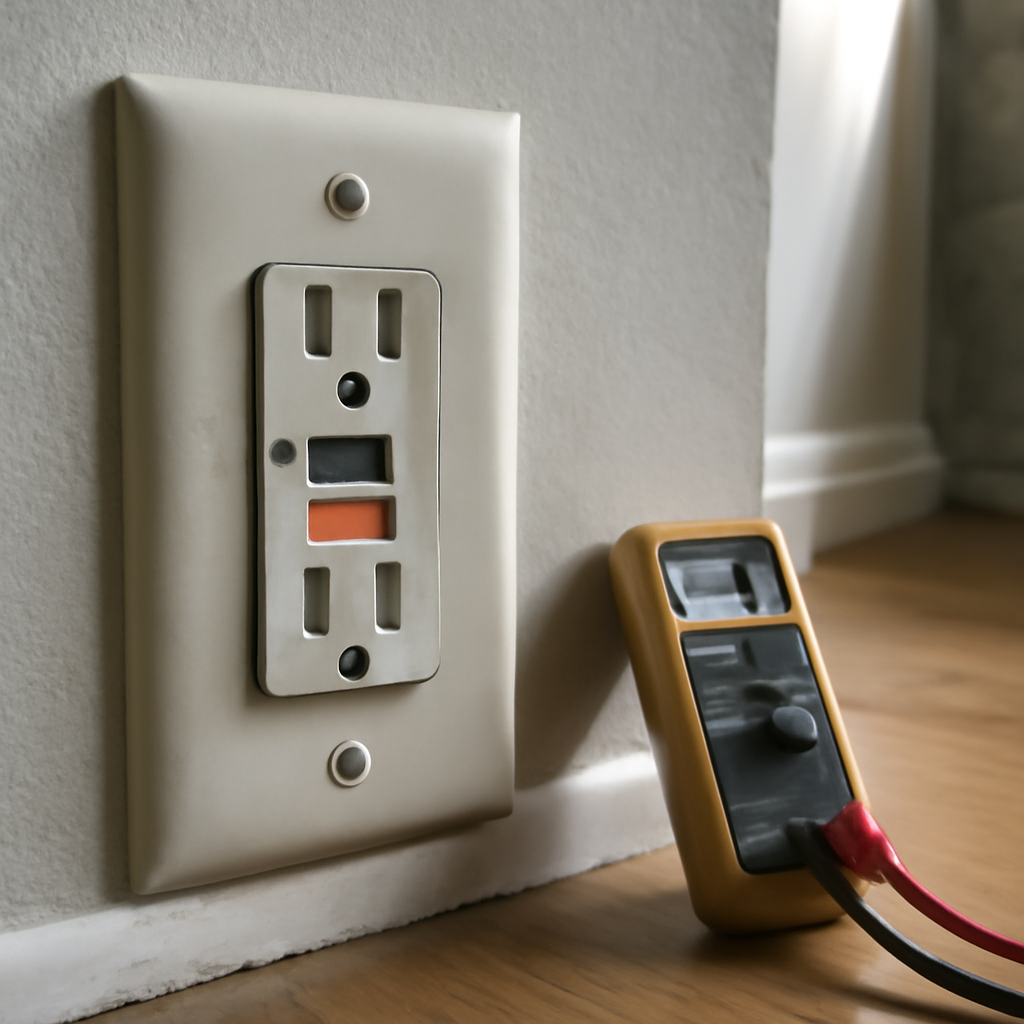
A GFCI usually keeps tripping because it is doing its job: it has detected current leaking to ground through moisture in an outlet box or outdoor receptacle, a worn appliance, a damaged cord, or a wiring fault somewhere on the protected circuit. Less often the cause is the GFCI itself wearing out, or a circuit carrying too many downstream outlets and long runs that add up to nuisance trips. Because every one of those causes can involve shock risk, the safe approach is to find what changed rather than keep resetting the device. This guide ranks the causes, shows how to isolate the problem without opening any wiring, and explains when to stop and call a licensed electrician.
Part of our Home Electrical guide — start there for the full picture →
Safety first: never tape a GFCI reset button, replace a GFCI with a standard outlet, or bypass it to stop the trips. If a GFCI trips with a burning smell, scorching, buzzing, or any sign of water inside an electrical box, leave it off and call an electrician. This guide does not involve removing outlet covers or touching wires; any work inside an electrical box should be done by a qualified professional with the power off. The information reflects general guidance as of 2026.
Electrical problem? Talk to a licensed electrician.
📞 Call (877) 560-2714What a GFCI Does and Why Tripping Is a Signal
A ground-fault circuit interrupter compares the current flowing out on the hot wire with the current returning on the neutral. If a small amount goes missing, which means it is leaking to ground through something it should not, such as water or a person, the device cuts power within a fraction of a second. That is different from a circuit breaker, which trips on overload or short circuit at much higher currents. A GFCI can trip on a leak far too small to trip a breaker.
The protection matters. OSHA lists “lack of ground-fault protection” among the most frequent causes of electrical injuries in workplaces, which is the same hazard GFCIs address in homes: current finding a path to ground through a person standing near water. The ASHI Standard of Practice includes ground fault circuit interrupters among the electrical components a home inspector inspects, and inspectors routinely test them in kitchens, bathrooms, garages, outdoors and near laundry and wet bar sinks.
A GFCI can be a receptacle with test and reset buttons, a breaker with a test button in the panel, or a combination device. One GFCI receptacle often protects several standard-looking outlets downstream on the same circuit, which is why a dead bathroom outlet is sometimes fixed by resetting a GFCI in a different bathroom, the garage or outside. If an outlet is dead and nothing seems tripped, our guide to a GFCI outlet not working explains how to trace which device controls it.
Quick Diagnosis: Match the Pattern to the Cause
| When it trips | Most likely cause | First step |
|---|---|---|
| During or after rain, snowmelt or sprinkler use | Moisture in an outdoor outlet, box or exterior light | Leave off; check covers; call an electrician if water entered a box |
| Only when one appliance is plugged in or switched on | Ground fault inside that appliance or its cord | Unplug it and test the GFCI without it |
| Immediately on reset with nothing plugged in | Wiring fault on the circuit, or a failed GFCI | Call an electrician |
| Randomly, more often with many devices running | Cumulative leakage from several loads or a long circuit | Spread loads; have the circuit evaluated |
| In a bathroom after showers | Humidity in the outlet box or a fan or light fixture on the circuit | Improve ventilation; have fixtures checked |
| Will not reset at all, or reset button feels loose | GFCI at the end of its life, or no power reaching it | Check the breaker; replace the device |
Cause 1: Moisture in Outlets, Boxes or Fixtures
Water is the most common reason a GFCI trips, especially on outdoor, garage, basement and bathroom circuits. Rain can blow into an outdoor receptacle with a missing or broken cover, condensation can form inside exterior boxes during temperature swings, and water can wick into a light fixture or outlet through a gap in siding or caulk. A downstream outdoor outlet you rarely think about may be the one holding water.
What to check:
- Note whether trips line up with storms, melting snow, hosing down the driveway or irrigation.
- Look at outdoor outlet covers from a distance. They should be the in-use, weatherproof style that closes over a plugged-in cord, and they should be intact and closed.
- Look for water staining or rust around exterior boxes, porch lights and landscape lighting transformers.
- Check for heavy humidity in bathrooms without a working exhaust fan.
Safe DIY step: Leave the GFCI off and let things dry out naturally. Do not use a hair dryer or heater on an electrical box, and do not open wet boxes. Once dry, a GFCI that resets and stays on may simply have caught a temporary moisture event. Replace a damaged or missing weatherproof cover, which is a simple fix that does not require opening the box.
When to call a pro: If you see water inside a box, rust on devices, or the trips return with every rain. An electrician can dry, reseal or relocate boxes, replace corroded devices with weather-resistant ones and correct flashing or caulking issues around the box.
Cause 2: A Faulty Appliance, Tool or Cord
If the GFCI trips the moment you turn on one specific item, the fault is very likely inside that item. Heating elements in hair dryers, space heaters, kettles, toasters and dishwashers can develop small leaks to their metal housings as they age. Motors in refrigerators, freezers, sump pumps, power tools and pool or hot tub equipment can do the same. Cracked cords, damaged plugs and worn extension cords are also common culprits, especially outdoors.
The CPSC’s electrical safety guidance advises against using equipment or cords that are damaged and recommends inspecting cords for excessive wear before plugging them in. The U.S. Fire Administration adds that major appliances should be plugged directly into a wall outlet, never into an extension cord.
What to check and safe DIY step:
- Unplug everything on the affected circuit, including outlets downstream that you may not realize are protected by the same GFCI.
- Reset the GFCI. If it holds, the wiring and device are probably fine.
- Plug items back in one at a time, turning each on and waiting a minute.
- When the GFCI trips, the last item connected is the likely problem. Confirm by trying that item on a different GFCI-protected outlet.
- Stop using an appliance that trips multiple GFCIs. Repair or replace it, and retire damaged cords.
When to call a pro: If the faulty item is hardwired, such as a hot tub, a garbage disposal or a well pump, or if the item is a refrigerator or freezer. Note that a GFCI tripping on a freezer or sump pump can leave food spoiling or a basement unprotected, so those circuits are worth having an electrician look at promptly. If a water heater is tripping its breaker instead, that has its own set of causes.
Cause 3: Too Many Downstream Outlets or Long Circuits
Every connected device and every foot of wire has a tiny amount of normal leakage. On a circuit with one GFCI protecting many outlets, long wire runs, or several electronics with surge-suppression components, those small amounts can add up close to the trip threshold. Then a minor extra load pushes it over, producing trips that seem random.
What to check: Count how many outlets go dead when the GFCI trips. Note whether trips happen when several things are running together, such as a garage freezer, a battery charger and power tools.
Safe DIY step: Move a high-use appliance to a different circuit, especially refrigerators and freezers if the manufacturer or local code allows it. Avoid running multiple heat-producing appliances on the same protected circuit.
When to call a pro: An electrician can split a long protected circuit, add GFCI protection at more than one point, or provide a dedicated circuit for a high-load appliance. Do not solve it by removing protection; code requires GFCI protection in many locations for good reason.
Cause 4: Wiring Problems
A GFCI that trips instantly with nothing plugged in, or trips whenever a switch elsewhere is flipped, may be sensing a wiring fault. Common examples include a neutral shared between two circuits, a neutral touching ground in a downstream box, loose or damaged conductors, nail or screw damage inside a wall, or an incorrectly connected line and load on the GFCI after a DIY replacement. Rodent damage in attics and crawl spaces can also expose conductors.
Safe DIY step: None beyond unplugging loads and noting what happens. Diagnosis requires testing inside boxes with the right meters and the power off.
When to call a pro: Promptly. Wiring faults can be fire and shock hazards. The CPSC recommends having a licensed electrician check a home’s electrical system if you notice warning signs such as dimming or flickering lights, sizzling or buzzing sounds, or the odor of overheated plastic. If breakers are also tripping, see our guide on a breaker that keeps tripping.
Cause 5: A Worn-Out or Defective GFCI
GFCIs are electronic devices and do not last forever. Heat, power surges, lightning and age can weaken their internal components. A failing GFCI may trip with no load, refuse to reset, reset but not restore power, or fail its own test. Newer self-testing models may show a warning light or refuse to supply power when they detect an internal fault.
What to check: Press the test button once a month. The device should click off and cut power. Press reset to restore it. A plug-in GFCI tester can also help. If the device fails the test, does not reset or trips constantly after you have ruled out moisture and appliances, it is likely at the end of its life.
When to call a pro: Replacement is inexpensive in parts but involves working inside the box and identifying line and load wires correctly. Many homeowners prefer to have an electrician do it, especially when more than one device or a GFCI breaker in the panel is involved. If an ordinary outlet elsewhere suddenly went dead at the same time, our guide to an outlet that stopped working helps trace it.
How to Reset a GFCI Correctly
A surprising number of “it keeps tripping” calls turn out to be a reset that never fully latched, or the wrong device being reset. A careful routine avoids that:
- Unplug or switch off everything on the affected outlets first. Resetting under load can trip the device again immediately.
- Find the right device. Look for test and reset buttons on outlets in nearby bathrooms, the kitchen, garage, basement and outdoors, and check the panel for a breaker with a test button.
- Press reset firmly until it clicks and stays in. If the device has an indicator light, note what it shows; the meaning varies by brand and is printed on the device or its instructions.
- If the reset will not latch, check the panel to make sure the breaker feeding that circuit is on. Many GFCIs will not reset without power.
- Press test to confirm it trips, then reset again. A device that does not trip on test is not protecting anyone and should be replaced.
- Restore loads one at a time, as described above, so a faulty item reveals itself.
Never hold the reset button in to keep power on, and never reset with wet hands or while standing on a wet floor.
GFCI vs AFCI vs Standard Breaker: Which One Tripped?
Homes built or renovated in recent years can have three kinds of protection, and knowing which one tripped narrows the cause:
- GFCI responds to current leaking to ground, typically from moisture, a damaged appliance or a person. It protects people from shock.
- AFCI responds to arcing patterns that can start fires, such as a damaged cord, a loose connection or a nail through a cable. AFCI breakers are common on bedroom and living area circuits.
- Standard breakers respond to overloads and short circuits, such as too many heaters on one circuit.
Combination devices exist that provide both GFCI and AFCI protection, and some breakers show which function caused the trip through an indicator. If you cannot tell which type of device you have, a photo of the panel and the outlet helps an electrician advise you quickly.
Typical Costs
Pricing depends on the cause, access, number of devices and local labor rates. These are typical ranges, not quotes.
| Fix | Typical range | Main cost drivers |
|---|---|---|
| Weatherproof in-use cover (DIY) | Roughly $10 to $40 | Cover style and size |
| GFCI receptacle replaced by an electrician | Often around $100 to $300 per device | Service call minimum, box condition |
| GFCI breaker in the panel | Often a few hundred dollars installed | Panel brand, breaker price |
| Troubleshooting a wiring fault | Often a few hundred dollars and up | Hours to locate, wall access |
| New dedicated circuit | Commonly several hundred to over $1,000 | Distance to panel, finished walls, panel capacity |
Front Range Factors
- Hail and wind. Hailstorms crack plastic outdoor covers and damage exterior fixtures, letting water in on the next storm. Check outdoor covers after hail.
- Freeze-thaw and condensation. Big daily temperature swings can create condensation in exterior and garage boxes, which explains trips on cold, clear mornings with no rain.
- Lightning. Summer thunderstorms bring surges that can damage GFCI electronics. A GFCI that began acting up after a storm may need replacement.
- Garage freezers and heaters. Cold garages, garage freezers and portable space heaters are a frequent combination for trips. Heaters draw heavily; plug them directly into a wall outlet and do not share the circuit with other large loads.
Prevention
- Test each GFCI monthly with its test button.
- Keep outdoor in-use covers closed and replace cracked ones.
- Retire damaged cords and appliances that trip more than one GFCI.
- Run bathroom exhaust fans during and after showers.
- Keep high-draw appliances on their own circuits where possible.
- Label which GFCI protects which outlets, so a dead outlet is easy to restore.
When to Call an Electrician or Inspector
Call a licensed electrician if the GFCI trips with nothing plugged in, will not reset, trips with every rain, protects a sump pump or freezer, or if you notice heat, burning smells, scorch marks or buzzing. If you are buying a home, your inspector will test accessible GFCIs and note missing protection in locations where it is expected; our electrical hiring guide explains when to bring in an electrician afterward. To arrange a Front Range inspection, contact our team.
References
- Electrical Safety — Occupational Safety and Health Administration
- Electrical Safety (Neighborhood Safety Network) — U.S. Consumer Product Safety Commission
- Appliance and Electrical Fire Safety — U.S. Fire Administration
- ASHI Standard of Practice for Home Inspection — American Society of Home Inspectors
Frequently asked questions
Is it dangerous if my GFCI keeps tripping?
Repeated trips mean the GFCI is detecting current leaking to ground, which is a shock hazard. The device is protecting you, so do not bypass it. Find the cause, such as moisture or a faulty appliance, and call an electrician if it trips with nothing plugged in.
Can rain make a GFCI trip?
Yes. Water in outdoor outlets, boxes or exterior light fixtures is one of the most common causes. Leave the GFCI off until things dry, replace damaged weatherproof covers, and have an electrician check boxes that collect water.
Why does my GFCI trip with nothing plugged in?
A GFCI that trips immediately with no load usually has an internal failure or is sensing a wiring fault, such as a shared neutral or damaged conductor. That needs a licensed electrician to diagnose.
How long do GFCI outlets last?
Lifespan varies with heat, surges and use. Test each device monthly; one that fails the test, will not reset or trips constantly after other causes are ruled out should be replaced.
Can a tripping GFCI be replaced with a regular outlet?
No. GFCI protection is required in many locations, including kitchens, bathrooms, garages, outdoors and near sinks, because it prevents electrocution. Replace a failed GFCI with a new GFCI device instead.
Have electrical concerns in a home you own or are buying? Get in touch with our team to arrange a Front Range inspection.