Best Tankless Water Heaters (2026): 6 Gas and Electric Picks
The best tankless water heater is the one sized to your peak hot water demand, matched to the fuel and electrical service you actually have, and approved for your altitude. That last point matters on the Front Range: two of the gas listings we compared say outright that they are not meant for use above 2,000 or 3,000 feet. Tankless units heat water only when a tap opens, so they skip the standby losses of a tank, but they trade that for big gas lines, dedicated venting or very large electrical circuits. Below are six picks across gas and electric, then a buying guide on flow rate, venting, wiring and the questions to ask an installer.
Part of our Plumbing & Water guide — start there for the full picture →
As an Amazon Associate we earn from qualifying purchases.
How we compared: we compared 13 current Amazon listings for tankless water heaters, five gas, five whole-house electric and three small point-of-use electric units, on what each listing states: maximum flow in gallons per minute, fuel and input rating, efficiency, venting and indoor or outdoor installation, electrical requirements, certifications, altitude limits and warranty. We did not lab-test or install any of them. Prices and availability change often, so check the current listing before buying.
Quick picks: the best tankless water heaters by use case
| Product | Best for | Key features | Price | Buy |
|---|---|---|---|---|
| Rinnai RX199iN | Best overall whole-home gas |
| $1,532.79as of October 18, 2026 | Buy now →Check current price |
| Rheem RTG 8.4 Outdoor | Outdoor install, no vent run |
| $953.00as of October 18, 2026 | Buy now →Check current price |
| Rheem RTEX-18 | Electric for a mid-size home |
| $419.53as of October 18, 2026 | Buy now →Check current price |
| Rheem RTEX-11 | Electric on a smaller panel |
| $269.58as of October 18, 2026 | Buy now →Check current price |
| Orbek 14kW | ETL-certified mid-range electric |
| $209.99as of October 18, 2026 | Buy now →Check current price |
| xwdzswgs 3000W 110V | Single sink point of use |
| $59.98as of October 18, 2026 | Buy now →Check current price |
Prices are Amazon’s listed prices as of the time shown and change often; check Amazon for today’s price. As an Amazon Associate we earn from qualifying purchases.
The six picks, compared listing by listing
1. Rinnai RX199iN — Best Overall Whole-Home Gas Tankless

Condensing 199,000 BTU gas tankless, up to 11.1 GPM, natural gas or propane, indoor or outdoor, UEF 0.98.
Check price on Amazon$1,532.79 as of October 18, 2026 — prices change; see Amazon for current price.Why we like it
- Highest stated flow on the shelf, 11.1 GPM
- Only condensing unit, UEF 0.98
- Runs on natural gas or propane
- Indoor or outdoor with one model
| Specification | Details |
|---|---|
| Fuel / input | Natural gas or propane via Smart Sense gas control; 199,000 BTU |
| Maximum flow | Up to 11.1 GPM (listing says 7 fixtures at once) |
| Efficiency | Condensing; UEF 0.98 |
| Venting / location | Indoor or outdoor via Versa Vent; RX-OVC vent cap required outdoors |
| Features | Quick Flush for descaling; Wi-Fi via separate Control-R module (not included) |
| Warranty | 15 years heat exchanger, 5 years parts, 5 years labor with registration |
Rinnai RX199iN — 199k BTU, NG or LP, up to 11.1 GPM, condensing UEF 0.98, indoor/outdoor, Quick Flush, 15/5/5-yr warranty
The Only Condensing Unit, With the Highest Stated Flow
Five of the 13 listings are gas tankless units. Of those, the RX199iN is the only one described as condensing, and its UEF of 0.98 is the highest stated. The two Rheem RTG units list 0.82. Condensing units capture heat from exhaust gases that a non-condensing unit sends up the vent, which is where the efficiency gain comes from. They also produce acidic condensate that needs a drain path, a detail to plan with the installer.
At up to 11.1 GPM it also leads on flow, ahead of the MIZUDO at 10.3 GPM and the Rheem RTG at 8.4. ENERGY STAR gives typical draws of about 2.5 GPM for a shower, 3.3 for a clothes washer, 2.2 for a sink and 1.3 for a dishwasher, so 11.1 GPM leaves headroom for simultaneous showers even when winter water arrives cold.
It is also the most flexible install: one model for natural gas or propane, indoors or out, which helps in foothills homes on propane. The listing recommends professional installation and does not state an altitude rating or adjustment; ask the installer to confirm the high-altitude setup in the manual for your elevation. Wi-Fi needs a separate module.
Pros
- Highest stated GPM and only condensing unit
- Natural gas or propane in one model
- Indoor or outdoor install
- Longest stated labor warranty with registration
Cons
- Altitude setup not stated in listing
- Needs a condensate drain
- Wi-Fi module sold separately
- Large gas line likely required
Check Rinnai RX199iN price on Amazon
2. Rheem RTG 8.4 GPM Outdoor — Best for an Outdoor Install
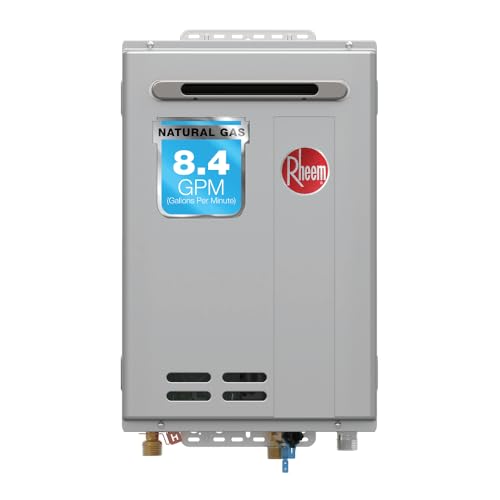
Non-condensing 180,000 BTU natural gas tankless for outdoor mounting, 8.4 GPM at a 35°F rise, CSA certified.
Check price on Amazon$953.00 as of October 18, 2026 — prices change; see Amazon for current price.Why we like it
- Outdoor mounting avoids an indoor vent run
- States GPM at a specific temperature rise
- Built-in freeze and flame-failure protection
- 15-year heat exchanger warranty
| Specification | Details |
|---|---|
| Fuel / input | Natural gas; 180,000 BTU per hour |
| Flow | 8.4 GPM at a 35°F temperature rise |
| Efficiency | Non-condensing; UEF 0.82 |
| Location | Outdoor, wall-mounted, metal cabinet |
| Safety / certification | Freeze protection, flame failure protection; CSA certified |
| Warranty | 15 years heat exchanger, 5 years parts, 1 year labor |
Rheem RTG-84XLN-3 — 180k BTU NG, 8.4 GPM at 35°F rise, UEF 0.82, outdoor, freeze protection, CSA, 15/5/1-yr warranty
The Only Listing That Ties Its Flow Rating to a Stated Temperature Rise
Flow rating without a temperature rise is half a number. The two Rheem RTG listings are the only ones that state the rise: 8.4 GPM (or 7.0 for the smaller unit) at a 35°F rise. That is the right way to compare, because in winter on the Front Range, incoming water is colder than in summer and the heater has to lift it further. Expect less flow than the headline at a larger rise.
This model is the outdoor version, and the listing says outdoor installation eliminates venting. Moving combustion outside also takes combustion gases out of the house, which the CDC flags as a carbon monoxide concern for indoor gas appliances that are not vented properly. The trade-off is weather exposure; the listing describes built-in freeze protection, but a Colorado install still needs a sheltered wall and a plan for power outages during cold snaps.
The listing does not mention altitude, and at UEF 0.82 it is less efficient than the condensing Rinnai. A line in the listing calls it an indoor gas tankless, contradicting the title and specs; it is the outdoor model.
Pros
- No indoor vent run
- Flow stated at a 35°F rise
- Freeze and flame-failure protection
- CSA certified
Cons
- Non-condensing, UEF 0.82
- Natural gas only
- Altitude not addressed
- 1-year labor warranty
Check Rheem RTG 8.4 Outdoor price on Amazon
3. Rheem RTEX-18 — Best Electric Tankless for a Mid-Size Home

18 kW, 240V electric tankless with self-modulating power, two field-serviceable copper elements and up to 4.4 GPM.
Check price on Amazon$419.53 as of October 18, 2026 — prices change; see Amazon for current price.Why we like it
- No venting, no gas line
- Two field-serviceable copper elements
- Self-modulates power to demand
- Digital thermostat with LED display
| Specification | Details |
|---|---|
| Power | 18 kW at 240 V; breaker and wire size not stated in this listing |
| Flow | Up to 4.4 GPM |
| Elements | Two copper immersion elements, field serviceable |
| Controls | External digital thermostatic control with LED display |
| Connections | 3/4 in NPT, bottom |
| Efficiency / weight | 99.8% stated; about 14.8 lb |
Rheem RTEX-18 — 18 kW, 240 V, up to 4.4 GPM, 2 serviceable copper elements, self-modulating, 3/4 in NPT, 99.8%
Field-Serviceable Elements From a Brand With Three Sizes on the Shelf
Five listings are whole-house 240 V electric tankless units: three Rheem RTEX sizes (11, 18 and 24 kW), the NOVIEEX 18 kW and the Orbek 14 kW. The RTEX-18 is the middle Rheem, rated up to 4.4 GPM, and its listing is the only one that calls out field-serviceable copper immersion elements. On a unit with no tank to replace, being able to swap an element is the main repair a plumber will ever do.
Electric tankless units need no vent and no gas line, which makes them attractive in homes without gas or where venting a gas unit would be difficult. The cost is current. This listing does not give breaker or wire requirements, but the RTEX-11 and RTEX-24 listings show the pattern: the 11 kW needs a single 50 A double-pole breaker and a 100 A panel minimum, while the 24 kW needs three 40 A breakers and a 200 A panel. The 18 kW sits between, so have an electrician confirm the panel before buying.
The NOVIEEX 18 kW lists a higher 4.9 GPM maximum, but its warranty is one year against Rheem’s 5-year leak and 1-year parts coverage on the sibling listings. At 4.4 GPM the RTEX-18 handles a shower plus a sink in most seasons; winter shower-plus-laundry is a stretch for any electric unit this size.
Pros
- No venting or gas required
- Serviceable elements
- Self-modulating power
- Light and compact
Cons
- Electrical requirements not in this listing
- 4.4 GPM limits simultaneous use in winter
- Warranty not stated on this listing
Check Rheem RTEX-18 price on Amazon
4. Rheem RTEX-11 — Best Electric Tankless on a Smaller Panel
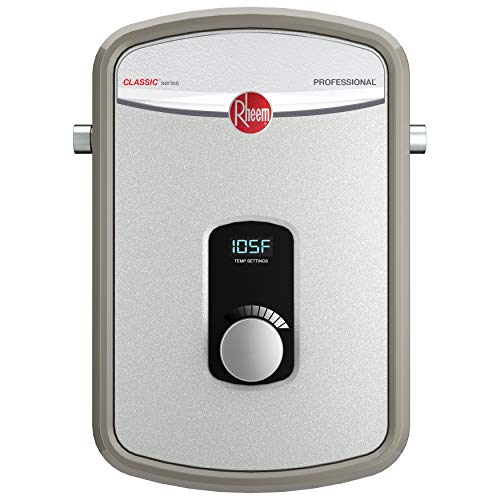
11 kW, 240V electric tankless, up to 2.68 GPM, one 50 A breaker, 100 A panel minimum, 80 to 140°F digital control.
Check price on Amazon$269.58 as of October 18, 2026 — prices change; see Amazon for current price.Why we like it
- Most modest wiring of any whole-house unit
- Lists breaker, wire gauge and panel size
- Digital control from 80 to 140°F
- 5-year leak warranty
| Specification | Details |
|---|---|
| Power | 11 kW, 240 V single phase |
| Wiring | One 50 A double-pole breaker, one set of #8 AWG copper with ground; 100 A panel minimum recommended |
| Flow | Up to 2.68 GPM |
| Temperature | 80 to 140°F in 1-degree steps |
| Venting | None required |
| Warranty | 5-year leak, 1-year parts |
Rheem RTEX-11 — 11 kW, 240 V, 50 A DP breaker, #8 AWG, 100 A panel min, up to 2.68 GPM, 80–140°F, 5-yr leak / 1-yr parts
The Lowest Electrical Demand Among the Whole-House Electric Units
Electric tankless units draw enormous current, and the panel is often the limit. Of the five whole-house electric listings, the RTEX-11 asks the least: one 50 A double-pole breaker and a 100 A minimum service. The Orbek 14 kW calls for a 60 A breaker and a 150 A panel, the NOVIEEX 18 kW for two 40 A breakers and up to 75 A of current, and the RTEX-24 for three 40 A breakers and a 200 A panel. In an older Front Range home on 100 A service, the RTEX-11 may be the only whole-house electric option that does not trigger a service upgrade.
The catch is flow. At up to 2.68 GPM, it is a single-shower heater, or a heater for a small condo, an accessory dwelling or a basement bathroom. Rheem markets it for multiple fixtures, but the ENERGY STAR typical shower draw of about 2.5 GPM leaves little room for a second tap, and less in winter.
It is also a sensible way to serve a distant bathroom where hot water takes a long time to arrive from the main heater. The listing’s wiring detail makes it easy for an electrician to quote.
Pros
- Works on a 100 A panel
- Complete wiring requirements stated
- No vent or gas line
Cons
- 2.68 GPM is a one-shower rate
- 1-year parts warranty
- Struggles with cold winter inlet water
Check Rheem RTEX-11 price on Amazon
5. Orbek 14kW — Best ETL-Certified Mid-Range Electric

14 kW, 240V electric tankless, up to 3.38 GPM, ETL certified, one 60 A breaker, 86 to 140°F control.
Check price on Amazon$209.99 as of October 18, 2026 — prices change; see Amazon for current price.Why we like it
- Only whole-house electric naming ETL certification
- Single breaker and wire set
- Wiring and panel minimum stated
- Compact 14.2-inch case
| Specification | Details |
|---|---|
| Power | 14 kW, 240 V |
| Wiring | One 60 A two-pole breaker, one set of 6 AWG; panel of at least 150 A |
| Flow | Up to 3.38 GPM |
| Temperature | 86 to 140°F; listing claims stability within 1°F |
| Certification / safety | ETL certified; leakage, over-temperature and dry-heat protection |
| Size / warranty | 14.2 x 9.5 x 3.1 in; at least 1 year |
Orbek 14kW — 240 V, 60 A two-pole, 6 AWG, 150 A panel min, up to 3.38 GPM, 86–140°F, ETL certified, 1/2 in NPT
The Only Whole-House Electric Listing That Names a Safety Certification
Among the five whole-house electric listings, the Orbek is the only one that names a third-party safety certification, ETL. The Rheem RTEX listings do not mention one, and the NOVIEEX describes an 8-in-1 certified security system without naming a lab. For a 240 V appliance pulling up to 60 A, a named listing is worth having; confirm the mark on the unit’s label when it arrives.
At 3.38 GPM it falls between the RTEX-11 and RTEX-18, and it runs on one breaker and one wire set rather than two or three, which can simplify the electrical work. It does need a 150 A panel minimum, more than the RTEX-11.
Two cautions: the 1/2 in NPT water connections are smaller than the 3/4 in on the Rheem and NOVIEEX, which can limit flow on a whole-house line, and the warranty is stated only as at least one year.
Pros
- ETL certification named
- Single breaker and wire set
- Full wiring requirements listed
Cons
- 1/2 in water connections
- Vague warranty term
- Needs a 150 A panel
Check Orbek 14kW price on Amazon
6. xwdzswgs 3000W 110V — Best Point-of-Use Unit for One Sink

3000 W, 110V under-sink tankless with LED display, IPX4 rating and a stated 82 to 131°F rise at very low flow.
Check price on Amazon$59.98 as of October 18, 2026 — prices change; see Amazon for current price.Why we like it
- Runs on 110 V, not 240 V
- Mounts under a single sink
- States flow and rise together
- Says it qualifies for an ETL standard
| Specification | Details |
|---|---|
| Power | 3000 W, 110 V |
| Output | Raises water about 82°F at 0.3 GPM to 131°F at 0.5 GPM, per listing |
| Use | Kitchen or bathroom sink; listing says not suitable for showers |
| Safety | IPX4, leakage, dry-boil and overheat protection; ETL standard claimed |
| Install | Vertical mounting only; 1/2 in NPT |
| Warranty | 24 months |
xwdzswgs 3000W — 110 V, 0.3–0.5 GPM, 82–131°F rise stated, IPX4, vertical mount, 1/2 in NPT, 24-month warranty
A Sink Heater, Clearly Labeled as Not for Showers
Three listings are 3000 W, 110 V point-of-use units: two from xwdzswgs and one from KZU. They are not whole-house heaters. This one is honest about it: the listing says it is not suitable for showers and gives an output tied to tiny flows, a large rise at 0.3 to 0.5 GPM. That is enough to put hot water at a bar sink, a garage utility sink or a far-off powder room faucet, where waiting for hot water from a distant tank wastes water.
It is the only point-of-use listing on the shelf that claims an ETL standard, and it states a 24-month warranty. It must be mounted vertically, and the listing gives wiring guidance but advises proper installation; a dedicated circuit is the safe assumption for a 3000 W appliance near water.
See our guide to the point-of-use water heater for where these units make sense and where a small tank does better.
Pros
- 110 V power
- Small enough for a sink cabinet
- ETL standard claimed
- 24-month warranty
Cons
- Under 0.5 GPM output
- Not for showers
- Vertical mount only
Check xwdzswgs 3000W 110V price on Amazon
Two listings that rule themselves out on the Front Range
Two gas units on the shelf state altitude limits that exclude most Colorado Front Range homes. The MIZUDO 199,000 BTU natural gas unit says it is not recommended for use above 3,000 feet, and the Ranein 80,000 BTU propane unit says it is not for elevations above 2,000 feet. Denver sits around 5,280 feet and the foothills go far higher, so neither should be installed here, whatever their flow ratings. The other gas listings do not state an altitude limit or adjustment at all. Gas appliances burn differently in thin air, and manufacturers specify high-altitude settings, derating or model variants in their manuals. Ask any installer to show you the altitude section for your elevation before signing off.
Gas vs electric tankless
Gas
Gas units deliver far more flow: the gas listings here run from 3.6 to 11.1 GPM, while whole-house electric units top out at 5.9 GPM. They need an adequately sized gas line and venting, unless installed outdoors. ENERGY STAR says the installer should confirm the right GPM size for the home, whether the existing natural gas line is sufficient, whether electricity is available near the heater for forced-ventilation models, and how the combustion gases will be vented (ENERGY STAR whole-home gas tankless water heaters). Replacing a 40-gallon gas tank with a 199,000 BTU tankless often means a larger gas line, because the tankless burner fires at several times the tank’s input. Our tankless water heater guide covers the trade-offs in more depth.
Electric
Electric units need no vent and no gas, but they need very large circuits. On this shelf, requirements run from a single 50 A breaker to three 40 A breakers and a 200 A panel. Many older homes cannot support the largest units without a service upgrade. In cold-water months, electric units lose the most flow, because the same kilowatts must produce a bigger temperature rise.
Sizing by flow rate and temperature rise
Tankless heaters are sized by GPM, not gallons. ENERGY STAR’s typical figures: about 2.5 GPM for a shower or tub, 3.3 for a clothes washer, 2.2 for a kitchen or bathroom sink and 1.3 for a dishwasher. Add up the fixtures likely to run at once, then apply the temperature rise. If incoming water is 45°F in January and you want 120°F at the tap, you need a 75°F rise, roughly twice the 35°F rise the Rheem RTG listings quote, and flow drops accordingly.
A practical approach:
- One shower plus a sink: about 5 GPM at your winter rise.
- Two showers plus a dishwasher: about 6.3 GPM at your winter rise.
- Two showers, a washer and a sink: 10 GPM or more, which only the largest gas units approach.
Our water heater sizing guide walks through the math for both tank and tankless.
Efficiency ratings and what UEF means
ENERGY STAR certifies water heaters on Uniform Energy Factor (UEF) and defines instantaneous, or tankless, units by how little water they hold relative to burner input (ENERGY STAR water heater key product criteria). On this shelf, the condensing Rinnai states UEF 0.98 and the non-condensing Rheem RTG units state 0.82. Electric units here state 98 to 99.8 percent thermal efficiency, which is a different measure, and electric resistance heating is near 100 percent efficient at the unit regardless; the question is what your electricity costs relative to gas.
Venting and carbon monoxide
Every gas tankless unit produces combustion gases that must leave the house. The CDC advises having water heaters and other gas appliances serviced by a qualified technician every year, making sure gas appliances are vented properly, and notes that horizontal vent pipes for appliances such as water heaters should slope slightly upward toward the outdoors to keep CO from leaking at joints (CDC carbon monoxide basics). Indoor tankless units typically use sealed direct-vent or power-vent systems with specific pipe materials; condensing and non-condensing units often call for different vent materials. Follow the manual exactly. Our guides to the direct vent water heater and water heater vent pipe explain the options. Any home with a gas water heater needs working CO alarms.
Maintenance on hard Front Range water
Water hardness varies across the Front Range by utility and by well, and where water is hard, scale builds inside tankless heat exchangers. Most manufacturers call for periodic flushing with a descaling solution through isolation valves; the Rinnai’s Quick Flush feature is designed for exactly that. Ask the installer to fit service valves, and see our tankless water heater maintenance guide for the routine. Outdoor units and units in unheated garages also need a plan for freeze protection during power outages.
When to call a professional
Every gas tankless and every whole-house electric unit on this shelf is a professional install: gas line sizing, venting, condensate drains, 240 V circuits, panel capacity, permits and, on the Front Range, altitude setup. The Rinnai listing itself says not to install a water heater without a technician. ENERGY STAR suggests getting written estimates, asking for references and checking that the contractor will pull a local permit. Our plumbing and water hiring guide covers what to ask. If you are buying a home with a tankless unit, an inspector can check the venting, gas connection and installation quality. Contact us to connect with a vetted Front Range inspector.
Frequently asked questions
What size tankless water heater do I need?
Add up the flow of fixtures likely to run at once, using ENERGY STAR's typical figures of about 2.5 GPM per shower, 3.3 for a washer and 2.2 for a sink, then check the heater's flow at your winter temperature rise. Front Range winter inlet water is cold, so size for January, not July.
Is a gas or electric tankless water heater better?
Gas units deliver much more flow, up to about 11 GPM on the shelf we compared, but need a large gas line and venting. Electric units need no vent but require very large circuits and top out around 6 GPM. Homes with gas service and high demand usually do better with gas.
Do tankless water heaters work at high altitude?
Electric units are not affected by altitude. Gas units need high-altitude setup or derating per the manufacturer. Two gas listings we compared say they are not for use above 2,000 or 3,000 feet, which rules them out for most of Colorado's Front Range.
Can I install a tankless water heater myself?
Whole-house gas and electric tankless units involve gas line sizing, venting, 240 V circuits and permits, and manufacturers recommend professional installation. Small 110 V point-of-use units are simpler, but still need a correct circuit near water.
How often should a tankless water heater be flushed?
Follow the manufacturer's schedule, which depends on water hardness. On hard Front Range water, many owners descale at least yearly. Service valves on the hot and cold lines make flushing straightforward, and some units, like the Rinnai, include a flush feature.
References
- Whole-Home Gas Tankless Water Heaters — ENERGY STAR
- Water Heater Key Product Criteria — ENERGY STAR
- Carbon Monoxide Poisoning Basics — Centers for Disease Control and Prevention