Best Gas Tankless Water Heaters (2026): 6 Picks Compared
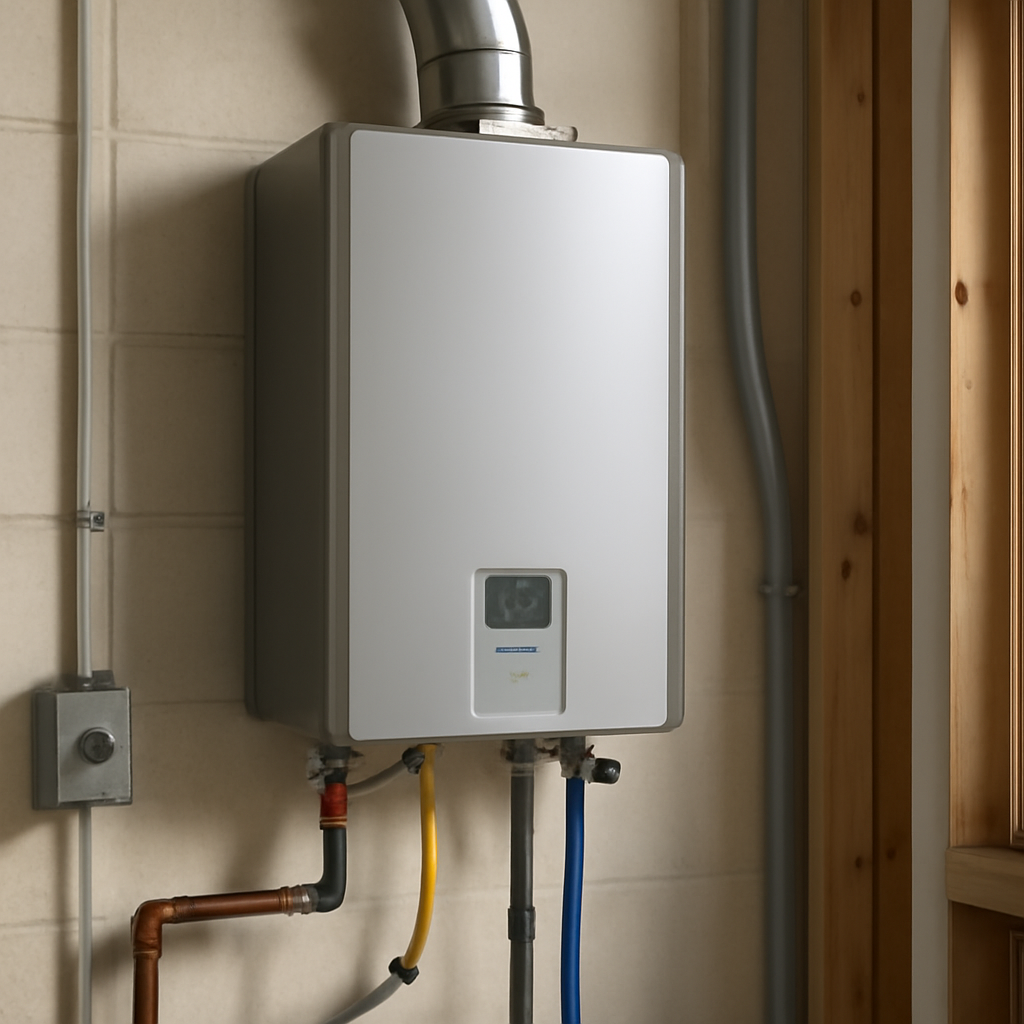
Choosing the best gas tankless water heater is mostly about installation, not the box. Natural gas or propane, a condensing or non-condensing heat exchanger, direct-vent or power-vent or outdoor mounting, whether your gas line can feed a burner rated near 200,000 BTU, and, in Colorado, whether the unit is rated to run at your elevation: those decide whether a heater works in your house. This page compares gas-fired whole-home units only (electric models are in our main tankless roundup) and flags what each listing says, and does not say, about those points.
Part of our Plumbing & Water guide — start there for the full picture →
As an Amazon Associate we earn from qualifying purchases.
How we compared: we compared 14 current Amazon listings for gas tankless water heaters on what each listing states: fuel type, BTU input, flow rate and the temperature rise it is quoted at, uniform energy factor (UEF), condensing design, venting method, stated altitude limits, safety certification and warranty. Four listings say they are not recommended above 2,000 or 3,000 ft, so we left them out for Front Range buyers. We did not lab-test or install any heater. Prices and availability change often, so check the current listing before buying.
Quick picks: the best gas tankless water heaters by use case
| Product | Best for | Key features | Price | Buy |
|---|---|---|---|---|
| Rheem RTGH-84DVLN | Best condensing indoor pick |
| $$$$ | Buy now →Check current price |
| Rheem RTG-70DVLN | Best non-condensing indoor pick |
| $$$$ | Buy now →Check current price |
| Rinnai RX199iN | Best for propane or dual fuel |
| $$$$ | Buy now →Check current price |
| Rheem RTG-70XLN Outdoor | Best outdoor, no vent pipe |
| $$$$ | Buy now →Check current price |
| MIZUDO FDG-CS120AW | Best mid-size with app control |
| $$$ | Buy now →Check current price |
| ThermoMate CZ422NG | Best compact power-vent unit |
| $$$ | Buy now →Check current price |
Price key: $ under $50 · $$ $50–150 · $$$ $150–500 · $$$$ $500+. Prices change often; check Amazon for today’s price. As an Amazon Associate we earn from qualifying purchases.
The 6 picks, compared listing by listing
1. Rheem RTGH-84DVLN-3 — Best Condensing Indoor Pick
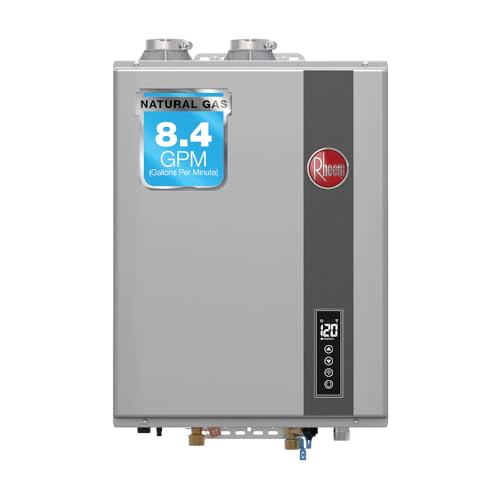
Condensing natural gas tankless heater, 157,000 BTU and 8.4 GPM at a 35 F rise, 0.93 UEF and direct vent.
Check price on Amazon$1,168.99 as of Oct 18, 2026 1:22 am GMT+0000 — prices change; see Amazon for current price.Why we like it
- Condensing heat exchanger with 0.93 UEF
- Direct vent for indoor closets and basements
- Ultra-low NOx compliant per listing
- 15-year heat exchanger, 5-year parts warranty
| Specification | Details |
|---|---|
| Fuel / location | Natural gas; indoor with direct vent |
| Input / flow | 157,000 BTU/hr; 8.4 GPM at a 35 F rise |
| Efficiency | Condensing; 0.93 UEF |
| Safety | CSA certified; freeze protection and multi-point safety system |
| Warranty | 15 years heat exchanger, 5 years parts, 1 year labor |
| Size / weight | About 23.7 x 17.7 x 9.8 in; about 59.9 lb |
Rheem RTGH-84DVLN-3 — NG, condensing, 157k BTU, 8.4 GPM @ 35 F rise, 0.93 UEF, direct vent, ultra-low NOx, 15/5/1-yr warranty
The Most Efficient Natural-Gas-Only Unit on the Shelf
Seven of the 14 listings state a UEF. Five sit at 0.81 or 0.82, which is typical for non-condensing units that send hot exhaust straight out the vent. Two are condensing: the Rinnai at 0.98 and this Rheem at 0.93. A condensing unit runs the exhaust through a second heat exchanger to pull out more heat, which lowers flue temperatures, typically allows plastic vent pipe, and produces acidic condensate that needs a drain. For an indoor natural-gas install where you want the efficiency gain without a dual-fuel premium, this is the pick.
Be clear on what 0.93 means. ENERGY STAR’s criteria for gas-fired instantaneous water heaters require a UEF of at least 0.95, a maximum flow of at least 2.8 GPM over a 67 F rise, and warranties of at least 6 years on the heat exchanger and 5 on parts. This unit clears the warranty and flow bars but falls just short on UEF, and the listing does not claim ENERGY STAR certification. If a utility rebate depends on that label, confirm before you buy.
It is the heaviest unit here at about 60 lb, and the listing does not state the vent material, the vent kit, the gas connection size or any altitude rating. Those come from the installation manual, and your installer should read it before quoting.
Pros
- Condensing efficiency at 0.93 UEF
- Direct vent for sealed indoor installs
- Long heat exchanger and parts warranty
- Ultra-low NOx
Cons
- Just below ENERGY STAR’s 0.95 UEF threshold
- Altitude rating not stated in listing
- Needs a condensate drain
- Heaviest pick at about 60 lb
Check Rheem RTGH-84DVLN price on Amazon
2. Rheem RTG-70DVLN-3 — Best Non-Condensing Indoor Pick

Non-condensing indoor direct-vent gas tankless heater, 160,000 BTU, 7.0 GPM at 35 F rise, with leak detection.
Check price on Amazon$653.77 as of Oct 18, 2026 1:22 am GMT+0000 — prices change; see Amazon for current price.Why we like it
- Indoor direct-vent install stated
- LeakGuard internal leak detection
- 160,000 BTU for two to three showers
- Freeze and flame-failure protection
| Specification | Details |
|---|---|
| Fuel / location | Natural gas; indoor with direct vent system |
| Input / flow | 160,000 BTU/hr; 7.0 GPM at a 35 F rise |
| Efficiency | Non-condensing; 0.82 UEF |
| Safety | CSA certified; freeze, flame failure and leak detection |
| Warranty | 1 year labor listed; other terms not stated in this listing |
| Size / weight | About 24.2 x 13.5 x 10.3 in; about 46.5 lb |
Rheem RTG-70DVLN-3 — NG, non-condensing, 160k BTU, 7.0 GPM @ 35 F rise, 0.82 UEF, indoor direct vent, LeakGuard, CSA
The Only Indoor Pick With Built-In Leak Detection
A tankless heater mounted in a finished basement or a closet above a hardwood floor is a water-damage risk if a fitting or heat exchanger weeps. This listing is the only one on the shelf that describes internal leak detection: Rheem’s LeakGuard, which it says detects large or small internal leaks. That is a meaningful feature for the indoor installs most Front Range homes need, since outdoor mounting is a poor fit for many cold-climate houses.
As a non-condensing unit at 0.82 UEF, it is less efficient than the condensing picks, but it is also simpler: no condensate drain and no condensate neutralizer. The trade-off is that non-condensing exhaust runs hot, so venting is typically stainless or other high-temperature category vent, which can cost more to run than plastic.
Gaps to note: this listing gives only the one-year labor term and does not repeat the heat exchanger and parts warranty that Rheem’s sibling listings state. It does not give the gas inlet size, vent diameter or an altitude rating.
Pros
- Internal leak detection
- No condensate drain needed
- Strong 160,000 BTU input
Cons
- 0.82 UEF, well below condensing units
- Hot exhaust needs high-temperature venting
- Full warranty terms not stated in listing
Check Rheem RTG-70DVLN price on Amazon
3. Rinnai RX199iN — Best for Propane or Dual Fuel

Condensing tankless heater that runs on natural gas or propane, 199,000 BTU, 11.1 GPM, 0.98 UEF, indoor or outdoor.
Check price on Amazon$1,532.79 as of Oct 18, 2026 1:22 am GMT+0000 — prices change; see Amazon for current price.Why we like it
- One model runs on natural gas or propane
- Highest stated UEF on the shelf at 0.98
- Indoor or outdoor via Versa Vent
- Quick Flush feature simplifies descaling
| Specification | Details |
|---|---|
| Fuel / location | Natural gas or propane (Smart Sense gas control); indoor or outdoor |
| Input / flow | 199,000 BTU; up to 11.1 GPM |
| Efficiency | Condensing; 0.98 UEF |
| Venting | Versa Vent; RX-OVC vent cap required for outdoor install |
| Warranty | 15 years heat exchanger, 5 years parts, 5 years labor if registered within 90 days |
| Weight | About 55 lb |
Rinnai RX199iN — NG or LP, condensing, 199k BTU, 11.1 GPM, 0.98 UEF, Versa Vent indoor/outdoor, 15/5/5-yr warranty
The Only Unit That Switches Between Natural Gas and Propane
Every other listing on the shelf is built for one fuel. The Rinnai’s Smart Sense gas control lets the same model run on natural gas or propane, which matters for rural Elbert or El Paso County homes on propane today that may get a gas main later, and for buyers who are not sure which fuel the next house will have. It is the top choice in our parent roundup; here it earns its spot on fuel flexibility rather than as the default pick.
It is also the most efficient listing, at 0.98 UEF, and the only one whose stated UEF and warranty both clear ENERGY STAR’s thresholds for gas-fired instantaneous heaters. The listing itself does not state ENERGY STAR certification, so check the product finder for the exact model. Rinnai’s listing is unusually frank about installation, recommending a qualified technician and pointing buyers to a groundwater temperature map for sizing.
At 199,000 BTU it has the largest burner of our picks, so it is also the most likely to need a gas line upgrade. The labor warranty drops to one year if the unit is not registered within 90 days. No altitude rating is stated.
Pros
- Natural gas or propane in one model
- 0.98 UEF, highest on the shelf
- Indoor or outdoor venting
- Strong warranty with registration
Cons
- 199,000 BTU may need a larger gas line
- Outdoor install needs a separate vent cap
- Wi-Fi module sold separately
Check Rinnai RX199iN price on Amazon
4. Rheem RTG-70XLN-3 Outdoor — Best Outdoor Install With No Vent Pipe
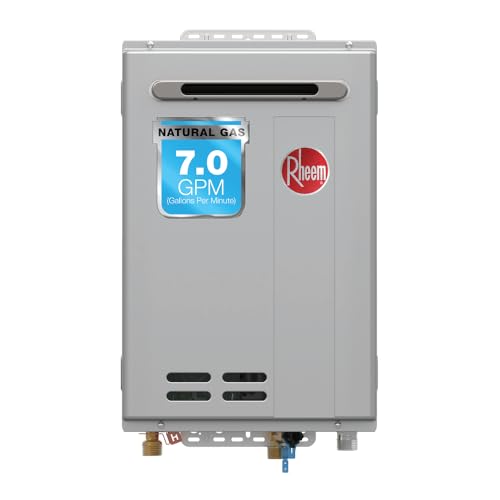
Outdoor gas tankless heater with no vent pipe, 160,000 BTU, 7.0 GPM at 35 F rise and freeze protection.
Check price on Amazon$829.96 as of Oct 18, 2026 1:22 am GMT+0000 — prices change; see Amazon for current price.Why we like it
- Outdoor mount eliminates indoor venting
- Durable metal cabinet for exterior walls
- 15-year heat exchanger, 5-year parts warranty
- Built-in freeze protection
| Specification | Details |
|---|---|
| Fuel / location | Natural gas; outdoor wall mount |
| Input / flow | 160,000 BTU/hr; 7.0 GPM at a 35 F rise |
| Efficiency | Non-condensing; 0.82 UEF |
| Safety | CSA certified; freeze and flame failure protection |
| Warranty | 15 years heat exchanger, 5 years parts |
| Size / weight | About 20.75 x 13.5 x 9.4 in; about 39.3 lb |
Rheem RTG-70XLN-3 — NG outdoor, 160k BTU, 7.0 GPM @ 35 F rise, 0.82 UEF, no vent pipe, freeze protection, 15/5-yr warranty
When There Is No Good Path for a Vent
Some houses make venting hard: a mechanical room in the middle of a slab-on-grade ranch, a finished basement with no clear route out, or a vent termination that would land under a deck or next to a window. An outdoor unit avoids the vent run entirely, since it exhausts directly from its cabinet. Two of the four Rheem listings on the shelf are outdoor models; this 7.0 GPM version is lighter than most picks at about 39 lb and carries the full 15-year heat exchanger and 5-year parts terms in its listing.
Colorado is the catch. The unit has freeze protection, but that protection needs electrical power, and the water and gas lines running to it still need insulation and heat tape. A long power outage during a cold snap can freeze an outdoor unit. Wind can also be an issue on exposed Front Range walls.
The listing does not state an altitude rating, the minimum operating temperature, or the gas connection size. Clearances to windows, doors and the property line still apply to the exhaust outlet.
Pros
- No vent pipe needed
- Frees indoor floor and wall space
- Full heat exchanger and parts warranty stated
Cons
- Freeze risk in a winter power outage
- Non-condensing 0.82 UEF
- Minimum operating temperature not stated
Check Rheem RTG-70XLN Outdoor price on Amazon
5. MIZUDO FDG-CS120AW-NG — Best Mid-Size With App Control
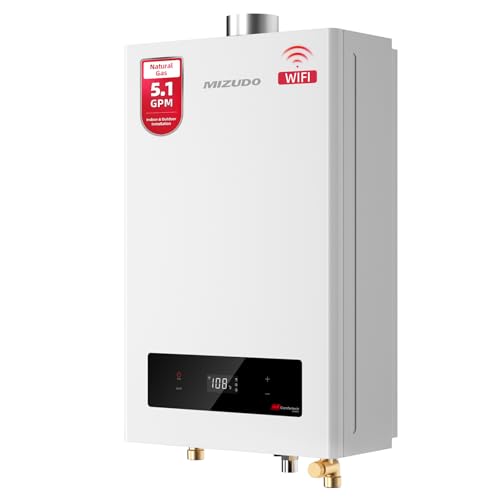
120,000 BTU natural gas tankless heater, 5.1 GPM, indoor with an outdoor kit option, Wi-Fi app and CSA certification.
Check price on Amazon$483.54 as of Oct 18, 2026 1:22 am GMT+0000 — prices change; see Amazon for current price.Why we like it
- Moderate 120,000 BTU burner eases gas-line demands
- Indoor unit convertible to outdoor with a kit
- App shows status and maintenance alerts
- Exhaust blockage and flame failure protection
| Specification | Details |
|---|---|
| Fuel / location | Natural gas; indoor, outdoor with accessory kit (sold separately) |
| Input / flow | 120,000 BTU; 5.1 GPM max (rise not stated) |
| Efficiency | UEF not stated in listing |
| Build | Copper heat exchanger; stainless combustion chamber |
| Safety | CSA certified; freeze, dry-burn, flame failure, exhaust blockage protection |
| Size | About 22.8 x 14.6 x 14.6 in; weight not stated |
MIZUDO FDG-CS120AW-NG — NG, 120k BTU, 5.1 GPM, indoor/outdoor-kit, Wi-Fi app, CSA, copper HX, stainless chamber
A Smaller Burner That Is Easier to Feed
Big tankless burners need big gas supply. At 120,000 BTU, this MIZUDO asks for well under the 157,000 to 199,000 BTU of the Rheem and Rinnai picks, which can make the difference between using an existing gas line and paying to run a larger one. In a two-bathroom house where only one shower and a sink typically run at once, a 5 GPM class unit can be enough. The listing also notes freeze protection and exhaust blockage detection, and an app that sends maintenance notifications.
Note that MIZUDO sells two units on this shelf. The larger 199,000 BTU model states it is not recommended above 3,000 ft, which rules it out for most of the Front Range. This 120,000 BTU listing makes no altitude statement at all, so confirm with the manufacturer that it can be set up for your elevation before buying.
The listing gives no UEF, no temperature rise for its 5.1 GPM figure and no warranty term in its feature bullets, which makes it harder to compare than the Rheem and Rinnai units.
Pros
- Moderate gas demand at 120,000 BTU
- Indoor with an outdoor kit option
- App monitoring and alerts
Cons
- No UEF or temperature rise stated
- Altitude suitability not stated
- Outdoor kit is an extra purchase
Check MIZUDO FDG-CS120AW price on Amazon
6. ThermoMate CZ422NG — Best Compact Power-Vent Unit

Compact 113,000 BTU indoor tankless heater with stated 3 in vent, 1/2 in gas inlet, 3/4 in water fittings and 120V cord.
Check price on Amazon$399.99 as of Oct 18, 2026 1:22 am GMT+0000 — prices change; see Amazon for current price.Why we like it
- Lists vent, gas and water connection sizes
- Strong DC fan for powered exhaust
- Small at about 21 x 13 x 7 in, 22 lb
- Detailed diagnostic display with error codes
| Specification | Details |
|---|---|
| Fuel / location | Natural gas; indoor |
| Input / flow | 113,000 BTU; up to 5 GPM; two showers at 105 F from a 65 F inlet |
| Efficiency | Non-condensing; 0.81 UEF |
| Connections | 3/4 in NPT water; 1/2 in NPT gas inlet; 3 in OD vent; 120V cord |
| Safety | CSA certified; freeze, flame-out, overheat, blockage and air-pressure protections |
| Size / weight | About 21 x 13 x 7 in; about 22 lb |
ThermoMate CZ422NG — NG indoor, 113k BTU, 5 GPM, 0.81 UEF, 3 in vent, 1/2 in gas, 3/4 in water, 120V, CSA, 22 lb
The Most Complete Installation Spec in Any Listing
Installers need connection sizes before they can quote, and most listings leave them out. This ThermoMate lists 3/4 in NPT water connections, a 1/2 in NPT gas inlet, a 3 in OD vent connection and a 120V power cord. It also gives its flow claim with a stated inlet and output temperature (two showers at 105 F from 65 F water), which is more honest than a bare GPM number. Its DC fan is rated at 360 Pa static pressure, which the listing ties to resisting backdraft in high wind.
A 1/2 in gas inlet does not mean a 1/2 in supply line is enough; the line size depends on the total demand on the gas system and the length of the run. That is a sizing calculation for the installer.
At 0.81 UEF it is the least efficient of our picks, and the listing does not state an altitude rating or a warranty term. It is one of the parent gas water heater guide’s picks; we include it here for buyers with a small mechanical space and modest demand.
Pros
- Full connection sizes listed
- Compact and light
- Flow stated with inlet and output temperatures
Cons
- Lowest UEF of our picks
- Altitude rating not stated
- Warranty term not stated in listing
Check ThermoMate CZ422NG price on Amazon
Natural gas vs propane, and how to read BTU and GPM
Gas tankless heaters are built for one fuel unless the listing says otherwise. Natural gas and propane burn differently and need different orifices and gas pressures, so a natural gas unit cannot simply be connected to a propane tank. Among our picks, only the Rinnai RX199iN runs on either fuel. If you are on propane, buy a propane-specific model or a dual-fuel unit, and have your propane supplier confirm the tank and regulator can deliver the heater’s full BTU demand in January, when tank pressure drops in the cold.
BTU input and GPM output are linked by temperature rise, which is where Colorado buyers often get caught. Rheem quotes its flow at a 35 F rise; Front Range groundwater in winter is much colder than that implies for a 120 F shower. A unit rated 7 GPM at a 35 F rise will deliver far less at a 70 F rise. ENERGY STAR’s criteria use a 67 F rise for that reason. To size:
- Add up the fixtures likely to run at the same time (a showerhead is typically rated 2.0 to 2.5 GPM).
- Estimate your coldest incoming water temperature, and the rise needed to reach about 120 F.
- Check the manufacturer’s flow chart at that rise, not the headline GPM.
Our water heater sizing guide walks through the math, and if you are still deciding whether to go tankless at all, see tankless vs tank water heaters.
Venting: direct vent, power vent, outdoor and condensing
Every gas water heater produces combustion gases, including carbon monoxide, and they must leave the house. The CDC advises making sure gas appliances are vented properly, with horizontal vent pipes rising slightly toward the outdoors, and having water heaters serviced by a qualified technician every year. With tankless units, the main options are:
- Direct vent. A sealed system that brings combustion air in from outside and sends exhaust out, often through a concentric pipe. Best for basements and closets because it does not draw on indoor air.
- Power vent. A fan pushes exhaust out, and combustion air comes from the room. The room needs enough air supply, and the fan needs a 120V outlet.
- Outdoor. No vent pipe, but exposure to cold and wind. Exhaust clearances to windows and doors still apply.
- Condensing. Cooler, acidic exhaust that usually allows plastic vent pipe, plus a condensate drain and often a neutralizer.
A tankless unit almost never reuses the old tank heater’s metal B-vent or a shared masonry chimney. Plan for a new vent run, and make sure there is a working CO alarm near the heater and outside sleeping areas. Our guides to direct-vent water heaters and water heater vent pipes cover what inspectors look for.
Gas line sizing and altitude derating on the Front Range
Two installation issues decide more Colorado tankless jobs than any feature on a listing.
Gas supply. The tankless picks here run 113,000 to 199,000 BTU, several times the input of a typical tank heater. ENERGY STAR advises that your installer should confirm the right GPM size, whether your existing natural gas line is sufficient, whether electricity is available, and how the combustion gases will be vented. Expect the installer to size the line from the meter based on the total load of every gas appliance and the length of the run. Undersized lines cause flame-outs and error codes when the furnace and the heater fire at the same time, and in some homes the meter or regulator itself needs an upgrade from the utility.
Altitude. Thinner air at Front Range elevations changes how a burner mixes gas and air, so gas appliances are commonly derated or set up differently at altitude, following the manufacturer’s high-altitude instructions. Four listings on this shelf state outright that they are not recommended above 2,000 or 3,000 ft, which excludes nearly every Front Range home. None of our six picks states an altitude limit in its listing, but none states a high-altitude rating either. Before you buy:
- Find the installation manual for the exact model and check its maximum elevation and any required settings or kits.
- Ask the installer how the unit’s output changes at your elevation, and size with that reduced output.
- Confirm the local permit office’s requirements; most Front Range jurisdictions require a permit and inspection for a new gas water heater.
Efficiency, ENERGY STAR and long-term upkeep
UEF is the standardized efficiency figure. Non-condensing units on the shelf sit at 0.81 to 0.82; the two condensing units reach 0.93 and 0.98. Only units at 0.95 or above, with the required flow and warranty, can carry the ENERGY STAR label for gas tankless heaters. A label matters if you want a utility rebate, so check the ENERGY STAR product finder for the exact model number rather than relying on listing wording.
Hard water is the other long-term cost. Scale builds inside tankless heat exchangers just as it does in tank heaters, which is why the Rinnai’s Quick Flush feature and service valves on any install are worth having. EPA WaterSense suggests flushing water heaters once a year to reduce sediment buildup that can decrease efficiency. Our tankless water heater maintenance guide covers descaling step by step. For electric tankless models and a wider comparison, see our parent roundup of the best tankless water heaters overall.
When to bring in a pro or an inspector
A gas tankless heater is not a DIY appliance. Gas piping, venting, combustion air and permits all need a licensed installer, and several listings here recommend or require professional installation. It is also worth an independent look when:
- You are buying a home with a tankless heater and do not know who installed it or whether it was permitted.
- The vent terminates near a window, door, deck or gas meter, or the vent run looks improvised.
- You see error codes, flame-outs or cold-water sandwiches after the install.
- There is no CO alarm near the mechanical room.
A home inspection checks the water heater’s venting, gas connection, relief valve, and the condition of the space around it. See our plumbing and water inspection guides, or get in touch to connect with a vetted Front Range inspector.
Frequently asked questions
Frequently asked questions
What is the best gas tankless water heater for a whole house?
For most whole-house installs, a natural gas unit in the 150,000 to 199,000 BTU range with a direct-vent indoor design is the practical choice. Condensing models are more efficient, with UEF ratings above 0.90. Size from the flow you need at your coldest incoming water temperature, not the headline GPM.
Can a natural gas tankless water heater run on propane?
Not unless the model is built or converted for it. Natural gas and propane need different gas pressures and burner settings. Some units, such as the Rinnai RX199iN on our list, are designed to run on either fuel; otherwise buy the propane version and confirm your tank and regulator can supply the full BTU demand.
Do gas tankless water heaters work at high altitude in Colorado?
Many do, but output drops at altitude and some models are not rated for it. Four listings we compared state they are not recommended above 2,000 or 3,000 feet. Check the installation manual for the exact model's maximum elevation and high-altitude settings before buying.
Do I need a bigger gas line for a tankless water heater?
Often. Tankless units can draw 110,000 to 199,000 BTU, several times a typical tank heater. ENERGY STAR advises having the installer confirm your existing gas line is sufficient. The line is sized from the total load of all gas appliances and the length of the run.
Is a condensing tankless water heater worth it?
Condensing units reach UEF ratings around 0.93 to 0.98 versus about 0.82 for non-condensing models, and they usually allow plastic vent pipe. They need a condensate drain and often a neutralizer. Only models at 0.95 UEF or higher, with the required warranty, can qualify for ENERGY STAR.
References
- ENERGY STAR — Residential water heaters key product criteria: https://www.energystar.gov/products/water_heaters/residential_water_heaters_key_product_criteria
- ENERGY STAR — Whole home tankless gas water heaters: https://www.energystar.gov/products/whole_home_tankless_gas_water_heaters
- CDC — Carbon monoxide poisoning basics: https://www.cdc.gov/carbon-monoxide/about/index.html
- U.S. EPA WaterSense — Home maintenance: https://www.epa.gov/watersense/home-maintenance