Under Sink Water Filter: Types, Certifications and Installation
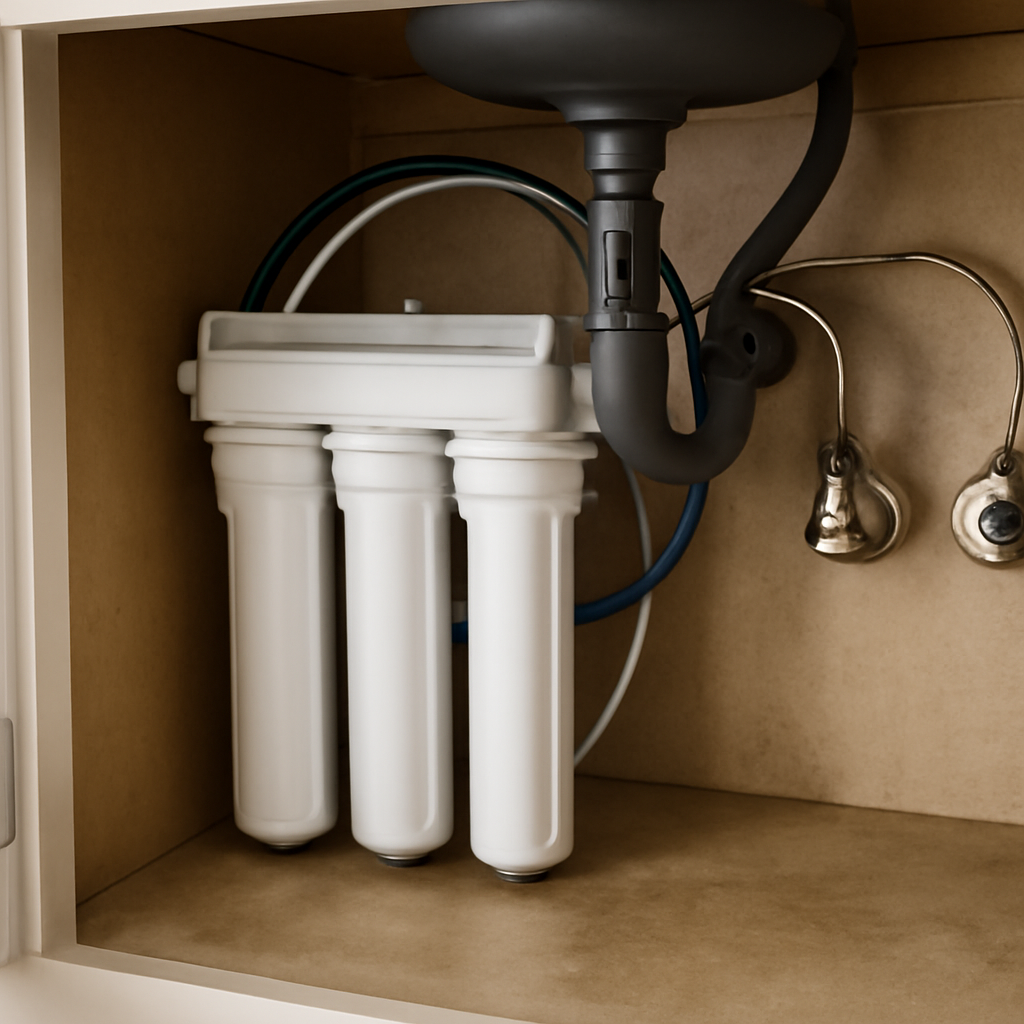
An under sink water filter is one of the most common upgrades buyers find in a kitchen cabinet, and one of the least understood. Some are simple carbon cartridges that improve taste and odor. Others are multi-stage reverse osmosis systems with a storage tank, a dedicated faucet and a drain connection. A few are certified to reduce lead or other specific contaminants; many are not. Because the equipment sits in a dark cabinet next to the supply valves and drain, it also adds fittings that can drip for months before anyone notices. This guide explains the main filter types, how to read certification claims, what filters can and cannot do for lead, how installation choices affect leak risk, how often cartridges need changing and what the whole setup tends to cost. It summarizes CDC and EPA guidance current as of 2026; for health questions about specific contaminants, talk with your health department or a certified laboratory.
Part of our Plumbing & Water guide — start there for the full picture →
What an Under Sink Water Filter Does (and Does Not Do)
An under sink water filter is a point-of-use system: it treats water for a single tap, usually a cold-water line at the kitchen sink, rather than every fixture in the house. The CDC describes point-of-use systems as ones that treat water and deliver it to a single tap, such as a kitchen sink, and notes that under-sink filters and faucet-mounted filters fall into this category.
The key point is that “filter” covers very different technologies. The CDC’s guidance on choosing home water filters says some filters mainly improve taste, others remove harmful chemicals and others remove certain germs. It also notes that most home water filters, such as pitcher or fridge filters, are not designed to remove germs and typically use carbon to improve taste or remove heavy metals like lead. What a given product removes depends on the size of its pores, the size of the substance and its electric charge.
So the first step is not choosing a brand. It is knowing what is in the water. The CDC recommends testing water and choosing a filter that removes the specific germs or chemicals you are concerned about, and it notes that if tap water is already free of harmful germs and chemicals, a filter may not be needed at all. Public-system customers can start with the utility’s annual water quality report.
The CDC also notes that filters remove good and bad substances alike, including chlorine, which kills germs, and fluoride, which helps prevent cavities.
Main Types: Carbon Block, Reverse Osmosis and Inline Filters
Most products fit into three broad categories that differ in what they reduce, how much space and water they use and how many connections they add.
Carbon block systems
Carbon block filters press finely ground activated carbon into a solid cylinder. Water passes through the block and many dissolved substances stick to the carbon’s surface. Depending on the specific product and its certifications, carbon block filters may reduce chlorine taste and odor, some volatile organic chemicals, certain pesticides, particulates and, in products certified for it, lead.
Carbon does not soften water, and most carbon filters are not designed to remove bacteria or viruses.
Reverse osmosis systems
Reverse osmosis (RO) pushes water through a very tight semipermeable membrane. The CDC states that an RO filter has a pore size of about 0.0001 micron and that RO systems will remove some chemicals, including lead, copper, chromium, chloride and sodium, and may reduce arsenic, fluoride, radium, nitrate and others; the CDC also lists RO as removing parasites, bacteria and viruses, while telling buyers to check the system’s label for the specific chemicals it removes. Most under-sink RO units include a sediment prefilter, one or more carbon stages to protect the membrane, the membrane itself, a pressurized storage tank and a polishing filter before a dedicated faucet.
The trade-offs are real. RO systems send a stream of reject water to the drain, need adequate water pressure to work well, take up most of a standard sink base, and add more fittings and a drain connection. For a deeper look at sizing, waste water and remineralization, see our guide to the reverse osmosis system.
Inline filters
Inline filters are single cartridges spliced into a line, often the tube feeding a refrigerator ice maker. They are cheap and easy to fit but usually carry limited capacity and few certification claims, so they suit taste improvement rather than a health-related contaminant.
How to Read NSF/ANSI Certifications
Packaging phrases such as “removes 99% of contaminants” are not meaningful on their own. The more reliable signal is independent certification to a published standard. The CDC explains that NSF International develops public health standards for products and that buyers can look for an NSF certification on a filter’s label and look up specific products in NSF’s database to see what they are certified to remove. The CDC lists several water treatment standards, including:
- Standard 42: taste and odor (aesthetic effects such as chlorine taste).
- Standard 53: health-related reduction; the CDC lists cyst reduction, and the standard also covers other health-related claims such as lead.
- Standard 58: reverse osmosis systems.
- Standard 62: distillation systems.
Check that the certification covers the exact contaminant you care about, not just the standard number; a product can be certified under Standard 53 for cysts but not lead. Certification also applies to a specific housing and cartridge, so a generic “compatible” cartridge may not carry the same claims.
Lead Reduction: What a Filter Can and Cannot Fix
Lead is the contaminant that drives many under-sink purchases, especially in older Front Range neighborhoods. The EPA states that the most common sources of lead in drinking water are lead pipes, faucets and fixtures, that lead service lines are typically the most significant source where they exist, and that lead pipes are more likely in older cities and homes built before 1986. In homes without lead service lines, the EPA says the most common problem is brass or chrome-plated brass faucets and plumbing with lead solder. The EPA and CDC agree there is no known safe level of lead in a child’s blood, and the EPA has set the health goal for lead in drinking water at zero.
A filter can be a sensible interim measure. The EPA’s consumer tool for point-of-use and pitcher filters says consumers can consider a drinking water filter evaluated by an accredited third-party certification body to reduce lead, and the tool is built around filters certified to reduce lead to 5 parts per billion or less with particulate reduction under both NSF/ANSI Standards 53 and 42. That is a more specific bar than “reduces lead,” and it is worth checking a product against it.
What a filter cannot do is remove the source. A lead service line or leaded brass valve is still there, and the filter only protects the one tap it serves. If the cartridge is overdue, protection can drop. For testing steps, service-line questions and how filters fit into a longer-term plan, see our guide to choosing a lead in water filter.
Installation Basics and Leak Risks
Most under-sink systems are sold as do-it-yourself installs: tap the cold supply, mount the housing, run tubing to a faucet and, for RO, connect a drain line. Every new fitting is a potential leak above a particleboard cabinet floor.
Connecting to the supply
Most current kits use a tee adapter that threads between the cold angle stop and the faucet supply line. Older kits sometimes used self-piercing saddle valves clamped onto copper pipe; many plumbers avoid these because they can clog, seep or fail over time. Push-to-connect fittings are common on plastic tubing. They work well when the tubing is cut square, deburred and pushed fully home, and poorly when the tubing is cut at an angle or not fully inserted.
The dedicated faucet
Many systems need a second faucet. If the sink already has a spare hole or a sprayer hole, it can be used. Otherwise the installer drills the sink or countertop. Stone and quartz need a diamond core bit and more care. If the sink is being replaced anyway, planning the filter faucet hole during an undermount sink installation avoids drilling a finished countertop later.
RO drain connection
RO systems discharge reject water into the sink drain, typically through a drain saddle clamped above the trap. Plumbing codes and manufacturer instructions generally call for an air gap or approved backflow prevention on that discharge so wastewater cannot be drawn back toward the system. Some RO faucets include a built-in air gap that vents through the faucet body; when the drain line is partly clogged, those faucets can spit water onto the countertop, which is one of the more common service calls.
Where leaks show up
Typical failure points include the tee adapter, compression nuts on housings, push-fit connections, a cracked filter housing after over-tightening, and the drain saddle. Housing sumps that are not fully seated after a cartridge change are another frequent culprit. If water appears in the cabinet, our guide to a leak under the kitchen sink walks through tracing it. And if the main faucet itself has started dripping after an install, the cause may be unrelated wear; see kitchen faucet leaking for the usual suspects.
Checking every joint with a dry paper towel after installation and again the next day, plus a battery water alarm on the cabinet floor, catches most slow leaks early.
Filter Change Intervals and Maintenance
A filter that is not maintained can perform worse than no filter. The CDC says any filter needs maintenance to keep it working and to prevent germs from growing in it, including changing filters according to the manufacturer’s recommendations. It also recommends wearing gloves while changing filters and washing hands afterward, and advises people with weakened immune systems to avoid changing filters themselves.
Manufacturers typically rate cartridges by gallons, months or both, and replacement should follow whichever comes first. Common patterns, which vary by product and water quality, look like this:
- Sediment prefilters: often every 6 to 12 months, sooner with sandy or high-sediment water.
- Carbon blocks: commonly every 6 to 12 months or at the rated gallon capacity.
- RO membranes: often every 2 to 5 years, depending on water hardness, dissolved solids and how well the prefilters are maintained.
- Inline cartridges: frequently every 6 months.
Hard water shortens the life of RO membranes. Many Front Range homes have moderately hard to hard water, and scale can foul a membrane early if prefilters are skipped. When hardness is high enough to cause visible scale elsewhere, a water softener upstream may extend membrane life, though it adds its own maintenance and sodium questions.
Slowing flow or a return of chlorine taste are common signs a cartridge is overdue. Writing the install date on the housing helps, and buyers of a home with an existing system should assume cartridges are due unless the seller can show receipts.
Under-Sink vs Whole-House Filtration
An under-sink unit and a whole-house system solve different problems. The CDC describes whole-home (point-of-entry) filters as treating water as it enters the home, so every tap gets filtered water, and suggests considering them when a harmful substance, such as certain volatile organic chemicals, needs to be removed from all water, including bathing and cleaning water. The CDC also cautions that if a whole-home filter removes chlorine or other disinfectants, more germs may grow in the household plumbing.
For most homes on treated municipal water, the practical pattern is a point-of-use system at the kitchen for drinking and cooking, with whole-house treatment reserved for problems that affect every fixture: sediment, iron staining, hardness or a contaminant of concern for skin or inhalation exposure. Our guide to a whole-house water filter covers sizing and placement.
Private Wells Need Testing First
Homes on wells are a different case. No utility tests the water or publishes an annual report, so the owner carries that responsibility. The CDC recommends that people with private wells test their water at least once a year for harmful germs and chemicals, and also test when they notice changes in color, taste or smell, contacting their health department for advice and a state-certified lab.
That matters for filter choice. A carbon block under the sink does little for bacteria, nitrate or many naturally occurring minerals. In parts of Colorado, wells can carry uranium, arsenic, nitrate or other contaminants depending on geology and nearby land use, and those call for specific treatment matched to lab results. Start with our guide to well water testing, then compare options in our well water filtration system guide. RO is often part of the answer for dissolved contaminants on a well, but only after testing confirms what it needs to handle.
What Under Sink Water Filters Cost
Prices vary widely by brand, number of stages, certifications and how much plumbing work the install involves. As general 2026 ranges, not quotes:
- Inline filter: often around $20 to $80 for the unit, with cartridges in a similar range.
- Carbon block system (one or two stages): commonly about $80 to $350, with replacement cartridges often $25 to $100 each.
- Reverse osmosis system: often about $200 to $700 for tank-style units and more for tankless or pumped systems; annual filter costs commonly run around $60 to $200, with membranes replaced every few years.
- Professional installation: frequently around $150 to $500, more if the countertop needs drilling, an outlet must be added for a pumped RO unit or supply valves need replacing.
Old angle stops that have not been turned in years may weep once disturbed, so replacing them during the install can save a later call. Total cost of ownership over five years can easily exceed the purchase price once cartridges are included, so compare cartridge prices before choosing a system.
What Inspectors Look for and When to Call a Professional
During a home inspection, the inspector generally evaluates the visible plumbing under the sink: supply and drain connections, active leaks, staining, damaged cabinet floors and faucet operation. The ASHI Standard of Practice requires inspectors to inspect interior water supply and distribution systems, including fixtures and faucets, and drain, waste and vent systems. The same standard states that inspectors are not required to inspect water conditioning systems or determine water quality. In practice, that means an inspector may note that a filter is present, that a fitting is leaking or that the cabinet floor is stained, but will not certify that the filter works or test the water.
A licensed plumber or water treatment professional makes sense when:
- The countertop is stone or quartz and needs a new hole.
- Supply valves are old, corroded or will not shut off completely.
- An RO unit needs a drain connection on a sink with a disposal, dishwasher and limited space.
- Water tests show a health-related contaminant that needs a matched, certified treatment system.
Buyers who want to understand how plumbing fits into a broader inspection can review our plumbing and water inspection section and the main guide to hiring a home inspector.
References
- About Choosing Home Water Filters — Centers for Disease Control and Prevention
- About Home Water Treatment Systems — Centers for Disease Control and Prevention
- Basic Information about Lead in Drinking Water — U.S. Environmental Protection Agency
- Consumer Tool for Identifying Point-of-Use and Pitcher Filters Certified to Reduce Lead in Drinking Water — U.S. Environmental Protection Agency
- ASHI Standard of Practice for Home Inspections — American Society of Home Inspectors
Frequently asked questions
Is an under sink water filter worth it?
It can be, if it targets a real problem. The CDC recommends testing water first and choosing a filter certified to remove the specific substances you are concerned about. For chlorine taste, a certified carbon block is often enough; for nitrate, arsenic or high dissolved solids, reverse osmosis is more common.
Does an under sink filter remove lead?
Only if it is certified for lead reduction. EPA's consumer tool focuses on point-of-use filters certified to reduce lead to 5 ppb or less with particulate reduction under NSF/ANSI Standards 53 and 42. A filter does not remove the lead source, such as a lead service line or leaded brass fixture.
How often should under sink filter cartridges be changed?
Follow the manufacturer's rating in gallons or months, whichever comes first. Carbon and sediment cartridges are commonly replaced every 6 to 12 months, and RO membranes every few years. The CDC notes that unmaintained filters can stop working and may grow germs.
Is reverse osmosis better than a carbon filter?
RO reduces a broader range of dissolved substances, including lead, sodium and nitrate, but it costs more, wastes some water and takes more cabinet space. A certified carbon block is simpler and may be enough when the concern is chlorine taste or lead in municipal water.
Will a home inspector check my water filter?
Inspectors generally look at visible under-sink plumbing, leaks and faucet operation. The ASHI Standard of Practice states that inspectors are not required to inspect water conditioning systems or determine water quality, so water testing is a separate service.
Buying a Front Range home with an RO system, a well or older plumbing under the sink? Send us a note and we can connect you with an inspector who will flag leaks, valves and what to test next.