Water Softener: Hard Water Testing, Types and Costs

White crust on faucets, spotty glassware, soap that will not lather, and a water heater that rumbles with scale are classic signs of hard water. A water softener is the standard fix, but it is not the right purchase for every home, and the decision gets easier once you know a few numbers. This guide explains what hardness is and how to measure it in grains per gallon, how salt-based ion exchange softeners differ from salt-free conditioners, how to size a system, the sodium and environmental trade-offs, routine maintenance, typical cost ranges, and how a softener differs from a whole house filter. It draws on EPA water quality guidance and the U.S. Geological Survey hardness classification current as of 2026. Hardness levels vary by source and season, so check your own utility’s water quality report or test your well before buying equipment. Cost figures are broad industry ranges, not quotes.
Do You Need a Water Softener?
A water softener is worth considering when testing shows moderately hard to very hard water and the household is dealing with scale on fixtures, reduced water heater efficiency, shortened appliance life, or soap and detergent problems. Hardness is not generally considered a health hazard, and the EPA does not set an enforceable limit for it, so the decision is about plumbing, appliances, cleaning, and comfort rather than safety.
A rough rule of thumb many water treatment professionals use: below about 3.5 grains per gallon, a softener is rarely needed; between about 3.5 and 7, it is a matter of preference; above about 7, the benefits for scale control usually become noticeable; and above 10.5, the water is very hard by common classifications. Those thresholds are guidelines rather than rules, and personal tolerance for spotting and scale varies.
Front Range water sources differ considerably. Many municipal supplies drawing on mountain snowmelt are relatively soft to moderately hard, while some groundwater-fed systems and private wells on the plains can be noticeably harder. The only reliable way to know is to check your utility’s report or test the water.
Understanding and Testing Hard Water
Water hardness is mostly dissolved calcium and magnesium picked up as water moves through soil and rock, especially limestone and dolomite. When hard water is heated or evaporates, those minerals precipitate as scale.
Units: Grains per Gallon and mg/L
Hardness is reported two common ways. Laboratories and utility reports often use milligrams per liter (mg/L) or parts per million as calcium carbonate. The water treatment industry uses grains per gallon (gpg). One grain per gallon equals about 17.1 mg/L. The U.S. Geological Survey publishes the following general classification, which many utilities and labs also use:
| Classification | mg/L as calcium carbonate | Approx. grains per gallon |
|---|---|---|
| Soft | 0–60 | 0–3.5 |
| Moderately hard | 61–120 | 3.6–7.0 |
| Hard | 121–180 | 7.1–10.5 |
| Very hard | More than 180 | More than 10.5 |
How to Test
- City water: Read your utility’s annual Consumer Confidence Report or water quality page. Many utilities list hardness, sometimes as a range because different treatment plants or seasons supply different water. Calling the utility’s water quality line is another option.
- Test strips or drop-count kits: Inexpensive and adequate for a hardness estimate, especially for checking softener output after installation.
- Laboratory testing: Recommended for private wells, where hardness should be measured alongside iron, manganese, pH, total dissolved solids, and the health-related contaminants the EPA recommends testing for. The site’s guide to well water testing covers what to include.
Test for iron at the same time. Dissolved iron affects softener sizing and media choice, and high iron or manganese may call for separate treatment ahead of the softener.
Best Water Softeners: our top 3 picks
| Product | Best for | Key features | Price | Buy |
|---|---|---|---|---|
| Aquasana SimplySoft 40K | Named NSF/ANSI 44 certification |
| $749.00as of Nov 19, 2026 7:52 am GMT+0000 | Buy now →Check current price |
| GE GXSH35W | Smart alerts and leak shutoff option |
| $699.00as of Nov 19, 2026 7:52 am GMT+0000 | Buy now →Check current price |
| Kenmore 350 | Smaller households of 1 to 4 |
| $626.10as of Nov 19, 2026 7:52 am GMT+0000 | Buy now →Check current price |

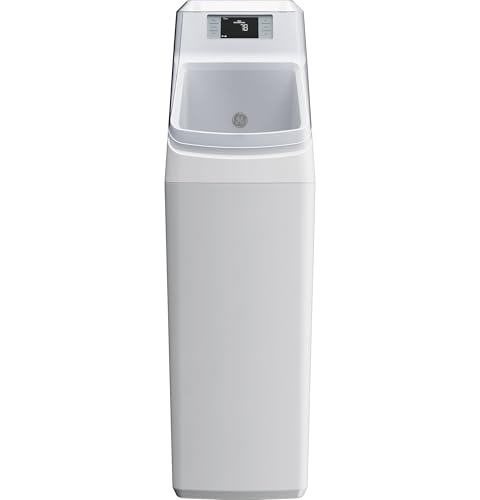

Prices are Amazon’s listed prices as of the time shown and change often; check Amazon for today’s price. As an Amazon Associate we earn from qualifying purchases.
Signs of Hard Water and What Scale Costs
Hard water rarely announces itself all at once. The clues build up over months, and many homeowners attribute them to aging fixtures before realizing the water is the cause. Common signs include:
- White or chalky crust on faucet aerators, showerheads, and kettle interiors
- Spots and film on glassware and dishes after the dishwasher runs
- Soap scum on shower walls and tubs that returns quickly after cleaning
- Laundry that feels stiff or looks dingy despite extra detergent
- A popping or rumbling tank-style water heater, often a sign of sediment and scale on the bottom
- Reduced flow from showerheads as mineral deposits narrow the openings
- Dry-feeling skin and hair after bathing, which some people associate with hard water
Scale has real costs beyond appearance. Mineral buildup on water heater elements and tank bottoms acts as an insulator, so more energy is needed to heat the same water. Tankless water heaters, dishwashers, washing machines, and coffee makers can also suffer from scale, and some appliance manufacturers recommend descaling schedules or softened water in their manuals. Spending on extra detergent, cleaning products, and replacement showerheads or cartridges adds up quietly over time.
None of those effects is dangerous, which is why softening is a cost-and-convenience decision. The more severe the hardness and the larger the household, the stronger the case usually becomes.
Salt-Based Ion Exchange Softeners
A conventional softener is a tank of resin beads charged with sodium (or potassium) ions, connected to a control valve and a brine tank. As hard water flows through, calcium and magnesium ions trade places with sodium ions on the resin. The water leaving the tank is soft.
Eventually the resin becomes saturated with hardness minerals. The system then regenerates: it backwashes the resin, draws salty brine from the brine tank through the bed to strip off calcium and magnesium, rinses, and sends the spent brine to the drain. Modern demand-initiated controls regenerate based on actual water use, which uses less salt and water than older timer-based systems that regenerate on a fixed schedule regardless of use.
Ion exchange is the only common residential method that actually removes hardness minerals from water. It is effective, well understood, and certifiable under NSF/ANSI 44, the standard for residential cation exchange softeners. Its drawbacks are salt handling, added sodium, brine discharge, and some water use for regeneration.
Potassium Chloride as an Alternative
Many salt-based softeners can use potassium chloride instead of sodium chloride. This avoids adding sodium to the water and is sometimes preferred for households on sodium-restricted diets or for brine discharge concerns. Potassium chloride typically costs more per bag, and some systems need a higher dose setting to regenerate effectively with it. Check the manufacturer’s guidance before switching.
Salt-Free Conditioners: What They Can and Cannot Do
“Salt-free softener” is a common marketing phrase, but most of these devices are more accurately called conditioners or scale inhibitors. They do not remove calcium and magnesium. Instead, they aim to change how those minerals behave so they are less likely to stick to surfaces as scale.
- Template-assisted crystallization (TAC) media converts dissolved hardness into microscopic crystals that stay suspended in water rather than forming scale. This is the most studied salt-free approach, and some independent testing has shown meaningful scale reduction in water heaters under certain conditions.
- Chelation or sequestration systems feed chemicals that bind hardness minerals.
- Magnetic and electronic devices clamp onto pipes and claim to alter minerals. Independent evidence for these is limited and inconsistent.
Honest expectations matter. Because hardness remains in the water, a salt-free conditioner will not produce the slippery feel of softened water, will not improve soap lather in the way softening does, and will not necessarily stop spotting on glass and shower doors as water evaporates. TAC media is also sensitive to iron, manganese, and chlorine levels and usually needs prefiltration. Where the main goal is protecting a water heater and plumbing from scale with no salt, no drain and no added sodium, a certified TAC system may be a reasonable compromise. Where the goal is genuinely soft water, ion exchange is the method that delivers it.
Sizing a Water Softener
Undersized softeners regenerate too often and wear out faster; oversized units can let water sit in the resin bed and may regenerate inefficiently. The basic sizing math is simple.
- Find compensated hardness. Start with hardness in gpg. If the water contains dissolved iron, many manufacturers suggest adding roughly 3 to 5 gpg for each part per million of iron. Follow the specific manufacturer’s method.
- Estimate daily water use. Industry estimates commonly use about 60 to 80 gallons per person per day indoors. Actual use from a water bill is better.
- Calculate daily grains. Multiply people by gallons per person by compensated hardness. Example: 4 people x 70 gallons x 10 gpg = 2,800 grains per day.
- Pick a regeneration interval. A common target is about every 7 days. 2,800 x 7 = 19,600 grains.
- Choose rated capacity at an efficient salt setting. Softener capacity is often advertised at maximum salt dose. At lower, more efficient salt settings, real capacity is smaller, so many installers size up, for example choosing a unit rated around 32,000 grains in this scenario.
Also check service flow rate and port size so the softener can keep up with peak demand without pressure loss, the same consideration that applies to filters.
Sodium and Environmental Considerations
Softening with sodium chloride adds sodium to the water in proportion to the hardness removed. Industry estimates suggest roughly 7.5 to 8 mg of sodium per liter for each grain per gallon of hardness removed. For moderately hard water, that is a modest amount compared with typical dietary sodium, but it adds up with very hard water. People on sodium-restricted diets should talk with their physician, and common options include using potassium chloride, leaving a cold-water kitchen tap unsoftened, or adding a point-of-use reverse osmosis unit for drinking water.
Brine discharge is the main environmental issue. Regeneration sends chloride-rich wastewater to the sewer or septic system. Chloride is not removed by conventional wastewater treatment, and the EPA lists chloride among its secondary (non-enforceable) drinking water contaminants for taste reasons. Some communities in the United States have restricted or banned self-regenerating softeners because of downstream chloride. On private septic systems, ask the septic designer or local health department about softener discharge, since recommendations vary. The site’s guide to septic tank inspections covers what a septic evaluation looks at.
Ways to reduce impact include demand-initiated regeneration, proper sizing, efficient salt settings, and avoiding softening of outdoor irrigation lines, which waste salt and can harm landscaping.
Water Softener Maintenance
- Keep the brine tank stocked. Check salt monthly and keep it above the water line.
- Watch for salt bridges. A hard crust can form over the water, leaving an empty space below so the system regenerates without brine. Break it up gently with a broom handle.
- Clean the brine tank occasionally to remove sludge, especially when using lower-purity salt.
- Test softened water periodically with a hardness strip. Hard water at the tap often signals a salt, setting, or valve problem.
- Protect the resin. Chlorine and iron can degrade or foul resin over time; resin cleaners and prefilters help, and resin may need replacement after many years.
- Reset the clock after power outages on timer-based units.
How Much Does a Water Softener Cost?
Industry estimates suggest typical whole-house salt-based softeners commonly fall in a broad range of roughly $800 to $3,000 installed, depending on capacity, control valve features, and plumbing complexity. Combination units with iron removal, or systems installed with new plumbing loops, can cost more. Salt-free TAC conditioners often fall in a similar or somewhat lower range for equipment.
Ongoing costs include salt or potassium chloride, a modest amount of electricity, water used during regeneration, and occasional service. A household with hard water might use a bag or two of salt per month, varying widely with hardness, usage, and settings. Rental and lease programs are another option, but compare the long-term total against purchase.
Ask installers whether the quote includes a bypass valve, a drain air gap where required, a dedicated outlet, and an unsoftened line to outdoor spigots and, if desired, the kitchen cold tap.
Water Softener vs Whole House Filter
These systems solve different problems. A softener removes hardness minerals; it does little or nothing for chlorine taste, sediment, or most health contaminants. A whole house filter reduces sediment, chlorine, odors, or specific contaminants depending on its media; it does not soften water. Homes with both issues commonly use a sediment and carbon filter ahead of the softener, which also protects the resin from chlorine. The companion guide on whole house water filters and testing first explains how to choose filter media. For lead or other drinking water contaminants, the site’s guide to a certified lead water filter covers point-of-use options.
Buying a Home With an Existing Softener
Water softeners are common in resale homes, especially on private wells, and buyers often inherit equipment with no manual and unknown history. A home inspection may note that a softener is present, but evaluating its performance is usually outside a standard inspection’s scope. A few quick checks help:
- Find the date. The control valve or tank label often shows a manufacture date or serial number. Resin and valves wear over time, so an older unit may need service or replacement.
- Check for salt and a working brine tank. An empty or crusted brine tank suggests the system has not been maintained.
- Test before and after. A hardness strip on raw water and on softened water at the kitchen tap shows whether the system is actually working.
- Look at the plumbing. Confirm there is a bypass valve, a proper drain connection with an air gap where required, and no leaks around the tank.
- Ask whether it is owned or leased. Rental agreements may transfer with the house or require removal.
Note also whether outdoor spigots are on softened or hard water, and whether any other treatment equipment, such as an iron filter or reverse osmosis unit, is part of the setup.
When to Call a Professional
A licensed plumber or water treatment professional should handle installations that require new plumbing loops, drain connections, or electrical outlets, as well as well-water systems with iron, manganese, or sulfur. If you are buying a home with an existing softener, ask for the age, maintenance history, and settings, and include water testing in the inspection period. The home inspector hiring guide explains how to schedule specialty testing during a purchase contingency.
More Questions About Water Softeners
How long does a water softener last?
A salt-based water softener typically lasts about 10 to 15 years, with resin often lasting about as long, though chlorine and iron in the water can shorten resin life. Control valves and electronics may need repair or replacement sooner.
Signs of a worn softener include hard water returning despite salt use, salt not being used, or frequent regeneration problems. Replacing resin can extend life when the tank and valve are still sound.
Is softened water safe to drink?
Softened water is generally safe for most people to drink, though it adds a small amount of sodium proportional to the hardness removed. People on sodium-restricted diets should ask a doctor and may want potassium chloride or a separate unsoftened drinking tap.
A water softener does not disinfect or remove most contaminants like lead, bacteria, nitrates or PFAS. Homes with those concerns need appropriate testing and a separate filter or treatment system.
Do water softeners help with dry skin and hair?
Many people report softer skin and hair after installing a water softener, since soap lathers more easily and leaves less residue. Experiences vary, and softened water should not be treated as a skin condition remedy.
Hard water can leave a soap scum film that some people notice as tightness or dull hair. Anyone with persistent eczema or skin issues should consult a dermatologist, since water softness is only one factor.
Can a water softener remove iron?
Many water softeners can remove small amounts of dissolved iron, often up to a few parts per million depending on the model and resin. Larger amounts of iron, or iron that has already oxidized into rusty particles, usually require a dedicated iron filter.
Iron fouls softener resin over time, reducing hardness removal. Well owners should test for iron, manganese and hardness together, then choose equipment that handles all three, sometimes using a resin cleaner during maintenance.
References
- Ground Water and Drinking Water — U.S. Environmental Protection Agency
- Consumer Confidence Reports (CCR) — U.S. Environmental Protection Agency
- Secondary Drinking Water Standards: Guidance for Nuisance Chemicals — U.S. Environmental Protection Agency
- Protect Your Home’s Water — U.S. Environmental Protection Agency
- Private Drinking Water Wells — U.S. Environmental Protection Agency
Frequently asked questions
How do I know if I need a water softener?
Check your utility's water quality report or test your water. Many professionals consider water above about 7 grains per gallon hard enough that a softener provides noticeable benefits, while water below about 3.5 grains per gallon rarely needs softening.
Do salt-free water softeners really work?
Salt-free conditioners do not remove hardness minerals, so they do not produce truly soft water. Template-assisted crystallization systems can reduce scale formation under some conditions, but magnetic and electronic devices have limited independent evidence behind them.
How much sodium does a water softener add?
Industry estimates suggest about 7.5 to 8 mg of sodium per liter for each grain per gallon of hardness removed. People on sodium-restricted diets can use potassium chloride, keep an unsoftened drinking tap, or add point-of-use reverse osmosis, and should consult their physician.
What size water softener do I need?
Multiply household members by daily gallons per person and by hardness in grains per gallon, then multiply by the days between regenerations, often about seven. Choose a unit whose capacity at an efficient salt setting covers that figure, adjusting for any iron.
Is a water softener the same as a water filter?
No. A softener exchanges calcium and magnesium for sodium or potassium to prevent scale, while a filter reduces sediment, chlorine, or specific contaminants. Many homes with both issues install a filter ahead of the softener.
How much salt does a water softener use per month?
A typical household water softener uses about one to two 40-pound bags of salt per month, depending on hardness, water use and softener efficiency. Metered, demand-initiated softeners usually use less salt than timer-based models, sometimes by a third or more.
Should a water softener be installed before or after a water heater?
A water softener should be installed before the water heater so softened water enters the tank, protecting it from scale. Outdoor hose bibs are often left on hard water to avoid wasting softened water on irrigation.
Does a water softener remove chlorine?
A standard water softener does not remove chlorine, which can damage some resin over time. A carbon filter installed before the softener reduces chlorine and can extend resin life, especially on city water with high chlorine or chloramine levels.
Shopping for a Front Range home and unsure what the water treatment equipment in the basement actually does? Get in touch to be connected with a qualified local inspector who can help arrange water testing before closing.