Best Water Filter Pitchers (2026): 7 Picks by Certification

The best water filter pitcher is the one whose certifications match the reason you are buying it. Most pitchers are designed to improve taste by reducing chlorine, and the CDC notes that their main purpose is taste and smell rather than safety. A few claim more, such as lead, PFAS or near-zero dissolved solids, and the wording behind those claims varies from a named NSF/ANSI standard to a percentage with no certifier attached. Below are seven picks, each matched to a different priority, and a guide to reading NSF/ANSI 42, 53 and 401 claims, comparing filter life and deciding when a pitcher is not enough.
Part of our Plumbing & Water guide — start there for the full picture →
As an Amazon Associate we earn from qualifying purchases.
How we compared: we compared 15 current Amazon listings: 14 filter pitchers and dispensers and one replacement cartridge pack. We judged each on what its listing states: certification standards and certifiers named, contaminants claimed, filter life in gallons and months, capacity, filter indicator and whether the listing says what the filter does not do. We did not lab-test any filter or use them hands-on, and NSF certifications are mentioned only as each listing states them. Prices and availability change often, so check the current listing before buying.
Quick picks: the best water filter pitchers
| Product | Best for | Key features | Price | Buy |
|---|---|---|---|---|
| Brita Everyday Elite | Best overall, with a lead claim |
| — | Buy now →Check current price |
| ZeroWater 10-cup | Best for low-TDS water |
| $34.99as of Nov 19, 2026 10:19 am GMT+0000 | Buy now →Check current price |
| Amazon Basics 10-cup | Best for named NSF standards |
| $18.98as of Nov 19, 2026 10:19 am GMT+0000 | Buy now →Check current price |
| PUR 7-cup | Best for microplastics claim |
| $13.99as of Nov 19, 2026 2:14 pm GMT+0000 | Buy now →Check current price |
| Waterdrop PT-05B-L | Best long-life budget pitcher |
| $13.19as of Nov 19, 2026 2:14 pm GMT+0000 | Buy now →Check current price |
| LifeStraw Home Essential | Best for germ-filtration claims |
| — | Buy now →Check current price |
| Waterdrop WFD-40L | Best large dispenser |
| $27.98as of Nov 19, 2026 2:14 pm GMT+0000 | Buy now →Check current price |
Prices are Amazon’s listed prices as of the time shown and change often; check Amazon for today’s price. As an Amazon Associate we earn from qualifying purchases.
The seven picks, compared listing by listing
1. Brita Everyday Elite 10-Cup — Best Overall, With a Lead Claim

10-cup pitcher with the Brita Elite filter, claiming 99% lead reduction, about 6-month life and an electronic indicator.
Check price on AmazonWhy we like it
- Claims 99% lead reduction
- Also lists cadmium, mercury, benzene and asbestos
- Filter changes about twice a year
- Electronic change indicator
- Elite filter fits all Brita pitchers except Stream
| Specification | Details |
|---|---|
| Capacity | 10 cups; about 10.1 x 5.4 x 10.7 in; 1.3 lb |
| Reductions claimed | 99% lead; chlorine taste and odor; cadmium, mercury, benzene, asbestos and more |
| Certification named | Not stated in this listing’s bullets (claims asterisked) |
| Filter life | Replace about every 6 months (2 times a year) |
| Indicator | Electronic filter reminder |
| Compatibility | Elite filters fit all Brita pitchers and dispensers except Stream |
Brita Everyday Elite — 10-cup, Elite filter, 99% lead claim, 6-month life, electronic indicator, BPA-free
The Longest-Life Brita Filter and the Only Brita Pitcher Here Claiming Lead
Five Brita listings appear on this shelf. Four ship with Standard or BritaPlus filters rated for 40 gallons or about two months, and their stated reductions cover chlorine taste and odor plus metals such as copper, mercury and cadmium. The Everyday Elite is the only Brita pitcher here whose listing claims lead reduction, and its filter runs about six months, roughly three times as long as the Standard.
That combination is why it ranks first. Most households buy a pitcher for taste, but many in older homes also wonder about lead from plumbing. The EPA notes that lead pipes are more likely in homes built before 1986 and that brass faucets and lead solder are common sources in homes without lead service lines.
The caution is in the wording. The listing asterisks its reduction claims but does not name the NSF/ANSI standard or certifier in its bullets. The EPA’s consumer tool for lead filters looks for certification against NSF/ANSI 53 for lead and 42 for particulates; check the Elite filter’s packaging or the NSF database for that certification before relying on the lead claim.
Pros
- Lead reduction claimed
- Six-month filter life
- Electronic indicator
Cons
- Certification not named in listing
- No PFAS claim
- Elite filters cost more than Standard
Check Brita Everyday Elite price on Amazon
2. ZeroWater 10-Cup Pitcher — Best for Low-TDS Water
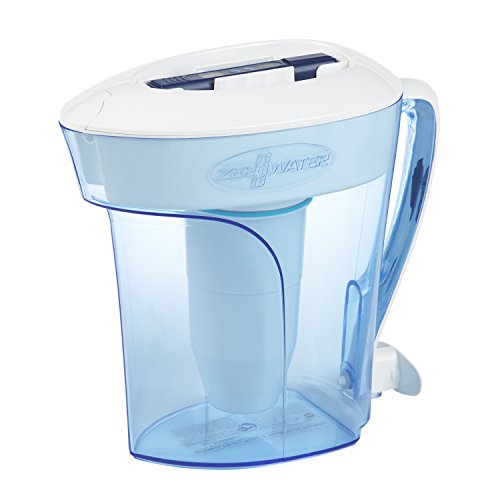
10-cup ion exchange pitcher, IAPMO certified for lead, PFOA/PFOS, chromium and mercury, with a TDS meter included.
Check price on Amazon$34.99 as of Nov 19, 2026 10:19 am GMT+0000 — prices change; see Amazon for current price.Why we like it
- Ion exchange removes nearly all dissolved solids
- IAPMO certified for lead, PFOA/PFOS, chromium, mercury
- TDS meter included to check performance
- Ready-pour spout
| Specification | Details |
|---|---|
| Capacity | 10 cups; about 11.6 x 5.9 x 11 in |
| Filter type | 5-stage ion exchange |
| Certification named | IAPMO certified to reduce PFOA/PFOS, lead, chromium and mercury (standard numbers not given) |
| TDS | Removes virtually all TDS; meter included |
| Filter life | Not stated in gallons; listing cites about 110 bottles per filter |
| Model | ZP-010; BPA-free plastic |
ZeroWater ZP-010 — 10-cup, 5-stage ion exchange, IAPMO: lead, PFOA/PFOS, chromium, mercury, TDS meter included
The Only Pitcher Family That Lowers TDS and Names a Certifier for Lead and PFAS
Three ZeroWater listings appear on the shelf, in 10, 22 and 32-cup sizes, and they are the only pitchers here that claim to remove total dissolved solids. Several other listings, including all three Waterdrop products, state plainly that they do not lower TDS. ZeroWater also names a certifier, IAPMO, for its lead, PFOA/PFOS, chromium and mercury claims, which is more specific than most of the shelf.
Ion exchange is one of the PFAS treatment technologies the EPA identifies, alongside activated carbon and high-pressure membranes. The included TDS meter gives you a simple way to see when the filter is spent, rather than relying on a sticker or calendar.
The trade-off is filter life. The listing does not state gallons, but its own figure of about 110 single-use bottles per filter works out to roughly 15 gallons, far shorter than carbon filters rated for 40 to 200 gallons. Water with high TDS to begin with will exhaust it faster. Low-TDS water also has a flat taste some people dislike.
Pros
- Lowers TDS, with meter included
- IAPMO named for lead and PFOA/PFOS
- Same filter fits larger ZeroWater dispensers
Cons
- Short filter life
- Standard numbers not given
- Removes minerals along with contaminants
Check ZeroWater 10-cup price on Amazon
3. Amazon Basics 10-Cup Pitcher — Best for Named NSF Standards

Brita-compatible 10-cup pitcher with filters WQA certified against NSF 42, 53, 401 and 372 for 9 contaminants.
Check price on Amazon$18.98 as of Nov 19, 2026 10:19 am GMT+0000 — prices change; see Amazon for current price.Why we like it
- Names four standards: NSF 42, 53, 401 and 372
- Lists the 9 contaminants covered
- Accepts Brita pitcher filters as well
- Secure lid designed against leaks while pouring
| Specification | Details |
|---|---|
| Capacity | 10 cups; about 9.8 x 5.7 x 10 in |
| Certification named | WQA certified against NSF 42, 53, 401 and 372 |
| Contaminants listed | Chlorine taste and odor, zinc, copper, cadmium, mercury, benzene, atenolol, linuron, trimethoprim |
| Filter life | Up to 40 gallons |
| Compatibility | Brita pitcher filters and standard replacements |
| Model | 1038354; lead-free, BPA-free filters |
Amazon Basics 1038354 — 10-cup, WQA to NSF 42 / 53 / 401 / 372, 9 contaminants, 40-gal filter, Brita-compatible
The Only Pitcher Listing That Names NSF 53 and 401
Fourteen pitchers and dispensers are on this shelf, and this is the only one whose listing names NSF 53 and 401. It also names the certifier, WQA, and lists exactly which nine contaminants the certification covers. That is the level of detail the CDC recommends checking: look for the certification, then look up what the product is certified to remove.
The list itself is instructive. NSF 53 here covers cadmium, mercury and benzene, and 401 covers emerging contaminants such as the pharmaceuticals atenolol and trimethoprim and the herbicide linuron. Lead is not on the list, which shows that a 53 certification does not automatically mean lead reduction. The “lead-free” wording on the filters refers to the materials, the 372 part of the claim.
Filter life is 40 gallons, in line with Brita Standard filters, and the pitcher accepts Brita filters if you prefer them. There is no electronic indicator mentioned. For lead specifically, choose a filter whose certification lists lead.
Pros
- Four NSF standards and a certifier named
- Exact contaminant list
- Takes Brita filters too
Cons
- Lead not on the certified list
- 40-gallon filter life
- No electronic indicator mentioned
Check Amazon Basics 10-cup price on Amazon
4. PUR 7-Cup Pitcher — Best for Microplastics Claim

7-cup pitcher with a PUR filter the listing says is NSF certified for microplastics and chlorine, plus a change light.
Check price on Amazon$13.99 as of Nov 19, 2026 2:14 pm GMT+0000 — prices change; see Amazon for current price.Why we like it
- NSF certification for microplastics named
- Filter change light
- Stay-tight lid lets you fill and pour together
- Dishwasher-safe components
| Specification | Details |
|---|---|
| Capacity | 7 cups; about 9.6 x 4.5 x 10.1 in |
| Certification named | Certified by NSF to reduce microplastics, chlorine and other substances (standard numbers not given) |
| Filter | Genuine PUR pitcher filter, 2-in-1 filtration |
| Filter life | Up to 2 months or 40 gallons |
| Indicator | Filter change light |
| Model | PPT700WAMA |
PUR PPT700W — 7-cup, NSF-certified microplastics + chlorine claim, 40 gal / 2 months, change light, dishwasher-safe parts
The Only Pitcher That Names NSF as the Certifier for Microplastics
Two pitchers on the shelf mention microplastics: this PUR and the LifeStraw. PUR’s listing says the pitcher has been certified by NSF to reduce microplastics and chlorine, naming the certifying body, while LifeStraw makes its claim without naming a certifier. For buyers whose main concern is microplastics, that makes PUR the more verifiable choice.
Practical details are good for a compact pitcher. A stay-tight lid lets you pour while water is still filtering, a change light tracks filter life, and dishwasher-safe components make cleaning easier, which matters because the CDC advises maintaining filters properly to keep germs from growing in them.
The listing does not give standard numbers or a full contaminant list, and it makes no lead claim. Filter life is 40 gallons, the shortest tier among carbon filters here. At 7 cups it suits one or two people.
Pros
- NSF named for microplastics
- Change light
- Easy to clean
Cons
- Standard numbers not given
- No lead claim
- Small 7-cup capacity
Check PUR 7-cup price on Amazon
5. Waterdrop PT-05B-L 7-Cup — Best Long-Life Budget Pitcher

7-cup pitcher with a carbon fiber filter certified by NSF International to NSF/ANSI 42 and 372, rated 200 gallons.
Check price on Amazon$13.19 as of Nov 19, 2026 2:14 pm GMT+0000 — prices change; see Amazon for current price.Why we like it
- Certified by NSF International to NSF/ANSI 42 and 372
- Filter rated 200 gallons or 3 months
- Mechanical life recorder needs no battery
- States plainly it does not lower TDS
| Specification | Details |
|---|---|
| Capacity | 7 cups; about 9.7 x 4.1 x 10 in |
| Certification named | NSF/ANSI 42 and 372, by NSF International |
| Other reductions claimed | PFOA, PFOS, iron, calcium, copper, mercury, magnesium (third-party lab tested) |
| Filter life | Up to 3 months or 200 gallons |
| Indicator | Mechanical life recorder |
| Replacement | PF-01A filter |
Waterdrop PT-05B-L — 7-cup, NSF/ANSI 42 + 372 (NSF International), 200 gal / 3 months, mechanical recorder, no TDS reduction
Five Times the Gallon Rating of Standard Pitcher Filters
Carbon pitcher filters on this shelf fall into tiers: 40 gallons for Brita Standard, BritaPlus, PUR and Amazon Basics; 160 gallons for the HOMEWATER replacement cartridge; and 200 gallons for the three Waterdrop products. This PT-05B-L is the smallest and simplest of the Waterdrop trio, which is why it earns the budget pick.
Its certification statement is precise: NSF International certified it against NSF/ANSI 42 for chlorine, taste and odor and 372 for lead-free materials. The extra reductions it lists, including PFOA and PFOS, are from third-party lab testing rather than a named certification, so treat them as manufacturer claims.
A gallon rating is only useful if you track it. The mechanical recorder needs no battery but must be set when you install a filter. The listing makes no lead claim and states it does not lower TDS.
Pros
- 200-gallon filter life
- NSF International named
- Clear about what it does not do
Cons
- No lead reduction claim
- PFAS claim is lab-tested, not certified
- Small capacity
Check Waterdrop PT-05B-L price on Amazon
6. LifeStraw Home Essential 10-Cup — Best for Germ-Filtration Claims

10-cup pitcher claiming removal of bacteria, parasites and microplastics plus reduction of PFAS, lead and mercury.
Check price on AmazonWhy we like it
- Only pitcher here claiming bacteria and parasite removal
- Also claims PFAS, lead, mercury and VOC reduction
- One-piece welded body, no seams to leak
- Fits standard fridge doors and shelves
| Specification | Details |
|---|---|
| Capacity | 10 cups; about 8 x 5.9 x 11.3 in; 1.7 lb |
| Removal claimed | Microplastics, bacteria and parasites |
| Reduction claimed | PFAS, lead, mercury, chlorine, herbicides, pesticides, VOCs, dirt, sand, cloudiness |
| Certification named | Not stated in listing |
| Filter life | Not stated in listing |
| Construction | One-piece welded, BPA-free |
LifeStraw Home Essential — 10-cup, claims bacteria + parasite removal, PFAS / lead / mercury reduction, welded body
The Only Pitcher Listing That Claims to Remove Germs
One of the 15 listings claims bacteria and parasite removal, and it is this LifeStraw. That sets it apart because, as the CDC explains, most pitcher filters are not designed to remove germs. The CDC lists the routes that do: for parasites, NSF 53 or 58 cyst reduction or an absolute pore size of 1 micron or smaller; for bacteria, an absolute pore size of 0.3 micron or smaller, ultrafiltration, nanofiltration or reverse osmosis.
The listing also claims the broadest list of chemical reductions among the pitchers, including PFAS and lead, which makes it appealing as a single all-purpose pitcher for treated tap water.
The gap is evidence. The listing names no certification, no certifier, no pore size and no filter life. Treated municipal water should not contain harmful bacteria, so for most city households the germ claim is extra margin. For untreated well water, follow the CDC’s advice: test first, and do not rely on a pitcher if germs are present.
Pros
- Broadest claimed reduction list
- Germ-removal claim
- Leak-resistant welded body
Cons
- No certification named
- Filter life not stated
- No pore size given for germ claims
Check LifeStraw Home Essential price on Amazon
7. Waterdrop WFD-40L Dispenser — Best Large Dispenser

35-cup dispenser with a carbon fiber filter certified to NSF 42 and 372, rated 200 gallons or 2 months.
Check price on Amazon$27.98 as of Nov 19, 2026 2:14 pm GMT+0000 — prices change; see Amazon for current price.Why we like it
- 35-cup capacity, 19 cups in the body
- Filter certified to NSF 42 and 372
- 200-gallon rating suits heavy use
- Carry handle and sliding fill cover
| Specification | Details |
|---|---|
| Capacity | 35 cups (19 cups in the body); about 14.4 x 5.6 x 10 in |
| Certification named | Replacement filter passed NSF 42 and 372 |
| Reductions claimed | Residual chlorine up to 97.4% (third-party lab); odor, iron, mercury, copper and others |
| Filter life | 200 gallons or 2 months |
| Flow | Fully filtered within about 5 minutes per listing |
| Replacement | WD-DF-01A; does not lower TDS |
Waterdrop WFD-40L — 35-cup dispenser, NSF 42 + 372 filter, 97.4% chlorine, 200 gal / 2 months, smart indicator
The Largest Capacity Among the Long-Life Filters
Five dispensers on the shelf hold 22 cups or more: two Brita 27-cup UltraMax versions, two ZeroWater dispensers at 22 and 32 cups, and this 35-cup Waterdrop. The WFD-40L is the largest, and it pairs that capacity with a 200-gallon filter rating, so a family filling bottles every day is not changing cartridges every few weeks.
Its fast fill rate also suits large households; Waterdrop says the reservoir fully filters within about five minutes. The certification is clear about scope: NSF 42 for chlorine, taste and odor and 372 for materials.
Two notes. The 200-gallon rating comes with a two-month limit, so light users will replace on time rather than gallons. And at over 14 inches long, check your fridge shelf depth before buying. Like the other Waterdrop products, it makes no lead claim and does not lower TDS.
Pros
- Largest capacity on the shelf
- 200-gallon filter
- Fast filtering
Cons
- No lead reduction claim
- Two-month time limit
- Needs a deep fridge shelf
Check Waterdrop WFD-40L price on Amazon
What a pitcher filter can and cannot do
The CDC is direct: pitcher filters and filters built into refrigerators often use activated carbon, and their main purpose is to improve taste and smell rather than safety. Most are not designed to remove germs. That does not make them useless; a carbon pitcher certified to NSF/ANSI 42 reliably improves chlorine taste and odor, which is why many people buy one. Our guide to the carbon water filter explains how carbon works.
The CDC also points out two trade-offs. Filters can remove beneficial substances, including chlorine, which kills germs, and fluoride, which prevents cavities. And if your tap water is already free of harmful germs and chemicals, you may not need a filter at all. Check your utility’s annual Consumer Confidence Report before buying for safety reasons.
How to read pitcher certifications
- NSF/ANSI 42: taste and odor, such as chlorine, according to the CDC’s summary. Nearly every pitcher claims this.
- NSF/ANSI 53: health-related reductions; the CDC lists cyst reduction under it. A 53 certification covers specific contaminants, so check the list. On this shelf, the one pitcher that names 53 does not list lead.
- NSF/ANSI 401: emerging contaminants such as certain pharmaceuticals and herbicides.
- NSF/ANSI 372: lead-free materials in the product, not lead removal from water.
Who certified it matters too. NSF International, WQA and IAPMO are certifying bodies; “tested by a third-party lab” is not the same as certification. Several listings here say “WQA and NSF/ANSI certified” without naming the standard number, and some make claims with no certifier at all.
Choosing a pitcher for lead
EPA and CDC agree there is no known safe level of lead in a child’s blood. Lead usually enters water from plumbing inside the home or the service line, and the EPA notes that lead pipes are more likely in homes built before 1986.
The EPA’s consumer tool for point-of-use and pitcher filters identifies products certified to reduce lead to 5 parts per billion or less and to reduce particulates, against both NSF/ANSI 53 and 42. Before buying a pitcher for lead, confirm that its certification specifically lists lead under 53. On this shelf, Brita Elite, the ZeroWater family and LifeStraw claim lead reduction, but only ZeroWater names a certifier for it, and none names the standard number in its listing.
If a test confirms lead, a certified under-sink water filter may be more convenient for daily cooking and drinking than a pitcher, and the long-term fix is replacing the source.
Filter life, capacity and maintenance
Filter life on this shelf ranges from roughly 15 gallons for ZeroWater, by its own bottle math, to 40 gallons for standard carbon filters, about 120 gallons for Brita Elite and 200 gallons for Waterdrop. A household drinking a gallon a day burns through a 40-gallon filter in about six weeks.
The CDC advises maintaining filters properly and changing them on the manufacturer’s schedule to keep them working and to prevent germs from growing inside. Rinse the reservoir when you change the filter, keep the pitcher in the fridge, and use an indicator or write the date on the lid. For a broader comparison of pitcher designs, see our water filter pitcher guide.
Front Range notes and when a pitcher is not enough
Many Front Range households on municipal water buy a pitcher for chlorine taste, which is exactly what a 42-certified carbon filter handles. Homes on private wells are different: the CDC recommends testing well water at least once a year for germs and chemicals, and a pitcher is not a substitute for well treatment when a test shows bacteria, nitrate or arsenic. If you rely on fridge water instead, our refrigerator water filter guide covers those cartridges.
When testing shows a health-related contaminant or you suspect lead plumbing, contact your local health department and consider a plumber’s assessment; our plumbing and water hiring guide explains what to ask. Buyers can contact us to connect with a local inspector who will note supply line materials and plumbing condition.
More Questions About Water Filter Pitchers
How long does a water filter pitcher last?
The pitcher itself can last for years, while its replacement filters typically last about 40 to 100 gallons or roughly 2 to 6 months, depending on the model.
Filter life is based on gallons filtered, so households drinking more water need replacements sooner. Hard or heavily chlorinated water may shorten useful life further. Pitcher bodies made from BPA-free plastic can be replaced if they crack or cloud. Wash the pitcher by hand regularly, since many are not dishwasher safe.
Do water filter pitchers remove microplastics?
Some water filter pitchers claim microplastic reduction, but only filters certified for it under NSF/ANSI Standard 401 or 53 have independently verified results.
Many pitchers use activated carbon combined with fine mesh or ion-exchange resin. Their pore sizes may not capture the smallest particles. Reading the certification listing and performance data sheet shows exactly what a pitcher was tested to reduce. Reverse osmosis systems generally remove smaller particles than pitcher filters.
Is a water filter pitcher or faucet filter better?
A water filter pitcher is better for renters and anyone who wants chilled, filtered water with no installation, while a faucet-mounted filter gives filtered water on demand without refilling.
Faucet filters do not fit pull-down or sprayer faucets well and can slow flow. Pitchers take up fridge space and filter slowly. Contaminant reduction depends on certification rather than format, so compare the NSF/ANSI listings for lead, chlorine and other concerns in each option before choosing.
Is a whole house water filter better than a pitcher?
A whole house water filter is not a direct replacement for a pitcher: it treats all water entering the home for sediment, chlorine and other general issues, while a pitcher targets drinking water.
Whole house systems cost far more and usually need professional installation. Pitchers remain useful for lead or taste concerns at the tap. Homes with well water, sediment or iron staining may benefit from whole house treatment, but drinking water filters are still common in those homes.
References
- About Choosing Home Water Filters — Centers for Disease Control and Prevention
- Consumer Tool for Identifying Point-of-Use and Pitcher Filters Certified to Reduce Lead — U.S. Environmental Protection Agency
- Basic Information about Lead in Drinking Water — U.S. Environmental Protection Agency
- Consumer Confidence Reports — U.S. Environmental Protection Agency
- Reducing PFAS in Drinking Water with Treatment Technologies — U.S. Environmental Protection Agency
Frequently asked questions
Do water filter pitchers actually work?
Pitchers certified to NSF/ANSI 42 reliably reduce chlorine taste and odor, and some are certified for additional contaminants. The CDC notes pitcher filters mainly improve taste and smell rather than safety, and most are not designed to remove germs.
Which water filter pitcher removes lead?
Look for a pitcher whose filter is certified to NSF/ANSI 53 specifically for lead, ideally one listed in EPA's consumer tool, which identifies filters certified to reduce lead to 5 parts per billion or less. A lead claim without a named standard or certifier is weaker evidence.
How often should I change a pitcher filter?
Follow the gallon or month rating, whichever comes first. On this shelf, ratings range from about 15 gallons for ion exchange filters to 40 gallons for standard carbon filters and 200 gallons for long-life carbon fiber filters.
Do pitcher filters remove fluoride?
Most carbon pitchers are not designed to, though the CDC notes some filters remove fluoride. Ion exchange pitchers that remove nearly all dissolved solids may reduce it. Check the product's certified contaminant list.
Is a pitcher enough for well water?
Usually not on its own. The CDC recommends testing well water at least yearly for germs and chemicals. If a test shows bacteria, nitrate, arsenic or other health-related contaminants, contact your health department and choose treatment designed for that contaminant.
Can bacteria grow in a water filter pitcher?
Yes, bacteria can grow in a water filter pitcher, especially when the pitcher sits out at room temperature or filters are used past their rated life. Keeping filtered water refrigerated, washing the reservoir regularly and changing filters on time reduce growth.
Should a water filter pitcher be kept in the fridge?
Yes, keeping a water filter pitcher in the refrigerator is recommended, because filtered water has lost its chlorine and can grow bacteria more easily at room temperature. Chilled water also tastes better to many people.
Why is my water filter pitcher filtering so slowly?
A slow water filter pitcher often has an air lock in a new filter, a filter not fully seated or a filter clogged with sediment. Soaking the new filter as directed, reseating it and replacing old filters usually restores normal speed.
Living in an older Front Range home and wondering about lead in your supply lines? Get in touch here to connect with a vetted local inspector who can identify pipe materials before you choose a filter.