Best Water Filters (2026): 6 Picks Compared by Filter Type

The best water filter is the one certified to reduce what is actually in your water, installed where you actually need it. That sounds obvious, but the market mixes products that do very different jobs: pitchers that mainly improve taste, refrigerator cartridges with long lists of certified reductions, reverse osmosis units that strip out most dissolved solids, and whole-house systems that protect plumbing from sediment and chlorine. The CDC’s first piece of advice is to test your water, or read your utility’s annual report, before choosing. Below are six picks, one or two per filter type, followed by a guide to reading NSF claims and matching a filter to a problem.
Part of our Plumbing & Water guide — start there for the full picture →
As an Amazon Associate we earn from qualifying purchases.
How we compared: we compared 18 current Amazon listings for drinking water and household filters: six refrigerator cartridges, six pitchers and dispensers, one pitcher replacement filter, three reverse osmosis units and two whole-house systems. We judged each on what its listing states: the certification standards named, contaminants claimed, filter life, capacity and installation. We did not lab-test any filter or use them hands-on. Certification claims are reported as each listing words them. Prices and availability change often, so check the current listing before buying.
Quick picks: the best water filters by type
| Product | Best for | Key features | Price | Buy |
|---|---|---|---|---|
| DREO countertop RO 112 | Best overall for broad reduction |
| $152.99as of Oct 19, 2026 8:59 pm GMT+0000 | Buy now →Check current price |
| Waterdrop PT-07B pitcher | Best pitcher |
| $17.99as of Oct 19, 2026 8:59 pm GMT+0000 | Buy now →Check current price |
| iSpring WGB21B | Best whole-house filter |
| $155.99as of Oct 19, 2026 8:59 pm GMT+0000 | Buy now →Check current price |
| GE XWFE | Best refrigerator filter for GE fridges |
| $49.98as of Oct 19, 2026 8:59 pm GMT+0000 | Buy now →Check current price |
| everydrop Filter 1 | Best for Whirlpool-family fridges |
| $50.99as of Oct 19, 2026 8:56 pm GMT+0000 | Buy now →Check current price |
| Brita 27-cup dispenser | Best large dispenser |
| $37.97as of Oct 19, 2026 8:59 pm GMT+0000 | Buy now →Check current price |
Prices are Amazon’s listed prices as of the time shown and change often; check Amazon for today’s price. As an Amazon Associate we earn from qualifying purchases.
The six picks, compared listing by listing
1. DREO Countertop Reverse Osmosis 112 — Best Overall for Broad Reduction
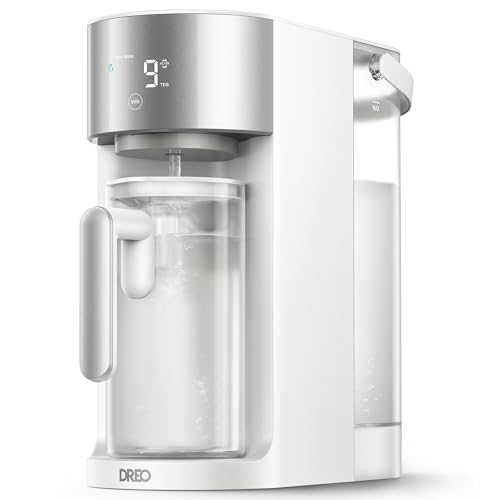
Install-free countertop RO unit with raw and filtered TDS readouts, auto-fill pitcher and a 3:1 pure-to-drain ratio.
Check price on Amazon$152.99 as of Oct 19, 2026 8:59 pm GMT+0000 — prices change; see Amazon for current price.Why we like it
- Reverse osmosis without drilling or plumbing
- Shows TDS of both incoming and filtered water
- States a 3:1 pure-to-drain ratio
- Filter lasts about 265 gallons and twists in
| Specification | Details |
|---|---|
| Type | Countertop reverse osmosis, 7-in-1 filter |
| Testing claim | Tested by SGS to meet NSF/ANSI 58 standards, per listing (certification not claimed) |
| Contaminants named | PFOA, PFOS, chlorine, fluoride and others; 99.9% claim |
| Capacity | 3 L tank plus 1.1 L pitcher; suited to 1 to 2 people per listing |
| Efficiency / filter life | 3:1 pure-to-drain; about 265 gallons (1,000 L) per filter |
| Size / weight | About 14.5 x 6.7 x 13.4 in; 9.46 lb |
DREO DR-KWF002 — countertop RO, 7-in-1 filter, raw + pure TDS display, 3:1 ratio, 265-gal filter, 3 L tank, auto-fill pitcher
The Broadest Reduction Available Without Touching the Plumbing
The CDC notes that reverse osmosis removes some chemicals that carbon filters do not, including lead, copper, chromium, chloride and sodium, and may also reduce arsenic, fluoride, radium, nitrate and others. On this shelf, that technology comes in two forms: an under-sink iSpring system that needs a drain connection and countertop installation, and two DREO countertop units that need none. This smaller DREO is the one that brings RO-level reduction to renters and anyone who cannot modify a kitchen.
Its display shows TDS for both the incoming tap water and the filtered water, which lets you see the difference rather than trust a filter-life countdown. The 3:1 pure-to-drain ratio is also better than older tank-style RO designs, though you still pour the reject water out or reuse it.
Read the certification wording precisely. DREO says the unit was tested by SGS to meet NSF/ANSI 58, the reverse osmosis standard, which is not the same as being certified to it. The 3-liter tank suits one or two people; a larger household will refill often. The listing does not state power requirements.
Pros
- RO reduction with no installation
- Raw and filtered TDS readouts
- Efficient 3:1 ratio stated
Cons
- Tested to, not certified to, NSF/ANSI 58
- Small capacity for families
- Removes beneficial minerals and fluoride too
Check DREO countertop RO 112 price on Amazon
2. Waterdrop PT-07B — Best Pitcher

10-cup pitcher with NSF/ANSI 42 and 372 named, a 200-gallon filter, LED indicator and hands-free pour lid.
Check price on Amazon$17.99 as of Oct 19, 2026 8:59 pm GMT+0000 — prices change; see Amazon for current price.Why we like it
- Names NSF/ANSI 42 and 372 specifically
- Filter rated 200 gallons or 3 months
- Hands-free lid keeps dust out
- Upfront that it does not lower TDS
| Specification | Details |
|---|---|
| Capacity | 10 cups; about 10 x 5 x 10.1 in |
| Standards named | NSF/ANSI 42 and 372 |
| Other reductions claimed | PFOA/PFOS, odor, iron, mercury, copper, per third-party lab testing |
| Filter life | Up to 200 gallons or 3 months; LED usage indicator |
| Replacement | PF-01A filter |
| Note | Does not lower TDS, per listing |
Waterdrop PT-07B — 10-cup, NSF/ANSI 42 + 372, 200-gal / 3-month filter, LED indicator, hands-free lid, no TDS reduction
Tied for the Longest Pitcher Filter Life on the Shelf
Six listings here are pitchers or dispensers. The Brita units rate their Standard filters at 40 gallons, or about two months, and their Elite filters at 120 gallons. Both Waterdrop listings, this pitcher and the 35-cup dispenser, rate theirs at 200 gallons, and the ZeroWater replacement is rated at about 15. That means far fewer cartridge changes and less chance of drinking through an exhausted filter, especially if you track usage with the LED indicator.
Waterdrop names the standards it meets: NSF/ANSI 42, which the CDC describes as covering taste and odor, and 372, which concerns lead-free materials. Its claims for PFOA/PFOS and metals rest on third-party lab testing, not on a named certification standard, so treat them as manufacturer claims.
The listing does not claim NSF/ANSI 53, the standard EPA’s consumer tool uses for lead reduction. If lead is your concern, this is not the pitcher to rely on; see our guide to filters for lead in water. It also states plainly that it does not lower TDS.
Pros
- 200-gallon filter life
- Specific NSF standards named
- Clear about what it does not do
Cons
- No NSF/ANSI 53 claim for lead
- Metal and PFAS claims are lab-tested, not certified
- 10-cup capacity only
Check Waterdrop PT-07B pitcher price on Amazon
3. iSpring WGB21B — Best Whole-House Filter
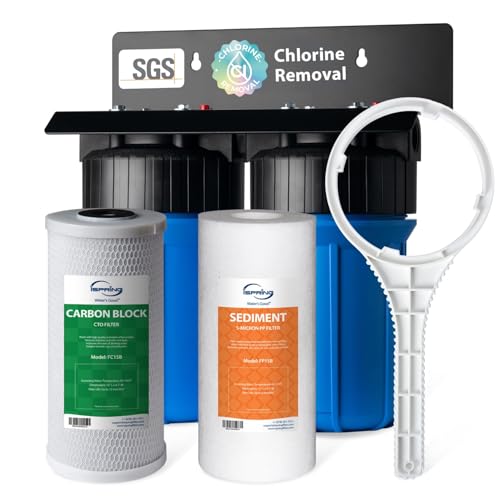
Two-stage point-of-entry system: 5-micron sediment filter then coconut-shell carbon block, rated up to 50,000 gallons.
Check price on Amazon$155.99 as of Oct 19, 2026 8:59 pm GMT+0000 — prices change; see Amazon for current price.Why we like it
- Treats every tap, shower and appliance
- Sediment stage protects the carbon block
- Up to 50,000 gallons, about a year for four
- Comes pre-assembled on a bracket with wrench
| Specification | Details |
|---|---|
| Stages | 5-micron polypropylene sediment (FP15B), then CTO carbon block (FC15B) |
| Reductions claimed | Over 90% of chlorine; bad taste and odor; VOCs such as pesticides and solvents |
| Testing named | SGS-tested CTO filter (title) |
| Capacity | Up to 50,000 gallons per set, about one year for a family of four |
| Connections | 1-inch inlet and outlet; 10 x 4.5 in filters; no power needed; pressure release valve |
| Warranty | 30-day money back; 1-year limited, extendable on registration |
iSpring WGB21B — 2-stage POE, 5 µm sediment + carbon block, 50,000 gal, 1-in ports, 10 x 4.5 in cartridges, 1-yr warranty
The Only Whole-House Pick Here That Keeps Minerals and Needs No Power
Two listings on this shelf are whole-house systems: this iSpring and a three-stage Express Water unit aimed at heavy metals and scale. The WGB21B is the simpler, more focused tool. It does what point-of-entry filters do best, catching sediment and reducing chlorine taste and odor at every tap, and iSpring states that it does not reduce total dissolved solids.
The CDC suggests whole-home filters when you need to remove something, such as certain volatile organic chemicals, from all of your water, including bathing water. It also cautions that a whole-home filter that removes chlorine can allow more germs to grow in household plumbing. That is a reason to keep the system maintained and not to let cartridges sit past their rated life.
The listing names SGS testing rather than an NSF certification for the system. It does not claim lead reduction. Installation is at the main water line, which for most homeowners means a plumber; see our whole-house water filter guide for sizing and placement.
Pros
- Filters all household water
- Large 50,000-gallon capacity
- No electricity, standard cartridge size
Cons
- No NSF system certification named
- No lead reduction claim
- Main-line plumbing work required
Check iSpring WGB21B price on Amazon
4. GE XWFE — Best Refrigerator Filter for GE Fridges

Genuine GE fridge filter certified to NSF/ANSI 42, 53, 372 and 401, listing 70+ impurities including lead.
Check price on Amazon$49.98 as of Oct 19, 2026 8:59 pm GMT+0000 — prices change; see Amazon for current price.Why we like it
- Names four NSF/ANSI standards: 42, 53, 372 and 401
- Lead, PFOA/PFOS and microplastics on its list
- No tools or water shutoff to change
- Fits GE, GE Profile, Cafe and Monogram models
| Specification | Details |
|---|---|
| Standards named | NSF/ANSI 42, 53, 372 and 401 |
| Reductions claimed | 70+ impurities including lead, chlorine, PFOA/PFOS, microplastics and select pharmaceuticals |
| Fit | Select GE French door, side-by-side and built-in refrigerators |
| Filter life | Replace every 6 months |
| Installation | No tools or water shutoff required |
| Size | About 1.8 x 1.8 x 9.8 in; single pack |
GE XWFE — genuine GE, NSF/ANSI 42 / 53 / 372 / 401, 70+ reductions incl. lead and PFOA/PFOS, 6-month life
The Most NSF Standards Named by Any Listing on the Shelf
Six listings are refrigerator cartridges, and their certification claims vary widely. The LG cartridge says “NSF-certified” without a standard number, Samsung names none, and the Crystala replacement for this same GE slot names only NSF/ANSI 42. The genuine GE XWFE names four: 42 for taste and odor, 53 for health-related contaminants such as lead, 372 for lead-free materials and 401 for emerging contaminants. No other listing here names more.
That distinction matters when choosing between genuine and compatible cartridges. A compatible filter that only claims 42 may improve taste but does not claim the health-related reductions. EPA’s consumer tool for lead filters specifically looks for certification against both NSF/ANSI 53 and 42.
The obvious limit: it only fits GE-family refrigerators that use the XWFE slot, and it only filters water drawn at the fridge. GE notes that the impurities it lists are not necessarily found in all users’ water. More on fridge cartridges is in our refrigerator water filter guide.
Pros
- Four NSF/ANSI standards named
- Lead and PFOA/PFOS listed
- Tool-free swap
Cons
- Fits GE-family fridges only
- Only filters fridge water and ice
- Six-month replacement interval
5. everydrop Filter 1 (EDR1RXD1) — Best for Whirlpool-Family Fridges

Whirlpool-family fridge filter certified to NSF 42, 53 and 401, claiming 70 contaminants including microplastics.
Check price on Amazon$50.99 as of Oct 19, 2026 8:56 pm GMT+0000 — prices change; see Amazon for current price.Why we like it
- Names NSF 42, 53 and 401
- Claims 99% microplastics reduction
- Coconut-shell carbon core
- Color and number coding for the right match
| Specification | Details |
|---|---|
| Standards named | NSF 42, 53 and 401 |
| Reductions claimed | 70 contaminants including microplastics, heavy metals and VOCs |
| Fit | Whirlpool, Maytag, KitchenAid, Amana and JennAir refrigerators using Filter 1 |
| Media | Coconut shell-based activated carbon, three-stage design |
| Filter life | Every 6 months or 200 gallons |
| Installation | Push-in |
everydrop EDR1RXD1 — Filter 1 (purple), NSF 42 / 53 / 401, 70 contaminants incl. microplastics, carbon core, 6 months / 200 gal
One of Three Fridge Listings That Name NSF 53
Three of the six refrigerator listings name NSF 53: the GE XWFE and both everydrop listings on the shelf, Filter 1 and Filter 2. Filter 1 earns its place because it covers the largest family of brands among them, spanning Whirlpool, Maytag, KitchenAid, Amana and JennAir models that take that filter style.
The listing claims 99% microplastics reduction and says everydrop was the first among leading brands certified for microplastics in these refrigerators. As with all fridge filters, the reductions only apply to water dispensed by the refrigerator.
Match the filter exactly. everydrop numbers and color-codes its filters, and Filter 1 will not fit a fridge that takes Filter 2 or another style. Replace on schedule; a carbon cartridge past its rated 200 gallons does not keep performing as certified.
Pros
- NSF 42, 53 and 401 named
- Wide brand coverage within its filter style
- Simple push-in install
Cons
- Fits only fridges that take Filter 1
- No lead percentage stated in bullets
- Fridge water only
Check everydrop Filter 1 price on Amazon
6. Brita UltraMax 27-Cup Dispenser — Best Large Dispenser
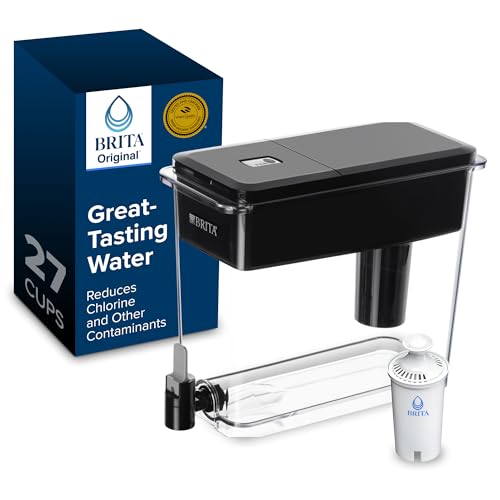
27-cup fridge-friendly dispenser with spigot, sold with a Standard filter and compatible with the Elite filter.
Check price on Amazon$37.97 as of Oct 19, 2026 8:59 pm GMT+0000 — prices change; see Amazon for current price.Why we like it
- 27-cup capacity for a family
- Precision-pour spigot and locking lid
- Works with Standard or Elite filters
- Slim shape for a fridge shelf
| Specification | Details |
|---|---|
| Capacity | 27 cups; about 18 x 5.7 x 10.5 in |
| Filter included | One Standard filter: 40 gallons or about 2 months |
| Optional filter | Elite: 120 gallons or about 6 months |
| Reductions claimed | Chlorine taste and odor, copper, mercury and other impurities |
| Certification named | WQA and NSF/ANSI certified (standard numbers not given in listing) |
| Indicator | Sticker filter indicator |
Brita UltraMax 27-cup — spigot dispenser, Standard filter 40 gal, Elite-compatible 120 gal, WQA / NSF named, sticker indicator
The Large Dispenser Whose Listing Offers a Longer-Life Filter Option
Four listings on the shelf hold 27 cups or more: two Brita UltraMax 27-cup versions, the Waterdrop 35-cup and the ZeroWater 32-cup. This UltraMax listing is the one that spells out a filter upgrade path, accepting both the Standard cartridge it ships with and Brita’s Elite filter, which the listing rates at three times the life of the Standard. The other Brita version ships with a BritaPlus filter rated, like the Standard, at 40 gallons.
For a family that drinks a lot of water, that matters more than capacity. A 40-gallon Standard filter in a 27-cup dispenser can be used up well before the two-month mark. The spigot design also means nobody lifts a heavy pitcher.
The certification wording is general. The listing says WQA and NSF/ANSI certified but does not name the standard numbers, and its Standard filter claims cover taste and a short list of metals, not lead. Brita sells the Elite filter with a lead reduction claim, which our water filter pitcher guide compares.
Pros
- Large capacity with spigot
- Accepts longer-life Elite filters
- Fits on a fridge shelf
Cons
- NSF standard numbers not stated
- Standard filter makes no lead claim
- Sticker indicator, not electronic
Check Brita 27-cup dispenser price on Amazon
Start with a water test, not a filter
The CDC’s guidance on choosing a filter begins with testing. Taste, smell and appearance are not reliable indicators of safety; harmful germs and chemicals often do not change how water looks or tastes, while harmless sulfur compounds can make it smell bad. If your water is free of harmful germs and chemicals, the CDC notes you may not need a filter at all.
How to find out:
- Public water: read the annual water quality report, or Consumer Confidence Report, that your utility must provide. EPA explains how to find and read it.
- Private well: the CDC recommends testing at least once a year for germs and chemicals, using a state-certified lab.
- Older homes: lead usually comes from plumbing rather than the utility. The EPA notes that lead service lines are typically the most significant source where present, and that among homes without them, brass faucets and lead solder are the most common problem.
Filters also remove things you might want. The CDC points out that some filters remove chlorine, which kills germs, and fluoride, which prevents cavities.
Reading NSF claims
The CDC suggests looking for an NSF certification on the label and checking the product in the NSF database. The standards that come up most on this shelf:
- NSF/ANSI 42: taste and odor, such as chlorine. Most pitchers and many cartridges claim this.
- NSF/ANSI 53: health-related contaminants; the CDC lists cyst reduction under it, and EPA’s consumer tool for lead filters looks for certification against both 53 and 42.
- NSF/ANSI 58: reverse osmosis systems.
- NSF/ANSI 401: emerging contaminants such as some pharmaceuticals and, in listings here, microplastics.
- NSF/ANSI 372: lead-free materials in the product itself, not lead removal from water.
Watch the verbs. “Certified to” means a certifying body evaluated the product. “Tested to” or “meets the standard” often means the manufacturer commissioned a lab test, which is useful but not the same thing. On this shelf, only some listings name standard numbers at all; several say “NSF certified” or “WQA and NSF/ANSI certified” without saying which standard.
Matching the filter type to the problem
Taste and chlorine
Activated carbon in a pitcher, faucet or fridge filter is usually enough. The CDC notes pitcher and refrigerator filters mainly improve taste and smell rather than safety. Carbon adsorbs chlorine and many organic compounds as water passes through it.
Lead
Use a point-of-use filter certified to NSF/ANSI 53 for lead, ideally one that appears in EPA’s consumer tool. EPA and CDC agree there is no known safe level of lead in a child’s blood, so treat lead as a reason to choose a certified product rather than a lab-tested claim. An under-sink water filter is often the most convenient certified option.
PFAS
EPA research identifies activated carbon, ion exchange resins and high-pressure membranes such as reverse osmosis as technologies that can remove PFAS, especially PFOA and PFOS. Effectiveness depends on the product, the carbon, contact time and the specific PFAS, and shorter-chain PFAS adsorb less well to carbon.
Germs
Most pitcher and fridge filters are not designed to remove germs, according to the CDC. Removing parasites calls for NSF 53 or 58 cyst reduction or an absolute pore size of 1 micron or smaller; bacteria and viruses need finer filtration or reverse osmosis. For well water with bacteria, disinfection is usually the answer.
Sediment and whole-house protection
A whole-house sediment and carbon system protects fixtures and appliances and improves bathing water. The CDC notes these point-of-entry filters treat every tap. A 5-micron sediment stage ahead of carbon keeps the carbon from clogging.
Maintenance and Front Range notes
Every filter needs regular changes to keep working and to prevent germ growth inside it, the CDC says, and recommends wearing gloves when changing filters and washing your hands afterward. Write the install date on each cartridge.
Front Range utilities publish the annual reports EPA requires, so check yours before buying a filter for safety reasons. Foothills and eastern plains homes on private wells face different issues, from iron and hardness to bacteria, and need testing before any treatment decision. Hard water that leaves scale is a mineral issue, not a health one, and a carbon filter will not soften it.
When to call a professional
Bring in a licensed plumber for whole-house systems, under-sink RO with drain connections, or any work on the main line. If your test shows lead, bacteria, nitrate or another health-related contaminant, contact your local health department for next steps before choosing equipment. Our plumbing and water hiring guide covers what to ask, and buyers who want water and plumbing looked at during an inspection can contact us to connect with a local inspector.
References
- About Choosing Home Water Filters — Centers for Disease Control and Prevention
- Consumer Confidence Reports — U.S. Environmental Protection Agency
- Basic Information about Lead in Drinking Water — U.S. Environmental Protection Agency
- Consumer Tool for Identifying Filters Certified to Reduce Lead — U.S. Environmental Protection Agency
- Reducing PFAS in Drinking Water with Treatment Technologies — U.S. Environmental Protection Agency
Frequently asked questions
What type of water filter is best for most homes?
It depends on what is in your water. For taste and chlorine, a carbon pitcher or fridge filter certified to NSF/ANSI 42 is usually enough. For lead, choose a filter certified to NSF/ANSI 53 for lead. For the broadest reduction of dissolved chemicals, consider reverse osmosis.
Do I need a water filter if I have city water?
Not necessarily. The CDC notes that if your water is free of harmful germs and chemicals, you may not need a filter. Read your utility's annual water quality report, and consider testing for lead if your home has older plumbing.
What does NSF/ANSI 53 mean on a water filter?
NSF/ANSI 53 covers health-related contaminant reduction. The CDC lists cyst reduction under it, and EPA's consumer tool for lead filters looks for certification against NSF/ANSI 53 and 42. Check which specific contaminants the product is certified for.
Do water filter pitchers remove bacteria?
Most do not. The CDC says pitcher and refrigerator filters are generally not designed to remove germs and mainly improve taste and smell. Removing bacteria requires very fine filtration, reverse osmosis or disinfection.
How often should water filters be changed?
Follow the manufacturer's rating. On this shelf, ratings range from about 2 months for standard pitcher filters to 6 months for fridge filters and up to a year for some whole-house cartridges. Overdue filters lose performance and can grow germs.
Buying a Front Range home and want the plumbing, water heater and supply lines checked along with everything else? Reach out through our contact page to connect with a vetted local inspector.