Best Under Sink Water Filters (2026): 7 Picks Compared

The best under sink water filter is the one that fits your cabinet, connects to the faucet you already have (or comes with its own), and carries a certification for the thing you actually want out of your water. Under-sink carbon and ultrafiltration units sit out of sight, filter on demand at the cold tap, and last far longer per cartridge than a pitcher. They do not remove dissolved minerals, and almost none of them are rated for well water or hot water. This page covers only the under-sink, non-reverse-osmosis form factor; for pitchers, refrigerator cartridges, whole-house systems and countertop RO, our broader best water filter roundup compares those types side by side.
Part of our Plumbing & Water guide — start there for the full picture →
As an Amazon Associate we earn from qualifying purchases.
How we compared: we compared 11 current Amazon listings for under-sink carbon and ultrafiltration systems (one more listing on the shelf was a reverse osmosis system, which we left for its own guide). We judged each on what the listing states: certifications and who issued them, cartridge life in months and gallons, stated flow rate, faucet connection, drilling needs and what the maker says the unit cannot handle. We did not lab-test or install any of these filters. Prices and availability change, so check the live listing before buying.
Quick picks: the best under sink water filters by use case
| Product | Best for | Key features | Price | Buy |
|---|---|---|---|---|
| Waterdrop 15UA | Best overall direct-connect |
| $51.29as of Oct 19, 2026 8:58 pm GMT+0000 | Buy now →Check current price |
| CuZn UC-200 | Longest stated filter life |
| $119.99as of Oct 19, 2026 8:58 pm GMT+0000 | Buy now →Check current price |
| ICEPURE WFS5300A | Highest stated flow rate |
| $49.99as of Oct 20, 2026 4:35 am GMT+0000 | Buy now →Check current price |
| Waterdrop TSA | Three-stage with fluoride resin |
| $94.99as of Oct 19, 2026 8:58 pm GMT+0000 | Buy now →Check current price |
| Waterdrop TSU | Ultrafiltration with own faucet |
| $139.99as of Oct 20, 2026 4:35 am GMT+0000 | Buy now →Check current price |
| Waterdrop UL12A | Renters and no-drill cabinets |
| $49.99as of Oct 20, 2026 4:35 am GMT+0000 | Buy now →Check current price |
| Amazon Basics AMZN8116UA | Simple single-cartridge budget pick |
| $38.63as of Oct 20, 2026 4:35 am GMT+0000 | Buy now →Check current price |
Prices are Amazon’s listed prices as of the time shown and change often; check Amazon for today’s price. As an Amazon Associate we earn from qualifying purchases.
The seven picks, compared listing by listing
1. Waterdrop 15UA (WD-15UA) — Best Overall Direct-Connect Under Sink Filter

Single-cartridge carbon filter that tees off the cold line, rated up to 24 months or 19,000 gallons on city water.
Check price on Amazon$51.29 as of Oct 19, 2026 8:58 pm GMT+0000 — prices change; see Amazon for current price.Why we like it
- Two named IAPMO certifications: NSF/ANSI 42 and 372
- Longest cartridge life among the Waterdrop single-stage units
- Feeds your existing faucet, so no countertop hole
- Converter fitting covers 3/8 and 1/2 inch lines
| Specification | Details |
|---|---|
| Filter type | Single carbon block cartridge, coconut shell carbon, multistage media |
| Certifications named | NSF/ANSI 42 (chlorine, taste, odor) and NSF/ANSI 372 (lead-free materials) by IAPMO; lead reduction tested by a third-party lab against NSF/ANSI 53 |
| Cartridge life | Up to 24 months or 19,000 gallons on municipal water |
| Flow rate | 0.75 gpm at 60 psi, as tested by the maker |
| Connection | 3/8 inch direct-connect hose plus 3/8 to 1/2 inch converter; cold water only |
| Size | About 16.7 in tall x 3.6 in wide; larger than the 1-year 10UA |
Waterdrop WD-15UA — single carbon cartridge, NSF/ANSI 42 + 372 (IAPMO), 53 lead test (third-party), 24 months / 19,000 gal, 0.75 gpm, cold only
The Longest-Lived Waterdrop Cartridge That Still Feeds Your Existing Faucet
Five of the 11 under-sink listings are single-cartridge Waterdrop or Waterdrop-style direct-connect units: the 10UA, the 15UA, the UL12A, the 10UB with its own faucet, and the Amazon Basics model that uses the same twist-and-lock format. The 15UA is the only one of those rated for 24 months; the others top out at 12. The longer interval makes the cartridge taller, close to 17 inches, so measure the cabinet first.
The certification wording is worth reading carefully. Waterdrop states that IAPMO certified the 15UA against NSF/ANSI 42 for chlorine, taste and odor and against NSF/ANSI 372 for lead-free materials. Lead reduction is a separate claim: the listing says a third-party lab tested it against NSF/ANSI 53, which is not the same as holding a 53 certification. Only two listings on the shelf (this one and the 10UB) mention NSF/ANSI 53 at all, and both use that “tested against” phrasing. If lead is the reason you are shopping, the EPA’s consumer tool points you toward filters certified to both 42 and 53 for lead and particulate reduction, so confirm the certification listing before relying on it for lead.
The other limits are stated plainly. Waterdrop says the 15UA is designed for municipal water, cold lines only, and is not suited to well water or hot water.
Pros
- 24-month cartridge, double the 12-month units
- NSF/ANSI 42 and 372 named with the certifier
- Push-to-connect install with no countertop drilling
- Keeps minerals, so no remineralization needed
Cons
- Lead claim is tested, not certified, to NSF/ANSI 53
- Tall cartridge can crowd a disposal or trash pull-out
- Not for well water or hot water
Check Waterdrop 15UA price on Amazon
2. CuZn UC-200 — Best for the Longest Stated Filter Life

Inline three-stage filter with micro-sediment membrane, KDF-55 and coconut carbon, sold on a 5-year filter life claim.
Check price on Amazon$119.99 as of Oct 19, 2026 8:58 pm GMT+0000 — prices change; see Amazon for current price.Why we like it
- Five-year filter life is the longest stated claim here
- Only listing with KDF-55 media under the sink
- Inline design, all parts included, no drilling
- Says plainly it does not reduce TDS
| Specification | Details |
|---|---|
| Filter type | Three stages: micro sediment membrane, KDF-55, coconut shell carbon |
| Certifications named | NSF/ANSI 42 certified components or material; NSF/ANSI 372 in the title |
| Filter life | Five years per listing; gallon rating not stated in listing |
| Flow rate | Not stated in listing |
| Connection | Inline to the faucet supply line for kitchen or bath sinks |
| Size | About 15 in tall x 4.5 in wide |
CuZn UC-200 — inline 3-stage (sediment, KDF-55, carbon), 5-yr life claim, NSF/ANSI 42 components + 372, flow not stated
The Only Under-Sink Listing That Adds KDF-55 and Claims Five Years
KDF-55 is a copper-zinc media that reacts with free chlorine, and the UC-200 is the only one of the 11 under-sink listings that names it. It pairs that stage with a sediment membrane and coconut shell carbon. The headline claim is life: five years from one housing, against 12 to 24 months for the Waterdrop and Amazon Basics cartridges and three years for ICEPURE.
Read the certification wording closely. The listing says NSF/ANSI 42 certified “components/material,” which is a narrower claim than a certified system. It also says the filter was independently tested to reduce PFAS, PFOA/PFOS, lead and chlorine, without naming a certifier or a standard for those reductions. A five-year life with no gallon figure is also hard to compare: a family that runs the drinking tap hard will push far more water through it than a couple who only fill a kettle.
Pros
- Longest stated service life on the shelf
- KDF-55 stage alongside carbon
- Inline install in kitchen or bath with no drilling
Cons
- NSF/ANSI 42 claim covers components, not the full unit
- No gallon capacity or flow rate stated
- PFAS and lead reductions not tied to a named certification
Check CuZn UC-200 price on Amazon
3. ICEPURE WFS5300A — Best for the Highest Stated Flow Rate

Direct-connect carbon block rated at 2.5 GPM at 60 PSI, with 22,000 gallons or 3 years of stated life.
Check price on Amazon$49.99 as of Oct 20, 2026 4:35 am GMT+0000 — prices change; see Amazon for current price.Why we like it
- 2.5 GPM at 60 PSI, triple the Waterdrop units
- 22,000-gallon rating tied to NSF/ANSI 42 testing
- Names NSF/ANSI 42 and 372
- 0.5 micron outer layer on the carbon block
| Specification | Details |
|---|---|
| Filter type | Coconut shell carbon block with 0.5 micron outer layer |
| Certifications named | NSF/ANSI 42 and NSF/ANSI 372 |
| Capacity | 22,000 gallons or about 3 years on municipal water |
| Flow rate | 2.5 GPM at 60 PSI |
| Connection | Faucets with 1/2 or 3/8 inch female NPT thread; cold water only |
| Size / weight | About 15.6 x 6.8 x 5.4 in; 3.95 lb |
ICEPURE WFS5300A — carbon block, NSF/ANSI 42 + 372, 22,000 gal / 3 yr, 2.5 GPM @ 60 PSI, 1/2 or 3/8 in female NPT, cold only
One of Two Listings Rated at 2.5 GPM, and the Same Model Number as the Other
Flow is where under-sink carbon filters differ most, and only two listings on this shelf claim 2.5 GPM at 60 PSI: this ICEPURE and the PUREPLUS under-sink system. Both carry the same model number, WFS5300A, and both quote 22,000 gallons, so they appear to be closely related products. The interesting difference is the stated life. ICEPURE says three years; PUREPLUS says five years for the same 22,000 gallons. We picked the ICEPURE listing because its time figure is the more conservative one, and the gallon rating is what should drive replacement anyway.
For comparison, the Waterdrop 10UA, 15UA and 10UB all state 0.75 gpm at 60 psi, and the UL12A converts to roughly 1.3 gpm. If you fill pots at the kitchen sink and find a slow filtered stream frustrating, flow rating matters more than any other spec on this list.
What the listing does not say: it names no lead, PFAS or cyst certification, so treat it as a chlorine, taste and odor filter with a strong flow rate. It connects only to faucets with a female NPT thread; the maker asks buyers with other connections to contact them first.
Pros
- Highest stated flow rate on the shelf
- 22,000-gallon capacity, about 3 years
- NSF/ANSI 42 and 372 named
Cons
- No lead or PFAS certification stated
- Fitting limited to female NPT faucet threads
- Wider body than slim single-cartridge units
Check ICEPURE WFS5300A price on Amazon
4. Waterdrop TSA (WD-TSA) — Best Three-Stage Filter With a Fluoride Stage

Three-cartridge under-sink system (PP, resin, carbon) that connects to your faucet and adds a resin stage for fluoride.
Check price on Amazon$94.99 as of Oct 19, 2026 8:58 pm GMT+0000 — prices change; see Amazon for current price.Why we like it
- One of two listings claiming fluoride reduction
- Separate sediment, resin and carbon cartridges
- Staggered life up to 18 months for the carbon
- Burst and pulse pressure tests listed
| Specification | Details |
|---|---|
| Filter type | Three cartridges: PP sediment (WD-10PP), resin (WD-10GC), carbon (WD-10CT) |
| Certifications named | Carbon stage passed IAPMO certification for chlorine reduction; NSF/ANSI 42 in the title |
| Cartridge life | About 6 months, 8 to 12 months, and 12 to 18 months |
| Pressure testing | 400 psi burst, 100,000+ pulses at 150 psi, 300 psi static, per listing |
| Connection | Existing faucet with 1/2 or 3/8 inch female NPT thread; cold only |
| Size | About 12.9 x 12.4 x 4.3 in |
Waterdrop WD-TSA — 3-stage PP / resin / carbon, IAPMO chlorine cert on CT stage, 6 / 8-12 / 12-18 mo life, female NPT, cold only
One of Two Listings With a Resin Stage Aimed at Fluoride
Only two of the 11 under-sink listings claim fluoride reduction without reverse osmosis: this TSA and its sibling TSA-UF. Both credit a resin cartridge for it. We chose the TSA because it keeps a dedicated carbon block as the final stage, while the TSA-UF swaps that position for an ultrafiltration membrane and does not mention any certification. Whether removing fluoride is desirable is a household decision; the CDC notes that filters can strip beneficial chemicals such as fluoride along with unwanted ones.
The three-housing format also changes maintenance. You replace the sediment cartridge about every six months, the resin every eight to 12, and the carbon every 12 to 18. That means more swaps than a single cartridge, but each change costs one inexpensive stage rather than the whole system. The TSA is also the only listing here that spells out a pressure-test regimen in numbers.
A useful detail for some Front Range readers: Waterdrop says the TSA is designed for municipal water, but it can be used on well water if the feed has been through a pre-filtration system first. Most of the other Waterdrop units say flatly not to use them on wells. The listing also warns that filtered water flows more slowly after all stages and does not give a gpm figure.
Pros
- Fluoride-reducing resin stage plus carbon
- Cheap single-stage replacements
- Pressure testing stated in numbers
- Allows well water with a pre-filter
Cons
- Flow rate not stated; listing says it runs slower
- Three cartridges to track and replace
- Fluoride claim not tied to a named certification
Check Waterdrop TSA price on Amazon
5. Waterdrop TSU (WD-TSU) — Best Ultrafiltration System With Its Own Faucet
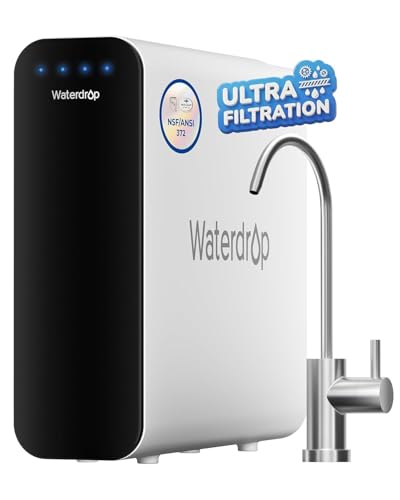
Three-stage system with a 0.01 micron UF membrane, its own brushed nickel faucet and a four-light filter panel.
Check price on Amazon$139.99 as of Oct 20, 2026 4:35 am GMT+0000 — prices change; see Amazon for current price.Why we like it
- 0.01 micron UF membrane rated for 24 months
- Dedicated brushed nickel drinking faucet included
- Four-light panel shows when each stage is due
- No wastewater and no drain line
| Specification | Details |
|---|---|
| Filter type | PP sediment, 0.01 micron ultrafiltration (UF), carbon (CT) |
| Certifications named | NSF/ANSI 372 (lead-free materials) by IAPMO |
| Cartridge life | UF 24 months, CT 12 months, PP 6 months |
| Flow rate | Maximum 1.05 GPM |
| Install | Separate faucet requires a countertop hole; fits 1/2 and 3/8 inch lines |
| Size | About 4.7 in wide x 14 in tall x 14.8 in deep |
Waterdrop WD-TSU — PP / 0.01 μm UF / carbon, 1.05 GPM max, separate faucet (drilling), filter-life panel, NSF/ANSI 372, cold only
The Only Listing Combining a Separate Faucet, Ultrafiltration and a Filter Panel
Two listings come with their own drinking faucet: this TSU and the Waterdrop 10UB. Two have an active filter-life reminder: this TSU with a four-light panel and the UL12A with a light-and-beep cartridge. The TSU is the only listing with both, and it is also one of two using a 0.01 micron ultrafiltration membrane.
The trade-off is installation. Waterdrop says outright that the faucet needs a hole drilled in the countertop, which is easy through an existing sprayer or soap-dispenser hole and a real project in stone or quartz.
The only certification named is NSF/ANSI 372, which covers lead-free construction materials, not contaminant reduction. The listing says the system reduces 30-plus substances including chlorine, PFAS and heavy metals, without tying those claims to a certification. It also states that it is not for well water or hot water and does not reduce TDS.
Pros
- Separate faucet keeps filtered water on its own tap
- Panel lights track each cartridge
- UF membrane rated for two years
Cons
- Countertop drilling required
- Only certification named is NSF/ANSI 372
- Not for well or hot water
Check Waterdrop TSU price on Amazon
6. Waterdrop UL12A (WD-UL12A) — Best for Renters and No-Drill Cabinets

Freestanding single-cartridge filter on a suction base, with a red-light and beep reminder when the cartridge is due.
Check price on Amazon$49.99 as of Oct 20, 2026 4:35 am GMT+0000 — prices change; see Amazon for current price.Why we like it
- Freestanding suction base, nothing screwed to the cabinet
- Light turns red and unit beeps at end of life
- About 1.3 gpm, faster than the 10UA
- NSF/ANSI 42 in the title
| Specification | Details |
|---|---|
| Filter type | Single cartridge (FUL12) carbon filter |
| Certifications named | NSF/ANSI 42 in the title; IAPMO certified per listing; PFAS and lead claims tested by a third-party lab |
| Cartridge life | 11,000 gallons or 12 months |
| Flow rate | 5.026 L/min, about 1.3 gpm |
| Mounting | Freestanding with suction cup base; no wall drilling |
| Connection | 3/8 inch line plus 3/8 to 1/2 inch converter; cold water |
Waterdrop WD-UL12A — freestanding single cartridge, 11,000 gal / 12 mo, about 1.3 gpm, light + beep reminder, NSF/ANSI 42, cold only
The Only Freestanding Unit and the Only Cartridge That Beeps When It Is Due
Every other under-sink listing here either screws a bracket to the cabinet wall or hangs off the supply line. The UL12A stands on a suction-cup base, so a renter can install it and take it out at move-out without leaving screw holes.
It is also the only listing whose cartridge has its own end-of-life alert: the indicator turns red and the unit beeps. The TSU’s panel serves a similar purpose but is a separate module tied to a drilled faucet. Forgetting a cartridge change is the most common way an under-sink filter stops doing its job, and the EPA warns that using a lead-reducing cartridge past its life can make it less effective.
The certification claim is less specific than the 15UA’s. The title names NSF/ANSI 42, and the bullets say the unit is IAPMO certified and meets a standard that is cut off in the listing text, while the PFAS, lead and heavy-metal reductions are described as tested by a third-party lab. Cartridge life is half that of the 15UA, at 12 months.
Pros
- No drilling into the cabinet or countertop
- Built-in replacement light and beep
- Faster stated flow than the 10UA it replaces
Cons
- 12-month cartridge life
- Lead and PFAS claims are tested, not certified
- Freestanding base takes floor space in the cabinet
Check Waterdrop UL12A price on Amazon
7. Amazon Basics AMZN8116UA — Best Simple Single-Cartridge Budget Pick
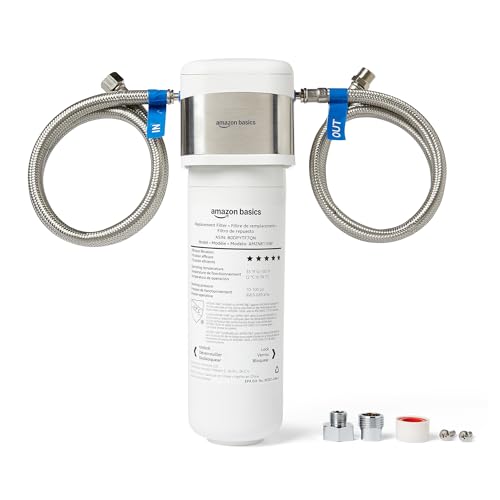
Compact twist-and-lock carbon filter certified by IAPMO to NSF/ANSI 42 and 372, rated 11,000 gallons or 12 months.
Check price on Amazon$38.63 as of Oct 20, 2026 4:35 am GMT+0000 — prices change; see Amazon for current price.Why we like it
- IAPMO certification to NSF/ANSI 42 and 372 named
- Shortest body on the shelf at about 10 inches
- Same twist-and-lock format as the Waterdrop units
- Clear 12-month or 11,000-gallon rating
| Specification | Details |
|---|---|
| Filter type | Single carbon cartridge for chlorine, taste and odor |
| Certifications named | NSF/ANSI 42 and NSF/ANSI 372 by IAPMO |
| Cartridge life | 12 months or 11,000 gallons on municipal water |
| Flow rate | Not stated in listing |
| Connection | 3/8 inch line to standard feed valves; works with 1/2 and 3/8 inch pipes; cold only |
| Size | About 10 in tall x 3.1 in wide |
Amazon Basics AMZN8116UA — single carbon cartridge, NSF/ANSI 42 + 372 (IAPMO), 11,000 gal / 12 mo, 10 in tall, cold only
The Most Compact Unit Here, With No Claims Beyond Chlorine, Taste and Odor
At about 10 inches tall and 3.1 inches wide, the Amazon Basics unit is the smallest under-sink filter on the shelf, a real advantage in a bathroom vanity or a kitchen cabinet with a disposal.
What makes it a sensible budget pick is restraint. The listing names IAPMO certification to NSF/ANSI 42 and 372 and claims chlorine, taste and odor reduction. It does not stretch into PFAS, lead or heavy-metal claims it cannot back with a named certification. Seven of the 11 listings make PFAS claims, and none of them ties that claim to a named PFAS certification. If your utility water is safe and you mainly dislike the chlorine taste, this is all the filter you need, and the CDC notes that a home with safe tap water may not need a filter at all.
Gaps: no flow rate, no lead reduction and a 12-month cartridge. Households worried about lead should skip it in favor of a filter certified for lead.
Pros
- Smallest footprint on the shelf
- Certifier and both standards named
- Claims stay inside what is certified
Cons
- No lead or PFAS reduction claimed
- Flow rate not stated
- 12-month cartridge
Check Amazon Basics AMZN8116UA price on Amazon
How to read under sink filter certifications
Every listing on this shelf mentions an NSF/ANSI standard somewhere, but they mean very different things. The CDC recommends looking for an NSF certification on the label and checking the product in the certifier’s database to see exactly what it is certified to reduce. In practice, four standards show up on under-sink listings:
- NSF/ANSI 42 covers aesthetic effects: chlorine, taste and odor. It does not cover lead, PFAS or germs.
- NSF/ANSI 53 covers health-related contaminants such as lead and cysts. The EPA’s lead-filter tool looks for filters certified to reduce lead to 5 ppb or less under both 53 and 42.
- NSF/ANSI 372 covers lead-free materials in the filter housing itself. It says nothing about what the filter removes from the water.
- NSF/ANSI 401 covers emerging contaminants; none of the under-sink listings here claim it.
The phrases to watch are “tested against” and “certified components.” A unit “tested by a third-party lab against NSF/ANSI 53” may perform well, but it is not listed as certified. Eight of the 11 listings name NSF/ANSI 372, which mostly tells you the plastics and brass are lead-free. For lead-specific shopping, our guide to filters for lead in water walks through how to confirm a lead certification.
Direct-connect, dedicated faucet or inline: which install fits your sink
Under-sink filters install three ways, and the right one depends more on your countertop than on the filter.
Direct-connect to your existing faucet (15UA, ICEPURE, TSA, UL12A, Amazon Basics): the filter sits between the cold shutoff valve and your faucet’s cold supply. Every cold draw is filtered, including the water you use to rinse dishes, so cartridges wear faster in a busy kitchen. The upside is no drilling.
Dedicated drinking faucet (TSU, 10UB): the filter feeds a small separate faucet, so only drinking and cooking water passes through the cartridge. That stretches cartridge life, but you need a hole in the countertop or sink deck.
Inline on the supply line (CuZn UC-200): similar to direct-connect, with the housing hanging on the line rather than a bracket.
Before ordering, check three things: the cold supply size at the shutoff valve (3/8 or 1/2 inch), the faucet’s supply thread (several listings require a female NPT connection) and the cabinet height left above the disposal or drain trap. Our under sink water filter guide covers the install steps in more detail, and a stuck or corroded shutoff valve is a good reason to bring in a plumber before you start.
Carbon, KDF and ultrafiltration: what each stage actually does
Most under-sink units on this shelf are carbon-based. Activated carbon adsorbs chlorine and many organic compounds, and the EPA’s research summary describes activated carbon as the most studied treatment for PFAS, alongside ion exchange resins and high-pressure membranes such as reverse osmosis. That is why so many carbon listings mention PFAS, though a claim without a certification is still only a claim. For background on how carbon blocks differ from granular media, see our carbon water filter explainer.
KDF-55, used only by the CuZn UC-200 here, is a copper-zinc media that targets chlorine and is often paired with carbon. Ultrafiltration membranes, in the TSU and TSA-UF, add a very fine physical barrier, but none of those listings claims a germ-reduction certification. The CDC points out that most home filters are not designed to remove germs at all.
None of these stages remove dissolved minerals. Several Waterdrop listings explain that a TDS meter reading will not drop after their filter, which is expected. If you want lower TDS, nitrate or arsenic reduction, you are shopping for reverse osmosis, not an under-sink carbon filter.
Well water, hard water and Front Range homes
Most of these units are built for treated city water. Eight of the 11 listings reference municipal water, and six Waterdrop listings warn against well water without pre-filtration. Sediment, iron and bacteria in raw well water will clog or overwhelm a carbon cartridge fast. Front Range homes on private wells in the foothills or eastern plains should test first and treat at the point of entry; a sediment filter or a whole house water filter usually comes before any under-sink unit.
Hard water is a separate issue. Under-sink carbon does not soften water, so it will not stop scale on fixtures or in the kettle. A softener handles that at the main line.
Older homes add one more variable. The EPA notes that lead pipes are more likely in homes built before 1986 and that brass or chrome-plated brass faucets and lead solder are common sources even without a lead service line. If an older Denver or Colorado Springs home is your concern, test the water before choosing a filter.
When a filter is not the answer
A filter treats water you already know about. If the water changes color, smells of sulfur or fuel, or a home sits on a well that has never been tested, start with a lab test rather than a cartridge. The CDC advises testing to find out what is in the water before choosing a filter, and annual testing for private wells.
Leaks are the other risk. An under-sink filter adds fittings under pressure inside a closed cabinet, and a slow drip can soak particleboard and start mold before anyone notices. Check the fittings a day after install and again after each cartridge change. If you are buying a home and want the plumbing, shutoff valves and water source looked at as part of the deal, our plumbing and water hub explains what an inspector checks, or contact us to connect with a Front Range inspector.
References
- About Choosing Home Water Filters — Centers for Disease Control and Prevention
- Consumer Tool for Identifying Point-of-Use and Pitcher Filters Certified to Reduce Lead — U.S. Environmental Protection Agency
- Basic Information about Lead in Drinking Water — U.S. Environmental Protection Agency
- Reducing PFAS in Drinking Water with Treatment Technologies — U.S. Environmental Protection Agency
Frequently asked questions
What is the best under sink water filter for most homes?
For most homes on city water, a direct-connect carbon filter that names its certifier and standards is the best starting point. The Waterdrop 15UA stands out because its listing names IAPMO certification to NSF/ANSI 42 and 372 and rates the cartridge for up to 24 months. If lead is the concern, choose a filter certified to NSF/ANSI 53 for lead.
Do under sink water filters remove lead?
Some do, but read the wording. A filter certified to NSF/ANSI 53 for lead has been evaluated for lead reduction; one that was only tested against 53 by a lab has not been listed as certified. The EPA suggests choosing filters certified to reduce lead to 5 ppb or less under NSF/ANSI 53 and 42.
Can you use an under sink water filter with well water?
Most under-sink carbon filters are designed for treated municipal water, and several listings say not to use them on wells without pre-filtration. Test the well first, then handle sediment, iron or bacteria at the point of entry before adding an under-sink unit for drinking water.
Does an under sink filter reduce TDS or soften water?
No. Carbon, KDF and ultrafiltration stages leave dissolved minerals in the water, so a TDS meter reading will not drop much and hardness stays the same. Reverse osmosis lowers TDS, and a water softener handles hardness at the main line.
How often should an under sink filter cartridge be replaced?
Follow the gallon or month rating, whichever comes first. On this shelf, single cartridges run from 12 months to 24 months, and multi-stage systems replace sediment stages about every 6 months. A cartridge used past its life can stop reducing contaminants, so set a reminder if the unit has no indicator.
Buying a Front Range home and want the plumbing, shutoff valves and water source checked before closing? Get in touch here to connect with a vetted local inspector.