Best Under Sink Reverse Osmosis Systems (2026): 6 Picks

Choosing the best under sink reverse osmosis system comes down to what your cabinet can hold and what your plumbing can feed it. Every RO system on the market pushes water through a membrane fine enough to reject dissolved salts, so the real differences are practical: tank or tankless, outlet or no outlet, how much water goes down the drain, whether the faucet needs a new hole, and how much pressure the system needs to work. This guide sticks to those under-sink installation questions. For a general introduction to RO and how it compares with carbon filters, our main best reverse osmosis system roundup is the place to start.
Part of our Plumbing & Water guide — start there for the full picture →
As an Amazon Associate we earn from qualifying purchases.
How we compared: we compared 14 current Amazon listings for under-sink RO systems, covering 13 distinct systems once two faucet-finish variants of one iSpring model are grouped. We read what each listing states about certification and certifier, tank or tankless design, power needs, pure-to-drain ratio, production rate, cabinet dimensions and faucet drilling. We did not lab-test or install any system. Prices and availability change, so check the live listing.
Quick picks: the best under sink RO systems by setup
| Product | Best for | Key features | Price | Buy |
|---|---|---|---|---|
| Waterdrop G3P600 | Best overall tankless RO |
| $429.00as of Oct 19, 2026 11:14 pm GMT+0000 | Buy now →Check current price |
| iSpring RCC7-BN | Classic tank system, no power |
| $197.99as of Oct 20, 2026 3:24 am GMT+0000 | Buy now →Check current price |
| Glacier Fresh GFU03 | Tankless RO with no outlet |
| $199.98as of Oct 20, 2026 3:24 am GMT+0000 | Buy now →Check current price |
| Home Master TMHP-L | Hard water and remineralizing |
| $568.31as of Oct 20, 2026 3:24 am GMT+0000 | Buy now →Check current price |
| Waterdrop T3-T | Small cabinets, no power |
| $169.99as of Oct 19, 2026 11:14 pm GMT+0000 | Buy now →Check current price |
| Waterdrop WD-T4-A | Plain and alkaline water lines |
| $249.98as of Oct 19, 2026 10:58 pm GMT+0000 | Buy now →Check current price |
Prices are Amazon’s listed prices as of the time shown and change often; check Amazon for today’s price. As an Amazon Associate we earn from qualifying purchases.
The six picks, compared listing by listing
1. Waterdrop G3P600 — Best Overall Tankless Under Sink RO System

Tankless 8-stage under-sink RO rated 600 GPD at 2:1, with a smart faucet showing TDS and filter life.
Check price on Amazon$429.00 as of Oct 19, 2026 11:14 pm GMT+0000 — prices change; see Amazon for current price.Why we like it
- Certified against NSF/ANSI 58 for TDS reduction
- Also names NSF/ANSI 42 and 372
- Tankless body frees cabinet space
- Faucet displays TDS and filter life
| Specification | Details |
|---|---|
| Stages | 8-stage tankless reverse osmosis |
| Certifications named | NSF/ANSI 58 (TDS), NSF/ANSI 372 (lead-free), NSF 42 (chlorine, taste, odor); title also lists NSF/ANSI 53 |
| Production / ratio | 600 gallons per day; 2:1 pure to drain |
| Power | Requires an outlet under the sink |
| Faucet | Smart LED faucet with TDS monitor and filter life tracker |
| Cabinet size | About 18.1 L x 5.7 W x 17.7 H in; 31 lb |
Waterdrop WD-G3P600 — tankless 8-stage RO, 600 GPD, 2:1, NSF/ANSI 58 + 42 + 372, smart TDS faucet, outlet required
The Broadest Named Certification Set Among the Tankless Systems
Seven of the 13 systems on this shelf are tankless, and six of those are Waterdrop. Among the tankless group, the G3P600 and the larger G3P800 name the widest certification set: NSF/ANSI 58 for TDS reduction, 42 for chlorine, taste and odor, and 372 for lead-free materials, with 53 also in the title. The G3P800 is the top pick in our main RO roundup, so this guide leads with the 600 GPD version, which keeps the same certifications and smart faucet at a slightly lower production rate that is still far beyond what a household drinks.
Tankless matters under a sink. A traditional RO system with a pressurized storage tank takes up most of a standard cabinet, while the G3P600 is a single slim box about 5.7 inches wide. Waterdrop says the tankless design saves 70% of under-sink space; that is their figure, but the dimensions bear out the point.
The price of tankless is power. Waterdrop states this system requires electricity under the sink, so you need an outlet in the cabinet or a licensed electrician to add one. It is also tall at almost 18 inches, which can collide with a disposal. Measure the cabinet first; the listing specifically asks you to.
Pros
- NSF/ANSI 58, 42 and 372 named
- Slim tankless body
- Faucet shows TDS and filter life
- Tool-free filter changes
Cons
- Needs an outlet under the sink
- Nearly 18 inches tall
- NSF/ANSI 53 named in title but not explained in bullets
Check Waterdrop G3P600 price on Amazon
2. iSpring RCC7-BN — Best Classic Tank System That Needs No Power

Five-stage NSF/ANSI 58 certified RO with a storage tank, no power needed, and a faucet that mounts from above.
Check price on Amazon$197.99 as of Oct 20, 2026 3:24 am GMT+0000 — prices change; see Amazon for current price.Why we like it
- NSF/ANSI 58 certified
- Runs on line pressure; no outlet needed
- Faucet tightens from above the counter
- Clear first-stage housing shows buildup
| Specification | Details |
|---|---|
| Stages | 5-stage RO: three pre-filters, 0.0001 micron membrane, GAC polishing filter |
| Certifications named | NSF/ANSI 58 |
| Production | 75 GPD |
| Power | None required; check valve prevents backflow |
| TDS claim | Reduces TDS by 80 to 90% per listing |
| Size / weight | About 18 H x 15 L x 8 W in; 27.5 lb; 1-year warranty |
iSpring RCC7-BN — 5-stage tank RO, 75 GPD, NSF/ANSI 58, no power, top-mounted faucet, clear first housing, 1-yr warranty
The Plain Five-Stage Tank Design, With No Outlet Needed
Four of the 13 systems on the shelf state outright that they run without electricity: this iSpring, the Glacier Fresh GFU03, the Waterdrop T3-T and the FS-TFC. The RCC7-BN is the only one of those four that combines a no-power design with an NSF/ANSI 58 certification claim. It is the conventional layout plumbers have installed for years: separate canisters on a bracket, a storage tank, a dedicated faucet.
The faucet detail is a real convenience. iSpring’s top-mounted faucet design lets you tighten it from above the counter, avoiding the cramped job of reaching up behind the sink basin. The clear first housing shows when the sediment filter is loading up, useful on dirtier water.
What you give up: space and speed. A tank system fills most of a standard cabinet. Production is 75 GPD, and the listing does not state a pure-to-drain ratio. Its TDS claim, 80 to 90%, is lower than the 93 to 98% iSpring claims for its alkaline RCC7AK, though the RCC7-BN skips the mineral stage some people want for taste.
Pros
- NSF/ANSI 58 certified with no power required
- Easy top-mounted faucet
- Standard-size replacement filters
Cons
- Tank takes most of the cabinet
- Drain ratio not stated
- 75 GPD, the slowest production here
Check iSpring RCC7-BN price on Amazon
3. Glacier Fresh GFU03 — Best Tankless RO for Cabinets Without an Outlet
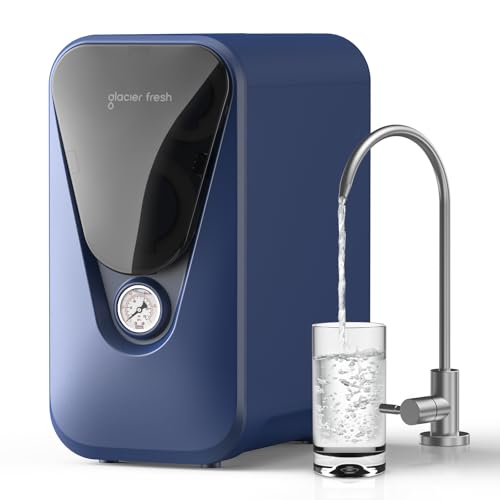
Water-powered RO with an internal tank, 800 GPD, 3:1 pure to drain and a built-in pressure gauge.
Check price on Amazon$199.98 as of Oct 20, 2026 3:24 am GMT+0000 — prices change; see Amazon for current price.Why we like it
- No electricity and no external tank
- 3:1 pure to drain, tied for best ratio
- Built-in water pressure gauge
- States a 40 PSI minimum inlet pressure
| Specification | Details |
|---|---|
| Stages | 5-stage RO with 0.0001 micron membrane; internal tank design |
| Certifications named | Says it meets NSF/ANSI 58, 372 and 401 standards; certifier not named |
| Production / ratio | 800 GPD; 3:1 pure to drain |
| Power | None; water-powered |
| Pressure | At least 40 PSI recommended; built-in gauge |
| Cabinet size | About 13.6 L x 8.3 W x 16.5 H in; faucet needs a 1/2 to 1 inch hole |
Glacier Fresh GFU03 — water-powered internal-tank RO, 800 GPD, 3:1, 40 PSI min, pressure gauge, says meets NSF/ANSI 58/372/401
The Only Compact No-Power System With a 3:1 Ratio and a Pressure Gauge
Only two systems on the shelf state a 3:1 pure-to-drain ratio: the GFU03 and the Waterdrop G3P800. The G3P800 needs power; the GFU03 does not. That combination solves a common under-sink problem: a compact tankless-style footprint in a cabinet with no outlet. Glacier Fresh calls the design “TankInside,” meaning the storage is built into the housing rather than a separate tank.
It is also the only listing with a built-in pressure gauge, and the only one that states a minimum inlet pressure, 40 PSI, below which output drops. That is an honest detail, because every non-electric RO system depends on line pressure to push water through the membrane. Homes with weak pressure, including some well systems, should check a pressure reading before choosing any no-power RO.
The certification wording is “meets NSF/ANSI 58, 372, and 401 standards,” with no certifier named, which is weaker than a certification listing. The faucet requires drilling a 1/2 to 1 inch hole.
Pros
- No outlet or external tank needed
- 3:1 pure-to-drain ratio
- Pressure gauge and stated minimum pressure
Cons
- No certifier named for the NSF standards
- Output drops below 40 PSI
- Faucet hole drilling required
Check Glacier Fresh GFU03 price on Amazon
4. Home Master TMHP-L HydroPerfection — Best for Hard Water and Remineralized Taste

Nine-stage RO with a high-hardness DOW membrane, two-pass remineralization, EPA-registered LED UV and fridge kit.
Check price on Amazon$568.31 as of Oct 20, 2026 3:24 am GMT+0000 — prices change; see Amazon for current price.Why we like it
- Membrane rated for high hardness, 18 gpg
- Minerals added back twice in the process
- LED UV stage carries an EPA registration number
- 5-year limited parts warranty, longest here
| Specification | Details |
|---|---|
| Stages | 9 stages including RO, remineralization and LED UV |
| Membrane | Dow Filmtec high-performance, high-hardness membrane (0.0001 micron, 18 gpg, 75 GPD) |
| Certifications named | UV sterilizer registered with EPA (#97952-AZ-1); no NSF standard named |
| Ratio | 1:1 waste ratio per title |
| Included | Lux RO faucet, fridge connection kit, garbage disposal drain adapter |
| Warranty | 5-year limited (parts) |
Home Master TMHP-L — 9-stage RO, 18 gpg high-hardness membrane, 2-pass remineralization, EPA-registered UV, 1:1, 5-yr warranty
The Only Listing That States a Hardness Rating for Its Membrane
Hard water shortens RO membrane life because calcium and magnesium scale the membrane surface. The Home Master is the only listing on the shelf that names a membrane rated for high hardness, specifying a Dow Filmtec membrane at 18 grains per gallon. For Front Range homes with hard city water and no softener, that is a meaningful detail.
It is also one of two systems with a UV stage, alongside iSpring’s RCC7AK-UV, and the only one whose UV unit carries an EPA registration number. EPA registration here relates to the device’s claim to kill or suppress microbes in water purification devices; it is not the same as an NSF/ANSI 55 certification, and the listing names no NSF standard at all. The box includes a refrigerator connection kit and a disposal drain adapter, two parts often bought separately.
The trade-off is water use. The title lists a 1:1 waste ratio, meaning one gallon to drain for every gallon of purified water, compared with 2:1 or 3:1 on the tankless picks. The warranty, five years on parts, is the longest stated on the shelf.
Pros
- High-hardness membrane rating stated
- Two-pass remineralization
- Fridge kit and disposal adapter included
- 5-year parts warranty
Cons
- 1:1 waste ratio
- No NSF/ANSI certification named
- Uses a storage tank, so needs cabinet room
Check Home Master TMHP-L price on Amazon
5. Waterdrop T3-T — Best Compact RO for Small Cabinets Without Power

Compact 7-stage remineralizing RO, 220 GPD, no power needed, about 12.6 x 6.1 x 14.7 inches.
Check price on Amazon$169.99 as of Oct 19, 2026 11:14 pm GMT+0000 — prices change; see Amazon for current price.Why we like it
- Smallest stated footprint among the tankless systems
- Runs without electricity
- Remineralization stage after RO
- NFC phone tap for filter reminders
| Specification | Details |
|---|---|
| Stages | 7 stages with remineralization; all-in-one filter design |
| Certifications named | SGS tested according to NSF/ANSI 58; not stated as certified |
| Production / ratio | 220 GPD; 2:1 pure to drain |
| Power | None needed |
| Filter life | CF up to 6 months, CBM up to 12 months, TRO up to 24 months |
| Cabinet size | About 12.6 L x 6.1 W x 14.7 H in; faucet needs a drilled hole |
Waterdrop WD-RT34T — compact 7-stage RO, 220 GPD, 2:1, no power, remineralizing, NFC reminders, SGS-tested to NSF/ANSI 58
The Smallest Tankless Footprint on the Shelf, Without Needing an Outlet
Under-sink space is the deciding factor in a lot of kitchens. At 12.6 x 6.1 x 14.7 inches, the T3-T has the smallest stated footprint of the seven tankless systems here, shorter than the G3P600 by about three inches and narrower than the Glacier Fresh by two. It also runs without power, which none of Waterdrop’s other tankless units on this shelf claim.
Waterdrop pairs it with a remineralization stage that adds potassium, calcium, sodium and magnesium after the membrane, and with NFC reminders: tap a phone to the unit to log filter changes. The 220 GPD production rate is modest beside the 600 to 800 GPD tankless units, but well above the 75 GPD of conventional tank systems.
The certification language is “SGS tested referred to NSF/ANSI 58,” a lab test against the standard rather than a certification listing. The faucet needs a hole in the countertop.
Pros
- Smallest tankless footprint here
- No power required
- Remineralization for taste
Cons
- NSF/ANSI 58 tested, not certified
- 220 GPD, slower than other tankless units
- Countertop drilling required
Check Waterdrop T3-T price on Amazon
6. Waterdrop WD-T4-A — Best for Separate Plain and Alkaline Water Lines
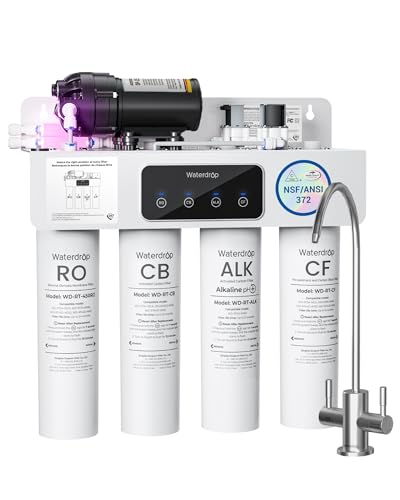
Tankless 10-stage RO with a dual-flow faucet for plain RO or mineralized water, 450 GPD at 2:1.
Check price on Amazon$249.98 as of Oct 19, 2026 10:58 pm GMT+0000 — prices change; see Amazon for current price.Why we like it
- Only dual-flow faucet on the shelf
- Choose plain RO or mineral-added water
- Lights and buzzer for each filter change
- Tankless design avoids storage-tank water
| Specification | Details |
|---|---|
| Stages | 10-stage tankless RO with dedicated alkaline mineral line |
| Certifications named | NSF/ANSI 372 (lead-free materials) |
| Production / ratio | 450 GPD; 2:1 pure to drain |
| Power | Requires an electrical connection |
| Filter life | CF 6 months; RO 24 months; CB 12 months; alkaline 12 months |
| Cabinet size | About 16.5 L x 6.2 W x 18 H in; faucet needs a drilled hole |
Waterdrop WD-T4-A — tankless 10-stage RO, dual-flow faucet (RO or alkaline), 450 GPD, 2:1, NSF/ANSI 372, outlet required
The Only System Whose Faucet Delivers Two Kinds of Water
Several systems on the shelf remineralize, including the iSpring RCC7AK, the Waterdrop G5P models, the T3-T and the Home Master. All of them send every glass through the mineral stage. The T4-A is the only listing with a dual-flow faucet, letting you draw plain RO water for coffee, baby formula or a steam iron, and mineral-added water for drinking.
The filter alert system, with indicator lights and a buzzer, gives specific replacement intervals for all four stages, which makes maintenance easy to plan. Tankless designs also avoid water sitting in a pressurized tank between uses.
The gaps are certification and power. The only standard named is NSF/ANSI 372, which covers lead-free materials, not contaminant reduction. The system needs an outlet under the sink, and the faucet needs a countertop hole. At about 18 inches tall, it is one of the taller units here.
Pros
- Plain RO or alkaline water on demand
- Clear per-stage replacement schedule
- Light and buzzer reminders
Cons
- Only NSF/ANSI 372 named
- Needs power under the sink
- Tall cabinet profile
Check Waterdrop WD-T4-A price on Amazon
Before you buy: check the cabinet, the drain, the power and the pressure
Under-sink RO is a plumbing project. Four checks prevent most returns:
- Cabinet dimensions. Measure width, depth and the height left under the drain trap or disposal. On this shelf, units range from about 14.7 to 18 inches tall. Leave room to change filters.
- Drain connection. RO sends reject water to the drain, usually through a saddle clamp on the sink drain above the trap. Disposal outlets complicate this; the Home Master includes a disposal adapter for that reason.
- Power. The G3P600 and T4-A require an outlet under the sink. If there is none, choose a no-power system or have an electrician add a receptacle; do not run an extension cord through a wet cabinet.
- Water pressure. Non-electric RO depends on line pressure. Glacier Fresh recommends at least 40 PSI, and output falls below that. A simple pressure gauge on a hose bib answers the question in a minute.
Most of the tankless systems and their faucets need a hole in the countertop or sink deck. An unused sprayer or soap-dispenser hole is the easy route; stone and quartz usually need a pro. Our reverse osmosis system guide walks through installation in more depth.
Tank vs tankless under the sink
Conventional tank systems (the iSpring RCC7 family, APEC and Home Master) store purified water in a pressurized tank and refill it slowly, which is why their production rates are 50 to 75 GPD. They usually need no power and have simpler parts, but the tank takes much of the cabinet, and a full tank is all the fast flow you get.
Tankless systems (Waterdrop G3, G5, T3-T and T4-A, plus the Glacier Fresh) produce on demand at 220 to 800 GPD and fit in a slim box. Most use an internal pump, so most need power; the T3-T and Glacier Fresh are the exceptions. Tankless units on this shelf also state better drain ratios, 2:1 or 3:1, while the two conventional systems that state a ratio, the Home Master and the compact FS-TFC, are 1:1.
For most kitchens with an outlet, tankless is the better fit. For cabinets without power or for homes that want the simplest, most serviceable layout, a certified tank system remains a sound choice.
What RO removes, and what it does not fix
The EPA describes reverse osmosis as extremely effective at removing PFAS and notes that RO membranes reject salts to a high degree. That is why RO lowers TDS when carbon filters do not. The EPA’s secondary standard for TDS is 500 mg/L, above which water may taste salty or leave deposits; RO addresses that taste issue at one tap. The CDC lists NSF Standard 58 as the standard for reverse osmosis systems and suggests looking up any filter in the certifier’s database.
RO at the kitchen sink does not treat the rest of the house. It will not stop scale in a water heater or shower, and it is not a substitute for disinfecting a well with a bacteria problem. Very hard water and sediment will also wear the membrane faster, so many well and hard-water homes add pre-treatment at the main line. Our guide to well water filtration systems covers that point-of-entry side.
Well water, Front Range homes and testing first
Private wells are where RO earns its keep for nitrate, arsenic or high TDS, and where it needs the most care. The CDC recommends testing a private well at least once a year for total coliform bacteria, nitrates, total dissolved solids and pH, and contacting the health department about other local concerns. Test first, then size the RO and any pre-treatment to the results.
Two well-specific cautions: low or fluctuating pressure from a well pump can starve a no-power RO system, and iron or sediment upstream will foul pre-filters quickly. If you are buying a Front Range home on a well, or want an under-sink system’s drain connection and shutoff valves checked, our plumbing and water hub explains what inspectors look at, and you can contact us to connect with a qualified inspector.
References
- Reducing PFAS in Drinking Water with Treatment Technologies — U.S. Environmental Protection Agency
- Secondary Drinking Water Standards: Guidance for Nuisance Chemicals — U.S. Environmental Protection Agency
- About Choosing Home Water Filters — Centers for Disease Control and Prevention
- Guidelines for Testing Well Water — Centers for Disease Control and Prevention
Frequently asked questions
What is the best under sink reverse osmosis system?
For most kitchens with an outlet under the sink, a tankless system that names NSF/ANSI 58 certification is the best starting point, and the Waterdrop G3P600 names 58, 42 and 372 with a 2:1 drain ratio. Without an outlet, a no-power option such as the NSF/ANSI 58 certified iSpring RCC7-BN or the compact Waterdrop T3-T fits better.
Do under sink RO systems need electricity?
Some do. Tankless systems with internal pumps, such as the Waterdrop G3P600 and WD-T4-A, require an outlet under the sink. Tank systems and some water-powered tankless designs, such as the iSpring RCC7-BN, Glacier Fresh GFU03 and Waterdrop T3-T, run on line pressure alone.
How much water does an under sink RO system waste?
It depends on the design. On this shelf, stated ratios run from 1:1 to 3:1 pure to drain, so one gallon of reject water for every one to three gallons purified. Tankless systems generally state better ratios than tank systems.
Do I need to drill a hole to install under sink RO?
Usually. Most RO systems use a dedicated faucet, and several listings here state that the faucet requires a hole in the countertop or sink deck. An unused sprayer or soap-dispenser hole often works; stone countertops typically need professional drilling.
Can I use an under sink RO system on well water?
Yes, after testing. The CDC recommends testing private wells at least once a year for bacteria, nitrates, TDS and pH. RO handles many dissolved contaminants, but bacteria, iron and sediment usually need treatment at the main line first, and low well pressure can limit no-power systems.
Buying a home on the Front Range and want the plumbing, drains and water source checked? Reach out through our contact page to connect with a vetted local inspector.