Reverse Osmosis System: How It Works, Costs and What It Removes

Few home water treatment products are marketed as aggressively as reverse osmosis. Sales pitches promise bottled-water quality straight from the kitchen tap, and in many cases a well-chosen reverse osmosis system does deliver noticeably cleaner, better-tasting drinking water. It also comes with trade-offs that brochures tend to skip: reject water sent down the drain, slow production, filters and membranes that need replacing on schedule, and limits on what the technology should be trusted to handle on its own. This guide explains how reverse osmosis works, what it can reduce, where it falls short, why a water test should come first, how it fits with well water on the Colorado Front Range, and what ownership typically costs. It summarizes EPA guidance current as of 2026; for health questions about a specific contaminant, talk with a physician or your local health department, and rely on certified laboratory results rather than sales demonstrations.
Part of our Plumbing & Water guide — start there for the full picture →
What Is a Reverse Osmosis System and How Does It Work?
A reverse osmosis (RO) system is a water treatment unit that uses pressure to push water through a semi-permeable membrane. The membrane lets water molecules pass but holds back a large share of dissolved salts, metals and many other contaminants. The EPA’s WaterSense program describes the process as producing two streams: treated water, called permeate, and reject water, called concentrate or brine, which carries the rejected material to the drain.
Most residential systems are point-of-use units installed under a kitchen sink, feeding a dedicated faucet on the countertop. A typical under-sink setup has several stages:
- Sediment prefilter. Catches sand, rust flakes and silt that would otherwise clog the membrane.
- Carbon prefilter. Reduces chlorine and some organic chemicals. This stage matters because chlorine can damage many common thin-film membranes.
- RO membrane. The core stage, where dissolved solids and many contaminants are rejected.
- Storage tank or tankless pump. Holds or delivers treated water, since the membrane produces water slowly.
- Carbon post-filter. A final polishing filter that improves taste and odor as water leaves the tank.
Some units add a remineralization cartridge that puts a small amount of calcium or magnesium back into the water, or an ultraviolet lamp as an extra stage. Neither changes the basic principle.
Tank vs Tankless RO
Traditional systems store treated water in a small pressurized tank, often holding a couple of gallons of usable water. The tank lets the faucet deliver a reasonable flow even though the membrane itself only produces water slowly. The downsides are the cabinet space the tank takes up and a tendency for flow to taper as the tank empties.
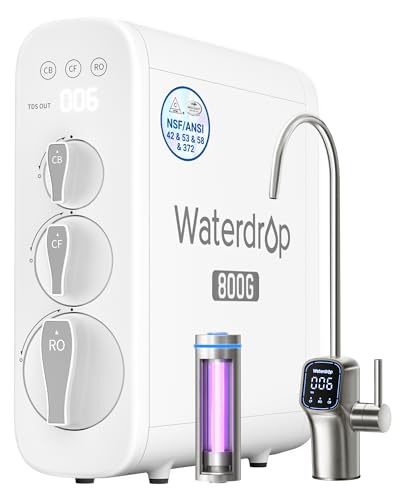
Tankless systems use a higher-output membrane and an electric booster pump to make water on demand. They save space and avoid stale tank water, but they need an electrical outlet under the sink, typically cost more up front and can have pricier replacement cartridges. Both styles depend on adequate incoming water pressure; units without a pump can underperform when household pressure is low. If the faucet trickles, checking pressure first is sensible, and the guide to a water pressure test walks through how.
What a Reverse Osmosis System Can Remove
RO is one of the broader-spectrum treatment technologies available for homes. According to the EPA WaterSense page on point-of-use RO systems, these units can potentially remove contaminants such as lead, volatile organic compounds (VOCs), PFAS, arsenic, bacteria and viruses. In practice, RO is commonly used to reduce:
- Total dissolved solids (TDS). The general measure of dissolved minerals and salts. Lower TDS is often what people notice as a cleaner taste.
- Lead and other metals. Lead usually enters drinking water from plumbing materials rather than the source water. The EPA’s lead in drinking water overview explains how corrosion of pipes, solder and fixtures contributes.
- Arsenic, nitrate and fluoride. Contaminants that ordinary carbon pitchers generally do not address well.
- Some radionuclides. Including certain forms of uranium and radium found naturally in some groundwater.
- Many PFAS compounds. A growing reason buyers consider RO.
Why Certification Claims Matter
The word “potentially” in the EPA’s description is doing real work. How much of a given contaminant a specific system reduces depends on its design, membrane, water pressure, temperature, the chemistry of the incoming water and how well it is maintained. A system that performs well on lead may not be certified for nitrate, and arsenic removal can depend on its chemical form in the water.
The useful habit is to read the product’s certified performance claims rather than the marketing copy. NSF/ANSI 58 is the industry standard specific to reverse osmosis drinking water systems, and certification bodies list which individual contaminant reduction claims a model has been tested for. WaterSense-labeled RO units must also be independently certified for any additional contaminants the manufacturer claims to remove. If a contaminant matters to you, confirm it is listed by name on the certification, not just implied by “removes up to 99%” language.
Best Reverse Osmosis Systems: our top 3 picks
| Product | Best for | Key features | Price | Buy |
|---|---|---|---|---|
| Waterdrop G3P800 | Best overall tankless system |
| $759.00as of Oct 30, 2026 6:23 am GMT+0000 | Buy now →Check current price |
| iSpring RCC7AK-BN | Best tank system with remineralization |
| $199.99as of Oct 30, 2026 6:23 am GMT+0000 | Buy now →Check current price |
| APEC ROES-50 | Best basic 5-stage tank system |
| $179.99as of Oct 30, 2026 6:23 am GMT+0000 | Buy now →Check current price |


Prices are Amazon’s listed prices as of the time shown and change often; check Amazon for today’s price. As an Amazon Associate we earn from qualifying purchases.
What RO Does Not Do Well
Reverse osmosis is effective, but it is not the right tool for every water problem, and some of its drawbacks are built into how it works.
Reject Water
Every RO system sends some water to the drain. The EPA notes that a typical point-of-use RO system generates five gallons or more of reject water for every gallon of treated water, and some inefficient units send up to 10 gallons down the drain. WaterSense-labeled models must use 2.3 gallons or less per gallon treated. For households on metered water, or for anyone on a well with limited yield, that ratio is worth checking before buying. Permeate pumps and higher-efficiency membranes can help.
It Strips Minerals
RO removes beneficial minerals such as calcium and magnesium along with the unwanted ones. Most people get these minerals mainly from food, so this is more of a taste issue than a health concern for many households, but some people find RO water flat. Remineralization filters are an option.
Slow Production and Low Flow
Membranes produce water slowly. Tank systems can run short during heavy use, such as filling large pots for canning, and the dedicated faucet typically flows more slowly than a standard kitchen tap.
Not a Disinfection Substitute for Contaminated Wells
Although RO membranes can reject bacteria and viruses, a home RO unit should not be treated as the fix for a well that tests positive for coliform bacteria. Membranes and seals can develop defects, storage tanks can harbor growth, and the unit only treats one tap, leaving showers and other faucets untreated. The EPA’s guidance for private well owners describes disinfection methods such as chlorine, ozone or ultraviolet light for bacteria problems and recommends contacting the local health department and retesting. Bacterial contamination also usually signals a well construction or surface-water problem that needs to be found and corrected.
Not a Whole-House Solution for Most Homes
Whole-house RO exists but is uncommon in residential settings because of cost, wastewater volume and the corrosive nature of very low-mineral water in metal plumbing. For most homes, RO serves drinking and cooking water only.
Test Your Water Before Buying
The most common mistake is buying treatment before knowing what is in the water. A certified laboratory test tells you which contaminants are present and at what levels, so you can choose equipment that targets real problems instead of hypothetical ones.
Homes on municipal water can start with the utility’s annual water quality report, then add a lab test at the tap if the house has older plumbing. Homes built before the mid-1980s, or with original galvanized supply lines, may have lead or corrosion issues that do not show up in the utility’s report; the guide to galvanized pipes covers what to look for.
Matching the Problem to the Equipment
- Chlorine taste, sediment or general aesthetics throughout the house: a whole-house water filter treats every tap and may be enough on its own.
- Hard water, scale and spotting: a water softener addresses hardness. Softening ahead of an RO unit can also extend membrane life, though softened water carries added sodium that RO then reduces.
- Lead concerns only: a certified point-of-use filter may be enough. The guide to a lead in water filter compares options, including RO.
- Arsenic, nitrate, uranium, high TDS or multiple contaminants: RO is often the practical point-of-use choice, ideally paired with a sediment or carbon prefilter suited to the water.
The EPA’s WaterSense program itself notes that RO is water-intensive and that, in some cases, filtration methods that use little or no water are sufficient. A test result is what tells you which group you are in.
Well Water on the Colorado Front Range
Many homes in unincorporated parts of the Front Range, including rural areas of Douglas, Elbert, El Paso, Jefferson, Boulder and Larimer counties, rely on private wells. Private wells are not regulated like public water systems, so testing and treatment are the owner’s responsibility.
The EPA’s private well guidance lists heavy metals such as arsenic, as well as radionuclides such as uranium and radium, among contaminants that can occur naturally in groundwater in some areas, along with nitrate from fertilizer, septic systems and animal waste. Granitic and mineralized geology in parts of Colorado means some wells may carry elevated uranium, arsenic or radon, while neighboring wells test clean. Results can vary from one well to the next, so a neighbor’s test is not a substitute for your own.
The EPA recommends testing private wells annually for total coliform bacteria, nitrates, total dissolved solids and pH, plus other contaminants suspected in the area. Local health departments can often say what is common in a given aquifer. The guide to well water testing covers sampling and which panels to request, and the guide to testing for radon in well water covers a contaminant that usually calls for aeration or carbon treatment rather than point-of-use RO.
For a well with elevated uranium or arsenic in drinking water, an under-sink RO unit certified for that contaminant is a common approach. For wells with iron, manganese or hardness, pretreatment usually comes first, because those minerals can foul a membrane quickly.
Maintenance: Filters, Membranes and Sanitizing
RO performance depends heavily on maintenance. Neglected prefilters let chlorine and sediment reach the membrane; a worn membrane lets more contaminants pass while the water may still taste fine.
Typical intervals, which vary by manufacturer and water quality:
- Sediment and carbon prefilters: often every 6 to 12 months.
- RO membrane: commonly every 2 to 5 years, sooner with hard, high-TDS or poorly prefiltered water. WaterSense-labeled systems must demonstrate a membrane life of at least one year.
- Carbon post-filter: often annually.
- Sanitizing: many manufacturers recommend sanitizing the system and tank when changing filters.
- Tank pressure: checking the tank’s air charge periodically helps maintain flow.
A handheld TDS meter is an inexpensive way to spot a declining membrane. Comparing tap TDS to RO TDS over time shows when rejection is slipping. A TDS reading does not identify specific contaminants, however, so periodic lab retesting is the more reliable check for lead, arsenic or nitrate.
Inspect the unit occasionally for drips at fittings and the drain saddle. Small leaks under a sink can go unnoticed for weeks and damage cabinet floors. A leak sensor in the cabinet is cheap insurance.
How Much Does a Reverse Osmosis System Cost?
Prices vary widely by brand, capacity, features and installer, so the figures below are general industry estimates rather than quotes.
- Basic under-sink tank systems: roughly $150 to $500 for the equipment.
- Tankless or higher-efficiency systems: often $400 to $1,200 or more.
- Professional installation: often a few hundred dollars, more if a new drain connection, refrigerator line or electrical outlet is needed.
- Dealer-installed systems: water treatment dealers sometimes bundle equipment and installation at higher prices, occasionally with financing or rental plans.
- Whole-house RO: typically several thousand dollars and up, plus pretreatment and storage.
- Ongoing costs: replacement filters and membranes commonly add up to around $50 to $200 or more per year, plus the water sent to the drain.
Questions to Ask Before Buying
- Which specific contaminants is this model certified to reduce, and to which standard?
- What is its waste-to-product ratio, and is it WaterSense labeled?
- What do replacement filters and membranes cost, and how often are they needed?
- Does it need a minimum water pressure or a booster pump?
- Is there a local installer or dealer who services it, and what does the warranty cover?
Be cautious with in-home sales demonstrations that rely on color-change or precipitation tests. Those demonstrations do not show whether the water meets health standards. A certified lab report is the right basis for a purchase decision.
Reverse Osmosis Systems and Home Inspections
A standard home inspection looks at visible plumbing, not water quality. An inspector may note that an RO unit is present, whether it leaks, how the drain line is connected and whether the dedicated faucet works, but evaluating performance or water chemistry falls outside a typical visual inspection. Buyers who want water quality answers usually order a separate lab test, and well properties often add a well flow and water quality evaluation during the inspection period.
If the home has an existing RO system, ask the seller for filter change records and the age of the membrane. A system with no maintenance history should be treated as needing new filters and possibly a new membrane. The guide to hiring a home inspector explains how to add water testing and other specialty evaluations without missing contract deadlines.
When to Call a Professional
A capable DIYer can install many under-sink RO units in an afternoon. Calling a plumber or water treatment professional makes more sense when the house has limited cabinet space, needs a new drain connection, has low water pressure, or when treatment needs to be designed around a well test showing several contaminants. For wells with bacteria, nitrate, uranium or arsenic, involve the local health department and plan follow-up testing after any treatment is installed.
References
- Point-of-Use Reverse Osmosis Systems — U.S. Environmental Protection Agency, WaterSense
- Potential Well Water Contaminants and Their Impacts — U.S. Environmental Protection Agency
- Protect Your Home’s Water — U.S. Environmental Protection Agency
- Basic Information About Lead in Drinking Water — U.S. Environmental Protection Agency
Frequently asked questions
What does a reverse osmosis system remove?
Reverse osmosis can reduce total dissolved solids and, depending on the model and its certifications, contaminants such as lead, arsenic, nitrate, fluoride, some radionuclides and many PFAS. Check the system's certified reduction claims for the specific contaminant you care about, since performance varies by design and water conditions.
How much water does reverse osmosis waste?
According to the EPA, a typical point-of-use RO system sends five gallons or more of reject water to the drain for each gallon of treated water, and some inefficient units send up to 10. WaterSense-labeled models must use 2.3 gallons or less per gallon treated.
Is reverse osmosis safe for well water with bacteria?
An RO unit should not be relied on as the fix for a well that tests positive for bacteria. EPA guidance points to disinfection methods such as chlorine or ultraviolet light, contacting the local health department and retesting. Finding and correcting the source of contamination matters too.
How often do RO filters and membranes need replacing?
Prefilters are commonly replaced every 6 to 12 months and membranes every 2 to 5 years, though intervals depend on the manufacturer and your water quality. Hard or high-TDS water can shorten membrane life, and a TDS meter can help show when performance is slipping.
How much does a reverse osmosis system cost?
Under-sink tank systems often cost roughly $150 to $500 for equipment, while tankless models commonly run $400 to $1,200 or more. Installation may add a few hundred dollars, and filters and membranes typically cost around $50 to $200 or more per year.
Buying a Front Range home on a private well, or curious what is really coming out of the kitchen tap? Reach out to our team and we can point you to a local inspector who can arrange water sampling alongside the home inspection.