Reverse Osmosis System Cost: Under-Sink to Whole-House

A typical reverse osmosis system cost for an under-sink drinking-water unit runs roughly $200 to $800 for the equipment and about $400 to $1,500 with professional installation, depending on the model and the plumbing involved. Whole-house reverse osmosis is a very different project, often costing $10,000 or more, and is usually reserved for wells or water with specific problems. Beyond the purchase price, homeowners should budget for replacement prefilters, postfilters and a membrane every few years, plus the extra water an RO unit sends to the drain. This guide explains what an RO system does and does not remove, breaks down each cost line, covers the factors that move quotes, the running costs, DIY versus hiring a plumber and how to compare bids fairly. All dollar figures are typical national ranges drawn from common retail and contractor pricing, not quotes; local labor rates and the specific product decide the final number.
Part of our Plumbing & Water guide — start there for the full picture →
Reverse Osmosis System Cost at a Glance
Most homeowners are pricing a point-of-use system that serves the kitchen sink and possibly a refrigerator. The table below shows how typical costs break down for that kind of installation, with whole-house and countertop options noted for comparison.
| Cost component | Typical range | What drives it |
|---|---|---|
| Equipment (under-sink RO) | About $200 to $800; premium tankless and smart units can exceed $1,000 | Number of stages, tank vs tankless, flow rate, certification, remineralization stage, faucet quality |
| Installation labor | Roughly $150 to $600 | Cabinet space, drain connection, countertop drilling, refrigerator or ice maker line, outlet for tankless units |
| Permits and extras | Usually $0 to a few hundred dollars | Air-gap faucet, booster or permeate pump, refrigerator line, local permit rules (rarely required for point-of-use) |
| Ongoing costs | Commonly $75 to $250 per year | Prefilter and postfilter changes, membrane replacement every few years, water sent to drain |
| Typical installed total (under-sink) | About $400 to $1,500 | All of the above |
| Whole-house RO (for comparison) | Often $10,000 to $20,000+ installed | Storage tank, repressurization pump, pretreatment, drain capacity, post-treatment |
Countertop RO units, which need no plumbing, typically sit in the same equipment band as mid-range under-sink systems and have almost no installation cost.
What a Reverse Osmosis System Removes
Knowing what the system is for keeps the purchase in proportion. The CDC explains that reverse osmosis systems push water “from a solution containing more substances (dirtier) through a filter to a solution containing fewer substances (cleaner),” and that the RO filter has a pore size of about 0.0001 micron. According to the CDC, RO removes parasites, bacteria and viruses and “will remove some types of chemicals from water, including lead, copper, chromium, chloride, and sodium (salt).” It may also reduce arsenic, fluoride, radium, sulfate, nitrate and other substances. The CDC adds a necessary caveat: “Check the system’s label for the specific chemicals it removes.”
That makes RO a strong fit for drinking and cooking water when a test shows a concern, or when a household simply wants lower dissolved solids and better taste. The EPA’s secondary standards guidance notes that non-conventional treatments like reverse osmosis “are effective for removal of chloride, total dissolved solids, and other inorganic substances,” while describing them as “fairly expensive technologies” at larger scale. That expense is one reason most homes treat only the water they drink rather than every gallon used for showers and laundry.
The CDC’s broader point applies before any spending: “If your tap water does not contain harmful chemicals or germs, you may not need a home water treatment system.” A test result is the cheapest piece of the project and the one that decides whether the rest is worthwhile.
Best Reverse Osmosis Systems: our top 3 picks
| Product | Best for | Key features | Price | Buy |
|---|---|---|---|---|
| Waterdrop G3P800 | Best overall tankless system |
| $849.00as of Nov 18, 2026 6:56 pm GMT+0000 | Buy now →Check current price |
| iSpring RCC7AK-BN | Best tank system with remineralization |
| $189.99as of Nov 18, 2026 6:56 pm GMT+0000 | Buy now →Check current price |
| APEC ROES-50 | Best basic 5-stage tank system |
| $179.99as of Nov 18, 2026 6:56 pm GMT+0000 | Buy now →Check current price |
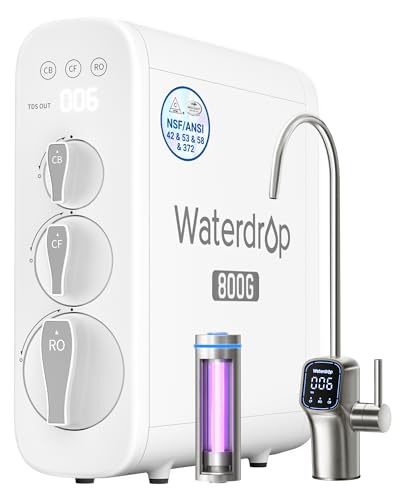


Prices are Amazon’s listed prices as of the time shown and change often; check Amazon for today’s price. As an Amazon Associate we earn from qualifying purchases.
Cost Breakdown in Detail
Equipment
Under-sink RO systems range from basic four- and five-stage units with a small storage tank to tankless designs with higher flow, digital filter-life indicators and app connectivity. Price typically rises with:
- Stages. Sediment and carbon prefilters, the RO membrane and a carbon postfilter are standard. Extra stages for remineralization, alkalinity or UV add cost.
- Tank vs tankless. Traditional systems store treated water in a small pressurized tank. Tankless units filter on demand at higher flow, usually need an outlet under the sink and cost more.
- Efficiency. Higher-efficiency designs and add-ons such as permeate pumps send less water to the drain per gallon produced.
- Certification. The CDC points out that NSF Standard 58 covers reverse osmosis systems and suggests checking a filter’s label and the NSF database to confirm what it is certified to remove. Certified systems are not always the most expensive, but they are the ones whose claims are independently backed.
For model comparisons once the budget is set, see our picks for the best reverse osmosis system and the more focused roundup of the best under-sink reverse osmosis system.
Installation labor
Point-of-use installation is a relatively small plumbing job, which is why labor is a modest share of the total. The installer connects a feed valve to the cold-water line, mounts the filter housings and tank, drills the countertop or sink for the dedicated faucet if needed and connects a drain saddle to the sink drain above the trap. Granite and quartz countertops may need a specialized drill bit, and some plumbers charge more for drilling stone. A refrigerator or ice maker connection adds tubing runs, and finished basements or long runs to an island raise the time involved.
Permits and extras
Permits are rarely required for a point-of-use RO system, though rules vary and a few jurisdictions want a permit for new drain connections or specify air-gap faucets. Common extras include:
- An air-gap faucet, which some local codes require to prevent backflow into the system
- A booster pump when household water pressure is low
- A permeate pump to improve efficiency and tank fill
- A refrigerator or ice maker line kit
- A sediment or iron prefilter on well water
- An outlet under the sink for tankless units
The Drivers That Move the Price
Capacity and output
RO systems are rated in gallons per day of treated water under test conditions. A household that drinks and cooks with a lot of filtered water, or that feeds a refrigerator and ice maker, needs more output and a larger tank or a tankless unit. Real output is often lower than the rating because it depends on water pressure, temperature and dissolved solids.
Type of system
- Countertop RO. No plumbing, easy for renters and the simplest to move. Lower capacity and counter space are the trade-offs.
- Under-sink tank systems. The most common and generally the most affordable plumbed option.
- Under-sink tankless systems. Higher flow and a smaller footprint at a higher equipment price.
- Whole-house RO. A large system with pretreatment, a storage tank and a repressurization pump. Usually justified only for specific well-water problems that other treatment cannot solve.
Water quality and pretreatment
Hard water, iron, sediment and chlorine all shorten the life of RO membranes and prefilters. Homes on very hard water may see faster membrane scaling, and some installers recommend a softener upstream or more frequent membrane changes. Well water may also need sediment or iron filtration before the RO unit. Pretreatment raises both installation and operating costs, but protects the more expensive membrane.
Plumbing and electrical work
Most under-sink installs need no electrical work. Tankless systems and booster pumps, however, require an outlet in the sink cabinet, and adding one where none exists brings in an electrician. Old or corroded shutoff valves under the sink often get replaced during installation, which is a small but common adder.
Front Range labor and water
Plumbing labor in the Denver, Boulder, Fort Collins and Colorado Springs areas has tended to run higher than many national averages, so local labor quotes may land toward the upper end of the ranges here. Water quality also varies widely. Many Front Range utilities deliver treated mountain water that already tests well, while private wells on the plains and in the foothills can show elevated hardness, dissolved solids, uranium or nitrates depending on local geology and land use. For homes on a public system, the CDC advises reviewing “the water quality report your utility must provide every year” before buying treatment equipment.
Ongoing and Running Costs
RO systems are inexpensive to buy compared with many home upgrades, but they require steady maintenance to keep working.
Filters and membranes
Sediment and carbon prefilters are commonly replaced every six to twelve months, and the RO membrane every two to five years, depending on water quality and use. Postfilters are typically changed annually. Annual filter costs for a typical under-sink system often fall in the range of roughly $50 to $150, with membrane replacements adding to that every few years. Proprietary cartridges on some premium systems cost more than standard-size filters. Our guide on how often to change reverse osmosis filters covers the schedule and the signs a change is overdue.
The CDC stresses that any filter must be maintained “to keep it working properly and prevent germs from growing in it,” including “regularly changing the filters according to the manufacturer’s recommendations.” It also suggests wearing gloves while changing filters and washing hands afterward.
Wastewater
RO systems send a stream of concentrated water to the drain as they produce treated water. The ratio varies widely by design and conditions; older or basic systems tend to send more water to the drain per gallon produced than newer high-efficiency units. For a household that uses RO only for drinking and cooking, the added water bill is usually small, but it becomes significant for whole-house systems.
Electricity and service
Tank systems use no electricity. Tankless units and booster pumps draw a small amount. Some households pay for annual service plans from dealers, which can be convenient but often cost more than buying filters and changing them at home.
Whole-House Reverse Osmosis: When the Higher Cost Makes Sense
Whole-house RO is a specialized solution. Because it treats every gallon entering the home, it needs pretreatment to protect the membranes, a storage tank, a repressurization pump and drain capacity for the reject water. It also strips minerals and disinfectant, which can make water more corrosive to plumbing and may require post-treatment. The CDC also cautions that if a whole-home filter “removes chlorine or other disinfectants, more germs may grow in your plumbing.”
It may be justified for a private well with a contaminant that affects water used throughout the home and that simpler treatment cannot address. For most households, a combination of a point-of-use RO unit for drinking water and, where needed, a softener or whole-house filter for scale and sediment costs far less and does the job. Our guide to the water softener installation process explains how a softener fits upstream of an RO system.
Is a Reverse Osmosis System Worth the Cost?
For many households, the comparison that matters is RO versus the alternatives they already pay for. A family that buys bottled water every week, or replaces pitcher filters constantly, may find that an under-sink RO system costs less over a few years while producing more treated water on demand. A household on good-quality city water that simply wants better taste may be equally happy with a certified carbon filter at a fraction of the price. The CDC notes that pitcher and refrigerator filters often use activated carbon whose “main purpose is to improve the taste and smell, rather than the safety, of water,” which is a useful benchmark for what a cheaper option will and will not do.
RO tends to earn its cost in a few situations:
- A test shows a contaminant RO is certified to reduce. Lead from older plumbing, high nitrate on a rural well or elevated dissolved solids are common examples.
- Private well water. The EPA advises testing private wells annually for total coliform bacteria, nitrates, total dissolved solids and pH, and testing for other contaminants if they are suspected. When results show a problem confined to drinking water concerns, point-of-use RO is often the most economical fix.
- Taste and scale complaints that carbon does not solve. Water high in dissolved minerals may taste flat or salty and leave residue in kettles and coffee makers.
If none of those apply, the money may be better spent elsewhere. A clear test result makes that decision straightforward rather than a judgment call made during a sales visit.
DIY vs Hiring a Plumber
Under-sink RO is one of the more DIY-friendly water treatment projects. Most systems ship with push-fit tubing, a feed valve adapter, a drain saddle and instructions. DIY can save the labor line entirely.
DIY is often realistic when
- The sink has a modern quarter-turn cold-water shutoff
- The sink already has a spare faucet hole, or the counter is laminate
- The cabinet has room for the tank and filters
- No refrigerator line or outlet work is needed
A plumber is worth the cost when
- Stone countertops need drilling
- Shutoff valves are old, stuck or corroded
- The refrigerator or island is far from the sink
- An outlet, booster pump or air gap is required
- The warranty requires professional installation
The most common DIY problem is a slow leak at a push-fit connection or drain saddle, which can damage a sink base cabinet before anyone notices. A small leak tray or water sensor under the sink is cheap insurance either way.
How to Get Fair Quotes
- Test the water first. For private wells, the CDC advises testing “at least once every year for total coliform bacteria, nitrates, total dissolved solids, and pH level,” and contacting the health department about local contaminants of concern. A test focuses the purchase on what actually needs removing.
- Decide where treated water is needed. Kitchen sink only, refrigerator too, or a second sink. This keeps quotes on the same scope.
- Get at least three written quotes. Include a licensed plumber and, if desired, a water treatment dealer.
- Ask for specifics. Brand and model, NSF/ANSI certifications, stage list, tank size or flow rate, faucet type, drain and air-gap details, refrigerator connection and any countertop drilling.
- Price the filters. Ask for the replacement cartridge part numbers and prices, and whether they are proprietary.
- Compare lifetime cost. Add five years of filters and at least one membrane to each installed price.
- Watch for scare tactics. In-home demonstrations that use TDS meters or color-change kits on city water can overstate problems. An independent lab result is a better basis for a purchase.
Our plumbing and water hiring hub covers broader contractor vetting.
What a Home Inspector Notes About RO Systems
A standard home inspection may note that a point-of-use RO system is present under the kitchen sink and look for visible leaks, kinked tubing or water damage in the cabinet. Inspectors generally do not test treated water or evaluate filter condition. Buyers who want to know whether an existing system is still effective can ask the sellers when filters and the membrane were last changed and budget for a full filter change after moving in.
If water quality is a question in a Front Range home you are buying, contact our team to discuss inspection and testing options.
More Questions About Reverse Osmosis Costs
How much does it cost to replace a reverse osmosis membrane?
Replacing a reverse osmosis membrane typically costs somewhere around $40 to $150 for the part on a standard under-sink system, according to industry estimates, with specialty or high-output membranes costing more. A plumber or water treatment service call to replace it often adds a service fee on top. Membranes usually last two to five years depending on water quality and prefilter maintenance. Replacing the sediment and carbon prefilters on schedule protects the membrane from chlorine and particles and is the cheapest way to stretch its life. A rising TDS reading signals that replacement is approaching.
Does a reverse osmosis system raise the water bill?
A reverse osmosis system does raise the water bill somewhat, because conventional systems send several gallons of reject water to the drain for each gallon of purified water produced. The actual cost depends on local water and sewer rates and household drinking-water use, and for an under-sink unit producing only drinking and cooking water it is usually modest. High-efficiency and tankless designs with permeate pumps or improved membranes waste considerably less. Whole-house RO systems waste much more water in absolute terms, which is one reason they cost so much more to run and are rarely the first choice.
Are cheaper reverse osmosis systems worth buying?
Lower-priced reverse osmosis systems can be worth buying if they carry certification to NSF/ANSI Standard 58 for the contaminants the household needs reduced and replacement filters are easy to find. Price differences usually come from tankless design, built-in pumps, smart monitoring, remineralization stages, and housing quality rather than basic filtration. Uncertified systems with vague claims are the real risk. Before buying, compare the annual filter cost, not just the purchase price, since a cheap system with expensive proprietary cartridges can cost more over five years than a mid-priced unit with standard filters.
Do landlords or renters pay for reverse osmosis systems?
Reverse osmosis systems are usually optional upgrades, so whoever wants one typically pays unless a lease or local rule says otherwise. Renters can often install a countertop RO unit or a faucet-mounted filter without permanent plumbing changes. Under-sink systems require drilling the sink or countertop for a dedicated faucet and tapping into the drain line, which needs landlord permission. Landlords sometimes install RO systems when a test shows a contaminant concern, such as elevated nitrate or arsenic in well water, and in that case regular filter changes should be written into the maintenance plan.
References
- About Home Water Treatment Systems — Centers for Disease Control and Prevention
- About Choosing Home Water Filters — Centers for Disease Control and Prevention
- Guidelines for Testing Well Water — Centers for Disease Control and Prevention
- Secondary Drinking Water Standards: Guidance for Nuisance Chemicals — U.S. Environmental Protection Agency
- Protect Your Home’s Water — U.S. Environmental Protection Agency
Frequently asked questions
How much does a reverse osmosis system cost installed?
A typical under-sink RO system costs about $400 to $1,500 installed, with equipment alone often around $200 to $800. Whole-house reverse osmosis is a much larger project that often runs $10,000 or more.
How much does it cost to maintain an RO system?
Typical upkeep runs roughly $75 to $250 per year for prefilters, postfilters and a share of membrane replacement every few years. Proprietary cartridges and poor water quality push costs higher.
What does reverse osmosis remove from water?
The CDC says RO removes parasites, bacteria and viruses and some chemicals such as lead, copper, chromium, chloride and sodium, and may reduce arsenic, fluoride, nitrate and others. Check the system's label and NSF certification for specific claims.
Can a homeowner install an under-sink RO system?
Often yes, especially with a modern shutoff valve, a spare faucet hole and room under the sink. Stone countertop drilling, refrigerator lines, outlets and old valves are good reasons to hire a plumber.
Is whole-house reverse osmosis worth it?
Usually only for specific well-water problems that affect all household water. Most homes are better served by point-of-use RO for drinking water plus a softener or whole-house filter where needed.
Can reverse osmosis be financed?
Some water treatment dealers offer financing or rental plans for reverse osmosis systems, particularly whole-house or bundled softener packages. Monthly rental can cost more over time than buying outright. Under-sink systems are usually inexpensive enough to purchase directly.
Do reverse osmosis systems need electricity?
Most basic under-sink reverse osmosis systems run on household water pressure and need no electricity. Tankless units, booster pumps, UV stages, and smart monitoring features require a nearby outlet. Adding an outlet under the sink can increase installation cost.
Is there a rebate for reverse osmosis systems?
Federal tax credits do not cover reverse osmosis systems. Some water utilities, health programs, or state agencies occasionally offer assistance for well owners facing specific contaminants such as arsenic or nitrate. Checking with the local health department or utility is the best route to any available help.
Questions about the water system in a Front Range home you are buying? Get in touch with our team to arrange an inspection.