Best Home Security Systems (2026): 7 Alarm Kits Compared

The best home security system is the one that matches how your house is laid out and who will respond when it goes off. A DIY alarm kit is a base station, a keypad and a set of door, window and motion sensors that report to an app. The real differences sit underneath: whether someone can watch it for you around the clock, whether it stays online when the Wi-Fi or power drops, and how many entry points the starter box actually covers. Below are seven alarm kits matched to specific homes and habits, followed by a buying guide that covers monitoring, sensor placement, backup power and where an alarm fits alongside smoke and CO protection. For a broader primer on the category, see our home security system guide.
Part of our Home Electrical guide — start there for the full picture →
As an Amazon Associate we earn from qualifying purchases.
How we compared: we compared 9 current Amazon listings for DIY alarm-system kits on what each listing states: what is in the box, how the system connects (Wi-Fi, cellular or both), whether professional monitoring is offered, backup power, keypad or screen type and voice-assistant support. The same search also returned three camera kits and a video doorbell; those are different products, covered in our camera and doorbell roundups, so they are not ranked here. We did not lab-test any of these systems or use them hands-on. Prices, plans and availability change often, so check the current listing and the provider’s terms before buying.
Quick picks: the best home security systems by use case
| Product | Best for | Key features | Price | Buy |
|---|---|---|---|---|
| SimpliSafe 8-Piece | Optional pro monitoring, no contract |
| $206.99as of Oct 19, 2026 8:59 pm GMT+0000 | Buy now →Check current price |
| Ring Alarm 14-Piece | 2 to 4 bedroom homes |
| $329.99as of Oct 19, 2026 8:59 pm GMT+0000 | Buy now →Check current price |
| Ring Alarm 8-Piece | Apartments and 1 to 2 bedrooms |
| $249.99as of Oct 19, 2026 8:58 pm GMT+0000 | Buy now →Check current price |
| PGST 12-Piece | No-fee kit with cellular failover |
| $54.89as of Oct 19, 2026 8:59 pm GMT+0000 | Buy now →Check current price |
| Hapippofa 24-Piece | Long power outages |
| $139.99as of Oct 19, 2026 8:59 pm GMT+0000 | Buy now →Check current price |
| RenseCum 24-Piece | Touchscreen for all ages |
| $142.19as of Oct 19, 2026 8:59 pm GMT+0000 | Buy now →Check current price |
| tolviviov 15-Piece | Lots of doors and windows |
| $92.85as of Oct 19, 2026 8:59 pm GMT+0000 | Buy now →Check current price |
Prices are Amazon’s listed prices as of the time shown and change often; check Amazon for today’s price. As an Amazon Associate we earn from qualifying purchases.
The seven picks, compared listing by listing
1. SimpliSafe 8-Piece — Best for Optional Professional Monitoring

No-wiring alarm kit with optional no-contract monitoring, pet-tolerant motion sensing and a panic button.
Check price on Amazon$206.99 as of Oct 19, 2026 8:59 pm GMT+0000 — prices change; see Amazon for current price.Why we like it
- Professional monitoring is optional and contract-free
- Motion sensor states range, angle and pet tolerance
- Secret Alerts flag private areas without a siren
- Works with both Alexa and Google Assistant
| Specification | Details |
|---|---|
| Kit contents | 8 pieces including base station, wireless keypad, entry sensors, motion sensor and panic button (exact split not itemized) |
| Motion sensing | About 35 ft range, 90-degree field of view, tolerant of pets under 60 lb |
| Monitoring | Optional 24/7 professional monitoring, no long-term contract; one free month included |
| Voice support | Amazon Alexa and Google Assistant |
| Installation | Plug-in base station, no wiring or drilling |
| Warranty | 1-year limited; extensions available with a monitoring plan |
SimpliSafe 8-piece — plug-in base, wireless keypad, entry + motion sensors, panic button, optional no-contract monitoring, 1-yr warranty
The Only Kit Here That Spells Out Pet-Tolerant Motion Sensing
All nine alarm-kit listings include at least one motion detector, but only this SimpliSafe listing says how its motion sensor treats pets: it is meant to ignore animals under 60 pounds, with roughly 35 feet of range and a 90-degree view when placed in a room corner. False alarms from a dog or cat are one of the main reasons people stop arming a system, so that one line matters more than the piece count.
SimpliSafe also sits in the small group with true professional monitoring. Three listings (this one and the two Ring kits) describe an optional paid plan where an agent can dispatch police; a fourth, PGST’s 12-piece kit, mentions 24/7 professional monitoring but also says there are no monthly charges, which is unclear enough that we would confirm it with the seller. SimpliSafe is explicit that its plan has no long-term contract and that the panic button’s police dispatch depends on that subscription.
The listing is Wi-Fi and plan dependent in ways it does not fully explain. It does not say whether the base station has a battery backup or cellular connection on its own, and it does not itemize how many entry sensors are in the eight pieces. The warranty is one year unless you add monitoring.
Pros
- Only listing stating pet-tolerant motion sensing
- Contract-free professional monitoring option
- Silent panic and Secret Alerts options
- Alexa and Google voice support
Cons
- Panic-button dispatch requires a paid plan
- Exact sensor split not listed
- Base-station backup power not stated
Check SimpliSafe 8-Piece price on Amazon
2. Ring Alarm 14-Piece — Best for 2 to 4 Bedroom Homes

Base station, two keypads, eight contact sensors, two motion detectors and a range extender, with optional monitoring.
Check price on Amazon$329.99 as of Oct 19, 2026 8:59 pm GMT+0000 — prices change; see Amazon for current price.Why we like it
- Only kit here with two keypads
- Eight contact sensors cover most entry doors
- Range extender helps in long or split-level homes
- Ties into other Ring cameras and doorbells
| Specification | Details |
|---|---|
| Kit contents | 1 base station, 2 keypads, 8 contact sensors, 2 motion detectors, 1 range extender |
| Sized for | 2 to 4 bedroom homes, per the listing |
| Alerts | Mobile notifications through the Ring app at no added cost |
| Ring Protect plan | Sold separately; adds remote arming, staying online if Wi-Fi drops and 24/7 professional monitoring for police, fire and medical |
| Voice | Alexa arm/disarm with a Ring Protect subscription |
| Model | 5AT2S7 (part 53-027054) |
Ring Alarm 14-piece — base, 2 keypads, 8 contact, 2 motion, range extender, app alerts, optional Ring Protect monitoring
The Only Kit Here That Ships With Two Keypads
Seven of the nine listings mention a keypad, and this is the only one that includes two. A second keypad by the garage or back door means the household can disarm at whichever door it actually uses, which cuts down on entry-delay false alarms. Eight contact sensors is also a realistic count for a mid-size house: front door, back door, garage entry and a handful of ground-floor windows.
The range extender is easy to overlook. Of the nine kits, only the two Ring kits list one, and it helps sensors at the far end of a ranch or in a walk-out basement reach the base station reliably.
The trade-off is the subscription line. Without a Ring Protect plan, the listing says you still get app notifications, but remote arming, Alexa voice arming, cellular-style continuity when Wi-Fi goes down and professional monitoring all sit behind the paid plan. The listing does not state the base station’s own battery runtime.
Pros
- Two keypads for two main entrances
- Generous sensor count for mid-size homes
- Range extender included
- Optional professional monitoring
Cons
- Many features need a Ring Protect plan
- Alexa voice arming needs the subscription
- Battery backup runtime not stated
Check Ring Alarm 14-Piece price on Amazon
3. Ring Alarm 8-Piece — Best for Apartments and Small Homes

Compact Ring kit with base, keypad, four contact sensors, one motion detector and a range extender.
Check price on Amazon$249.99 as of Oct 19, 2026 8:58 pm GMT+0000 — prices change; see Amazon for current price.Why we like it
- Right-sized for one or two bedrooms
- Includes a range extender despite the small kit
- Same app and add-on sensors as larger Ring kits
- Optional monitoring when you want it
| Specification | Details |
|---|---|
| Kit contents | 1 base station, 1 keypad, 4 contact sensors, 1 motion detector, 1 range extender |
| Sized for | 1 to 2 bedroom homes, per the listing |
| Alerts | Ring app mobile notifications |
| Monitoring | Optional through a Ring Protect plan, sold separately |
| Expansion | Additional sensors and accessories sold separately |
| Generation | 2nd Gen (part 53-023733) |
Ring Alarm 8-piece (2nd Gen) — base, keypad, 4 contact, 1 motion, range extender, optional monitoring
The Smallest Kit Here Sized by Its Maker
Three listings give a bedroom-count recommendation: Ring sizes this kit for 1 to 2 bedrooms and the 14-piece for 2 to 4, and PGST sizes its 12-piece for 3 to 5. This 8-piece kit is the one aimed at a condo, apartment or small bungalow, where four contact sensors cover the entry door, a patio door and a couple of accessible windows.
Starting small is reasonable because the listing says every sensor type can be added later. That is a better path than buying a 24-piece kit and leaving half of it in the box. It also keeps the household in one app with any Ring doorbell or camera already in use.
The same caveats as the larger Ring kit apply: remote arming, voice arming and monitoring sit behind the paid plan, and a single motion detector covers only one room or hallway.
Pros
- Right-sized for small homes
- Range extender included
- Easy to expand sensor by sensor
Cons
- Only one motion detector
- Key features need a subscription
- Battery backup details not stated
Check Ring Alarm 8-Piece price on Amazon
4. PGST 12-Piece — Best No-Fee Kit With Cellular Failover
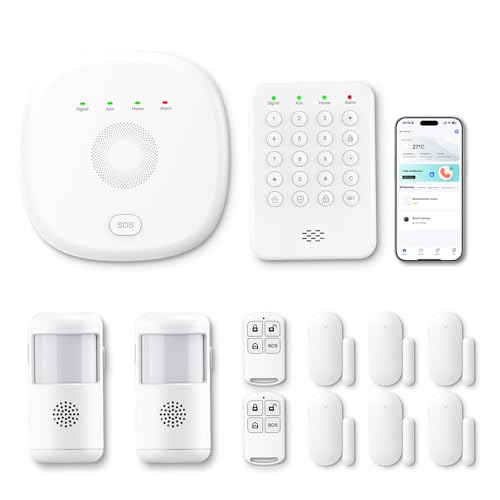
Wi-Fi plus 4G alarm kit with keypad modes, two motion detectors and app control through Smart Life or Tuya.
Check price on Amazon$54.89 as of Oct 19, 2026 8:59 pm GMT+0000 — prices change; see Amazon for current price.Why we like it
- Switches to 4G when Wi-Fi drops
- Stay, away and emergency modes on the keypad
- No subscription needed for app features
- Can add PGST cameras later
| Specification | Details |
|---|---|
| Kit contents | 1 base station, 1 keypad, 4 door/window sensors, 2 motion detectors, 2 remotes, mounting hardware and power adapter |
| Connectivity | 2.4 GHz Wi-Fi and 4G; automatic switch to 4G when Wi-Fi disconnects (SIM not described as included) |
| App | Smart Life or Tuya; mobile notifications |
| Modes | Stay, away and emergency set from the keypad |
| Monitoring claim | Listing states 24/7 professional monitoring and no monthly charges; confirm terms with seller |
| Model / warranty | A04-US-I; warranty listed as 2 |
PGST A04-US-I — Wi-Fi + 4G, keypad, 4 door/window, 2 motion, 2 remotes, Smart Life/Tuya, Alexa
A Mid-Size No-Fee Kit With a Stated Wi-Fi-to-4G Switchover
Five of the nine listings describe a cellular path (GSM or 4G) alongside Wi-Fi: both PGST kits, Hapippofa, RenseCum and DEEPVIGLX. That matters because a burglar who cuts a cable line, or a winter outage that takes the router down, can silence a Wi-Fi-only system. This 12-piece kit is the mid-size option in that group, and its listing states that it switches to 4G automatically when Wi-Fi drops. Plan on buying and activating a SIM; the listing does not say one is included.
The listing sizes it for 3 to 5 bedrooms, but four door and window sensors will not cover that many openings, so most larger homes will add sensors. The keypad modes are useful in practice: stay mode arms perimeter sensors while people move around inside.
The wording on monitoring needs care. The listing says the system provides 24/7 professional monitoring and, in the same breath, that there are no subscriptions. Treat this as a self-monitored system with app alerts unless the seller confirms a staffed monitoring service in writing.
Pros
- Wi-Fi plus 4G failover stated
- No monthly fee for app features
- Useful stay and away keypad modes
Cons
- Monitoring claim is ambiguous
- Only four door/window sensors for a large home
- SIM card and plan not described
Check PGST 12-Piece price on Amazon
5. Hapippofa 24-Piece — Best for Long Power Outages

Wi-Fi plus 4G alarm kit with a hub battery rated up to 48 hours, 10 door sensors and 5 motion detectors.
Check price on Amazon$139.99 as of Oct 19, 2026 8:59 pm GMT+0000 — prices change; see Amazon for current price.Why we like it
- Longest stated hub backup: up to 48 hours
- Five motion detectors, the most in any kit here
- Anti-tamper switch on the back of the hub
- 4G backup path when Wi-Fi fails
| Specification | Details |
|---|---|
| Kit contents | Hub with keypad, 10 door/window sensors, 5 motion detectors, siren and accessories (24 pieces total) |
| Backup power | Built-in rechargeable battery, up to 48 hours during an outage |
| Connectivity | 2.4 GHz Wi-Fi with 4G SIM backup (SIM not included) |
| Motion sensors | 110-degree view, about 12 m (39 ft) range |
| Siren / tamper | 120 dB siren; physical anti-removal switch on hub |
| Model | P-108F-US-F |
Hapippofa P-108F — Wi-Fi + 4G, 48-hr hub battery, 10 door/window, 5 motion, 120 dB, anti-tamper, Smart Life/Tuya
The Longest Stated Backup Battery on the Shelf
Only two of the nine listings give any backup-battery runtime for the hub. The tolviviov kit states 8 hours; this Hapippofa kit states up to 48 hours. The Ring and SimpliSafe listings do not give a number. For foothills and plains homes where wind events and winter storms can knock power out overnight, a hub that keeps running for two days, paired with a cellular path, is the most outage-tolerant combination on this shelf.
The sensor count is generous too. Ten door and window contacts plus five motion detectors is the largest motion-sensor count of any kit here, enough for a two-story home with a finished basement. The hub also has a back-mounted tamper switch, one of two listings (with PGST’s 24-piece kit) that describe one.
What the listing leaves out: there is no professional monitoring option, the SIM card is not included, and the brand has no long track record compared with Ring or SimpliSafe. The rechargeable backup battery type and replacement process are not described.
Pros
- Up to 48-hour hub backup stated
- Five motion detectors included
- Tamper switch and 4G backup
- No monthly fee
Cons
- No professional monitoring option
- SIM card not included
- Backup battery type not stated
Check Hapippofa 24-Piece price on Amazon
6. RenseCum 24-Piece — Best Touchscreen Panel for All Ages

Wi-Fi and 4G alarm with a 4.3-inch color touchscreen, pre-paired sensors and SOS buttons.
Check price on Amazon$142.19 as of Oct 19, 2026 8:59 pm GMT+0000 — prices change; see Amazon for current price.Why we like it
- Largest screen here at 4.3 inches
- Accessories arrive pre-paired to the hub
- SOS on hub, remote and separate button
- Alerts by app, SMS or voice call
| Specification | Details |
|---|---|
| Control panel | 4.3-inch color touchscreen showing status, time and alerts; multi-language menu |
| Connectivity | 2.4 GHz Wi-Fi plus 2G/4G (GSM card needed for SMS and calls) |
| Alerts | Push notifications, SMS or phone call |
| Kit | 24 pieces; exact sensor split not itemized |
| Setup | Factory pre-paired accessories |
| Support | 1-year after-sales support stated |
RenseCum A107F — 4.3-in touchscreen, Wi-Fi + 4G, SOS buttons, pre-paired, Smart Life/Tuya, Alexa
The Largest Control Screen of the Nine Kits
Two listings describe a screen on the control panel instead of a basic keypad: the DEEPVIGLX kit with a 2.4-inch display and this RenseCum kit with a 4.3-inch color touchscreen. For a household with older parents or young kids, a large “Arm” and “Disarm” target is easier than remembering a code sequence on small rubber buttons.
Three listings describe an SOS or panic function (SimpliSafe, PGST’s 24-piece and this one). RenseCum puts it in three places: the base, the remote and a separate button. That can be useful for an aging-in-place setup, but note that a local siren and a text to a family member are not the same as a monitored medical alert service.
The listing does not itemize how many door versus motion sensors are in the 24 pieces, and the 1-year promise is described as “after-sales support” rather than a formal warranty. A GSM-capable SIM is needed for text and call alerts.
Pros
- Big, simple touchscreen panel
- Pre-paired sensors speed setup
- App, SMS and call alerts
Cons
- Sensor mix not itemized
- Support promise, not a stated warranty
- No professional monitoring
Check RenseCum 24-Piece price on Amazon
7. tolviviov 15-Piece — Best for Homes With Many Doors and Windows

Wi-Fi alarm kit with ten door sensors, a 120 dB siren, an 8-hour backup battery and room to grow to 20 sensors.
Check price on Amazon$92.85 as of Oct 19, 2026 8:59 pm GMT+0000 — prices change; see Amazon for current price.Why we like it
- Ten door sensors right out of the box
- Only listing that states a sensor ceiling
- 8-hour backup battery stated
- No subscription for app alerts
| Specification | Details |
|---|---|
| Kit contents | 1 Wi-Fi base station, 1 keypad, 1 motion sensor, 10 door sensors, 2 remotes |
| Expansion limit | Up to 20 sensors and 5 remotes or keypads |
| Siren | 120 dB |
| Backup power | 8-hour backup battery |
| Connectivity | 2.4 GHz Wi-Fi only; 5 GHz not supported; no cellular described |
| Model | Dp-w2 |
tolviviov Dp-w2 — Wi-Fi only, 10 door + 1 motion sensor, keypad, 2 remotes, 120 dB, 8-hr backup, expands to 20 sensors
The Only Listing That States How Far the System Can Expand
Several listings say their systems are expandable, but this is the only one that gives a ceiling: 20 sensors and 5 remotes or keypads per base station. Ten door sensors are already in the box, tied with Hapippofa for the most entry contacts on the shelf. For a house with lots of ground-floor windows, a sliding door and a garage entry, that is an efficient starting point.
The weakness is a single motion sensor and Wi-Fi-only connectivity. If the router or power goes down for more than the stated 8 hours, alerts stop reaching your phone. There is no cellular fallback and no professional monitoring option.
Think of this kit as a strong perimeter system for a household that is usually nearby to respond, rather than a set-and-forget solution for a cabin that sits empty for weeks.
Pros
- Ten door sensors included
- Stated expansion to 20 sensors
- 8-hour backup battery
Cons
- Only one motion sensor
- Wi-Fi only, no cellular path
- No monitoring option
- 2.4 GHz network required
Check tolviviov 15-Piece price on Amazon
Professional monitoring vs self-monitoring
The biggest decision is not which box to buy but who responds. On this shelf, the split is clear: the Ring and SimpliSafe kits offer optional paid plans with staffed 24/7 monitoring that can contact police, while the five no-fee kits (PGST, Hapippofa, RenseCum, tolviviov and DEEPVIGLX) send alerts to your phone, by text or by voice call, and leave the next step to you.
When self-monitoring works
Self-monitoring suits households that are usually within reach of their phones, live in a dense neighborhood where someone can check quickly, and mainly want a deterrent siren and a record of door openings. It is also the cheapest long-term option because there is no plan to pay.
When paid monitoring is worth it
Monitoring earns its keep when nobody would see an alert in time: frequent travel, a second home in the mountains, elderly parents living alone or a rental between tenants. Read the plan terms for what triggers a dispatch, whether there is a contract and whether fire, medical and CO events are covered. Ring’s listing says its plan covers police, fire and medical response; SimpliSafe’s says agents alert emergency responders.
Cellular backup and the router problem
A Wi-Fi-only system depends on your router and your internet provider. Five listings here describe a cellular path that takes over automatically, and Ring describes keeping the system online if Wi-Fi goes down as part of its paid plan. For a house that sits empty, a cellular path is one of the most important specs on the box, and the SIM and data plan are a recurring cost to factor in even with a “no monthly fee” kit.
How many sensors does your house need?
Start with the doors. Every exterior door, including the door from an attached garage, should get a contact sensor. Then add ground-floor and walk-out basement windows that someone could reach from outside, and any sliding glass doors. Motion detectors cover the interior paths an intruder would have to take, such as the main hallway or the foot of the stairs, which is why a single motion sensor in a large home leaves gaps.
Count your openings before you shop and compare against what is actually in the box, not the piece count. A 24-piece kit includes remotes, stickers and mounting parts in that total. The listings that itemize contents (both Ring kits, PGST’s 12-piece, tolviviov and Hapippofa) are the easiest to plan around.
- Small apartment: entry door, patio door, one motion sensor; 4 contacts is usually enough.
- Typical 3-bedroom ranch: 3 exterior doors plus 4 to 6 accessible windows, 1 to 2 motion sensors.
- Two-story with walk-out basement: add basement doors and windows, plus a motion sensor on each level.
Homes that already have intercom wiring or a dated hardwired panel have other options; our guide to an intercom system covers how those older low-voltage systems are usually laid out.
Power, batteries and outages
Every system here runs from a plug-in power adapter at the base and batteries in the sensors. When the power goes out, the base station either keeps going on its internal battery or stops. Only two listings state a runtime: 8 hours for tolviviov and up to 48 hours for Hapippofa. If backup runtime matters to you, ask the manufacturer before buying a kit that does not state it.
Backup batteries in hubs and sensors are typically rechargeable or lithium cells, and they need the same care as any household battery. The U.S. Fire Administration advises stopping use of a lithium-ion battery that shows an odor, change in color or shape, too much heat, leaking or odd noises, and not putting lithium-ion batteries in the trash, as its battery fire safety guidance explains. Mount the base station where it will not sit in direct sun or above a heat register.
Smart-home hubs can do more than security. The ENERGY STAR program notes that smart products can be managed remotely, run on schedules and send alerts, and that smart security can be added to a certified smart home energy management package, as described on its smart home tips page. Several kits here pair with Alexa routines that can switch lights when the system is armed.
Security alarms are not smoke or CO alarms
None of the nine listings describe a smoke or carbon monoxide sensor in the box. Ring’s monitoring plan mentions fire response, but that depends on adding compatible sensors, and a burglar alarm kit alone does not meet smoke-alarm requirements. The U.S. Fire Administration recommends smoke alarms in every bedroom, outside each separate sleeping area and on every level, including the basement, and recommends interconnected alarms so that when one sounds they all sound, per its smoke alarm guidance.
Keep the life-safety layer separate and complete first, then add intrusion protection. If gas appliances or a propane tank are part of the house, a dedicated detector is a separate purchase; our gas leak detection system guide explains the options.
Installation, wiring and privacy
All seven picks are wireless DIY kits: sensors stick or screw on, and the base plugs into an outlet. No electrical work is needed. The situation changes when you are removing an old hardwired panel, adding a hardwired siren or running new low-voltage cable through walls. The NFPA advises having electrical work done by a qualified electrician, and says that when buying or remodeling a home it should be inspected by a qualified private inspector or according to local requirements, per its electrical safety guidance. Our guide to hiring for electrical work walks through what to ask.
For privacy and account security, use a unique password on the app account, turn on two-factor sign-in if the app offers it, and keep the hub’s firmware updated. Shared access, which several listings describe, should go only to people who need to arm and disarm. Keypad codes deserve the same care as a house key.
Front Range notes
Denver-area homes see long winter outages during wind and snow events, and foothills properties often have weaker cell coverage. Before you pick a cellular-backup kit, check signal strength at the spot where the base station will sit. Garage entry doors and walk-out basement doors are the openings most often left without a sensor in the ranches and split-levels common across Jefferson, Arapahoe and Douglas counties.
Attached garages also expose sensors to temperature swings. Adhesive mounts can let go in a cold garage, so screw-mount sensors where the listing includes hardware.
When to bring in a professional
A DIY kit is the right answer for most renters and owners. Bring in a pro when the house has an existing hardwired alarm panel you want to remove or reuse, when you are adding hardwired sirens or cameras that need new circuits, or when the system needs to tie into fire alarms. If you are buying a home, an inspection is a good time to check whether the existing smoke and CO alarms, exterior lighting and door hardware support the security setup you have in mind. For more on choosing who to hire, see our hiring process hub, or contact us to be connected with a vetted Front Range inspector.
Frequently asked questions
What is the best home security system for most homes?
For most homes, a DIY alarm kit with enough contact sensors for every exterior door, at least one motion detector per level and an optional monitoring plan is the best starting point. On this shelf, SimpliSafe and Ring offer optional professional monitoring, while several no-fee kits add cellular backup and send alerts to your phone.
Do I need professional monitoring?
Not always. Self-monitoring works when someone is usually able to check an alert quickly. Professional monitoring is worth considering for frequent travelers, second homes, vacant rentals and older adults living alone, because staff can contact responders when you cannot.
Will a wireless security system work during a power outage?
Only if the base station has a backup battery, and runtime varies. Two listings here state a number: 8 hours for one kit and up to 48 hours for another. Wi-Fi-only systems also stop sending alerts when the router loses power, so a cellular backup path matters for long outages.
Does a home security system replace smoke and CO alarms?
No. None of the alarm kits compared here include smoke or carbon monoxide sensors in the box. The U.S. Fire Administration recommends smoke alarms in every bedroom, outside each sleeping area and on every level, and interconnected alarms are best.
How many sensors does a home security system need?
Plan on a contact sensor for every exterior door, including the garage entry door, plus ground-floor and basement windows someone could reach. Add a motion detector on each main level. Count your openings before buying and compare that to what is itemized in the kit, not the total piece count.
References
- Smoke Alarms — U.S. Fire Administration
- Battery Fire Safety — U.S. Fire Administration
- Electrical Safety in the Home — National Fire Protection Association
- Smart Home Tips for Saving Energy — ENERGY STAR