Best Countertop Water Filters (2026): 6 Picks Compared
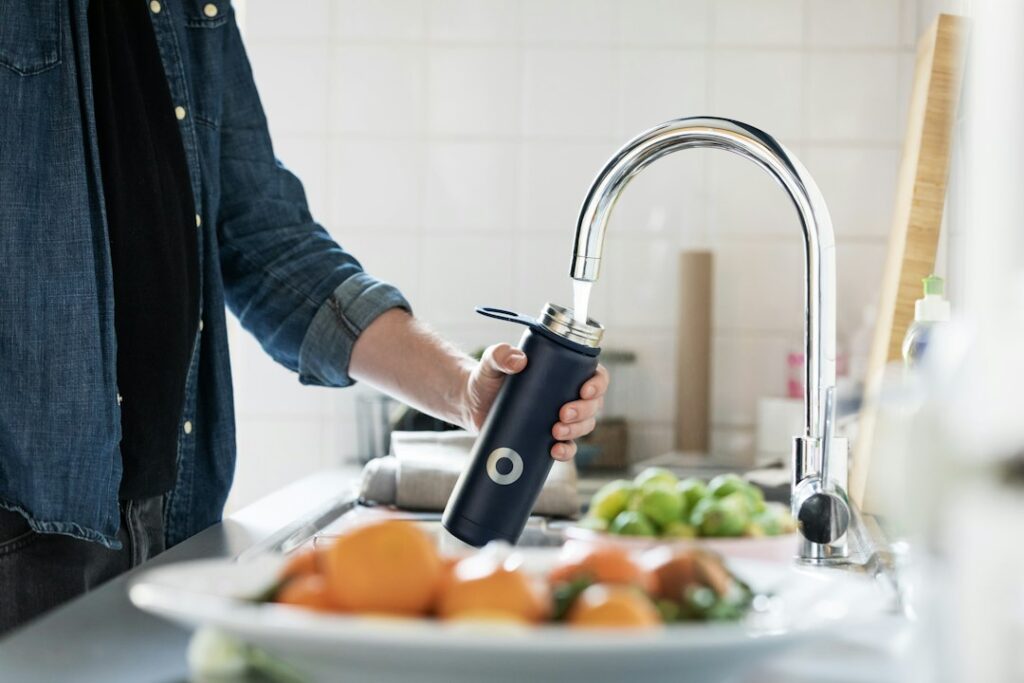
The best countertop water filter is the right choice when you cannot or do not want to touch the plumbing: renters, condo owners, anyone with a cramped sink cabinet, or a household that wants filtered water without drilling a hole. Countertop units come in four very different shapes: plug-in reverse osmosis machines that you fill by hand, plug-in carbon dispensers, faucet-fed units that divert water through a tube, and gravity systems with no power at all. Picking among them is mostly about what your water needs and how much counter you can give up. For a wider look that includes pitchers, refrigerator cartridges and whole-house systems, our main best water filter guide covers every type.
Part of our Plumbing & Water guide — start there for the full picture →
As an Amazon Associate we earn from qualifying purchases.
How we compared: we compared 12 current Amazon listings for countertop filters, covering 10 distinct products once color and size variants are grouped. We read what each listing states about certifications and certifiers, filtration method, filter life, tank or reservoir size, power and plumbing needs, and wastewater. We did not lab-test or use any of these units. Prices and availability change, so check the live listing.
Quick picks: the best countertop water filters by use case
| Product | Best for | Key features | Price | Buy |
|---|---|---|---|---|
| Ninja HydraSense WF1001WH1 | Best overall, most named certifications |
| $249.99as of Oct 19, 2026 8:58 pm GMT+0000 | Buy now →Check current price |
| AquaTru Carafe | Countertop RO with a glass carafe |
| — | Buy now →Check current price |
| Bluevua ROPOT-UV | RO with UV and remineralization |
| $409.00as of Oct 19, 2026 11:14 pm GMT+0000 | Buy now →Check current price |
| DREO 113 (5L) | Larger households, RO |
| $199.99as of Oct 19, 2026 11:14 pm GMT+0000 | Buy now →Check current price |
| Waterdrop CTF-01 | Faucet-fed, no electricity |
| $59.99as of Oct 19, 2026 11:14 pm GMT+0000 | Buy now →Check current price |
| Purewell PW-OB | Gravity, no power or plumbing |
| $108.99as of Oct 19, 2026 8:58 pm GMT+0000 | Buy now →Check current price |
Prices are Amazon’s listed prices as of the time shown and change often; check Amazon for today’s price. As an Amazon Associate we earn from qualifying purchases.
The six picks, compared listing by listing
1. Ninja HydraSense WF1001WH1 — Best Overall Countertop Filter for Named Certifications

Plug-in countertop dispenser certified by IAPMO R&T to NSF/ANSI 42, 53 and 401, with a 96 oz reservoir.
Check price on Amazon$249.99 as of Oct 19, 2026 8:58 pm GMT+0000 — prices change; see Amazon for current price.Why we like it
- Only listing naming NSF/ANSI 42, 53 and 401 together
- Certifier named: IAPMO R&T
- No wastewater, unlike the RO units
- Touchscreen tracks actual usage against filter life
| Specification | Details |
|---|---|
| Filtration | Filter cartridge; method not detailed beyond “advanced filtration” in listing |
| Certifications named | NSF/ANSI 42, 53 and 401, independently certified by IAPMO R&T; PFAS under NSF 53 (7-PFAS mixture) |
| Filter life | About 120 gallons or two replacements per year |
| Reservoir | 96 oz; recirculate cycle chills water when ice is added |
| Power / plumbing | Plugs into an outlet; no installation or plumbing |
| Size / weight | About 13.8 x 14.4 x 5.1 in; 6.6 lb; 1-year warranty |
Ninja WF1001WH1 — plug-in dispenser, NSF/ANSI 42 + 53 + 401 (IAPMO R&T), 96 oz reservoir, about 120 gal per filter, no wastewater
The Only Countertop Listing That Names Health-Contaminant Certifications With a Certifier
Of the 12 countertop listings, the Ninja is the only one that names NSF/ANSI 53, the standard for health-related contaminants such as lead, and NSF/ANSI 401 for emerging contaminants, along with 42 for taste and odor. It also names the body that certified it, IAPMO R&T, and points readers to a performance data sheet. Most other listings here use looser wording. The four DREO listings say their RO units were “tested by SGS meeting NSF/ANSI 58 Standards,” and the AquaTru says it is certified to “NSF standards” by IAPMO without listing which ones.
The listing ties its PFAS claim to NSF Standard 53’s 7-PFAS mixture, which is more specific than the “PFOA, PFOS” language elsewhere on the shelf. The CDC suggests looking up any filter in the certifier’s database to confirm what it is actually certified to reduce; with a standard and certifier named, the Ninja makes that lookup easy.
The trade-offs are capacity and method. At 120 gallons per filter, it is closer to a large pitcher than a plumbed system, and the listing does not explain the filtration media. It is not reverse osmosis, so it will not lower dissolved solids the way the RO units below do. The upside is zero wastewater and a footprint narrower than any RO machine here. The comparison to a “leading brand” pitcher in the listing is marketing; judge it on the named certifications instead.
Pros
- NSF/ANSI 42, 53 and 401 with the certifier named
- No drain water and no plumbing
- Usage-based filter tracking on a touchscreen
Cons
- 120 gallons per filter is modest
- Not RO, so TDS stays roughly the same
- Filter media not described in listing
Check Ninja HydraSense WF1001WH1 price on Amazon
2. AquaTru Carafe (AT100) — Best Countertop Reverse Osmosis With a Glass Carafe

Four-stage countertop reverse osmosis unit that dispenses into a removable glass carafe; no plumbing needed.
Check price on AmazonWhy we like it
- True RO with a separate VOC carbon stage
- Each stage has a stated gallon and month life
- Glass carafe instead of a plastic pitcher
- 30-day money-back plus 1-year warranty
| Specification | Details |
|---|---|
| Filtration | Four stages: pre/carbon, reverse osmosis, VOC carbon |
| Certifications named | Tested and certified to NSF standards by IAPMO; specific standards not named in listing |
| Filter life | Pre/carbon 6 months or 300 gal; RO 1 year or 600 gal; VOC 1 year or 300 gal |
| Claims | Reduces microplastics, fluoride, chromium-6, arsenic, PFOA and PFOS, among 84 contaminants |
| Power / plumbing | Standard outlet; fill tank by hand |
| Wastewater ratio | Not stated in listing |
AquaTru Carafe AT100 — 4-stage countertop RO, glass carafe, IAPMO-certified to NSF standards (unnamed), RO filter 1 yr / 600 gal
The Clearest Per-Stage Filter Schedule Among the RO Units
Seven of the 12 listings are countertop reverse osmosis machines: four DREO listings, two Bluevua and this AquaTru. All of them need an outlet and a hand-filled tank. The AquaTru stands out for how clearly it states the life of each stage in both months and gallons, which makes it easier to budget replacements than the DREO’s single 265-gallon figure or the Bluevua’s 12-to-24-month range.
Reverse osmosis is the reason to pick a unit like this over a carbon dispenser. The EPA describes RO membranes as extremely effective at removing PFAS and notes they reject salts to a high degree, which is also why RO lowers TDS where carbon does not. If your concern is arsenic, nitrate or a high-TDS taste, RO is the countertop route.
Two gaps matter. The listing says it is certified to “NSF standards” by IAPMO without naming which ones, so check the certifier’s database for the specific listing. It also does not state a pure-to-drain ratio, which DREO and Bluevua both publish. RO always sends some water to a reject tank you empty by hand.
Pros
- Reverse osmosis without plumbing
- Stage-by-stage life in months and gallons
- Removable glass carafe with lid
Cons
- Specific NSF standards not named
- Wastewater ratio not stated
- About 14.7 lb, heavier than the DREO units
Check AquaTru Carafe price on Amazon
3. Bluevua RO100ROPOT-UV — Best Countertop RO With UV and Remineralization
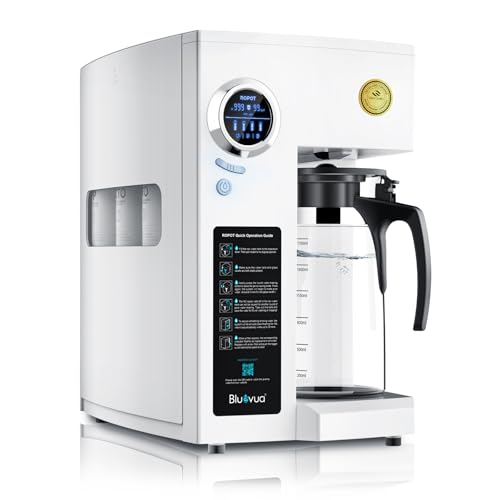
Six-stage countertop RO with a UV light stage, remineralization filter and a borosilicate glass carafe.
Check price on Amazon$409.00 as of Oct 19, 2026 11:14 pm GMT+0000 — prices change; see Amazon for current price.Why we like it
- Only countertop listing with a UV light stage
- Adds minerals back after the RO membrane
- 2:1 pure-to-drain ratio stated
- Filter life and water quality shown on a display
| Specification | Details |
|---|---|
| Filtration | Six stages: 0.0001 micron RO membrane, UV light, remineralization, plus pre-filters |
| Certifications named | WQA certified against NSF/ANSI/CAN 372 (lead-free); contaminant claims tested by SGS |
| Filter life | 12 to 24 months depending on water |
| Wastewater ratio | 2:1 pure to drain |
| Carafe | High borosilicate glass |
| Size / weight | About 14.3 x 10.9 x 15.4 in; 17.8 lb |
Bluevua ROPOT-UV — 6-stage countertop RO + UV + remineralization, glass carafe, 2:1, WQA cert to NSF/ANSI/CAN 372
The Only Countertop Unit That Adds a UV Stage After Reverse Osmosis
The two Bluevua listings are the same countertop RO in two versions. The base ROPOT has five stages; this ROPOT-UV adds a UV light, making it the only countertop listing on the shelf with ultraviolet treatment. Both versions add minerals back after the membrane, which some households prefer for taste because RO strips calcium and magnesium along with contaminants.
The certification claim is narrower than the title suggests. The title says “WQA & NSF Certified,” but the bullet that explains it says WQA certified the unit against NSF/ANSI/CAN 372, which covers lead-free materials, while reductions of TDS, PFOA, PFOS, fluoride, arsenic and lead were tested by SGS. Both are useful facts, but neither is a contaminant-reduction certification. The listing also does not say what the UV stage is rated to treat, so do not treat it as a substitute for disinfecting a contaminated well.
Practical details favor it for daily use: a glass carafe, a standby power-saving mode and a stated 2:1 pure-to-drain ratio. At about 17.8 lb and over 15 inches wide, it needs real counter space.
Pros
- UV stage plus remineralization
- Glass carafe
- Stated 2:1 pure-to-drain ratio
Cons
- Only certification named is for lead-free materials
- UV performance not specified
- Wide, heavy footprint
Check Bluevua ROPOT-UV price on Amazon
4. DREO 113 5L (DR-KWF003) — Best Countertop RO for Larger Households

Countertop RO with a 5L tank, two 1.1L auto-fill pitchers and live TDS readings for raw and filtered water.
Check price on Amazon$199.99 as of Oct 19, 2026 11:14 pm GMT+0000 — prices change; see Amazon for current price.Why we like it
- 5L tank sized by DREO for 3 to 4 people
- Shows raw and filtered TDS in real time
- 3:1 pure-to-drain, best ratio on the shelf
- Auto-fill pitchers and self-flushing tubes
| Specification | Details |
|---|---|
| Filtration | 7-in-1 reverse osmosis filter |
| Certifications named | Tested by SGS to meet NSF/ANSI 58; not stated as certified |
| Filter life | 265 gallons (1,000 L) per filter |
| Tank / pitchers | 5L tank plus two 1.1L pitchers |
| Wastewater ratio | 3:1 pure to drain |
| Size / weight | About 13.3 x 7.9 x 13.8 in; 10.8 lb |
DREO 113 DR-KWF003 — countertop RO, 5L tank + two 1.1L pitchers, live TDS, 3:1, 265 gal filter, SGS-tested to NSF/ANSI 58
The Largest Countertop RO Tank Here, With the Best Stated Water Ratio
DREO sells two countertop RO models on this shelf, each in two colors: the 112 with a 3L tank and one pitcher, and the 113 with a 5L tank and two pitchers. The 3L 112 is the top pick in our broader water filter roundup, so this page highlights the larger 113, which DREO sizes for three to four people. Its 3:1 pure-to-drain ratio matches the 112 and beats the Bluevua’s 2:1.
The DREO is also the only countertop listing that displays TDS for both raw and filtered water in real time. That readout is a convenient check that the membrane is still working; when filtered TDS starts creeping up, the filter is due. Keep in mind that TDS is a general measure, not a test for lead, PFAS or bacteria.
The certification claim is “tested by SGS meeting NSF/ANSI 58 Standards,” which describes a lab test rather than a certification listing. The filter is rated for 265 gallons, so a family drinking several gallons a day will replace it more often than the AquaTru’s RO stage. Plan on emptying a drain tank as well.
Pros
- Biggest tank among the countertop RO units
- Live raw and filtered TDS display
- 3:1 pure-to-drain ratio
Cons
- NSF/ANSI 58 is tested, not certified
- 265-gallon filter life
- Needs an outlet and hand filling
Check DREO 113 5L price on Amazon
5. Waterdrop CTF-01 — Best Faucet-Fed Countertop Filter With No Electricity

Stainless countertop filter fed from the faucet by a diverter, rated 8,000 gallons or 12 months.
Check price on Amazon$59.99 as of Oct 19, 2026 11:14 pm GMT+0000 — prices change; see Amazon for current price.Why we like it
- Runs on tap pressure, no outlet or hand filling
- 8,000 gallons or 12 months per filter
- Up to 1.6 gpm, fast for a countertop unit
- States operating pressure and temperature limits
| Specification | Details |
|---|---|
| Filtration | Five-stage filter for sediment, chlorine and some heavy metals |
| Certifications named | NSF/ANSI 42 certified per title; other reductions third-party tested |
| Filter life | Up to 12 months or 8,000 gallons on municipal water |
| Flow rate | Up to 1.6 gpm |
| Operating limits | 41 to 100°F; 15 to 100 psi |
| Compatibility | Standard faucets only; not pull-out, handheld, spray or sensor faucets |
Waterdrop CTF-01 — faucet-fed countertop, 304 stainless, 8,000 gal / 12 mo, 1.6 gpm, NSF/ANSI 42, 41–100°F, 15–100 psi
The Only Countertop Unit That Filters on Demand From Tap Pressure
Every RO unit and the Ninja dispenser on this shelf need an outlet and a reservoir you fill by hand, and the two gravity systems drip slowly into a lower chamber. The CTF-01 is the one countertop listing that connects to the faucet with a diverter and filters on demand: flip the switch, and water flows through the canister at up to 1.6 gpm. Its 8,000-gallon rating is also the largest on the shelf by a wide margin.
The listing is more specific about operating limits than most: 41 to 100°F and 15 to 100 psi. That matters for anyone tempted to run hot water through it. The EPA advises never running hot water through a filter. It is also explicit that it only fits standard faucets, with no pull-out or sensor models, which rules out many newer kitchens.
The certification in the title is NSF/ANSI 42, so think chlorine, taste and odor. Heavy-metal, fluoride and hydrogen sulfide reductions are described as third-party lab results. It does not reduce TDS, and the listing notes TDS may even read slightly higher because of added minerals.
Pros
- No electricity, filters on demand
- Largest gallon rating on the shelf
- Stainless steel, BPA-free housing
Cons
- Will not fit pull-out or sensor faucets
- Only NSF/ANSI 42 named
- Diverter hose clutters the faucet
Check Waterdrop CTF-01 price on Amazon
6. Purewell PW-OB (K8626) — Best Gravity Countertop Filter for No Power or Plumbing

2.25-gallon stainless gravity system with two carbon filters certified to NSF/ANSI 42 and a 0.01 micron UF membrane.
Check price on Amazon$108.99 as of Oct 19, 2026 8:58 pm GMT+0000 — prices change; see Amazon for current price.Why we like it
- Needs no outlet, faucet or plumbing at all
- Carbon filters passed NSF/ANSI 42
- Stainless steel chambers and spigot
- 3,000 gallons per filter element
| Specification | Details |
|---|---|
| Filtration | Three stages: 0.01 micron hollow fiber UF, silver ion membrane, activated carbon block |
| Certifications named | Carbon filter passed NSF/ANSI 42; title names NSF/ANSI 42 and 372 |
| Filter life | 3,000 gallons per element (6,000 for the pair); replace every 6 months for best performance |
| Flow | About 4 gallons per hour |
| Capacity | 2.25 gallons; stand included |
| Size / weight | About 20 in tall x 8.9 in wide; 8.5 lb |
Purewell PW-OB K8626 — gravity, 2.25 gal stainless, UF + silver + carbon, NSF/ANSI 42 carbon filters, 4 gal/hr, no power
One of Two Gravity Systems, and the Only One Naming an NSF Standard
Two listings on the shelf are gravity-fed stainless systems: this Purewell and the Glacier Fresh PC04. Both run with no power, which makes them useful during outages and in cabins. The Purewell is the one that names an NSF/ANSI standard for its filters, 42 for chlorine, taste and odor, and its 3,000-gallon rating per element far outlasts the Glacier Fresh’s 200 gallons. The Glacier Fresh only says it “meets SGS standards.”
Gravity filtration is slow. At about 4 gallons per hour, the Purewell needs to be topped up ahead of demand, and the listing warns that the lower chamber can overflow if you refill the top while the bottom is full. It is tall, close to 20 inches on its stand, so check the clearance under upper cabinets.
The listing states the filter elements do not lower TDS. The 0.01 micron UF and silver ion stages suggest particle and microbe reduction, but the listing does not name a certification for germs, so do not rely on it to treat untested surface or well water. The CDC notes most home filters are not designed to remove germs.
Pros
- Zero power, zero plumbing
- NSF/ANSI 42 named for the carbon filters
- Long 3,000-gallon element life
Cons
- Slow, about 4 gallons per hour
- Tall; may not fit under cabinets
- No germ-reduction certification stated
Check Purewell PW-OB price on Amazon
Countertop RO vs carbon dispenser vs faucet-fed vs gravity
The four countertop formats solve different problems, and the right one depends on your water and your kitchen.
Countertop reverse osmosis (AquaTru, Bluevua, DREO) is the only countertop option that meaningfully lowers dissolved solids, and the EPA describes RO membranes as extremely effective for PFAS. The costs are an outlet, a reservoir to fill and a reject tank to empty. Seven of the 12 listings on this shelf are countertop RO.
Plug-in carbon dispensers (Ninja) produce no wastewater and can carry health-contaminant certifications, but they leave minerals in the water and hold less per filter.
Faucet-fed units (Waterdrop CTF-01) run on tap pressure with no reservoir, but they need a standard faucet with a removable aerator. Our carbon water filter guide explains what the carbon stage in these units does well and where it stops.
Gravity systems (Purewell) need nothing but counter space and patience, which makes them a sensible backup for outages.
If you have the cabinet space and own the home, an under-sink unit does the same job without occupying the counter. Our under sink water filter guide covers that option, and a pitcher remains the simplest choice for a small household; see our water filter pitcher guide.
Reading certifications on countertop filters
Certification language on this shelf ranges from precise to vague. Ranked from most to least useful:
- “Certified by [named body] to NSF/ANSI [numbers]”: the Ninja’s claim. You can look this up.
- “Certified to NSF standards” without numbers: the AquaTru’s wording. Probably real, but you have to find the listing yourself.
- “Tested by SGS meeting NSF/ANSI 58”: the DREO wording. A lab test against the RO standard, not a certification listing.
- NSF/ANSI 372 only: the Bluevua UV’s certified claim. It covers lead-free materials, not contaminant reduction.
The CDC lists Standard 42 for taste and odor, 53 for health-related contaminants such as cysts, and 58 for reverse osmosis, and recommends checking the product in the certifier’s database. For lead specifically, the EPA’s consumer tool looks for point-of-use filters certified to reduce lead to 5 ppb or less under NSF/ANSI 53 and 42. If lead is your concern, start with our guide to filters for lead in water.
Counter space, outlets and daily upkeep
A countertop filter is something you will see and touch every day, so measure first. The RO units on this shelf run 13 to 15 inches tall and up to about 15 inches wide, and need an outlet within cord reach. The gravity systems are narrow but tall, close to 20 inches. The faucet-fed CTF-01 is low and wide, with a hose to the faucet.
Then think about routine. RO units need the source tank filled and the reject water emptied; the DREO and Bluevua listings both describe auto-fill and standby features that reduce fuss but do not remove it. Wipe reservoirs regularly, because standing water in a warm kitchen can grow a film. The CDC advises changing filters on the manufacturer’s schedule and washing hands afterward. Running hot water through any of these is a mistake: the CTF-01 tops out at 100°F, and the EPA says not to run hot water through a filter at all.
When to test before you buy
A countertop filter is a good fit for treated city water that tastes or smells off. It is a poor first step for a private well that has never been tested. The CDC recommends testing your water to find out what is in it before choosing a filter, and testing private wells at least once a year. A filter chosen for taste will not fix bacteria, nitrate or arsenic unless it is certified for them.
Older homes are the other common trigger. The EPA notes that lead pipes are more likely in homes built before 1986 and that brass faucets and lead solder can contribute lead even without a lead service line. If you are buying an older home on the Front Range and want the plumbing and water source checked, our plumbing and water hub explains what inspectors look at, and you can contact us to connect with a local inspector.
References
- About Choosing Home Water Filters — Centers for Disease Control and Prevention
- Reducing PFAS in Drinking Water with Treatment Technologies — U.S. Environmental Protection Agency
- Consumer Tool for Identifying Point-of-Use and Pitcher Filters Certified to Reduce Lead — U.S. Environmental Protection Agency
- Basic Information about Lead in Drinking Water — U.S. Environmental Protection Agency
Frequently asked questions
What is the best countertop water filter?
For most households, a countertop unit whose listing names both the certifier and the NSF/ANSI standards is the best starting point. The Ninja HydraSense WF1001WH1 names IAPMO R&T certification to NSF/ANSI 42, 53 and 401. If you need lower TDS, a countertop reverse osmosis unit such as the AquaTru or DREO is the better fit.
Are countertop reverse osmosis filters worth it?
They are worth it when you want RO-level reduction without plumbing, such as in a rental. The EPA describes reverse osmosis membranes as extremely effective at removing PFAS. The trade-offs are an outlet, a tank you fill by hand and a reject tank you empty.
Do countertop water filters waste water?
Reverse osmosis units do. On this shelf the stated ratios run from 2:1 to 3:1 pure to drain, meaning one cup of reject water for every two or three cups filtered. Carbon dispensers, faucet-fed units and gravity systems produce no reject water.
Can a countertop filter be used with well water?
Only after the well has been tested. The CDC recommends testing private wells at least once a year and choosing a filter that removes what the test finds. Most countertop listings here do not claim certification for bacteria, so a contaminated well needs proper treatment first.
How often do countertop filter cartridges need replacing?
It varies widely by type. On this shelf, filter life runs from about 120 gallons for the Ninja dispenser to 8,000 gallons for the faucet-fed Waterdrop CTF-01, with RO stages typically rated 6 to 24 months. Follow whichever limit, gallons or months, comes first.
Front Range buyers who want the plumbing and water supply of a home checked before closing can reach out through our contact page to connect with a vetted local inspector.