Refrigerator Water Filters: What They Remove and When to Change

A refrigerator water filter is the most common water treatment device in many homes, and also one of the most misunderstood. Owners often assume it makes any water safe, when most fridge filters are designed mainly to improve taste and reduce specific contaminants listed on the label. Others forget the filter exists until the dispenser slows to a trickle or the ice tastes stale. This guide explains what certified filters claim, how to read the label, why taste is not a safety test, how often filters are typically replaced, the risks of counterfeit cartridges, what changes for homes on private wells, and how kinked or leaking supply lines behind the fridge cause damage. It summarizes EPA and CDC guidance current as of 2026; a certified laboratory test is the only way to know what is actually in a home’s water.
Part of our Plumbing & Water guide — start there for the full picture →
What a Refrigerator Water Filter Actually Does
Most refrigerator water filters are point-of-use cartridges built around activated carbon. Water from the home’s cold supply line flows through the cartridge on its way to the dispenser and ice maker, and contaminants stick to the carbon or are caught in its pores. EPA’s home water filtration fact sheet lists devices connected to a refrigerator’s water and ice dispensing system among point-of-use units, and notes that carbon filters are effective at improving taste, with many also reducing lead and other contaminants depending on the model.
The CDC is direct about the limits. Its guidance on choosing home water filters says most home water filters, such as pitcher or fridge filters, are not designed to remove germs, and typically use carbon to make water taste better or remove heavy metals like lead. The CDC also explains that what a filter removes depends on the size of its pores, the size of the substance, and the substance’s electric charge.
In practical terms, a typical fridge filter is a taste-and-specific-contaminant device. It can be a sensible part of a home’s water plan, but it is not a disinfection system and does not replace testing or whole-house treatment where those are needed.
Filter locations and styles
Refrigerators place the cartridge in a few common spots. Many French-door and side-by-side models put it inside the fresh-food compartment, either in the upper right corner or in a pod near the crisper drawers. Older side-by-sides often hide a push-in cartridge behind the kickplate grille at the bottom front. Some models use a cartridge in the back of the unit, and a few older refrigerators have no built-in filter at all, relying instead on an inline filter spliced into the supply line behind the fridge.
Inline filters are also sold as add-ons for refrigerators without built-in filtration. They work on the same principle but add two more connection points in a hidden line, which is worth keeping in mind for leak risk. Whatever the style, the manual identifies the correct cartridge by part number, and that part number is what to search when checking certification.
Start with the water itself
EPA’s fact sheet recommends learning about the tap water before buying any treatment unit. Homes served by a public water system can request the utility’s annual water quality report, sometimes called a consumer confidence report, which lists detected contaminants and compares them with EPA standards. EPA also notes that some contaminants, such as lead from household pipes and solder, vary from house to house, so a certified laboratory test of the home’s own tap is the most reliable way to decide what a filter needs to address.
Reading the Certification Claims
Filter packaging is full of claims, and the useful ones are tied to independent certification. Both EPA and CDC point consumers toward third-party certification rather than marketing language.
How the standards are organized
EPA’s filtration fact sheet explains that organizations accredited by the American National Standards Institute certify water treatment units to ANSI/NSF standards, and that those standards come in two broad sets: one for health concerns, such as reduction of specific contaminants, and one for aesthetic concerns, such as taste or appearance. EPA says certification requires verification of contaminant reduction claims, evaluation of the unit’s materials and structural integrity, and review of labels and sales literature. The CDC lists several relevant standards by number, including Standard 42 for taste and odor and Standard 53 for cyst reduction, and suggests looking for the certification on the filter’s label and checking the certifier’s product database.
The key point for homeowners is that certification is contaminant-specific. A filter certified only to the aesthetic standard has been tested for things such as chlorine taste and odor, not for health-related contaminants like lead. A filter certified for lead reduction will say so explicitly. If the label simply says “filters impurities,” the claim is too vague to rely on.
Lead claims
Lead is the contaminant most homeowners ask about. EPA’s consumer tool for point-of-use and pitcher filters says lead can enter drinking water when service pipes containing lead corrode, and that homes may also have internal plumbing materials containing lead. The tool helps consumers identify filters evaluated by an accredited third-party certification body for lead reduction to 5 parts per billion or less, along with particulate reduction, against both NSF/ANSI Standards 53 and 42. Some refrigerator cartridges carry lead reduction certification and many do not, so the specific model’s performance data sheet matters more than the brand.
Chlorine and taste
Chlorine taste and odor reduction is the most common claim on fridge filters and the one most owners notice. EPA’s fact sheet explains why chlorine is there: most tap water is treated with chlorine to kill disease-causing microbes, and it continues to disinfect as water travels through pipes. The CDC adds that filters remove both good and bad substances, including chlorine and, in some cases, fluoride. That is not necessarily a problem for drinking water, but it is a reminder that filtered water sitting in a dispenser line has lost some of its disinfectant.
Taste is not a safety test
The CDC notes that taste, smell and appearance are not always good indicators of water safety; harmful germs and chemicals often do not change how water looks or tastes, while some harmless substances, such as certain sulfur compounds, can make water smell bad. A filter that makes water taste better has not necessarily made it safer, and a filter that makes no noticeable difference may still be reducing a certified contaminant.
Best Refrigerator Water Filters: our top 3 picks
| Product | Best for | Key features | Price | Buy |
|---|---|---|---|---|
| GE XWFE | GE, Profile, Cafe and Monogram |
| $49.98as of Nov 26, 2026 2:07 am GMT+0000 | Buy now →Check current price |
| everydrop Filter 1 | Whirlpool family push-in fridges |
| $53.99as of Nov 26, 2026 5:40 am GMT+0000 | Buy now →Check current price |
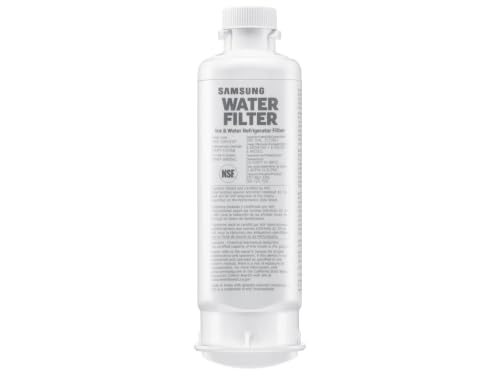
| Samsung HAF-QIN | Samsung square-filter fridges |
| $29.99as of Nov 25, 2026 2:31 pm GMT+0000 | Buy now →Check current price |


Prices are Amazon’s listed prices as of the time shown and change often; check Amazon for today’s price. As an Amazon Associate we earn from qualifying purchases.
Replacement Intervals and Maintenance
Every carbon filter has a finite capacity. EPA’s fact sheet notes that activated carbon filters are designed to filter a certain amount of water, after which they become clogged and ineffective, and that units should be maintained according to the manufacturer’s recommendations. The CDC adds that filters need maintenance to keep working and to prevent germs from growing in them, and recommends changing filters according to the manufacturer’s schedule.
Many refrigerator manufacturers recommend replacement roughly every six months, or after a rated number of gallons, whichever comes first. The exact figures vary by model and are listed in the owner’s manual and on the filter’s performance data sheet. Signs a filter may be due:
- The refrigerator’s filter indicator light is on. On many models this is a simple timer, not a sensor, so it may need to be reset after each change.
- Dispenser flow has slowed noticeably.
- Taste or odor has returned, or ice tastes stale.
- The household cannot remember when the filter was last changed.
After installing a new cartridge, most manufacturers call for flushing several gallons through the dispenser to remove trapped air and loose carbon fines. Sputtering and cloudy water immediately after a change are usually air and fines, not a defect. The CDC suggests wearing gloves while changing filters and washing hands afterward, and advises people with weakened immune systems to avoid changing filters themselves because of exposure to whatever the filter has captured.
Running without a filter
Many refrigerators include a bypass plug so the dispenser works without a cartridge. That is a reasonable choice when a home’s water is already well treated and the household prefers not to filter, but it means the dispenser delivers unfiltered tap water. Some refrigerators will not dispense at all without a filter or bypass installed.
Counterfeit and Lookalike Filters
Replacement cartridges are a high-volume product, and online marketplaces sell many lookalike and generic filters at a fraction of the brand price. Some generics are legitimately certified by an accredited organization for specific contaminants. Others may display certification marks they have not earned, or claim to meet a standard without being certified to it.
Because performance claims depend on certification, a few habits reduce the risk:
- Check that the certification mark names an accredited certifier and a specific standard, then look up the exact model number in that certifier’s online database, as the CDC suggests.
- Be cautious with prices far below the market and packaging with misspellings, missing model numbers or vague claims.
- Buy from the appliance manufacturer, an authorized dealer or a reputable retailer, and keep the receipt.
- Watch for fit problems: a cartridge that leaks at the housing, will not lock or causes the dispenser to sputter for days may not be built to the original specification.
Industry groups and appliance makers have warned about counterfeit filters for years, but the scale of the problem is hard to measure. EPA’s fact sheet offers a general rule that applies here: if a unit is not certified by one of the accredited organizations, contact the manufacturer and ask for proof of its claims.
Homes on Private Wells
Many homes in the foothills west of Boulder, Golden and Colorado Springs, and on rural parcels across the Front Range, draw water from private wells. That changes the filter conversation considerably. Public water systems must meet federal drinking water standards and publish an annual water quality report; private wells generally do not have that oversight, and the owner is responsible for testing and treatment.
The CDC advises people who get water from a private well to test at least once a year for harmful germs and chemicals, and to test again if color, taste or smell changes. Its guidance on treating well water says no single treatment type protects against all problems, and that owners should confirm any system removes the specific germ or chemical of concern. A fridge filter, which the CDC says is generally not designed to remove germs, is not a substitute for addressing bacterial contamination in a well. If a well tests positive for harmful germs, the CDC advises not drinking the water until it has been treated and retested, and using bottled or another safe source in the meantime.
Front Range wells also raise other questions. Granite-rich geology in parts of Colorado can contribute radon and uranium to groundwater; our guide to testing for radon in well water explains that process. Hardness and iron can shorten filter life by clogging cartridges with scale and sediment. Our water hardness test guide covers measuring hardness, and our page on iron filters explains whole-house iron treatment. On a well, the fridge filter is best thought of as a final polishing step after testing and any needed whole-house treatment.
Water Line Kinks and Leaks Behind the Fridge
The filter is only part of the system. Water reaches the refrigerator through a small supply line, usually from a valve under the kitchen sink or a recessed outlet box in the wall behind the fridge. Older installations commonly used thin plastic tubing or soft copper; newer ones often use braided stainless lines.
Several problems are common:
- Kinks. Pushing the fridge back against the wall can kink plastic or copper tubing, reducing flow and sometimes cracking the line over time. A coil of slack behind the fridge, secured so it does not get crushed, reduces this risk.
- Saddle valves. Self-piercing saddle valves clamped onto a copper pipe were once common for fridge lines. Many plumbers now discourage them because they are prone to leaking and are not allowed by some local codes.
- Brittle plastic lines. Older plastic tubing can become brittle, especially near heat sources, and split.
- Filter housing leaks. A cracked housing or a cartridge that is not fully seated can drip inside the fridge or onto the floor.
Because the line runs behind a heavy appliance, small leaks can soak flooring and subfloor for weeks before anyone notices. A battery-powered sensor on the floor behind or beside the fridge is an inexpensive safeguard; our guide to smart water leak detectors compares options. Swollen laminate, cupped hardwood and musty odors near the refrigerator are all reasons to pull it out and look.
Costs and Hiring
Prices vary by refrigerator brand and model, region and access. As a rough 2026 guide:
- Brand-name replacement cartridges: commonly in the range of a few tens of dollars each, sometimes more for premium or multi-stage cartridges.
- Certified third-party cartridges: often less, though certification and fit should be confirmed.
- Annual filter spending: at a typical six-month interval, roughly double the single-cartridge price per year.
- New braided supply line and shutoff valve installed by a plumber: often in the low hundreds of dollars, depending on access.
- Laboratory water testing: varies widely with the number of contaminants tested, from basic bacterial panels to comprehensive well packages.
- Whole-house treatment for well problems: often several hundred to several thousand dollars depending on the contaminants and system type.
What inspectors cover
Standard home inspections generally do not test water quality or evaluate water conditioning equipment; the ASHI Standard of Practice lists water conditioning systems among items inspectors are not required to inspect, and many inspectors do not test refrigerators at all. Some inspectors offer water quality testing as an add-on service, which is especially worth considering for well homes. Our plumbing and water inspections hub explains what a standard plumbing inspection covers, and the main guide to hiring a home inspector explains how to find a qualified inspector and which add-ons are available.
More Questions About Refrigerator Water Filters
What happens if you don’t change your refrigerator water filter?
If a refrigerator water filter is not changed, it can lose effectiveness, reduce water flow and make ice or water taste worse. Once its capacity is exhausted, the filter may no longer reduce the contaminants listed on its certification.
Some refrigerators slow dispensing or produce smaller ice cubes when the filter is clogged. Replacing the filter on schedule, usually every few months, keeps water flowing and helps the filter perform as claimed.
Do refrigerator water filters remove fluoride?
Most refrigerator water filters do not remove significant fluoride. Many are designed to reduce chlorine taste and odor, sediment and certain contaminants listed on their certification, but fluoride removal usually requires reverse osmosis or specialized treatment.
Buyers who want fluoride reduction should check certification claims carefully rather than assuming a refrigerator filter removes it. Public water systems and local health departments can provide information about fluoride levels in tap water.
Can a refrigerator water filter grow bacteria?
A refrigerator water filter can harbor bacteria if it is left in place too long, especially when water sits unused for extended periods. Filters trap particles and organic material that can support microbial growth over time.
Changing filters on schedule, flushing water after installation and after long periods of non-use, and keeping the refrigerator water system clean reduce the risk. If water tastes odd or smells unusual, replace the filter and flush the system.
How do you reset the refrigerator water filter light?
The refrigerator water filter light is usually reset by pressing and holding a filter reset button, pressing a button combination, or using the refrigerator’s control panel menu. The exact method depends on the model.
Check the owner’s manual or the manufacturer’s model support page if the light does not reset. Some refrigerators reset automatically after a new filter is installed, while others require manual reset. Resetting the light does not replace the filter.
References
- About Choosing Home Water Filters — Centers for Disease Control and Prevention
- Home Drinking Water Filtration Fact Sheet — U.S. Environmental Protection Agency
- Consumer Tool for Identifying Point-of-Use and Pitcher Filters Certified to Reduce Lead — U.S. Environmental Protection Agency
- Guidelines for Treating Well Water — Centers for Disease Control and Prevention
- ASHI Standard of Practice for Home Inspections — American Society of Home Inspectors
Frequently asked questions
Does a refrigerator water filter make water safe to drink?
Not on its own. The CDC says most fridge filters are not designed to remove germs and mainly improve taste or reduce specific contaminants such as lead. What a filter removes depends on its certification, so check the label for specific standards and contaminants.
How often should a refrigerator water filter be changed?
Many manufacturers recommend about every six months or after a rated number of gallons, whichever comes first. Follow the specific model's instructions, and replace sooner if flow slows or taste returns.
Do refrigerator water filters remove lead?
Some do and many do not. Look for a filter certified for lead reduction by an accredited certifier. EPA's consumer tool describes filters certified to reduce lead to 5 parts per billion or less under NSF/ANSI Standards 53 and 42.
Are cheap generic fridge filters safe to use?
Some generic filters are legitimately certified, but others carry unearned marks or vague claims. Look up the exact model in the certifier's database and buy from reputable sellers.
Is a fridge filter enough for well water?
Usually not. The CDC recommends testing private wells at least once a year and choosing treatment that targets the specific problem. A fridge filter is generally not designed to remove germs.
Should you run water after replacing a refrigerator water filter?
Yes, run water through the dispenser after replacing a refrigerator water filter. Flushing removes trapped air and loose carbon particles that can make the first water cloudy or gray. Many manufacturers recommend dispensing several gallons; the owner's manual gives the exact amount.
Can a refrigerator water filter remove PFAS?
Some refrigerator water filters are certified to reduce certain PFAS, such as PFOA and PFOS, but many are not. Check the filter's performance data sheet and certification claims for the specific contaminants before buying, since a general taste-and-odor claim says nothing about PFAS.
Do refrigerator water filters affect ice quality?
Yes, refrigerator water filters can improve ice taste and clarity by reducing chlorine and sediment. An old or clogged filter can lead to smaller or hollow ice cubes, slower ice production and stale-tasting ice, so replace it on schedule.
Buying a well home or worried about the plumbing behind the kitchen appliances? Contact us to connect with a Front Range inspector who can review the water supply and recommend testing where it makes sense.