Water Hardness Test: Strips, Kits and Reading Results
White crust on faucets, spotty glasses, soap that will not lather and a water heater that rumbles are the usual reasons someone starts looking for a water hardness test. Hardness is easy to measure at home, and the result drives real decisions: whether a softener is worth buying, what size it should be, how to set it, and whether a salt-free conditioner or nothing at all might be enough. The catch is that test methods vary a lot in precision, and results come in two different units that are easy to mix up. This guide compares test strips, drop-count titration kits and lab tests, explains how to read results in grains per gallon and milligrams per liter, walks through the hardness classes the USGS uses, shows where to find hardness in a utility water report, and explains how results feed into softener sizing for homes on city water and private wells. It summarizes USGS, EPA and CDC information current as of 2026.
Part of our Plumbing & Water guide — start there for the full picture →
What Water Hardness Is and Why It Matters
Hardness is a measure of dissolved minerals, mainly calcium and magnesium. The USGS explains that hardness is caused by compounds of calcium and magnesium and by a variety of other metals, and that groundwater picks up these minerals as it moves through soil and rock. The USGS also notes that hard water can lead to scale buildup inside pipes and that hardness varies across the United States.
Hard water is not considered a health hazard in the way bacteria or lead are; it is primarily a nuisance and an equipment issue. The practical effects include:
- White scale on faucets, shower glass and fixtures.
- Spots on dishes and reduced dishwasher performance.
- Soap and detergent that lather poorly, leaving a film on skin and laundry.
- Scale inside water heaters, which can reduce efficiency and cause rumbling or popping noises.
- Shorter life for valves, cartridges, humidifiers and appliances with heating elements.
The EPA’s secondary drinking water standards do not include hardness as its own entry, but they set a non-enforceable guideline of 500 mg/L for total dissolved solids and list hardness and deposits among the noticeable effects above that level. The EPA describes scale as a mineral deposit that builds up inside hot water pipes, boilers and heat exchangers and can restrict or even block flow. For how scale shows up on surfaces and how to clean it, see our guide to hard water stains.
Types of Water Hardness Test Kit
There are three common ways to measure hardness, and each suits a different purpose.
Test strips
Test strips are the cheapest and fastest option. A strip is dipped in a water sample for a second or two, then the color of the pad is compared to a chart on the bottle after a short wait. Strips usually report hardness in ranges, such as 0, 1, 3, 7, 10, 15 and 25 grains per gallon, or the equivalent in mg/L or ppm.
Strips are good for a quick screen: is the water soft, moderate or very hard, and is the softener working? Their limits are precision and color interpretation. Lighting, color vision, timing and expired strips all affect the reading. When a result falls between two color blocks, the true value could be anywhere in that range. Strips should be stored sealed and used before their expiration date, because humidity degrades the pads.
Drop-count titration kits
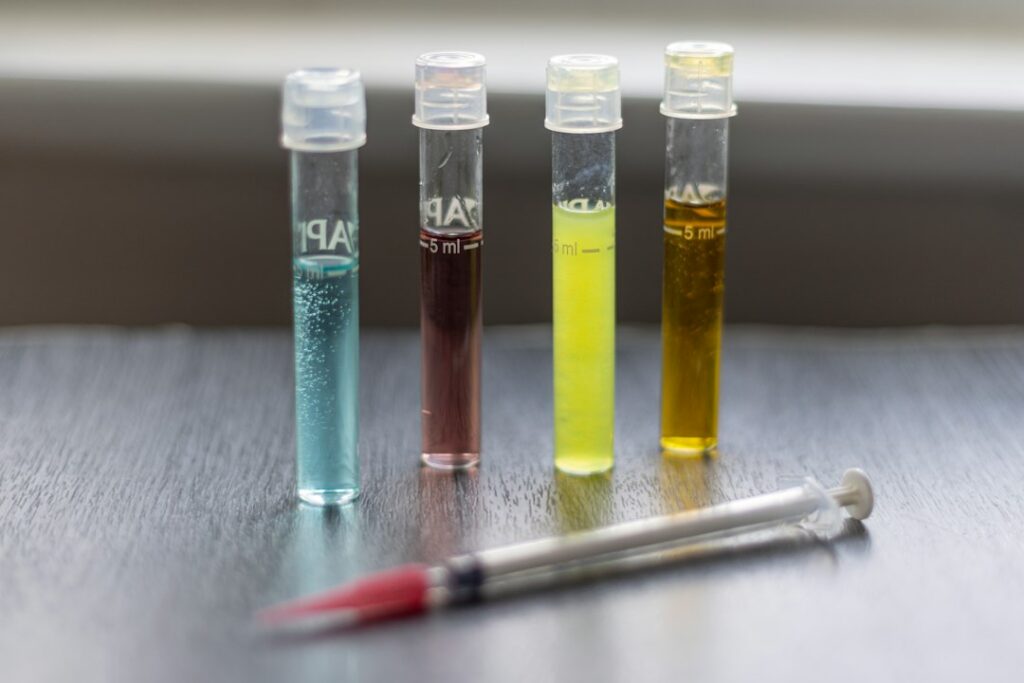
A titration kit measures hardness more precisely. A measured water sample goes into a vial, an indicator turns it a color such as pink or red, and a reagent is added one drop at a time until the color changes, often to blue. Each drop represents a set amount of hardness, commonly 1 grain per gallon or a fixed number of mg/L depending on the kit, so counting drops gives the result.
Titration kits take a few minutes and a bit of care, but they typically resolve hardness to about one grain per gallon, which is precise enough to size and program a softener. They are popular with water treatment installers for that reason. Accuracy depends on using the exact sample volume, counting drops consistently and swirling after each drop.
Laboratory tests
A laboratory reports hardness as a measured value, often along with calcium, magnesium, iron, manganese, pH and total dissolved solids. Lab tests cost more and take days, but they are the right choice when equipment decisions depend on several parameters at once, as they often do on wells. A lab panel also reveals iron, which affects softener choice and settings.
Digital meters and TDS pens
Inexpensive TDS pens measure electrical conductivity and estimate total dissolved solids. TDS includes hardness minerals but also sodium, chloride, sulfate and other ions, so a TDS reading is not a hardness reading. After a softener, TDS can stay about the same even though hardness has dropped, because sodium replaces calcium and magnesium. A TDS pen is useful for checking reverse osmosis output, not for checking softener performance.
How to Run a Home Hardness Test
A few steps make home results more reliable:
- Choose the right tap. To measure incoming hardness, sample from a tap that bypasses the softener, often an outdoor hose bib or a dedicated cold line. To check the softener, sample a treated cold tap.
- Run the water. Let cold water run for a minute or two so the sample represents water from the main line rather than water that has been sitting in the pipes.
- Use a clean container. Rinse it with the water being tested. Soap residue or leftover softened water can skew results.
- Follow timing exactly. For strips, read the color at the stated time, not minutes later. For titration, swirl and count carefully.
- Read in good light. Natural daylight helps with color comparison.
- Repeat. Two or three tests that agree are more trustworthy than one.
Testing both raw and treated water at the same time is the simplest way to tell whether a softener is regenerating properly. Treated water from a working softener typically tests at or near zero grains per gallon.
Reading Results: gpg, mg/L and Hardness Classes
Hardness is reported in two common units:
- Milligrams per liter (mg/L) as calcium carbonate: used by labs, utilities and government agencies. For water, mg/L is essentially the same as parts per million (ppm).
- Grains per gallon (gpg): used by the water treatment industry and by most softener settings.
The general conversion is 1 grain per gallon equals about 17.1 mg/L. To convert mg/L to gpg, divide by 17.1; to convert gpg to mg/L, multiply by 17.1. A utility report showing 170 mg/L is therefore about 10 gpg.
The USGS gives general guidelines for classifying water by hardness, measured as mg/L of calcium carbonate:
- Soft: 0 to 60 mg/L (roughly 0 to 3.5 gpg).
- Moderately hard: 61 to 120 mg/L (roughly 3.5 to 7 gpg).
- Hard: 121 to 180 mg/L (roughly 7 to 10.5 gpg).
- Very hard: more than 180 mg/L (above roughly 10.5 gpg).
The gpg figures here are approximate conversions of the USGS mg/L ranges, not separate USGS categories. Some test kit makers and softener manufacturers use slightly different labels, so it helps to compare the number, not just the word.
Along the Front Range, hardness varies by source. Utilities drawing on mountain snowmelt reservoirs may deliver relatively soft water, while systems blending in groundwater, and many private wells on the plains, can deliver hard or very hard water. Results can also change seasonally when a utility switches sources.
What to Do at Each Hardness Level
A test result is only useful if it leads to a sensible next step. As a general guide, not a rule:
- Soft water: Treatment for hardness is usually unnecessary. Very soft water can sometimes be more corrosive to plumbing, so a pH check is worthwhile, particularly on a well.
- Moderately hard water: Many households live with it comfortably, using descaling cleaners and periodic water heater flushing. Some choose a softener for appliance protection or a point-of-use filter for drinking water taste.
- Hard water: Scale on fixtures and in the water heater becomes more noticeable. This is the range where softeners and conditioners are most commonly considered.
- Very hard water: Scale accumulates quickly, tankless water heaters and boilers may need protection under their manufacturers’ guidance, and softening is common. Wells in this range often carry iron or other minerals as well, so a full lab panel is worth the cost before buying equipment.
Appliance manuals are a practical tiebreaker. Many tankless water heater, dishwasher and espresso machine makers state a hardness limit or a descaling schedule tied to hardness, and staying within those limits can matter for warranty coverage.
Checking a Softener With a Test Kit
Homes that already have a softener benefit from occasional testing. A treated-water test that shows hardness creeping up usually means one of a few things: the brine tank is out of salt or has a salt bridge (a hard crust that keeps salt from dissolving), the regeneration schedule no longer matches water use, the bypass valve is partly open, or the resin is fouled or worn out. Testing raw water at the same time shows whether incoming hardness has changed, which happens when a utility switches sources.
A simple routine is to test treated water every few months and after any power outage, since some control valves lose their settings. Programming the valve with the measured raw hardness, rather than a guessed number, keeps salt use and regeneration frequency in line with real conditions.
Using Your Utility’s Water Quality Report
Homes on public water have a free shortcut. The EPA requires community water systems to deliver a Consumer Confidence Report, also called an annual drinking water quality report, to their customers, and states that reports must be sent each year by July 1. If the report did not arrive, the EPA says customers can call their water supplier or look it up with the EPA’s CCR search tool.
The EPA lists what the report contains, including the source of the drinking water, the regulated contaminants found in it and any health-related violations. Hardness is not a regulated contaminant, so it may appear in an “unregulated” or “other parameters” table, or only on the utility’s website or by request. Many Front Range utilities publish hardness separately because customers ask for it so often. Where the utility gives a range, a home test helps narrow down what is actually reaching the tap.
Private Wells: Test Hardness Alongside Safety Tests
Well owners do not receive a water quality report. The CDC states that well owners are responsible for testing their wells, that EPA rules for public water systems do not apply to private wells, and that wells should be tested at least once a year for total coliform bacteria, nitrates, total dissolved solids and pH, using a state-certified laboratory. The CDC notes that water with higher levels of dissolved solids is more likely to leave scale or buildup on pipes and devices.
A home hardness test kit is a useful supplement on a well, but it should not replace a lab panel. Iron is especially important, because it affects softener capacity and may call for separate treatment; see our sibling guide to the iron filter. For sampling, lab selection and what to test, see our guide to well water testing.
From Test Results to Softener Sizing
Hardness results are the starting point for sizing a softener. The usual approach is to estimate daily softening demand:
- Estimate daily water use, often figured per person per day; household habits vary widely.
- Multiply by hardness in gpg. Many installers add a few grains per gallon for each 1 mg/L of dissolved iron, because iron consumes resin capacity.
- Multiply by the number of days between regenerations, often several days to about a week.
For example, a household using 300 gallons a day with 12 gpg hardness needs to remove about 3,600 grains a day, or roughly 25,000 grains for a seven-day cycle. A softener rated around 30,000 to 40,000 grains might fit, depending on how the manufacturer rates capacity at different salt settings. These are illustrative numbers; installers should size from actual test results and water use. Our guide to water softener installation covers placement, bypass valves and drain requirements.
Salt-free conditioners take a different approach, typically changing how minerals form scale rather than removing them, so a hardness test on treated water may show little change. Whether they suit a home depends on hardness level and expectations. Our guide to the salt-free water softener explains the trade-offs.
What Hardness Testing Costs
As general 2026 ranges, not quotes:
- Test strips: often about $8 to $25 for a pack of dozens of strips.
- Drop-count titration kit: commonly $15 to $40, with refill reagents available.
- Digital hardness meters: often $50 to $200 or more; TDS pens are cheaper but do not measure hardness directly.
- Lab hardness test alone: frequently $20 to $60; broader panels with iron, pH and TDS often cost $50 to $200.
- Free tests: some water treatment dealers offer free in-home tests, usually tied to a sales visit. The numbers can be useful, but it is worth confirming with an independent test before buying equipment.
What a Home Inspection Covers
A home inspector may point out scale on fixtures, a softener with its bypass engaged or a water heater with mineral buildup, but water quality testing is outside a standard inspection. Buyers who want hardness or well results should arrange tests separately during the inspection period. For how plumbing and water fit into the inspection, see our plumbing and water inspection section and the main guide to hiring a home inspector.
More Questions About Water Hardness Testing
Can you test water hardness without a kit?
Water hardness can be roughly checked without a kit using the soap shake test: fill a clear bottle one-third with tap water, add a few drops of pure liquid castile soap, and shake. Soft water makes plenty of lasting suds; hard water gives little foam and a cloudy, scummy layer.
The shake test only separates soft from clearly hard water and gives no number. Spotting on glasses, white crust on faucets and scale in the kettle are further hints. Sizing a softener needs a measured value in grains per gallon from strips, a titration kit or a lab.
Does water hardness change over time?
Water hardness can change over time, especially on city systems that blend water from several sources or switch between surface water and groundwater by season. Private wells can also shift after drought, heavy pumping, or nearby construction.
A softener set years ago may no longer match the water. Retesting once a year, or whenever spotting and scale return, helps keep the softener’s hardness setting accurate. Utility annual water quality reports often show a hardness range rather than a single number for that reason.
Should hot and cold water be tested for hardness separately?
Testing cold water is the standard for water hardness, since hot water can drop some calcium out as scale inside the water heater and read lower. Cold water from a kitchen tap before any filter gives the true incoming value.
To check whether a softener is working, test a cold tap after the softener and compare it with a sample taken upstream, often from an outdoor spigot that bypasses treatment. Both readings should be taken the same day for a fair comparison.
What is a good hardness level for drinking water?
There is no health-based limit for water hardness, and EPA does not regulate it as a drinking water contaminant. Calcium and magnesium in hard water are not considered harmful to drink, and some people prefer the taste.
Hardness is mainly a plumbing and appliance issue. Water under about 3.5 grains per gallon is generally considered soft enough to avoid noticeable scale, while levels above roughly 7 gpg usually justify a softener for the home’s fixtures, water heater and dishwasher.
References
- Hardness of Water — U.S. Geological Survey
- CCR Information for Consumers — U.S. Environmental Protection Agency
- Secondary Drinking Water Standards: Guidance for Nuisance Chemicals — U.S. Environmental Protection Agency
- Guidelines for Testing Well Water — Centers for Disease Control and Prevention
Frequently asked questions
Are water hardness test strips accurate?
Strips are fine for a quick screen but report ranges, and color reading, timing and expired strips affect results. A drop-count titration kit usually resolves hardness to about 1 grain per gallon, which is better for sizing or programming a softener.
How do I convert mg/L to grains per gallon?
Divide mg/L (as calcium carbonate) by about 17.1. For example, 170 mg/L is roughly 10 grains per gallon. To go the other way, multiply grains per gallon by 17.1.
What hardness level counts as hard water?
The USGS classifies 0 to 60 mg/L as soft, 61 to 120 mg/L as moderately hard, 121 to 180 mg/L as hard and more than 180 mg/L as very hard, measured as calcium carbonate.
Where can I find my city's water hardness?
Check your utility's annual Consumer Confidence Report or its website. The EPA requires community water systems to send the report each year by July 1. Because hardness is not regulated, it may be listed separately or available on request.
Can a TDS meter test water hardness?
Not directly. TDS meters estimate all dissolved solids, including sodium and chloride. After a softener, TDS may barely change even though hardness drops, so use a hardness kit to check softener performance.
How often should water hardness be tested?
Water hardness should be tested once when moving in or installing a softener, then about once a year to confirm the softener setting. Test sooner if spotting returns, salt use changes noticeably, or the city announces a change in water source.
Does boiling water reduce hardness?
Boiling reduces temporary hardness, caused by calcium bicarbonate, which drops out as the white scale seen in kettles. Permanent hardness from sulfates and chlorides stays dissolved. Boiling is not a practical way to soften household water, but it explains why kettles and water heaters collect scale.
Can a pool test kit check household water hardness?
Many pool test kits measure calcium hardness, which can give a reasonable estimate of household water hardness, though they miss magnesium and report in ppm. Divide the result by about 17.1 to convert to grains per gallon. A dedicated total hardness kit is more accurate for softener sizing.
Not sure whether the softener in a home you are buying actually works, or what the well water holds? Get in touch and we can help you plan an inspection and the water tests worth adding.