How Often to Change Refrigerator Water Filter (and Why)
Most refrigerator manufacturers tell owners to change the water filter about every six months, or sooner if the filter reaches its rated gallon capacity first. That rated capacity is commonly somewhere in the range of a few hundred gallons, and the label or owner’s manual for your specific cartridge is the number that counts. Households that drink a lot of dispenser water, make a lot of ice or have sediment in the supply line often need a new filter before the six-month mark, while a lightly used refrigerator should still get a fresh cartridge on schedule because an old filter can harbor bacterial growth even when it has not filtered much water.
Part of our Plumbing & Water guide — start there for the full picture →
This guide explains where those intervals come from, what the change-filter light on the door actually measures, the warning signs that a filter is past its useful life, how to change and flush a new cartridge, how to reset the indicator, and what to think about when you move into a home with an unknown filter. It summarizes general guidance as of 2026; your refrigerator’s manual and the filter’s own packaging take priority over any rule of thumb.
The Short Answer: Typical Replacement Intervals
Refrigerator filter schedules are written around two limits. The first is time, usually six months. The second is volume, the number of gallons the cartridge was tested to treat while still meeting its contaminant-reduction claims. Whichever limit you hit first is the one to follow. The table below summarizes how the common situations usually play out. These are typical patterns, not manufacturer specifications.
| Situation | Typical replacement timing | Why |
|---|---|---|
| Average household, filter rated for six months | About every 6 months | The time limit is usually reached before the gallon limit |
| Large family or heavy ice use | Often every 3 to 5 months | The rated gallon capacity can run out before six months |
| Light use, one or two people | Still about every 6 months | Time-based limits protect against stale water and microbial growth inside the cartridge |
| Well water or supply with sediment | Often sooner than the label | Particles clog carbon faster and reduce flow |
| Refrigerator unused for weeks (vacation home, vacant listing) | Replace before relying on it again | Water sitting in a warm or idle line and cartridge can grow bacteria |
| Moving into a home with unknown filter age | Replace at move-in | You cannot know how many gallons it has treated |
If you have not looked at your filter recently, check the brand-specific details. Our guides to the Whirlpool refrigerator water filter, GE refrigerator water filter, Samsung refrigerator water filter, LG refrigerator water filter and Frigidaire refrigerator water filter cover cartridge locations, part numbers and the reset procedure for each brand.
Why the Six-Month and Gallon Limits Exist
Nearly every refrigerator filter is built around activated carbon, often a compressed carbon block. Carbon works by adsorption: chlorine, some organic chemicals and, in certified models, lead and other contaminants stick to the enormous internal surface area of the carbon. That surface area is finite. Once enough material has bonded to it, the carbon has less capacity left, and the filter gradually stops doing what its label promises.
The U.S. Environmental Protection Agency’s Home Drinking Water Filtration Fact Sheet puts it plainly: all units require some maintenance, activated carbon filters are designed to filter a certain amount of water, and after that the filters become clogged and ineffective. EPA advises following the manufacturer’s recommendations for replacement and notes that carbon filters have a specified shelf life.
The gallon rating comes from certification testing. When a cartridge is certified to an NSF/ANSI standard, it is tested to a stated capacity, and the claims on the box apply up to that capacity. Running water through the filter past that point does not instantly make it dangerous, but the reduction claims no longer apply, and performance can drop off.
The time limit exists for a different reason. Carbon traps organic material, and the inside of a cartridge is a dark, damp space at refrigerator temperature or slightly above where the line runs through the cabinet. The Centers for Disease Control and Prevention’s guidance on choosing home water filters says you will need to maintain any filter you use to keep it working properly and prevent germs from growing in it, including regularly changing filters according to the manufacturer’s recommendations. Carbon also removes chlorine, the residual disinfectant your utility adds, so the water sitting inside and after the cartridge has less protection against microbial regrowth than the water in the supply line. A lightly used filter therefore still has a shelf life.
What a refrigerator filter does and does not do
It helps to be realistic about the job. CDC notes that most home water filters, including pitcher and fridge filters, are not designed to remove germs from water; they typically use carbon to improve taste or reduce heavy metals such as lead. Refrigerator filters are mainly about taste, odor and certain chemicals. If you rely on yours for lead reduction, confirm the exact cartridge is certified for lead, and replace it on time, because an exhausted filter will not keep meeting that claim. If you need protection from germs, CDC’s overview of home water treatment systems explains which technologies, such as reverse osmosis or certain fine-pore filters, are designed for that job. Our main guide to the refrigerator water filter explains the certifications to look for on the box.
Best Refrigerator Water Filters: our top 3 picks
| Product | Best for | Key features | Price | Buy |
|---|---|---|---|---|
| GE XWFE | GE, Profile, Cafe and Monogram |
| $49.98as of October 18, 2026 | Buy now →Check current price |
| everydrop Filter 1 | Whirlpool family push-in fridges |
| $50.99as of October 18, 2026 | Buy now →Check current price |
| Samsung HAF-QIN | Samsung square-filter fridges |
| $36.79as of October 18, 2026 | Buy now →Check current price |


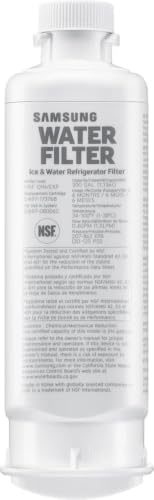
Prices are Amazon’s listed prices as of the time shown and change often; check Amazon for today’s price. As an Amazon Associate we earn from qualifying purchases.
What the Change-Filter Light Actually Measures
Many owners treat the filter light as a sensor that knows when the filter is dirty. On most refrigerators it is not. In most models the indicator is a timer, and in some it is a timer combined with a running estimate of how much water the dispenser has delivered. It does not test the water, measure flow restriction directly or detect contamination.
That has a few practical consequences:
- The light can come on early or late relative to real wear. A filter on sediment-heavy well water may be clogged long before the timer runs out. A filter in a refrigerator that sat unplugged for a while may still show green even though it has been sitting stagnant.
- The light only knows what you tell it. If someone reset the light without changing the cartridge, or changed the cartridge without resetting the light, the indicator is out of step with the filter.
- Ice may not count. On some designs the ice maker draws water through the filter but the usage estimate is based mainly on dispenser time. Heavy ice use can wear a filter faster than the light suggests.
- A “smart” refrigerator app usually works the same way. Connected models often report the same timer or usage estimate through an app; they are reminders, not water tests.
The safest approach is to use the light as a reminder and keep your own record: write the installation date on a piece of tape on the cartridge or note it in your phone. If the light and your date disagree, go by the date and the manufacturer’s interval.
Signs Your Refrigerator Filter Is Overdue
A filter that has reached the end of its life usually gives some signals before the light changes, or long after it was ignored. Any of these suggest it is time for a new cartridge:
- Slower dispenser flow. A carbon block that has trapped particles restricts flow. If filling a glass takes noticeably longer than it used to, a clogged filter is the most common cause, although low household pressure, a kinked supply line or a partly closed saddle valve can do the same.
- Taste and odor coming back. If the chlorine taste or an earthy, musty or stale smell returns, the carbon may be exhausted or the cartridge may be harboring growth.
- Smaller, hollow or cloudy ice cubes. Restricted flow can starve the ice maker, so cubes come out small, thin or incomplete. Cloudy ice on its own is often just trapped air and is not a reliable filter signal.
- Sputtering or spitting at the dispenser. Air in the line is normal right after a filter change. If it persists weeks later, the cartridge may not be seated correctly or may be failing.
- The filter is simply old. If you cannot remember when it was changed, or the date written on it is more than about six months ago, replace it.
Some signals are not about the filter. Black specks immediately after installing a new cartridge are usually loose carbon fines, which is why flushing matters. Leaks at the filter head usually point to a damaged O-ring, a cross-threaded cartridge or a non-genuine filter that does not fit the housing tightly. Water that looks discolored, smells of sulfur or tastes metallic even with a new filter suggests a supply issue worth testing rather than another cartridge.
How to Change a Refrigerator Water Filter
The exact steps depend on where the filter lives. Common locations include the upper right corner inside the fresh-food compartment, a pull-down compartment in the ceiling of the fridge, a twist-in housing in the base grille below the doors, or a cartridge behind a small panel near the crisper drawers. The steps below cover the general process; check your manual or the brand guides linked above for the specifics.
- Confirm the replacement part. Match the cartridge model number to the one printed on the old filter or listed in your manual. Filters that look alike often use different locking tabs or bypass designs.
- Get a towel ready. A small amount of water usually drips out when the old cartridge comes free, especially from base-grille and ceiling designs.
- Remove the old filter. Most cartridges turn a quarter-turn counterclockwise and pull straight out. Push-button designs release when you press the eject button. Some housings have a cap that must be removed and kept for the new filter.
- Wear gloves if you can. CDC recommends wearing gloves while changing filters and washing your hands afterward, because a used filter holds whatever it caught. CDC also advises that people with weakened immune systems avoid changing water filters themselves.
- Prepare the new cartridge. Remove the protective cap and any packaging. Check that the O-rings are in place and undamaged. Write today’s date on the cartridge.
- Install the new filter. Insert it fully and turn clockwise until it locks, or push until it clicks for push-in types. Do not force it; resistance usually means it is misaligned.
- Check for leaks. Look around the housing for a few minutes after the water starts flowing through it.
Flushing a new filter
A new carbon cartridge contains air and loose carbon dust. Most manufacturers tell owners to run water through the dispenser before drinking it. A common instruction is to dispense several gallons, often in short bursts into a pitcher, and discard it; the exact volume varies by brand and is printed in the filter instructions. Expect sputtering, cloudy-looking water that clears from the bottom up as air escapes, and possibly a few black specks in the first containers. Many owners also discard the first batch or two of ice made after a change, since the ice maker may have drawn water before the line was fully flushed.
Pressing a glass against the paddle continuously for a long time can cause some dispensers to pause, so short cycles with a few seconds of rest are gentler on the valve.
How to Reset the Filter Indicator Light
Changing the cartridge does not usually reset the light. Most refrigerators need a deliberate reset, and the method varies by brand and model. Typical approaches include:
- Press and hold. Hold a button labeled Filter, Filter Reset, Water Filter or similar for about three to five seconds until the indicator changes color or turns off.
- Button combination. Some models require holding two buttons at once, such as the filter button and a lock or ice button.
- Menu reset. Models with a digital display may have the filter reset under a settings or maintenance menu.
- Automatic reset. A few designs detect a new cartridge and reset on their own.
If the light will not reset, the control panel may be locked; unlock it first. If it still will not reset, check the manual for your exact model number, which is usually on a label inside the fresh-food compartment. Resetting the light without changing the filter is a common reason owners lose track of how old a cartridge really is, so reset only after a real change.
Factors That Shorten or Stretch the Interval
The six-month figure assumes an average household on treated municipal water. Several things move the real-world interval.
Water use
A family that fills bottles at the dispenser, cooks with dispenser water and runs the ice maker hard will burn through a gallon rating quickly. If your filter is rated for a few hundred gallons and your household uses a couple of gallons a day, you are likely to reach the gallon limit before six months.
Water source and sediment
Homes on private wells often deliver more sediment, iron or manganese than city water. These clog carbon and stain housings. Many Front Range foothill and rural properties are on wells, and EPA’s private well guidance on protecting your home’s water recommends testing a household well regularly; a well test tells you whether a whole-house sediment or iron filter upstream would protect the refrigerator cartridge and other fixtures.
Municipal disinfectant and taste
Front Range utilities largely draw from treated snowmelt and reservoir sources and keep a residual disinfectant in the water. Taste and odor from that disinfectant is one of the main reasons people want a fridge filter, and a returning chlorine taste is often the first thing owners notice when a cartridge is exhausted. Seasonal changes in source water, such as spring runoff, can also make an aging filter more noticeable.
Idle time
Second homes in the mountains, rentals between tenants and houses that sit on the market for months all leave water standing in the line and cartridge. When a refrigerator has been idle for weeks, the cautious approach is to install a new filter and flush the line before using the dispenser or ice again.
Genuine versus compatible filters
Compatible or generic cartridges are often cheaper, and many fit and perform well. The questions to ask are the same for any filter: which NSF/ANSI standards is it certified to, what capacity was it certified at, and does it fit the housing without leaking? A cartridge with a lower certified capacity may need replacement sooner. Our guide to the best refrigerator water filters compares options; see our picks there when you are ready to buy.
Typical Costs of Staying on Schedule
Replacement cartridges span a wide range. As a typical national picture, brand-name filters from the refrigerator maker often cost noticeably more than certified compatible cartridges, and multi-packs usually lower the per-filter price. The main cost drivers are the brand, the certification list (filters certified for lead and other health contaminants generally cost more than taste-and-odor-only filters), the cartridge design and the retailer.
Over a year, most households buy two cartridges, or three to four for heavy users. Compared with the cost of bottled water or the cost of a service call for a frozen or clogged line, staying on schedule is usually inexpensive. A bypass plug, available for some models, lets the dispenser run without a filter, but it also removes the taste and contaminant reduction, so it is a short-term workaround rather than a money saver for most people.
What Inspectors Notice and When to Call a Pro
A standard home inspection is not a water-quality test, and inspectors generally do not evaluate refrigerator filters as part of a typical scope. Still, an inspector checking the kitchen often notices the conditions around the refrigerator that affect the filter and the water line:
- Water stains, swelling or soft flooring around the base of the refrigerator, which can point to a leaking filter head, supply line or ice maker valve
- Older plastic or self-piercing saddle valves feeding the supply line, which are prone to leaks
- Kinked or crushed supply tubing behind the unit
- Signs of moisture damage in the cabinet or subfloor below
Call a plumber or appliance technician if the dispenser stays slow after a fresh filter, if the filter head leaks with a correctly installed genuine cartridge, if the ice maker stops working after a change, or if you find a damp floor under the refrigerator. If the water tastes, smells or looks off even with a new cartridge, the issue is probably upstream of the refrigerator, and a water test is the logical next step.
Buying or selling a Front Range home and want the kitchen plumbing, supply lines and moisture risks checked properly? Contact our team to arrange an inspection.
References
- Home Drinking Water Filtration Fact Sheet — U.S. Environmental Protection Agency
- About Choosing Home Water Filters — Centers for Disease Control and Prevention
- About Home Water Treatment Systems — Centers for Disease Control and Prevention
- Protect Your Home’s Water — U.S. Environmental Protection Agency
Frequently asked questions
How often should a refrigerator water filter be changed?
Most manufacturers recommend about every six months, or sooner if the filter reaches its rated gallon capacity first. Heavy water and ice use, sediment in the supply or long idle periods can all justify changing it earlier. Your filter's packaging and the refrigerator manual are the final word.
Does the filter light on my refrigerator measure water quality?
Usually not. On most refrigerators the change-filter light is a timer, sometimes combined with an estimate of dispenser use. It does not test the water or detect contamination, so keep your own record of the installation date.
What happens if you never change a refrigerator water filter?
Flow slows as the carbon clogs, taste and odor problems return, and the filter stops meeting its contaminant-reduction claims. EPA notes that carbon filters become clogged and ineffective after their rated volume, and CDC says filters must be maintained to prevent germs from growing in them.
How much water should be flushed through a new refrigerator filter?
It varies by brand, and the filter instructions give the exact amount. A common instruction is to dispense several gallons in short bursts and discard it, which removes air and loose carbon fines. Many owners also discard the first batch of ice.
Should a refrigerator filter be changed after moving into a house?
Yes. You cannot know how long the existing cartridge has been in place or how much water it has treated, and vacant homes often leave water standing in the line. Installing a new filter and flushing it at move-in is a simple precaution.