Kitchen Faucet Leaking: Find the Source and Fix It

A kitchen faucet leaking is one of the most common plumbing complaints in any house, and it is also one of the easiest to misdiagnose. A steady drip from the spout, a puddle that forms around the base every time the handle moves, and a damp cabinet floor below the sink are three different problems with three different fixes. The faucet you have matters too: a cartridge faucet, a ball faucet, a compression faucet and a ceramic disk faucet each fail in their own way and take different parts. This guide walks through how to tell where the water is coming from, how each faucet design works, how to replace O-rings and cartridges, why pull-down sprayer hoses leak, how hard water and high pressure speed up wear, and when replacing the whole faucet makes more sense than repairing it. Cost figures are general 2026 ranges that vary by brand, region and contractor.
Part of our Plumbing & Water guide — start there for the full picture →
Plumbing problem? Talk to a local plumber now.
📞 Call (877) 637-1527Why Is My Kitchen Faucet Leaking? Three Places to Look
Start by watching the faucet closely with a dry paper towel in hand. Where the water first appears tells you which part has failed.
Drip From the Spout
If water drips from the spout outlet after the handle is fully off, the internal seal that stops water flow is no longer sealing. Depending on the faucet type, that seal is a rubber washer, a pair of rubber seats and springs, a cartridge, or a set of ceramic disks. A spout drip almost never damages the house, but it wastes water around the clock and usually gets worse over time.
Leak at the Base or Around the Handle
Water that pools around the base of the spout or seeps out under the handle while the faucet is running usually points to worn O-rings. On swivel-spout faucets, two or three O-rings seal the spout to the faucet body, and they wear each time the spout swings from one bowl to the other. A leak right under the handle can also mean a loose cartridge retaining nut or a cracked cartridge housing.
Water Under the Sink
If the cabinet below is wet, the faucet may not be the culprit at all. Supply lines, shutoff valves, the drain assembly, the disposal and the dishwasher hose all share that cabinet. Water from a failing pull-down sprayer hose also ends up there, out of sight. Our guide to tracing a leak under the kitchen sink walks through how to test each of those components one at a time. A useful rule of thumb: a leak that only appears while the faucet runs is on the faucet, sprayer hose or drain side; a leak that drips with everything off is on the pressurized supply side and will not stop on its own.
Identify Your Faucet Type Before Buying Parts
Buying the wrong replacement part is the most common reason a faucet repair takes two trips to the hardware store. Most kitchen faucets fall into four designs.
Cartridge Faucets
Cartridge faucets use a hollow cylinder that moves up and down or rotates to control flow and temperature. They are common in both single-handle and two-handle designs. A leaking cartridge usually causes a spout drip, while worn O-rings on the outside of the cartridge can let water seep around the handle. Cartridges are brand-specific, so take the old one to the store or order by model number.
Ball Faucets
Ball faucets have a single handle sitting on top of a rounded cap, with a slotted metal or plastic ball inside. Rubber seats and springs press against the ball to seal the inlets. When the seats and springs wear, the spout drips; when the cam or the O-rings around the body wear, water leaks at the handle or base. Repair kits that include seats, springs, the cam and O-rings are widely sold for common ball faucet brands.
Compression Faucets
Compression faucets are the oldest design and have separate hot and cold handles that tighten down onto a rubber washer. They are increasingly rare in kitchens but still turn up in older Front Range homes, utility sinks and basement bars. A spout drip almost always means a worn washer, and a leak around the handle stem usually means worn packing or a stem O-ring.
Ceramic Disk Faucets
Ceramic disk faucets use two hard ceramic disks that slide against each other inside a cylinder. They are generally durable, and many mid-range and premium faucets use them. Leaks tend to come from the rubber seals at the bottom of the cylinder rather than from the disks themselves, though disks can crack or become scored by sediment. Replacement cylinders are model-specific.
Best Kitchen Faucets: our top 3 picks
| Product | Best for | Key features | Price | Buy |
|---|---|---|---|---|
| VFAUOSIT 06STV | Best overall pull-down faucet |
| $26.98as of Oct 28, 2026 6:28 am GMT+0000 | Buy now →Check current price |
| FORIOUS FF0023C | Best for measuring a replacement |
| $43.99as of Oct 28, 2026 6:28 am GMT+0000 | Buy now →Check current price |
| LUFG LB0U003F1DP | Best certified faucet with deck plate |
| $27.89as of Oct 28, 2026 6:28 am GMT+0000 | Buy now →Check current price |


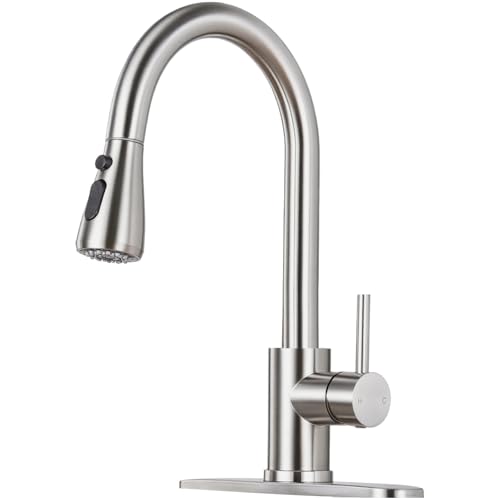
Prices are Amazon’s listed prices as of the time shown and change often; check Amazon for today’s price. As an Amazon Associate we earn from qualifying purchases.
How to Fix a Leaking Kitchen Faucet Step by Step
The exact steps vary by brand, so download the manufacturer’s parts diagram if one is available. The general sequence below covers most cartridge and ceramic disk repairs and the O-ring replacement that cures most base leaks.
Prepare the Work Area
- Turn off the water. Close both shutoff valves under the sink. If a valve will not turn or keeps dripping, close the main shutoff instead. EPA’s WaterSense program includes the same reminder in its faucet repair tips: turn off the water line before starting.
- Relieve pressure. Open the faucet to drain the water still in the lines.
- Plug the drain. Put a stopper or a rag in the drain opening so small screws and clips cannot fall in.
- Lay out a towel. Place parts on the towel in the order they come off. A phone photo at each step makes reassembly much easier.
Replace a Cartridge or Ceramic Disk Cylinder
- Pry off the decorative cap on the handle and remove the handle screw, which often needs a small hex key.
- Lift off the handle and unscrew the dome cap or retaining nut.
- Note the orientation of the cartridge (many have a tab or marking that indicates hot and cold), remove any retaining clip, then pull the cartridge straight up. Stubborn cartridges may need a brand-specific cartridge puller.
- Inspect the faucet body for mineral scale or debris and clean it gently with a soft cloth. Avoid scratching the sealing surfaces.
- Install the new cartridge in the same orientation, lightly coating its O-rings with plumber’s silicone grease if the manufacturer recommends it.
- Reassemble the retaining nut and handle, turn the water back on slowly, and check for leaks at the spout, handle and base.
If hot and cold come out reversed after the repair, the cartridge was installed rotated 180 degrees. Shut the water off again and turn it.
Replace Spout O-Rings
- With the handle and cartridge or ball assembly removed, lift the spout straight up off the faucet body. Some spouts are held by a set screw or a collar nut.
- Cut off the old O-rings with a utility knife, taking care not to score the brass body.
- Clean the grooves, roll on new O-rings of the exact size, and coat them lightly with silicone grease.
- Press the spout back down with a slight twisting motion and reassemble.
Replacing O-rings without replacing a worn cartridge or ball seat sometimes just moves the leak, so many homeowners install a full repair kit while the faucet is apart.
Pull-Down and Pull-Out Sprayer Hose Leaks
Pull-down and pull-out faucets add a flexible hose that runs from the spray head, down through the spout, and connects to the supply under the sink. These hoses flex every time the spray head is used, and that movement eventually wears the hose or loosens the connections. Typical failure points include:
- The quick-connect under the sink. If the fitting is not fully seated or its O-ring is damaged, it can spray or drip whenever the faucet runs.
- The hose itself. Braided nylon or metal sheathing can hide a pinhole leak in the inner tube. Water then runs down the hose into the cabinet, often only while the faucet is on.
- The spray head connection. A worn washer where the hose threads onto the spray head lets water drip from the head or run along the hose.
- The diverter. A failing diverter can cause weak spray, water coming from the wrong outlet, or dripping from the spray head.
To check the hose, run the faucet with the cabinet open and a flashlight on the hose loop. Dry everything first and wrap a paper towel around each connection. Many manufacturers sell replacement hoses by model, and swapping one usually takes less than an hour.
Hard Water, High Pressure and Faster Faucet Wear
Many parts of the Front Range have moderately hard to hard water, depending on the water provider and source. Calcium and magnesium leave white scale on aerators, spray heads and cartridges. Scale on a cartridge or ceramic disk can prevent it from closing completely, which shows up as a slow spout drip. Scale also roughens rubber seals as they move, shortening their life.
Cleaning the aerator and spray head with a vinegar soak helps restore flow, but it does not address scale inside the faucet body. Homeowners who replace cartridges every couple of years, or who see heavy buildup on every fixture, may want to read our overview of how water softeners work and what they cost before committing to another round of parts.
Water pressure is the other hidden factor. Pressure that runs too high stresses cartridges, hoses, valves and every other fixture in the house. Signs include banging pipes, a toilet that runs intermittently, and supply hoses or sprayer hoses that fail more often than expected. An inexpensive hose-bib gauge gives a quick reading, and our guide to testing household water pressure explains what the numbers mean and when a pressure-reducing valve may need adjusting or replacing. Fixing a faucet without addressing excessive pressure can lead to the same leak returning.
How Much Water Does a Dripping Faucet Waste?
A slow drip looks harmless, but it adds up. According to EPA’s WaterSense program, a faucet that drips at one drip per second can waste more than 3,000 gallons per year. EPA also notes that old and worn faucet washers and gaskets frequently cause these leaks, and that fixing easily corrected household leaks can save homeowners about 10 percent on their water bills.
WaterSense publishes a simple whole-house check worth running if more than one fixture is suspect: read the water meter before and after a two-hour period when no water is being used. If the meter changes at all, there is probably a leak somewhere in the home. EPA also suggests examining faucet gaskets and pipe fittings for water on the outside of the pipe.
Leaks under the sink carry a second cost beyond the water bill. Cabinet bases are typically made of particleboard or MDF, which swells and crumbles when it stays wet. EPA’s mold guidance stresses drying water-damaged areas and items within 24 to 48 hours to prevent mold growth, so a hose or supply leak that soaks the cabinet floor deserves prompt attention even if the faucet itself is working normally.
Repair or Replace the Faucet?
Most faucet leaks can be repaired, but replacement sometimes makes more sense. Consider these factors:
| Situation | Usually Repair | Consider Replacing |
|---|---|---|
| Faucet age | Under 10 to 15 years, parts still sold | Older, discontinued model, parts hard to find |
| Leak source | Single cartridge, O-ring or hose | Cracked faucet body or corroded base |
| Warranty | Covered by manufacturer’s lifetime parts warranty | No warranty and multiple parts failing |
| Condition | Finish and spout in good shape | Pitted finish, wobbly base, poor spray head |
| Remodel plans | Keeping existing sink and countertop | Changing sink or countertop soon anyway |
Check the warranty before buying anything. Several major faucet brands offer limited lifetime warranties on parts for the original purchaser, and some will ship a replacement cartridge at no charge with proof of purchase or a model number. Warranty terms vary by brand and usually exclude labor.
Kitchen Faucet Repair and Replacement Costs
Costs depend heavily on the brand, the parts required, local labor rates and whether the repair turns up other problems such as seized shutoff valves. The ranges below are general 2026 estimates for budgeting, not quotes.
- O-rings, washers or a basic repair kit: roughly $5 to $30 for DIY parts.
- Replacement cartridge: often $15 to $80 depending on brand and model, sometimes free under warranty.
- Pull-down sprayer hose: commonly $25 to $75 for the part.
- Plumber repair visit: often around $150 to $350 including a cartridge or O-ring replacement, with higher minimums in some areas or for after-hours calls.
- New faucet (fixture only): roughly $100 to $400 for many mid-range models, with premium and touchless faucets often costing more.
- Faucet installation labor: commonly $150 to $350, more if shutoff valves or supply lines also need replacement.
Old shutoff valves are worth inspecting during any faucet job. Multi-turn valves that have not been turned in years can seize or start leaking at the stem once disturbed. Replacing them while the water is already off often costs less than a separate service call later.
What Home Inspectors Look for at the Kitchen Faucet
A faucet leak in a house that is being bought or sold usually shows up during the general home inspection. The ASHI Standard of Practice directs inspectors to inspect interior water supply and distribution systems, including fixtures and faucets, as well as interior drain, waste and vent systems. That typically means running the faucet, checking for leaks at the spout and base, looking for active drips or staining in the sink cabinet, and noting functional flow.
The same standard also lists items an inspector is not required to do, such as measuring water supply flow and pressure or inspecting water conditioning systems. Buyers who want those answered may need a separate pressure check or a plumber’s evaluation. Cabinet staining, swollen particleboard or a musty odor are worth calling out in a report even when no active leak is visible, because they suggest a past problem that may not have been fully repaired. For context on how this fits into the broader inspection process, see our hub on hiring a home inspector on the Front Range and the related coverage of plumbing and water issues.
When to Call a Plumber
A homeowner with basic tools can handle most O-ring, cartridge and sprayer hose repairs. A plumber is a better choice in these situations:
- The shutoff valves under the sink will not close fully or leak when turned.
- The faucet body is cracked or the base is corroded through.
- The leak continues after a cartridge and O-ring replacement.
- Water pressure measures high and a pressure-reducing valve needs work.
- The cabinet floor, wall or subfloor is soft, swollen or shows mold growth.
- The faucet connects to a filtration system, instant hot water dispenser or other add-on that complicates the plumbing.
Persistent leaks in several fixtures at once can point to a system issue such as high pressure or aggressive water chemistry rather than coincidental wear. Treating the cause is usually cheaper over time than replacing parts one fixture at a time.
References
- Fix a Leak Week: Checking for Leaks and Faucet Leaks — U.S. EPA WaterSense
- WaterSense Statistics and Facts — U.S. EPA WaterSense
- A Brief Guide to Mold, Moisture and Your Home — U.S. Environmental Protection Agency
- ASHI Standard of Practice for Home Inspections — American Society of Home Inspectors
Frequently asked questions
Why is my kitchen faucet leaking at the base?
A leak around the base of the spout usually means the O-rings that seal the spout to the faucet body are worn. They wear each time the spout swivels. Replacing them, often along with the cartridge or repair kit, typically stops the leak.
How do I know what type of kitchen faucet I have?
Single-handle faucets with a rounded cap often use a ball, while most modern single and two-handle faucets use a cartridge or ceramic disk cylinder. Older two-handle faucets that tighten down are compression faucets. The brand and model number, often found on the base or in the manual, confirm the exact part.
Is a dripping kitchen faucet worth fixing?
Usually yes. EPA WaterSense estimates that a faucet dripping once per second can waste more than 3,000 gallons a year, and the repair parts often cost under $50. A drip also tends to get worse as seals and cartridges wear further.
Why does my pull-down kitchen faucet leak under the sink?
The flexible hose, its quick-connect fitting or the hose-to-spray-head connection can wear from repeated flexing. Run the faucet with the cabinet open and dry paper towels around each connection to find the source. Replacement hoses are sold by faucet model.
Should I repair or replace a leaking kitchen faucet?
Repair is usually best when parts are available and the faucet body is sound, especially if a manufacturer warranty covers the cartridge. Replacement makes more sense for older discontinued models, cracked or corroded bodies, or when multiple parts are failing at once.
Noticed a stained or swollen sink cabinet in a home you are about to buy? Contact us and we can connect you with a Front Range home inspector who will check the faucet, supply lines and surrounding cabinetry for signs of past or active leaks.