Baseboard Heater: Electric vs Hydronic, Clearances and Costs

Long, low metal heaters along the bottom of exterior walls are a familiar sight in Colorado condos, basement apartments, mountain cabins and older Front Range additions. Some are electric resistance units wired to their own 240-volt circuits; others are hydronic fin-tube radiators fed by hot water from a boiler. Both are quiet and duct-free, and both are easy to overlook during a showing. Yet a baseboard heater can tell a buyer a lot about a home: how it is heated, what winter bills may look like, whether the wiring was done carefully, and whether furniture and curtains are sitting too close to a hot surface. This guide explains the two main types, how they are wired and controlled, the clearance and fire-safety issues that matter most, routine cleaning, operating cost compared with heat pumps, and what repairs and replacements tend to cost.
Part of our Heating, Cooling & Ventilation guide — start there for the full picture →
What a Baseboard Heater Is and How It Works
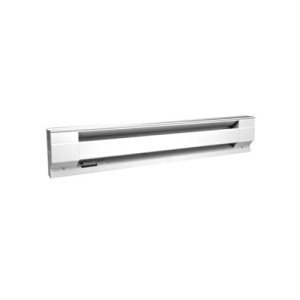
A baseboard heater is a room-by-room heat emitter mounted low on a wall, usually under a window. Cool air near the floor enters the bottom of the unit, passes over a heated element or fin tube, warms up, and rises out of the top. That rising air sets up a gentle convection loop across the room.
There are two broad families:
- Electric resistance baseboards. An electric element runs the length of the unit, surrounded by aluminum fins that spread the heat. Each heater, or each room’s group of heaters, is controlled by its own thermostat. Nothing burns, so there is no flue, no combustion air and no carbon monoxide from the heater itself.
- Hydronic (hot-water) baseboards. A copper pipe with closely spaced aluminum fins runs inside the cover. Hot water from a boiler circulates through the pipe, and the fins release the heat. A third, in-between category is the self-contained “hydronic” electric baseboard, which surrounds an electric element with sealed fluid so the unit keeps radiating heat after the element cycles off. It is still an electric heater, with no boiler or piping.
The two look similar from across a room. A quick way to tell them apart is to look at the end caps and the wall behind them: hydronic units have pipes entering through the floor or wall and usually connect to a boiler in the basement or mechanical room, while electric units have a junction box at one end and no piping at all.
Electric Resistance vs Hydronic Baseboards
Electric resistance
Electric baseboards are inexpensive to buy and simple to install, which is why they show up in additions, finished basements, and multifamily buildings where running ductwork or gas lines would be difficult. Every room becomes its own zone, so unused rooms can be kept cooler. The downside is operating cost. Resistance heat converts electricity directly into heat at roughly one unit of heat per unit of electricity, which makes it one of the more expensive ways to heat a whole house in most utility markets.
Electric units also tend to cycle on and off sharply, especially with older bimetal thermostats, so rooms can swing a few degrees above and below the set point. Surface temperatures on the fins and cover can be high enough to scorch fabrics or melt plastic items left against them.
Hydronic baseboards
Hydronic baseboard is part of a boiler system. The boiler, often gas-fired in the Denver metro, heats water and a circulator pump moves it through loops of fin-tube baseboard. Zone valves or separate pumps let different areas be controlled independently.
Hydronic systems bring their own inspection points: boiler age and condition, expansion tank and relief valve, signs of leaks at fittings and valves, corrosion on copper and fins, and the possibility of frozen pipes if a loop runs along a poorly insulated exterior wall. The guide to boiler repair covers common boiler failures and service questions. Homes with hydronic heat sometimes also have tubing in the floors; the guide to radiant floor heating explains how in-floor systems compare with baseboard emitters.
Which is better?
Neither type is universally better. Hydronic baseboard paired with a modern, efficient boiler usually costs less to run than electric resistance in areas with reasonably priced natural gas, but it costs more to install and requires boiler maintenance. Electric baseboards make sense in small spaces, rarely used rooms, and as supplemental heat. For whole-house heat in a Front Range climate, many owners of all-electric homes eventually look at heat pumps, discussed below.
Best Baseboard Heaters: our top 3 picks
| Product | Best for | Key features | Price | Buy |
|---|---|---|---|---|
| Cadet F Series 2F500W | Best permanent 240V baseboard |
| $51.98as of Oct 29, 2026 8:49 am GMT+0000 | Buy now →Check current price |
| Cadet 05534 | Best permanent 120V baseboard |
| $79.21as of Oct 29, 2026 8:49 am GMT+0000 | Buy now →Check current price |
| Comfort Zone CZ650B | Best portable with digital thermostat |
| $48.87as of Oct 29, 2026 8:49 am GMT+0000 | Buy now →Check current price |


Prices are Amazon’s listed prices as of the time shown and change often; check Amazon for today’s price. As an Amazon Associate we earn from qualifying purchases.
Wiring: 240-Volt Circuits and Breakers
Most permanently installed electric baseboard heaters in North American homes run on 240 volts, though 120-volt models exist for small rooms. A 240-volt heater is fed by a circuit protected by a two-pole breaker in the panel, which occupies two adjacent spaces and disconnects both hot conductors at once. The guide to the double pole breaker explains how these breakers work and why a single-pole breaker cannot serve a 240-volt load.
A few wiring points tend to come up during inspections and remodels:
- Circuit sizing. Each circuit has a maximum continuous load it can safely carry. Adding heaters to an existing circuit without checking the total wattage can overload it. An electrician sizes wire and breaker for the total connected wattage with the margins required by the electrical code.
- Junction box connections. Connections are made inside the heater’s built-in junction box. Loose or overheated connections can discolor the box or melt insulation. A burning smell when the heater first runs in fall is often dust, but a persistent electrical smell or discoloration warrants an electrician.
- Outlets above heaters. Electrical code guidance and manufacturer instructions generally warn against installing baseboard heaters directly below receptacles, because cords can drape across the hot surface. Some manufacturers offer heaters with built-in receptacles that are listed for that purpose.
- Mismatched voltage. A 240-volt heater accidentally wired to 120 volts produces roughly a quarter of its rated output, which can explain a room that never warms up. The reverse, 120-volt units on 240 volts, is a serious hazard.
Homeowners sometimes ask whether an existing 220 outlet can be used for a plug-in heater. Permanently installed baseboards are hardwired, and any change in heater wattage or circuit layout is work for a licensed electrician who can confirm the panel has capacity. If the panel is already full or the home is adding several electric heaters, an electrical panel upgrade may enter the conversation.
Line-Voltage Thermostats and Controls
Unlike a furnace thermostat, which runs on low-voltage control wiring, an electric baseboard thermostat usually switches the full 240-volt current to the heater. These are called line-voltage thermostats. They come in a few forms:
- Built-in thermostats mounted on the heater itself. These sense air temperature right next to the heater, so they tend to be less accurate and can short-cycle.
- Wall-mounted mechanical thermostats with a simple dial. Durable but often imprecise.
- Electronic and programmable line-voltage thermostats that hold temperature more tightly, allow setbacks, and in some models connect to Wi-Fi.
The most important point is compatibility. A standard low-voltage thermostat designed for a furnace or heat pump will not work on a line-voltage baseboard circuit and can fail dangerously if connected. Smart thermostats marketed for baseboards are a separate product category. The guide to thermostat wiring explains the difference between low-voltage and line-voltage systems and why mixing them causes problems.
Hydronic baseboards, by contrast, are usually controlled by low-voltage thermostats that open zone valves or start circulator pumps, so a standard thermostat may be appropriate there. A buyer touring a home with both systems should not assume the controls are interchangeable.
Clearances, Furniture, Drapes and Fire Risk
Baseboard heaters are designed to be safe in normal use, but they need space. Manufacturers publish minimum clearances in their installation manuals, typically covering distance to drapes, furniture, and the floor covering beneath the unit. Those clearances exist because the top of the heater discharges hot air and the cover can get hot enough to damage or ignite nearby materials over time.
The U.S. Fire Administration reports that heating was the second leading cause of home fires in 2021, with an estimated 32,200 home heating fires. Its general advice is to keep anything that can burn at least 3 feet from heat sources such as fireplaces, wood stoves, radiators and space heaters. Baseboard manufacturers’ clearances for specific items can differ, so the installation manual governs, but the USFA guidance is a useful rule of thumb for bedding, papers and laundry.
Common problems inspectors and homeowners notice include:
- Couches, beds or dressers pushed tight against the heater, blocking airflow and trapping heat.
- Floor-length curtains or drapes hanging over the top of the unit.
- Thick carpet or rugs tucked under the heater, blocking the intake.
- Toys, papers, laundry or electronics stored on or against the cover.
- Damaged or missing end caps and covers that expose the element or fins.
- Cords draped across the top of the heater from outlets above.
Bedrooms deserve extra attention, especially children’s rooms, where furniture is often arranged along the walls. Tall dressers and bookcases moved away from a heater should still be secured; the guide to furniture anchors covers tip-over prevention. Older heaters with bent fins, missing covers or scorched paint above them are worth flagging for an electrician’s review, and working smoke alarms on every level remain the baseline safety measure in any home heated room by room.
Cleaning Fins and Routine Maintenance
Baseboard heaters need very little maintenance, but they do collect dust, pet hair and debris. Dust on the fins acts as insulation, reduces output, and produces the familiar burning-dust smell at the start of the heating season.
A typical annual cleaning routine for electric units looks like this:
- Turn the thermostat down and switch off the breaker for the heater circuit. Confirm the unit is cool.
- Remove the front cover if the manufacturer’s instructions allow it.
- Vacuum the fins gently with a brush attachment, working along the length of the element. Fins bend easily.
- Straighten bent fins carefully with a fin comb or flat tool; crushed fins restrict airflow.
- Wipe the cover, reinstall it, and restore power.
Hydronic baseboards are cleaned the same way, without the electrical shutoff step, though owners should look for green or white crust at copper joints and valves, which can indicate slow leaks. Air trapped in hydronic loops can make gurgling noises or leave some baseboards cold; many systems have bleed valves, and a heating contractor can purge air if the problem persists.
Signs that a heater needs professional attention include a unit that stays cold while the thermostat calls for heat, a unit that never shuts off, clicking or buzzing from the thermostat, discoloration around the junction box, or a breaker that trips repeatedly.
Operating Cost vs Heat Pumps
Operating cost is the biggest practical drawback of electric resistance baseboard heat. Each kilowatt-hour of electricity becomes about one kilowatt-hour of heat. Heat pumps move heat rather than creating it, so they can deliver more heat than the electricity they consume.
ENERGY STAR describes air-source heat pumps as able to deliver up to three times more heat energy to a home than the electrical energy they use, and lists switching from electric resistance heat among the ways heat pumps can lower energy bills. For homes without ducts, ENERGY STAR notes that ductless mini-split heat pumps are an alternative to radiator or baseboard heating, and says certified mini splits use up to 60% less energy than standard home electric radiators. Actual savings depend on local electricity rates, outdoor temperatures, the specific equipment, the home’s insulation and how the occupants use the heat.
In Colorado, cold-climate heat pumps have become a common replacement for baseboard heat in condos and additions. Before replacing anything, it can pay to look at the building envelope: air sealing and insulation upgrades reduce the heat needed regardless of the heating system.
For buyers, a useful step is to request a year of utility bills. An all-electric home heated by resistance baseboards can carry noticeably higher winter bills than a similar home with a gas furnace or a heat pump, and that difference belongs in the budget.
What a Home Inspection Covers
The ASHI Standard of Practice directs inspectors to inspect installed heating equipment and distribution systems and to describe the energy source and heating system. In practice, an inspector will typically note whether heaters are present in each room, operate them through normal controls when conditions allow, and comment on obvious damage, clearance concerns and missing covers. The standard also says inspectors are not required to determine heat supply adequacy or distribution balance, so a home inspection will not confirm that each room heats evenly in January.
Electrical items, such as double-tapped breakers, scorched wiring or improper breaker sizing found in the panel, fall under the electrical portion of the inspection. Measuring voltage or tracing circuits belongs to a licensed electrician.
Repair and Replacement Costs
Costs vary with brand, length and wattage, access, wiring condition and local labor rates. The ranges below are rough planning figures only, not quotes:
- Electric baseboard heater unit: standard residential models are often well under a few hundred dollars per heater, depending on length and features; hydronic-style electric and decorative models cost more.
- Electric heater replacement on an existing circuit: commonly a few hundred dollars per unit including electrician labor, more if the junction box or wiring needs repair.
- New 240-volt circuit for an added heater: often several hundred dollars or more, depending on panel capacity and how far the run is.
- Line-voltage thermostat replacement: typically modest for a basic model, higher for programmable or smart line-voltage thermostats.
- Hydronic baseboard repairs: wide range; replacing a damaged section of fin-tube, fixing a leaking valve, or purging air are smaller jobs, while boiler repairs or replacement are substantially larger.
- Converting from baseboard to a ductless heat pump: usually thousands of dollars or more depending on the number of indoor heads and electrical work, sometimes offset by utility rebates or tax incentives.
Asking contractors to itemize equipment, labor, permits and any panel work makes quotes easier to compare. In many Front Range jurisdictions, adding circuits or replacing heating equipment requires an electrical or mechanical permit.
When to Call a Professional
Basic cleaning and furniture placement are homeowner tasks. Call a licensed electrician for any new wiring, thermostat replacement on line-voltage circuits, heaters that stay cold or never shut off, burning-plastic smells, scorched outlets or breakers that trip repeatedly. Call a heating contractor for hydronic leaks, cold loops, boiler noises or pressure problems. Buyers who are weighing the long-term cost of a baseboard-heated home can use the broader guidance in the hiring a home inspector guide and the heating and cooling inspection hub to plan which specialists to bring in before closing.
References
- Heating Fire Safety — U.S. Fire Administration (FEMA)
- Air-Source Heat Pumps — ENERGY STAR (U.S. EPA)
- Ductless Heating and Cooling — ENERGY STAR (U.S. EPA)
- ASHI Standard of Practice for Home Inspections — American Society of Home Inspectors
Frequently asked questions
Are baseboard heaters safe to leave on overnight?
Permanently installed baseboard heaters are designed for continuous thermostat-controlled operation. The main risks come from blocked clearances, such as bedding, curtains or furniture against the unit, and from damaged wiring. Keeping combustibles away and maintaining working smoke alarms are the key precautions.
How far should furniture be from a baseboard heater?
Follow the manufacturer's installation manual for specific clearances. As a general rule, the U.S. Fire Administration advises keeping anything that can burn at least 3 feet from heat sources such as radiators and space heaters.
Can a regular thermostat control an electric baseboard heater?
Usually not. Most electric baseboards use line-voltage thermostats that switch 240 volts directly. Standard low-voltage furnace thermostats are not designed for that load. Use a thermostat listed for line-voltage baseboard heat.
Are baseboard heaters expensive to run?
Electric resistance baseboards are among the more expensive ways to heat a whole home because they convert electricity directly to heat. ENERGY STAR says ductless heat pumps can use up to 60% less energy than standard electric radiators, though actual savings vary.
What is the difference between electric and hydronic baseboard heat?
Electric baseboards heat an element with electricity and are wired to their own circuits. Hydronic baseboards circulate hot water from a boiler through finned copper pipe. Hydronic systems usually cost more to install but can be cheaper to operate with gas heat.
Touring a condo or older home heated room by room? Reach out through our contact page and we can connect you with a Front Range inspector who will check the heaters, clearances and electrical panel before you commit.