Best Baseboard Heaters (2026): 6 Electric Picks Compared

The best baseboard heater for your home depends on a question most product pages skip: do you want a permanent heater wired into a wall circuit, or a portable convector shaped like one that plugs into an outlet? Both use the same quiet, fanless convection that makes baseboard heat popular in bedrooms. Hot-water hydronic baseboard is a third category, plumbed into a boiler, and it is not something you buy as a standalone appliance. This roundup separates all three, then compares six electric picks on wiring, voltage, thermostat control, safety cutoffs and warranty. A buying guide on line-voltage thermostats, clearances, covers and running cost follows.
Part of our Heating, Cooling & Ventilation guide — start there for the full picture →
As an Amazon Associate we earn from qualifying purchases.
How we compared: a baseboard heater search returned 14 current Amazon listings. Eight are electric baseboard-style heaters, two of them permanent wired-in units and six portable plug-in convectors; the rest are wall heaters, line-voltage thermostats and a hydronic cover, which we discuss in the buying guide but did not rank. We judged each heater on what its listing states: voltage, wattage, installation type, thermostat, safety features, size and warranty. We did not lab-test or handle any of them. Prices and availability change, so check the current listing before buying.
Quick picks: the best baseboard heaters by install type
| Product | Best for | Key features | Price | Buy |
|---|---|---|---|---|
| Cadet F Series 2F500W | Best permanent 240V baseboard |
| $$ | Buy now →Check current price |
| Cadet 05534 | Best permanent 120V baseboard |
| $$ | Buy now →Check current price |
| Comfort Zone CZ650B | Best portable with digital thermostat |
| $ | Buy now →Check current price |
| BEYOND HEAT BH600 | Best ETL-certified portable |
| $$ | Buy now →Check current price |
| ROVSUN 48-inch | Best long portable with remote |
| $$ | Buy now →Check current price |
| Comfort Zone CZ600 | Best simple manual portable |
| $ | Buy now →Check current price |
Price key: $ under $50 · $$ $50–150 · $$$ $150–500 · $$$$ $500+. Prices change often; check Amazon for today’s price. As an Amazon Associate we earn from qualifying purchases.
The six picks, compared listing by listing
1. Cadet F Series 2F500W — Best Permanent 240V Baseboard Heater

30-inch hardwired convection baseboard, 500W at 240V or 375W at 208V, with a limited lifetime warranty.
Check price on Amazon$51.96 as of Oct 18, 2026 12:38 am GMT+0000 — prices change; see Amazon for current price.Why we like it
- True wired-in baseboard for permanent rooms
- Dual 240V and 208V rating spelled out
- Universal wiring and pre-punched knockouts
- Only limited lifetime warranty on the shelf
| Specification | Details |
|---|---|
| Installation | Permanent, hardwired to a 240V or 208V circuit |
| Output | 500W (1,710 BTU) at 240V; 375W (1,280 BTU) at 208V |
| Heating method | Convection, no fan |
| Thermostat | None built in; needs a wall or unit-mounted line-voltage thermostat |
| Size / weight | About 30 in long, 7 in tall; 6.1 lb |
| Model / warranty | 2F500W, part 09950; limited lifetime warranty |
Cadet F Series 2F500W — 30″ hardwired convection baseboard, 500W/240V or 375W/208V, universal wiring, white, lifetime limited warranty
One of Only Two Permanent Baseboard Heaters on the Shelf
Most of what turns up in a baseboard heater search is portable: six of the eight heaters are plug-in convectors with feet. The Cadet F Series and the 120V Cadet in pick 2 are the only two that install permanently along a wall, and this is the only 240V unit. That makes it the realistic replacement for an older baseboard in a Front Range basement or addition already wired for electric heat.
It is also the only listing that states output at both 240V and 208V. The difference matters: at 208 volts, common in some condos and multifamily buildings, the same heater delivers only 375 watts, about three quarters of its rated output. Check your building’s supply before sizing a room on the 240V number. Its limited lifetime warranty is the longest coverage stated anywhere on this shelf; every portable lists one year or nothing.
At 500 watts this is a small heater, meant for a bathroom, a short wall under a window or one of several sections in a larger room. The listing does not include a thermostat, so plan for a line-voltage wall control like the ones discussed below.
Pros
- Permanent, clean wall installation
- Clear 240V and 208V ratings
- Limited lifetime warranty
Cons
- Needs an electrician and a 240V circuit
- No built-in thermostat
- Low 500W output for its length
Check Cadet F Series 2F500W price on Amazon
2. Cadet 05534 — Best Permanent 120V Baseboard Heater
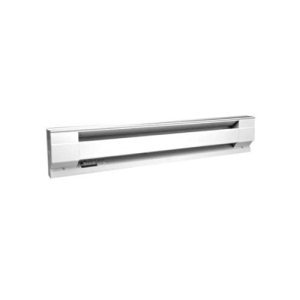
51.75-inch 120V, 1,000W floor-mount convection baseboard rated for about 175 sq ft, with no fan.
Check price on Amazon$78.10 as of Oct 18, 2026 12:38 am GMT+0000 — prices change; see Amazon for current price.Why we like it
- Permanent baseboard that runs on 120V
- Highest wired-in output here: 1,000W
- Stated coverage of 175 sq ft
- No fan, so no fan noise
| Specification | Details |
|---|---|
| Installation | Floor-mount permanent baseboard; 120V |
| Output / coverage | 1,000W, 3,412 BTU; up to 175 sq ft |
| Heating method | Radiant element with convection airflow, no fan |
| Thermostat | Not stated in listing |
| Size / weight | 51.75 in wide, 7.5 in tall; listed weight 47 lb |
| Model / warranty | 05534; warranty not stated in listing |
Cadet 05534 — 51.75″ 120V permanent baseboard, 1000W / 3,412 BTU, about 175 sq ft, fanless
The Only Permanent Baseboard on the Shelf That Runs on 120V
Permanent electric baseboard is usually a 240V product, which means a double-pole breaker and a dedicated run. The Cadet 05534 is the only wired-in heater on this shelf rated for 120V, so it can be a simpler retrofit in a room where a dedicated 120V circuit is easier to add than a 240V one. At 1,000 watts it draws a little over 8 amps.
The listing’s coverage claim of 175 sq ft is modest and plausible for an interior bedroom. In a room with a large north-facing window, two sections or a higher-wattage unit may be needed. Its length, just under 52 inches, puts more of the heating element along the wall than any other heater here.
The listing is thin on control details: it does not say whether a thermostat is built in, and it gives no warranty term. The listed 47 lb weight looks high for a unit this size and may reflect shipping packaging, so confirm before planning a solo install.
Pros
- 120V permanent installation option
- 1,000W along a 52-inch length
- Silent, fanless operation
Cons
- Thermostat not described
- No warranty term stated
- Listed weight seems inconsistent
Check Cadet 05534 price on Amazon
3. Comfort Zone CZ650B — Best Portable Baseboard Heater With a Digital Thermostat

1500W portable convection baseboard with digital thermostat display, two heat settings and a tip-over switch.
Check price on Amazon$48.87 as of Oct 18, 2026 12:38 am GMT+0000 — prices change; see Amazon for current price.Why we like it
- Only portable here with a digital thermostat display
- Tip-over switch and overheat sensor
- Stay-cool body reduces burn risk
- Light at about 4 lb
| Specification | Details |
|---|---|
| Installation | Portable, plugs into a 120V outlet |
| Output | 1,500W; two heat settings |
| Thermostat | Digital adjustable thermostat with temperature display |
| Safety | Tip-over switch, overheat protection sensor, stay-cool body, dent-proof end panels |
| Size / weight | About 35.75 in long; 4 lb |
| Model / warranty | CZ650B; 1-year warranty against defects |
Comfort Zone CZ650B — 1500W portable convection baseboard, digital thermostat, 2 heat settings, tip-over + overheat, stay-cool, 1-yr warranty
The Only Portable Convector Here With a Digital Readout
Six portable baseboard-style heaters appear on the shelf, and the Comfort Zone CZ650B is the only one whose listing describes a digital thermostat with a temperature display. Its siblings, the CZ600 in white and black and the identical EZ-HEAT version, use a manual dial. A number on a screen makes it easier to set the same temperature every night instead of nudging a knob.
The safety package matches the rest of the Comfort Zone line: tip-over switch, overheat sensor and a body that the listing says stays cool to the touch. Four of the six portables mention a stay-cool housing, all from this design family. A cool cabinet is useful along a wall where kids and pets brush past.
The listing does not name a certification mark or state a thermostat range. Like every portable here, it draws 1,500 watts on high, so it belongs on its own wall outlet.
Pros
- Digital thermostat with display
- Tip-over and overheat cutoffs
- Stay-cool body
Cons
- No certification mark named
- Thermostat range not stated
- One-year warranty
Check Comfort Zone CZ650B price on Amazon
4. BEYOND HEAT BH600 — Best ETL-Certified Portable Baseboard Heater

Slim 750W/1500W portable convection baseboard with adjustable thermostat, tip-over and overheat cutoffs, ETL named.
Check price on Amazon$59.99 as of Oct 18, 2026 12:38 am GMT+0000 — prices change; see Amazon for current price.Why we like it
- Only baseboard heater listing that names ETL
- States both wattages: 750W and 1500W
- Fanless convection with no hum claimed
- Slim profile sits flush against the wall
| Specification | Details |
|---|---|
| Installation | Portable, 120V plug-in |
| Output | 750W or 1,500W |
| Thermostat | Adjustable; type and range not stated |
| Safety / certification | Tip-over switch, overheat protection; ETL approved |
| Size / weight | About 30.7 in long, 7 in tall; 6 lb |
| Model / warranty | BH600; warranty not stated in listing |
BEYOND HEAT BH600 — 750/1500W portable convection baseboard, adjustable thermostat, tip-over + overheat, ETL, 6 lb
The Only Baseboard Heater Listing That Names a Testing Mark
None of the Comfort Zone, EZ-HEAT, ROVSUN or Cadet listings names ETL, UL or CSA. The BEYOND HEAT is the only one of the eight baseboard heaters whose listing says it is ETL approved. The U.S. Fire Administration advises choosing a heater tested by a recognized laboratory, so a named mark is a real point in its favor; for the others, look for the mark on the rating label.
It is also the only portable that states its low setting in watts, 750W, instead of just “low.” Knowing the actual draw helps when the heater shares a bedroom circuit with other loads, and the USFA advises not running other items on the same circuit as a portable heater where possible.
At 6 lb it is the heaviest portable, though still easy to move. The listing does not name a warranty or a thermostat range.
Pros
- ETL named in listing
- Stated 750W low setting
- Tip-over and overheat cutoffs
Cons
- Warranty not stated
- Thermostat details thin
- No digital display
Check BEYOND HEAT BH600 price on Amazon
5. ROVSUN 48-Inch — Best Long Portable Baseboard Heater With Remote
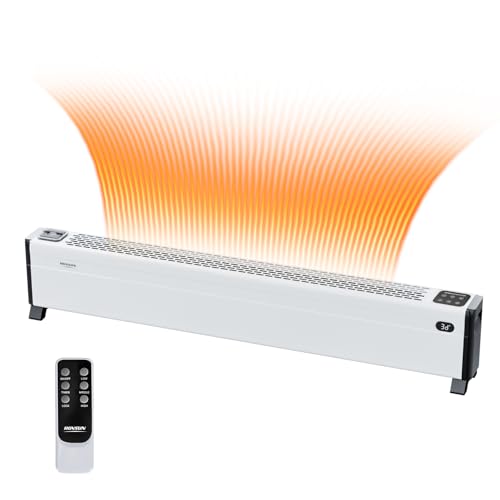
48-inch 1500W PTC baseboard-style heater with remote, 12-hour timer, child lock, humidifier and three heat settings.
Check price on Amazon$123.49 as of Oct 18, 2026 12:38 am GMT+0000 — prices change; see Amazon for current price.Why we like it
- Longest portable here at 48 inches
- Remote, 12-hour timer and child lock
- Three heat settings, stated for 300 sq ft
- Built-in humidifier for dry winter air
| Specification | Details |
|---|---|
| Installation | Portable, 120V plug-in |
| Output / coverage | 1,500W PTC element; Low, Medium, High; up to 300 sq ft |
| Controls | Remote control, 12-hour timer, child lock |
| Safety | Overheat and tip-over protection |
| Extras | Humidifier function |
| Size / model | 48 in long, 9.3 in tall; NTJX-T250FR; weight and warranty not stated |
ROVSUN NTJX-T250FR — 48″ 1500W PTC portable baseboard, 3 settings, remote, 12-hr timer, child lock, humidifier, 300 sq ft
The Only Baseboard Heater With a Remote, Timer and Child Lock
The other portables on the shelf are knob-and-switch appliances. The ROVSUN is the only baseboard heater listing that names a remote, a timer and a child lock. The 12-hour timer is a practical safety tool, since the USFA advises turning heaters off when you go to bed or leave the room, and a timer does that even when you forget.
Its 48-inch length spreads heat along more of the wall, and it is the only listing that pairs a heater with a humidifier, a reasonable idea in a Front Range winter when indoor humidity falls. Note that this uses a PTC ceramic element rather than the finned convection element in the Comfort Zone and Cadet units, so it may behave more like a low ceramic heater than a classic baseboard.
The listing is sparse: one detailed bullet, no weight, no warranty and no certification mark. A humidifier on a heater also needs regular cleaning to avoid stale water.
Pros
- Remote, timer and child lock
- Long 48-inch body
- Humidifier included
Cons
- Thin listing detail
- No warranty or mark stated
- Humidifier tank needs upkeep
Check ROVSUN 48-inch price on Amazon
6. Comfort Zone CZ600 — Best Simple Manual Portable Baseboard Heater

1500W portable convection baseboard with dial thermostat, two heat settings, tip-over switch and dent-proof end panels.
Check price on Amazon$48.87 as of Oct 18, 2026 12:38 am GMT+0000 — prices change; see Amazon for current price.Why we like it
- Simple dial thermostat and two settings
- Tip-over switch and overheat sensor
- Dent-proof end panels for daily bumps
- Earliest release date stated on the shelf: 2011
| Specification | Details |
|---|---|
| Installation | Portable, 120V plug-in |
| Output | 1,500W; two heat settings |
| Thermostat | Adjustable manual dial |
| Safety | Tip-over switch, overheat sensor, stay-cool body |
| Size / weight | About 30.4 in long, 6 in tall; 4.78 lb |
| Model / warranty | CZ600; 1-year warranty against defects |
Comfort Zone CZ600 — 1500W portable convection baseboard, dial thermostat, 2 settings, tip-over + overheat, stay-cool, 4.78 lb
The Same Design Sold Under Three Listings
The CZ600 appears on the shelf three times: this white Comfort Zone listing, a black CZ600BK and an EZ-HEAT listing that uses the same model number and the same bullet text. That repetition is useful information. It suggests a long-running design, and this listing carries the oldest release date on the shelf, 2011.
For a guest room or a cold home office, a dial thermostat and two settings are all most people use. The convection design runs without a fan, which is why baseboard-style heaters are popular for bedrooms. If you want a readable temperature number, step up to the CZ650B in pick 3.
Like its siblings, the listing does not name a testing mark or a thermostat range.
Pros
- Simple, proven design
- Tip-over and overheat cutoffs
- Light and fanless
Cons
- Dial thermostat has no readout
- No certification mark named
- One-year warranty
Check Comfort Zone CZ600 price on Amazon
Hydronic vs electric baseboard: what you are actually choosing
Electric baseboard heaters, including every pick above, turn electricity directly into heat with a resistance element. Each one is self-contained; you can add a section to one room without touching the rest of the house. Hydronic baseboard looks similar but works differently: hot water from a boiler flows through a copper pipe with aluminum fins, and the baseboard is just the emitter. It is part of a central system, so it is installed by a plumbing or heating contractor, not bought as a standalone heater.
The only hydronic product on this shelf is a slide-on steel cover, which its listing says is designed for hot-water baseboards and fits units no taller than 7.5 inches from floor to back-plate top. Old, rusted or bent hydronic covers are a common reason people search for “baseboard heater,” and replacing the cover is far cheaper than replacing the system; see our guide to baseboard heater covers.
- Electric baseboard is cheap to install and zone-by-zone, but resistance heat costs more to run per unit of heat than most alternatives.
- Hydronic baseboard gives gentle, even heat and keeps radiating after the boiler shuts off, but needs a boiler, piping and periodic service.
- Heat pumps are worth comparing for any electric-heat home. The EPA says a heat pump typically uses about half the energy of other electric home-heating sources, and that pairing one with a hot-water baseboard system means the baseboard does not have to work as hard on very cold nights. ENERGY STAR adds that because heat pumps move heat rather than make it, an air-source unit can deliver up to three times more heat energy than the electricity it consumes.
Our full baseboard heater guide covers sizing and running cost in more depth.
Line-voltage thermostats for permanent baseboard
A wired-in baseboard like the Cadet F Series needs a line-voltage thermostat, which switches the full 120V or 240V heating load. That is a different device from the low-voltage 24V thermostat on a furnace. Three such thermostats came up in this search, and their listings show why matching matters:
- A Honeywell non-programmable model lists a maximum load of 2,000W at 240V and says it cannot control a fan-forced convector.
- A Honeywell 5-2 day programmable model lists 3,500W maximum at 240V and works with baseboards, convectors and fan-forced heaters.
- A Wi-Fi model from meross covers 120 to 240V electric baseboard, convector and fan-forced heat and says it is not compatible with 24V systems.
Add up the wattage of every baseboard on the circuit and pick a thermostat rated above that total. Programmable and smart controls let a bedroom cool during the day without anyone remembering to turn it down. For wiring options and placement, see our guide to the baseboard heater thermostat.
Placement, clearances and safety
Baseboard heaters sit low, right where curtains hang and furniture gets pushed. The USFA advises keeping anything that can burn at least three feet from heat sources including radiators and space heaters, and that rule matters for long-running baseboard sections that heat all winter.
- Do not let floor-length drapes rest on or in front of a baseboard, and leave a gap between the heater and sofas or beds. The manufacturer’s manual gives the exact clearances.
- Place permanent units under windows where possible; rising warm air offsets the cold downdraft from the glass.
- Plug portable baseboard heaters directly into a wall outlet. The USFA says never to use an extension cord or power strip with a portable heater.
- Check that a portable model has a tip-over switch. Six of the eight heaters on this shelf mention one; the two permanent Cadets do not need one because they are fixed to the wall.
- Vacuum dust from the fins before the first cold snap; the first run of the season often smells of burning dust.
Baseboard heat in a Front Range home
Electric baseboard is common in Front Range basements finished after the original build, in mountain cabins and in some older condos where gas service was never extended. It is quiet and works well on cold nights when outdoor temperatures fall below zero, but the running cost adds up when every room relies on it. In a whole-house electric-baseboard home, a cold-climate heat pump is often the largest efficiency upgrade available.
Dry winter air is another factor. Baseboard heat does not dry the air by itself, but heating cold outdoor air lowers relative humidity indoors. A humidifier, either standalone or built into a unit like the ROVSUN, keeps rooms more comfortable.
A portable baseboard-style heater is a good stopgap for one room. If you find yourself running one all winter, ask why that room is cold: missing insulation, an undersized duct run or a failing permanent heater are common answers. For portable options beyond baseboard shapes, see our space heater guide.
When to call an electrician or inspector
Hire a licensed electrician to add or replace any permanent baseboard heater or line-voltage thermostat; the circuit, breaker and wire size must match the heater load, and a new circuit usually needs a permit. Call one sooner if a baseboard thermostat feels hot, a breaker trips repeatedly, or you see scorching on the heater housing or wall. Hydronic systems that bang, leak or heat unevenly belong to a heating contractor.
Buying a home with baseboard heat? An inspector will check that heaters work, look at clearances and note the condition of covers, thermostats and visible wiring. Our overview of heating and cooling inspection topics explains what gets checked.
Frequently asked questions
Are electric baseboard heaters expensive to run?
Electric baseboard heaters convert electricity to heat with resistance elements, so running cost depends on how much heat a room needs and local electric rates. They are efficient at the point of use but cost more per unit of heat than most heat pumps. The EPA says a heat pump typically uses about half the energy of other electric heating sources.
What is the difference between hydronic and electric baseboard heaters?
Electric baseboards heat with a built-in resistance element and run on a 120V or 240V circuit. Hydronic baseboards carry hot water from a boiler through finned pipe and are part of a central heating system installed by a contractor. Hydronic heat feels gentler and lingers after the boiler shuts off.
Can you plug in a baseboard heater?
Portable baseboard-style heaters plug into a standard 120V outlet and include tip-over switches. Permanent baseboard heaters are hardwired to a dedicated circuit, often 240V, and controlled by a wall or unit-mounted line-voltage thermostat. Wiring a permanent unit is work for a licensed electrician.
What thermostat works with electric baseboard heaters?
Electric baseboards need a line-voltage thermostat rated for 120V or 240V, not a 24V furnace thermostat. Check the maximum wattage rating against the total of all heaters on the circuit, and confirm whether it supports fan-forced heaters if any are on the same line.
How far should furniture be from a baseboard heater?
Follow the heater manual for exact clearances. As a general rule, the USFA advises keeping anything that can burn at least three feet from heat sources, and drapes should never rest on or in front of a baseboard heater.
References
- Heating Fire Safety — U.S. Fire Administration
- Heater Fire Safety card (PDF) — U.S. Fire Administration
- Heat Pumps — U.S. Environmental Protection Agency
- Air-Source Heat Pumps — ENERGY STAR
Buying a Front Range home heated by baseboards, a boiler or a mix of both? Contact us here to connect with a vetted local inspector who can check the system before you commit.