Best Space Heaters (2026): 7 Picks Compared for Room Safety
The best space heater is the one that warms a single room without becoming the reason the fire department visits. Portable electric heaters are cheap, quick and easy to move, but they also sit close to bedding, curtains and feet, and they get left running. So this roundup leads with safety behavior: what happens when the heater tips over, whether it switches itself off after hours of inattention, how precisely the thermostat holds a setting, and which certification mark the listing names. Heat output is nearly identical across the shelf, since every pick here tops out at 1,500 watts, the normal ceiling for a standard household outlet. Below are seven picks matched to specific rooms and habits, followed by a buying guide on placement, circuits and when a portable heater is the wrong fix.
Part of our Heating, Cooling & Ventilation guide — start there for the full picture →
As an Amazon Associate we earn from qualifying purchases.
How we compared: we compared 13 current Amazon listings for portable electric space heaters on what each listing states: tip-over and overheat protection, automatic shutoff, thermostat range, power settings, stated noise, certification mark, weight and warranty. We did not lab-test any of these heaters or handle them. Several listings are color variants of the same model, so the 13 listings cover 11 distinct model numbers. Prices and availability change often, so check the current listing before buying.
Quick picks: the best space heaters by room and habit
| Product | Best for | Key features | Price | Buy |
|---|---|---|---|---|
| DREO HSH006 | Best overall for bedrooms |
| $35.13as of October 18, 2026 | Buy now →Check current price |
| DREO HSH003 tower | Best auto-off for forgetful users |
| $67.46as of October 18, 2026 | Buy now →Check current price |
| DREO HSH013 25-inch | Best for larger living rooms |
| $89.99as of October 18, 2026 | Buy now →Check current price |
| Lasko 751320 | Best warranty and cool-touch body |
| $71.99as of October 18, 2026 | Buy now →Check current price |
| Amazon Basics DQ1927-Y | Best simple no-frills heater |
| $20.69as of October 18, 2026 | Buy now →Check current price |
| JIBUFI PTC-SL1702 | Best low-watt setting for busy circuits |
| $39.98as of October 18, 2026 | Buy now →Check current price |
| GiveBest PTC-905 | Best desk and home-office heater |
| $25.99as of October 18, 2026 | Buy now →Check current price |
Prices are Amazon’s listed prices as of the time shown and change often; check Amazon for today’s price. As an Amazon Associate we earn from qualifying purchases.
The seven picks, compared listing by listing
1. DREO HSH006 — Best Overall Space Heater for Bedrooms

1500W ceramic heater with a tilt-detection sensor, 1-degree thermostat, child lock and ETL certification named.
Check price on Amazon$35.13 as of October 18, 2026 — prices change; see Amazon for current price.Why we like it
- Describes a dedicated tilt-detection sensor for tip-over shutoff
- Thermostat sets 41 to 95 F in 1-degree steps
- Child lock stops curious hands changing settings
- Stated 34 dB noise suits a sleeping room
- About 3 lb with a carry handle
| Specification | Details |
|---|---|
| Heating element / power | PTC ceramic, 1,500 watts maximum |
| Safety features named | Tilt-detection tip-over protection, overheat protection, safety plug, V0 flame-retardant materials, all described as ETL certified |
| Controls | Digital thermostat 41 to 95 F; Power, ECO and Fan Only modes; remote, 12-hour timer, mute, child lock, memory |
| Stated noise | 34 dB |
| Size / weight | About 10 x 6 x 6 in; 3.04 lb |
| Model / warranty | HSH006; 12 months, extendable to 30 months with registration |
DREO HSH006 — 1500W PTC, tilt sensor, overheat cutoff, 41–95 F thermostat, child lock, 12-hr timer, 34 dB, ETL, 3.04 lb
One of Only Two Listings Describing a Separate Tilt-Detection Sensor
Twelve of the 13 listings on the shelf mention tip-over protection in some form, so the feature alone does not separate anything. What sets the HSH006 apart is the wording: it is one of only two listings, both this same model in different colors, that describe a dedicated tilt-detection sensor rather than a generic tip-over switch. The U.S. Fire Administration specifically tells households to choose a heater with an automatic shutoff that trips if the unit tips over, so this is the right feature to lead with in a bedroom.
It also pairs that shutoff with controls that discourage fiddling. Only four listings on the shelf mention a child lock, all from DREO. The thermostat range of 41 to 95 F in single-degree steps is shared with four other DREO listings, and a fine-grained setpoint means the heater cycles at the temperature you chose instead of running flat out.
What the listing does not say is coverage area in square feet, and its default warranty is only 12 months unless you register the product. It also does not state a 24-hour automatic shutoff, which three other listings do.
Pros
- Dedicated tilt sensor for tip-over shutoff
- Child lock plus 1-degree thermostat
- Quiet stated noise level for sleeping
- Light enough to move room to room
Cons
- No stated heating area in square feet
- No 24-hour idle shutoff described
- 12-month default warranty
Check DREO HSH006 price on Amazon
2. DREO HSH003 Tower — Best Automatic Shutoff for Forgetful Households

16-inch oscillating tower that powers off after 24 hours without input and warns against extension cords.
Check price on Amazon$67.46 as of October 18, 2026 — prices change; see Amazon for current price.Why we like it
- Turns itself off after 24 hours with no interaction
- Only listing that warns against extension cords
- States a 270 sq ft heating coverage
- ECO mode drops between 1000W and 1500W automatically
| Specification | Details |
|---|---|
| Heating element / power | PTC ceramic; ECO mode moves between 1,000 and 1,500 watts |
| Safety features named | Tip-over and overheat protection, 24-hour automatic power off, V0 flame-retardant 2-prong plug, ETL certified |
| Coverage / oscillation | Stated 270 sq ft; 70-degree oscillation |
| Cord | 6 ft flat cord; listing says plug directly into the wall outlet |
| Size / weight | About 15.8 in tall; 4.63 lb |
| Model / warranty | DR-HSH003; 12 months, extendable to 30 months with registration |
DREO HSH003 — 1500W PTC tower, 70° oscillation, 24-hr idle shutoff, tip-over + overheat, 270 sq ft, 34 dB, ETL, 4.63 lb
The Only Listing That Tells Buyers Not to Use an Extension Cord
Three listings on the shelf describe a 24-hour automatic power off when nobody touches the controls: this DREO tower, the JIBUFI in pick 6 and an AUBKN tower. That backstop matters because the most common failure with a portable heater is not mechanical but human: it gets left on overnight or while the house is empty, which the USFA says never to do.
The HSH003 is also the only one of the 13 listings that spells out a direct warning not to run the heater on an extension cord and to plug it straight into the wall. That matches USFA heater guidance word for word in spirit: plug portable heaters directly into outlets and never use an extension cord or power strip. A listing that repeats the rule is not safer by itself, but it signals a manufacturer that expects the heater to draw a full load for hours.
Its stated coverage is 270 sq ft. The listing does not mention a child lock, and its oscillation sends warm air across a wider arc, which means clearance to curtains and bedding has to hold across that whole sweep.
Pros
- 24-hour idle shutoff as a backstop
- Explicit direct-to-outlet instruction
- Stated coverage of 270 sq ft
Cons
- No child lock mentioned
- Oscillation widens the clearance zone
- Heavier than the compact picks
Check DREO HSH003 price on Amazon
3. DREO HSH013 25-Inch — Best Space Heater for Larger Living Rooms

25-inch tower rated for 100 to 270 sq ft, with a 45-degree tip-over cutoff, child lock and 25 dB stated noise.
Check price on Amazon$89.99 as of October 18, 2026 — prices change; see Amazon for current price.Why we like it
- Lowest stated noise on the shelf at 25 dB
- Rated for rooms from 100 to 270 sq ft
- States the tip angle that trips shutoff: 45 degrees
- Four heat modes plus fan only
| Specification | Details |
|---|---|
| Heating element / power | PTC ceramic, 1,500 watts maximum |
| Safety features named | 45-degree tip-over and overheat protection, reinforced plug, V0 materials, child lock, ETL certified |
| Controls | H1, H2, H3 and ECO modes plus fan; thermostat 41 to 95 F in 1-degree steps; remote |
| Coverage / oscillation | 100 to 270 sq ft; 70-degree oscillation |
| Size / weight | 25 in tall, about 7.9 in square base; 7.26 lb |
| Model / warranty | DR-HSH013; warranty not stated in listing |
DREO HSH013 — 25″ 1500W PTC tower, 4 heat modes, 45° tip-over cutoff, child lock, 100–270 sq ft, 25 dB, ETL, 7.26 lb
The Quietest Stated Noise Level and the Only Stated Tip Angle
Six listings give a decibel figure under 40, all DREO, and this tower’s 25 dB claim is the lowest number anywhere on the shelf; the Amazon Basics models state 43 dB. It is also the only listing that tells you at what angle its tip-over switch trips, 45 degrees, rather than leaving the behavior undefined.
At 7.26 lb and 25 inches tall it is the heaviest and tallest pick, and that is a fair trade in a living room. A taller unit puts warm air at seated height, and a wide base is harder for a dog or a vacuum cord to knock over in the first place. Its square-foot range overlaps the HSH003 tower but is stated as a span, which is more honest: 100 sq ft is realistic for a drafty room, 270 sq ft for a well-insulated one.
The listing does not state a warranty term or a 24-hour idle shutoff, and its larger footprint still needs the full three-foot clearance from furniture and drapes.
Pros
- Lowest stated noise on the shelf
- Defined 45-degree tip-over cutoff
- Child lock and 1-degree thermostat
Cons
- Warranty not stated in the listing
- No 24-hour idle shutoff described
- Heaviest pick to carry between rooms
Check DREO HSH013 price on Amazon
4. Lasko 751320 — Best Warranty and Cool-Touch Tower

23-inch ceramic tower with cool-touch housing, self-regulating element, 7-hour timer and a 3-year limited warranty.
Check price on Amazon$71.99 as of October 18, 2026 — prices change; see Amazon for current price.Why we like it
- Longest stated warranty on the shelf: 3 years
- Only listing claiming a cool-touch housing
- Self-regulating ceramic element and overheat cutoff
- Lightest tower here at 2.5 lb
| Specification | Details |
|---|---|
| Heating element / power | Self-regulating ceramic, 1,500 watts; 2 heat settings |
| Safety features named | Overheat protection, cool-touch housing, ETL listed; tip-over protection not stated in listing |
| Controls | Remote for heat, oscillation and timer; 7-hour timer |
| Oscillation | Widespread oscillation, angle not stated in listing |
| Size / weight | 22.5 in tall; 2.5 lb |
| Model / warranty | 751320; 3-year limited warranty |
Lasko 751320 — 23″ 1500W ceramic tower, 2 heat settings, oscillation, cool-touch, overheat cutoff, 7-hr timer, ETL, 3-yr warranty
The Longest Warranty, but the One Listing That Never Mentions Tip-Over
Most listings here carry a 12-month warranty, and DREO extends that to 30 months only with registration. The Lasko’s 3-year limited warranty is the longest term stated on the shelf. It is also the only listing that claims a cool-touch housing, which matters in a house with toddlers or pets who brush against the cabinet.
The honest catch: this is the single listing out of 13 that does not mention tip-over protection anywhere in its title or bullets. That does not prove the heater lacks it, but the USFA treats a tip-over shutoff as a basic requirement, so confirm it on the box or the manual before you buy for a room with kids or animals.
The 7-hour timer is shorter than the 12-hour timers on most competitors, which works in its favor for overnight use: it will not run all night. The listing does not state a thermostat range or a decibel figure.
Pros
- 3-year limited warranty
- Cool-touch housing claimed
- Light and easy to carry
Cons
- Tip-over protection not stated in listing
- No thermostat range given
- Only two heat settings
Check Lasko 751320 price on Amazon
5. Amazon Basics DQ1927-Y — Best Simple, No-Frills Space Heater

Non-oscillating ceramic cube with High, Low and Fan Only settings, tip-over and overheat protection, about 3 lb.
Check price on Amazon$20.69 as of October 18, 2026 — prices change; see Amazon for current price.Why we like it
- Three plain settings: 1500W, 900W or fan only
- Tip-over and overheat protection named
- Listing clearly rules out bathrooms and laundry rooms
- Small cube footprint, under 3 lb
| Specification | Details |
|---|---|
| Heating element / power | Ceramic; High 1,500W, Low 900W, Fan Only |
| Safety features named | Tip-over protection, overheat protection, power indicator light |
| Oscillation | None; fixed direction |
| Stated noise | 43 dB |
| Size / weight | 7.5 x 6.3 x 9.5 in; 2.75 lb |
| Certification / warranty | Certification mark not stated in listing; warranty not stated in listing |
Amazon Basics DQ1927-Y — ceramic cube, 1500W/900W/fan, tip-over + overheat, non-oscillating, 43 dB, 2.75 lb
The Only Listings That Explicitly Warn Against Humid Rooms
Two Amazon Basics listings on the shelf, both this non-oscillating DQ1927 model in different colors, carry a direct warning not to use the heater in bathrooms, laundry rooms or other high-moisture areas. None of the DREO, Lasko, JIBUFI or AUBKN listings says anything either way, and one GiveBest listing actually suggests bathrooms. A heater sold as a general room heater should not be treated as bathroom-rated, and this is the only listing that says so plainly.
The rest of the appeal is simplicity. A fixed-direction cube with three settings has fewer things to misconfigure, and a non-oscillating heater keeps its hot air stream pointed where you aimed it, which makes the clearance zone easier to manage at the foot of a desk or bed.
The weak spot is documentation. The listing does not name ETL, UL or any testing mark, while nine of the 13 listings do. The USFA advises choosing a heater tested by a recognized laboratory, so look for the mark on the unit’s label before relying on it. It also lacks a thermostat range, timer or remote.
Pros
- Simple three-setting control
- Tip-over and overheat protection named
- Clear warning about wet rooms
Cons
- No certification mark named in listing
- No timer, remote or stated thermostat range
- Louder stated noise than DREO picks
Check Amazon Basics DQ1927-Y price on Amazon
6. JIBUFI PTC-SL1702 — Best Low-Watt Setting for Busy Circuits
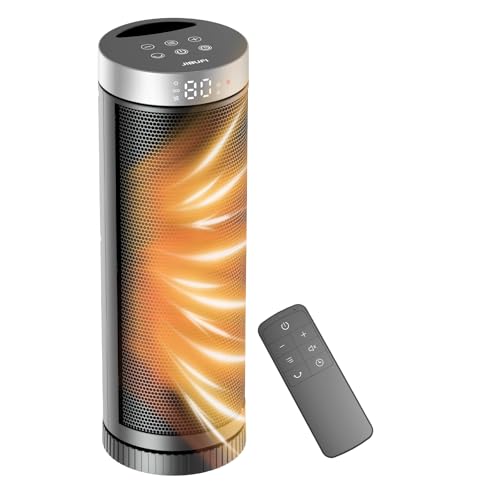
17-inch oscillating heater with 700W, 1000W and 1500W levels, tip-over shutoff and a 24-hour automatic power off.
Check price on Amazon$39.98 as of October 18, 2026 — prices change; see Amazon for current price.Why we like it
- Lowest stated power step on the shelf: 700W
- Three fixed power levels instead of just high and low
- Powers off after 24 hours without interaction
- ETL certification and flame-retardant plug named
| Specification | Details |
|---|---|
| Heating element / power | PTC ceramic; 700W, 1,000W or 1,500W |
| Safety features named | Tip-over shutoff, overheat protection, 24-hour automatic power off, flame-retardant 2-prong plug, ETL certified |
| Controls | Thermostat (range not stated), 1–12 hour timer, remote (2 AAA not included) |
| Oscillation | 70 degrees |
| Size / weight | About 16.5 in tall; weight not stated in listing |
| Model / warranty | PTC-SL1702; 1 year |
JIBUFI PTC-SL1702 — 17″ PTC heater, 700/1000/1500W, 70° oscillation, tip-over, 24-hr idle shutoff, 12-hr timer, ETL
A 700-Watt Setting for Rooms Sharing a Circuit
The stated low settings on this shelf are 750W on the GiveBest, 900W on the Amazon Basics models and 1,000W in the DREO tower’s ECO mode. The JIBUFI’s 700W step is the lowest fixed setting stated by any listing. That matters in older Front Range houses where one 15-amp bedroom circuit also feeds lamps, a computer and a phone charger. The USFA advises not plugging anything else into the same circuit as a space heater, and a lower draw leaves more margin when that is not practical.
It is also one of the three listings with a 24-hour idle shutoff, and it names ETL certification and tip-over protection. Its thermostat is described as automatic, but the listing never states the temperature range or step size, unlike the DREO models.
The listing does not give a weight, a decibel number or a coverage area, and the remote needs batteries you supply.
Pros
- 700W setting eases circuit load
- 24-hour idle shutoff
- ETL and tip-over protection named
Cons
- Thermostat range not stated
- Weight and noise level not stated
- Remote batteries not included
Check JIBUFI PTC-SL1702 price on Amazon
7. GiveBest PTC-905 — Best Desk and Home-Office Space Heater

Compact 1500W/750W ceramic heater with a cool fan mode, overheat cutoff and a tip-over switch that beeps.
Check price on Amazon$25.99 as of October 18, 2026 — prices change; see Amazon for current price.Why we like it
- Two heat levels plus a cool-air fan for summer
- Tip-over switch sounds a beep when knocked over
- Rated to heat up to 200 sq ft
- Small 3 lb body fits under a desk
| Specification | Details |
|---|---|
| Heating element / power | PTC ceramic; 1,500W or 750W plus cool fan |
| Safety features named | Overheat shutoff, tip-over shutoff with audible beep, V0 flame-retardant material |
| Controls | Automatic thermostat (range not stated); no remote or timer mentioned |
| Coverage | Up to 200 sq ft |
| Size / weight | About 10.2 x 7.9 x 6.2 in; 3 lb; 6 ft cord |
| Model / warranty | PTC-905; 1 year |
GiveBest PTC-905 — 1500W/750W PTC, cool fan, overheat + beeping tip-over cutoff, 200 sq ft, 3 lb, 1-yr warranty
The Only Tip-Over Switch Described as Restarting on Its Own
The GiveBest listing is unusually specific about tip-over behavior: the heater shuts off with a loud beep when knocked over, then comes back on automatically once it is set upright. No other listing describes the restart behavior at all. The beep is useful at a desk because you know immediately why the heat stopped. The automatic restart is a mixed blessing; in a room with a pet that likes to knock things over, a heater that resumes heating without a button press is not ideal.
The 750W low setting is the second-lowest stated on the shelf, and the cool-fan mode lets it earn a place on the desk in July. The 200 sq ft rating matches a small office or bedroom.
The listing does not name ETL or another certification mark, and it suggests bathrooms among suitable rooms without stating any moisture rating. Treat that as a general description, not a wet-location approval.
Pros
- Audible alert on tip-over
- 750W low setting
- Doubles as a summer fan
Cons
- Restarts automatically when uprighted
- No certification mark named in listing
- No timer or remote mentioned
Check GiveBest PTC-905 price on Amazon
The safety features that actually matter
Every heater on this shelf is a 1,500-watt resistance heater, and every watt of electricity becomes roughly the same amount of heat regardless of brand, so the real differences are behavioral. The USFA’s heater safety card lists the essentials: choose a heater tested by a recognized laboratory, make sure it has an automatic shutoff if it tips over, keep anything that can burn at least three feet away, set it on a solid, flat surface and turn it off when you go to bed or leave the room.
Tip-over shutoff
This is the floor, not a bonus. Twelve of the 13 listings mention it. Look for a stated trip angle or a dedicated sensor if the heater will sit where people walk. And notice what happens after it trips: most listings never say whether the heater restarts by itself.
Overheat protection and idle shutoff
Overheat cutoff protects against blocked intakes and lint-clogged grilles. A 24-hour idle shutoff, stated on three listings, protects against the human failure of forgetting the heater entirely. A countdown timer of 7 or 12 hours does the same job if you use it every time.
Certification mark
Nine of the 13 listings name ETL, a mark issued by the testing lab Intertek. A listing that names no mark is not proof of a problem, but check the rating label on the heater itself for ETL, UL or CSA before trusting it unattended.
Placement, outlets and the three-foot rule
The USFA reports that portable heater fires were only about 3 percent of home heating fires in 2017 to 2019 but accounted for 41 percent of fatal heating fires. That gap comes from placement and habits more than hardware. Bedding, clothing, curtains, sofas and stacked paper should stay at least three feet from any side the heater blows toward, and oscillating models widen that zone.
- Plug the heater directly into a wall outlet. The USFA says never to run a portable heater on an extension cord or power strip, and to avoid putting other loads on the same circuit.
- Check the plug and cord. A plug that feels hot, or an outlet face that discolors, is a sign of a loose or worn receptacle; stop using that outlet and have it looked at.
- Keep it on the floor on a hard, level surface, not on a rug edge, bed or chair.
- Do not run a general-purpose heater in a bathroom. Two listings here explicitly forbid it, and bathroom-rated heaters with ALCI plugs or splash ratings exist for that job; see our guide to choosing a bathroom heater.
For a broader walkthrough of heater types, wattage and running cost, read our full space heater guide.
Electric vs fuel-burning portable heaters
Every pick in this roundup is electric, and that is deliberate for bedrooms and living spaces. Unvented propane or kerosene heaters release combustion gases into the room. The U.S. Consumer Product Safety Commission says never to operate unvented fuel-burning appliances in any room where people are sleeping, and never to use portable fuel-burning camping equipment indoors unless it is specifically designed for enclosed spaces. If a fuel-burning unit is already in the house, read our explainer on the ventless propane heater question, and install carbon monoxide alarms that meet UL 2034 on every level and outside sleeping areas.
For outdoor seating, the trade-offs change completely; electric infrared and propane units are compared in our patio heater guide.
How Front Range homeowners use space heaters
On the Front Range, a space heater usually solves one of three problems: a bedroom over the garage that runs ten degrees colder than the rest of the house, a basement office in a raised ranch, or a home office that would otherwise force the whole-house thermostat up during a January cold snap. In each case the heater is a zone tool, not a furnace replacement.
Dry winter air is the other factor. Ceramic heaters do not remove moisture from the air, but warm air holds more moisture, so relative humidity in a heated room drops and skin and sinuses notice it. A small humidifier in the same room helps more than switching heater types.
If you are running a space heater every day in the same room, that is a signal worth investigating. Rooms over garages and additions are often under-insulated or poorly ducted, and long term the fix may be air sealing, a balanced supply register or a dedicated system. The U.S. EPA notes that a heat pump typically uses about half the energy of other electric home-heating sources, which is why a ductless mini-split often beats a portable heater for a room that is cold all season. Homes with electric baseboard zones can also gain a lot from a better wall control; see our guide to the baseboard heater thermostat.
When a space heater is not the answer
Call a professional rather than buying a bigger heater when a room never reaches temperature, when breakers trip whenever the heater runs, when outlets or cover plates feel warm, or when the furnace is short-cycling or failing to keep up. Those are wiring, duct or equipment problems that a portable heater only masks. The USFA also recommends having heating equipment and chimneys cleaned and inspected every year by a professional.
Buying a home with rooms that feel colder than the rest? A home inspector will look at insulation, ductwork, electrical capacity and the heating system as a whole. Our overview of heating and cooling inspection topics explains what gets checked.
Frequently asked questions
What is the safest type of space heater for a bedroom?
An electric heater with tip-over shutoff, overheat protection and a named testing mark such as ETL or UL is the safest starting point for a bedroom. A thermostat and a countdown or 24-hour idle shutoff add a backstop. Keep it three feet from bedding and turn it off before sleeping, as the USFA advises.
Can a space heater be plugged into an extension cord or power strip?
No. The USFA says to plug portable heaters directly into a wall outlet and never use an extension cord or power strip, and to avoid plugging other items into the same circuit. A 1,500-watt heater draws a near-continuous heavy load that can overheat cords and strips.
Do ceramic space heaters use less electricity than other electric heaters?
Not meaningfully. Any electric resistance heater turns its rated wattage into heat, so a 1,500-watt ceramic, oil-filled or infrared unit uses about the same energy per hour on high. Savings come from heating one room instead of the whole house, using the thermostat and lower power settings, and turning the heater off.
Can a regular space heater be used in a bathroom?
Only if the manufacturer says so. Some listings, including the Amazon Basics models compared here, explicitly forbid bathroom use. For bathrooms, look for a heater designed for that space, typically with an ALCI or GFCI-type safety plug and a splash rating, and plug it into a GFCI-protected outlet.
How large a room can a 1,500-watt space heater warm?
Listings on this shelf claim between about 100 and 270 square feet. Real results depend on insulation, ceiling height, windows and outdoor temperature. A drafty Front Range room over a garage may need the low end of that range, while a well-sealed interior bedroom may reach the high end.
References
- Heating Fire Safety — U.S. Fire Administration
- Heater Fire Safety card (PDF) — U.S. Fire Administration
- Appliance and Electrical Fire Safety — U.S. Fire Administration
- Carbon Monoxide Questions and Answers — U.S. Consumer Product Safety Commission
- Heat Pumps — U.S. Environmental Protection Agency
Shopping for a Front Range home with cold rooms, tired wiring or an aging furnace? Get in touch through our contact page to connect with a vetted local inspector before you close.