Best Bathroom Heaters (2026): 5 Picks for Wet-Room Safety
The best bathroom heater is not simply a space heater moved closer to the shower. Bathrooms combine water, steam, metal fixtures and bare feet on tile, which is exactly the setting where an electrical fault becomes a shock instead of a tripped breaker. So this roundup judges heaters on wet-location features first: an ALCI leakage-cutoff plug, a splash rating such as IP24, stated distances from tubs and showers, and whether the heater can mount out of reach. Of the 15 listings a bathroom heater search returned, only a handful claim any of those features, and one popular heater’s own listing forbids bathroom use. Five picks follow, each matched to a bathroom type, then a guide to GFCI outlets, placement, exhaust fans and when a hardwired heater is the better answer.
Part of our Heating, Cooling & Ventilation guide — start there for the full picture →
As an Amazon Associate we earn from qualifying purchases.
How we compared: a bathroom heater search returned 15 current Amazon listings. We set aside general-purpose space heaters that make no bathroom claim, one that explicitly rules out bathrooms, and a towel-warmer bucket that is not a room heater, leaving five heaters whose listings either address bathroom use with a safety feature or are sold for small wet rooms. We judged each on what its listing states: leakage-protection plug, splash rating, mounting, wattage, thermostat, tip-over and overheat cutoffs and certification. We did not lab-test or handle them. Prices and availability change, so check the current listing before buying.
Quick picks: the best bathroom heaters by room
| Product | Best for | Key features | Price | Buy |
|---|---|---|---|---|
| GiveBest PWM320EW | Best overall for bathrooms |
| $$ | Buy now →Check current price |
| DREO HSH004A | Best portable bathroom heater |
| $$ | Buy now →Check current price |
| DREO HSH017S | Best splash-rated smart wall heater |
| $$ | Buy now →Check current price |
| GiveBest MH-21 | Best cordless outlet heater |
| $ | Buy now →Check current price |
| ASNUG Q21 | Best tiny heater for a powder room |
| $ | Buy now →Check current price |
Price key: $ under $50 · $$ $50–150 · $$$ $150–500 · $$$$ $500+. Prices change often; check Amazon for today’s price. As an Amazon Associate we earn from qualifying purchases.
The five picks, compared listing by listing
1. GiveBest PWM320EW — Best Overall Bathroom Heater

1500W wall heater with ALCI plug, IP24 splash rating, tip-over and overheat cutoffs, child lock and app control.
Check price on Amazon$74.99 as of Oct 18, 2026 12:36 am GMT+0000 — prices change; see Amazon for current price.Why we like it
- Only listing with both an ALCI plug and IP24
- Wall mounting keeps it off a wet floor
- Tip-over and overheat shutoff named
- Thermostat sets 41 to 95 F in 1-degree steps
- Child lock for shared family bathrooms
| Specification | Details |
|---|---|
| Wet-room features | ALCI safety plug; IP24 splash rating |
| Mounting / power | Wall mount with drilling template; 1,500W PTC; High, Medium, Low, ECO, fan only |
| Coverage | Up to 200 sq ft in well-insulated spaces |
| Controls | 41–95 F thermostat, 24-hour timer, remote, app and Alexa, child lock |
| Safety | Overheat protection; tip-over shutoff |
| Size / weight | About 15 x 10.2 x 4.5 in; 6.13 lb; warranty not stated in listing |
GiveBest PWM320EW — 1500W wall heater, ALCI plug, IP24, 41–95 F, 24-hr timer, child lock, tip-over + overheat, 6.13 lb
The Only Heater on the Shelf With Both a Leakage-Cutoff Plug and a Splash Rating
Two listings on this shelf mention an ALCI safety plug and two mention an IP24 rating. The GiveBest PWM320EW is the only one that claims both. That combination is what a bathroom heater should have: the IP24 rating describes protection against water splashed from any direction, and the ALCI plug is designed to cut power if it detects current leaking to ground, the same principle as a GFCI outlet.
Mounting it on the wall is the other advantage. A heater on the floor of a bathroom sits in the path of drips, bath mats and bare feet; a wall unit can go high and away from the tub. The listing provides a template but does not state minimum distances from the tub or shower, so follow the manual.
The listing does not name a certification mark such as ETL or UL, and it gives no warranty term. At 1,500 watts it needs a bathroom circuit that is not also running a hair dryer at the same moment.
Pros
- ALCI plug plus IP24 rating
- Wall mount, off the floor
- Fine thermostat and child lock
Cons
- No certification mark named
- No stated tub or shower distances
- Warranty not stated
Check GiveBest PWM320EW price on Amazon
2. DREO HSH004A — Best Portable Bathroom Heater
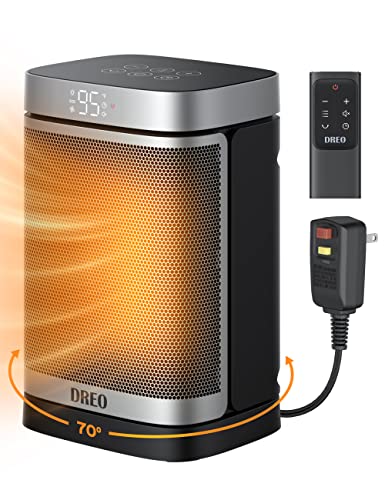
Compact 1500W ceramic heater with ALCI plug, 41–95 F thermostat, oscillation, tip-over cutoff, 24-hour auto shutoff.
Check price on Amazon$53.95 as of Oct 18, 2026 12:36 am GMT+0000 — prices change; see Amazon for current price.Why we like it
- ALCI plug cuts power on a short or water contact
- Three stated wattages: 900W, 1300W, 1500W
- Powers off after 24 hours automatically
- Tip-over and overheat protection named
- Washable intake filter
| Specification | Details |
|---|---|
| Wet-room features | ALCI safety plug; no IP rating stated |
| Power | H1 900W, H2 1,300W, H3 1,500W, ECO, fan only |
| Controls | 41–95 F thermostat in 1-degree steps, 1–12 hour timer, remote, 70-degree oscillation |
| Safety | Tip-over and overheat protection, 24-hour auto shutoff, V-0 materials |
| Noise | 36.5 dB stated |
| Size / warranty | About 10.3 in tall; 3.85 lb; 12-month default warranty |
DREO HSH004A — 1500W PTC portable, ALCI plug, 900/1300/1500W, 41–95 F, tip-over, 24-hr shutoff, 36.5 dB, 3.85 lb
The Only Portable Heater Here With a Leakage-Cutoff Plug
The portable heaters on this shelf mostly avoid the bathroom question. One Amazon Basics listing states plainly that the heater should not be used in bathrooms or other high-moisture rooms. The DREO HSH004A is the only portable whose listing addresses the risk directly, with an ALCI plug that DREO says shuts the heater off immediately if it shorts or contacts water.
It also pairs that plug with the full set of portable-heater cutoffs: tip-over shutoff, overheat protection and a 24-hour automatic power off. The 900-watt low setting is useful on a bathroom circuit that may also feed lights and an exhaust fan.
The weakness is form factor. A portable heater still sits on the floor or a counter, within reach of water and bath mats, and this listing states no IP splash rating. Use it in a large bathroom where it can sit well away from the tub, shower and sink, never on a wet floor.
Pros
- ALCI plug for a portable
- Tip-over, overheat and 24-hour cutoffs
- Three stated power levels
Cons
- No IP splash rating stated
- Sits low, near water and mats
- 12-month default warranty
Check DREO HSH004A price on Amazon
3. DREO HSH017S — Best Splash-Rated Smart Wall Heater

IP24 wall-mounted PTC heater with 28 dB stated noise, app, remote and Alexa control, and 150 sq ft primary coverage.
Check price on Amazon$99.98 as of Oct 18, 2026 12:36 am GMT+0000 — prices change; see Amazon for current price.Why we like it
- IP24 splash rating named in the listing
- Quietest stated noise here at 28 dB
- App with temperature calibration
- Honest coverage split: 150 sq ft primary
| Specification | Details |
|---|---|
| Wet-room features | IP24 splash rating; ALCI plug not stated in this listing |
| Mounting / power | Wall mount with template; PTC element; 70.8-inch cord; wattage not stated |
| Coverage | 150 sq ft as primary heat; up to 750 sq ft supplemental |
| Controls | Digital thermostat, ECO, remote, DREO app with calibration, Alexa, 30-degree manual tilt |
| Safety | Overheat protection; 5VA flame-retardant materials |
| Size / weight | About 16 x 12.2 x 4.5 in; 6.13 lb; model DR-HSH017S |
DREO HSH017S — IP24 wall heater, PTC, 28 dB, app + Alexa + remote, ECO, 150 sq ft primary, overheat cutoff, 6.13 lb
The Quietest Splash-Rated Heater, Without the Leakage Plug
This is one of two listings on the shelf with an IP24 rating, and its stated 28 dB is the lowest noise figure among the five picks. A quiet heater matters in a bathroom that shares a wall with a bedroom, where the heater might run during an early shower.
The app includes a temperature calibration function, which no other pick mentions. That is useful in a bathroom, where a wall-mounted sensor can read high from shower steam or low from a cold exterior wall. The coverage claim, 150 sq ft as a primary heat source, is realistic for even a large primary bathroom.
The gap is the plug. This listing does not mention an ALCI plug, while a separate DREO bathroom variant of the same model family does. If you choose this one, the bathroom outlet it plugs into must be GFCI protected. The listing also does not state wattage, tip-over behavior or a certification mark.
Pros
- IP24 splash rating
- Very low stated noise
- App temperature calibration
Cons
- No ALCI plug in this listing
- Wattage not stated
- No certification mark named
Check DREO HSH017S price on Amazon
4. GiveBest MH-21 — Best Cordless Outlet Heater for Small Bathrooms

400W/800W plug-in outlet heater with rotating plug, 60–90 F thermostat, ETL listing and 100 sq ft rating.
Check price on Amazon$25.98 as of Oct 18, 2026 12:36 am GMT+0000 — prices change; see Amazon for current price.Why we like it
- Plugs straight into the outlet, no cord to trip on
- Low 400W and 800W settings
- ETL certification named
- Thermostat, 12-hour timer and remote
| Specification | Details |
|---|---|
| Wet-room features | No IP rating or ALCI plug stated |
| Mounting / power | Plugs directly into a wall outlet; 180-degree rotating plug; 400W, 800W or ECO |
| Coverage | Up to 100 sq ft |
| Controls | 60–90 F thermostat, 12-hour timer, remote, memory, LED display, mute |
| Safety / certification | Overheat protection; flame-resistant casing; ETL certified |
| Noise / model | Under 38 dB; MH-21; weight and warranty not stated |
GiveBest MH-21 — 400/800W plug-in outlet heater, rotating plug, 60–90 F, 12-hr timer, remote, ETL, 100 sq ft
The Only Bathroom Pick That Names ETL Certification
Of the five picks, this is the only one whose listing names a testing mark: ETL. The USFA advises choosing a heater tested by a recognized laboratory, and the others leave that unstated. Its 800-watt maximum is the second-lowest stated draw among the picks, which leaves headroom on a bathroom circuit shared with lights and a fan.
The plug-in body removes the cord entirely, so there is nothing to trip on or lay across a wet floor, and the rotating plug lets it sit upright in a sideways outlet. For a half bath or a small guest bathroom up to about 100 sq ft, that is the right size.
The caution is placement. A bathroom outlet is usually beside the sink, and this listing states no splash rating or leakage plug. Use it only in an outlet with GFCI protection, ideally away from the basin, and do not leave it running while the sink is in use.
Pros
- ETL certified
- No cord on the floor
- Low 400W and 800W draw
Cons
- No splash rating or ALCI plug
- Outlet often sits by the sink
- Only for small bathrooms
Check GiveBest MH-21 price on Amazon
5. ASNUG Q21 — Best Tiny Heater for a Powder Room

500W mini ceramic heater with flip-switch tip-over cutoff, overheat protection and a 6 x 5.75 x 2.9 in body.
Check price on Amazon$16.19 as of Oct 18, 2026 12:36 am GMT+0000 — prices change; see Amazon for current price.Why we like it
- Low 500W draw, gentle on shared circuits
- Flip switch shuts it off if tipped
- Overheat protection and insulated shell
- Very small footprint for a vanity corner
| Specification | Details |
|---|---|
| Wet-room features | No IP rating or ALCI plug stated |
| Power | 500W PTC ceramic; single on/off button |
| Safety | Overheat protection, tilt flip switch, insulated shell, enhanced safety plug |
| Controls | One-touch on/off with LED indicator; no thermostat stated |
| Size | About 6.1 x 5.75 x 2.9 in |
| Model / warranty | Q21; certification and warranty not stated |
ASNUG Q21 — 500W mini PTC heater, tip-over flip switch, overheat cutoff, insulated shell, about 6 x 5.75 x 2.9 in
The Lowest-Draw Bathroom Pick, With a Simple Tip-Over Switch
At 500 watts the ASNUG draws a third of a full-size heater, the lowest maximum among the five picks. In a half bath or powder room that only needs a few degrees of warmth for a few minutes, that is enough, and it leaves the circuit free for lights and a fan. The listing describes a mechanical flip switch under the base that cuts power if the heater tips.
It is the simplest pick here: one button, no thermostat, no timer. That means it runs until you switch it off, so it suits a quick warm-up before a shower rather than running while you are away.
Like the GiveBest outlet heater, it states no splash rating, leakage plug or certification mark. It is a small desk heater that lists bathrooms among suitable rooms, not a wet-location product. Keep it on a dry counter away from the basin, plugged into a GFCI-protected outlet.
Pros
- Very low 500W draw
- Tip-over flip switch
- Tiny footprint
Cons
- No thermostat or timer
- No splash rating or mark named
- Only for small rooms
Check ASNUG Q21 price on Amazon
What the shelf left out, and why
Ten listings did not make the cut. Eight are general space heaters from DREO, Amazon Basics, GiveBest, Lasko and BLACK+DECKER that make no bathroom-specific safety claim. One Amazon Basics listing goes further and explicitly tells buyers to avoid bathrooms, laundry rooms and other high-moisture areas, which is the honest answer for a general-purpose heater. A heated towel-warmer bucket also turned up; its listing names ETL certification and an auto shutoff, but it warms towels, not the room. For a broader look at those heaters, see our space heater guide.
GFCI outlets, ALCI plugs and IP ratings explained
Three different protections show up in bathroom heater listings, and they are not interchangeable:
- GFCI outlet. A ground-fault circuit interrupter in the receptacle or breaker. OSHA explains that GFCIs are used in wet locations and other high-risk areas, compare current flowing out with current returning, and shut off power if the difference exceeds 5 milliamperes, in as little as one-fortieth of a second. Press the TEST button monthly; if it does not trip, have the outlet replaced.
- ALCI plug. An appliance leakage current interrupter built into the heater’s plug. It works on the same principle but travels with the appliance. It is a second layer, not a replacement for a GFCI outlet.
- IP24 rating. An ingress-protection code: the 2 means fingers cannot reach live parts, and the 4 means protection against water splashed from any direction. It does not mean the heater can be sprayed or submerged.
Most bathrooms in homes built or remodeled in recent decades have GFCI-protected receptacles. In older Front Range houses, especially pre-1970s bungalows and ranches, that is not guaranteed. If the outlet has no TEST and RESET buttons and none upstream, have an electrician add protection before plugging in a heater.
Placement rules for a bathroom heater
General heater rules still apply in a bathroom, and the USFA states them clearly: keep anything that can burn at least three feet away, place portable heaters on a solid, flat surface, plug them directly into a wall outlet and never use an extension cord or power strip, and turn heaters off when you leave the room. Bathroom additions:
- Never place a heater where it could fall into a tub, shower or sink, or where someone in the bath could reach it.
- Keep portable heaters off wet floors and bath mats; towels on a nearby bar must stay clear of the heater’s outlet.
- Do not run a 1,500-watt heater and a hair dryer on the same bathroom circuit at once; that can trip the breaker or overheat the receptacle. The USFA advises against overloading outlets.
- Wipe condensation off the heater and let it dry before use if the room has been steamy.
Our full bathroom heater guide covers sizing and the trade-offs between portable, wall and ceiling heaters.
Matching the heater to the bathroom
Bathroom size, layout and outlet location narrow the choice quickly. Use the room, not the wattage, as the starting point.
Powder room or half bath
A half bath with no tub or shower is the lowest-risk room for a plug-in heater because there is less standing water and steam. Something in the 400- to 800-watt range, such as the GiveBest outlet heater or the ASNUG mini, warms a small room in a few minutes. Keep it on a dry counter or in an outlet away from the basin, and switch it off when guests leave.
Full hall bathroom
A shared bathroom with a tub-shower combination gets heavy steam and wet floors. This is where a wall-mounted heater with a splash rating, ideally with an ALCI plug, earns its place. Mount it on the wall farthest from the tub, at a height children cannot reach, and use a timer or schedule so it pre-heats before the morning rush and then shuts off.
Primary bathroom
Larger primary bathrooms often have separate shower and tub areas and more floor space. A portable with an ALCI plug can work if it sits well away from both, but a wall unit or a hardwired option is usually the better long-term answer. If the room feels cold every day, that is a sign the room is under-heated by the central system, not that it needs a bigger plug-in.
Basement bathroom
Basement bathrooms on the Front Range are often the coldest in the house, with concrete floors and short duct runs. They are also where outlets are most likely to predate modern GFCI rules in older homes. Test the outlet before buying anything, and consider whether a dedicated circuit or a heated floor makes more sense for a room used every day.
Hardwired fan heaters, heat lamps and heated floors
For a bathroom that is cold every morning, a permanent heater often beats any plug-in. Common options include a recessed wall heater on its own circuit, a ceiling exhaust fan with a built-in heater or heat lamp, and electric radiant floor mats installed under tile. All three are hardwired, keep cords out of the room entirely and avoid the outlet-by-the-sink problem. They need an electrician, a correctly sized circuit, GFCI protection where the manufacturer requires it and usually a permit. Permanent electric heaters are controlled by a line-voltage thermostat; see our guide to the baseboard heater thermostat for how those controls are rated.
Front Range bathrooms: cold tile and dry air
Bathrooms on exterior walls, over unheated garages or in basements are the coldest rooms in many Front Range homes, and tile floors feel colder still on January mornings when overnight lows dip below zero. A short pre-heat before showering, using a timer or app schedule, is usually enough. Because heated bathrooms dry quickly in our low humidity, mold is less of a risk than in humid climates, but a bathroom that stays damp because the exhaust fan is weak or missing still needs ventilation. Run the fan during and after showers; heat alone does not remove moisture from the house.
When to call an electrician or inspector
Call an electrician if the bathroom outlet lacks GFCI protection, if the GFCI will not trip on test, if the outlet or cover plate feels warm under load, or if the breaker trips whenever the heater and another appliance run. The CPSC lists hot outlet covers and frequently tripping breakers as warning signs that warrant a licensed electrician. Any hardwired heater, fan-heater or radiant floor is an electrician’s job.
A home inspection tests bathroom GFCI protection and notes missing or weak exhaust fans. Our overview of heating and cooling inspection topics explains what inspectors check in heating equipment.
Frequently asked questions
Is it safe to use a space heater in a bathroom?
Only if the manufacturer allows it. Some space heater listings explicitly forbid bathroom use. Choose a heater sold for bathrooms, ideally with an ALCI safety plug and an IP splash rating, plug it into a GFCI-protected outlet, keep it well away from the tub, shower and sink, and switch it off when you leave.
What does IP24 mean on a bathroom heater?
IP24 is an ingress-protection rating. The 2 means fingers cannot reach live parts, and the 4 means the heater is protected against water splashed from any direction. It does not mean the heater can be sprayed directly, submerged or placed inside a shower.
What is the difference between an ALCI plug and a GFCI outlet?
Both cut power when they detect current leaking to ground. A GFCI is built into the outlet or breaker and protects everything plugged into it. An ALCI is built into an appliance's plug and travels with that appliance. A bathroom heater with an ALCI plug should still be plugged into a GFCI-protected outlet.
How many watts does a bathroom heater need?
A small half bath or powder room can be comfortable with 400 to 800 watts. A full bathroom of 50 to 100 square feet usually does well with 1,000 to 1,500 watts. Avoid running a 1,500-watt heater and a hair dryer on the same circuit at the same time.
Should a bathroom heater be wall-mounted or portable?
Wall-mounted heaters keep cords and the heater body off wet floors and out of reach of the tub, which makes them the safer choice. Portable heaters suit large bathrooms where they can sit well away from water. For daily use in a cold bathroom, a hardwired wall or ceiling heater installed by an electrician is often best.
References
- Controlling Electrical Hazards (PDF) — Occupational Safety and Health Administration
- Heater Fire Safety card (PDF) — U.S. Fire Administration
- Appliance and Electrical Fire Safety — U.S. Fire Administration
- Electrical Safety (PDF) — U.S. Consumer Product Safety Commission
Remodeling a bathroom or buying a Front Range home where the outlets and fans look original? Get in touch here to connect with a vetted local inspector who will test GFCI protection and ventilation.