Best Garage Heaters (2026): 7 Picks by Voltage and Mounting

Picking the best garage heater starts at the electrical panel, not the product page. A garage heater that actually keeps a two-car space workable in a Front Range January usually runs on 240 volts, mounts on the ceiling or high on a wall and needs a dedicated circuit, while a 120-volt portable heater only warms the person standing in front of it. Gas-fired unit heaters move even more heat but bring venting, gas piping and carbon monoxide into the decision. This roundup sorts the shelf by what each heater demands from the house: voltage and plug type, mounting height and clearances, and who should install it. Seven picks follow, then a buying guide on sizing, circuits, clearances and when the job belongs to an electrician or gas fitter.
Part of our Heating, Cooling & Ventilation guide — start there for the full picture →
As an Amazon Associate we earn from qualifying purchases.
How we compared: we compared 18 current Amazon listings returned by garage heater searches. Ten are heaters sold for garage or shop use; the rest are bedroom wall heaters, indoor space heaters and patio units that we set aside. We judged each listing on what it states: voltage, plug or hardwire connection, wattage or BTU, stated coverage, mounting, required clearances, thermostat and safety cutoffs. We did not lab-test or handle any of these heaters. Prices and availability change, so check the current listing before buying.
Quick picks: the best garage heaters by circuit and mounting
| Product | Best for | Key features | Price | Buy |
|---|---|---|---|---|
| TEMPWARE GR7500ER-EC | Best for large two- and three-car garages |
| $$$ | Buy now →Check current price |
| CTSC MGH1056-02 | Best 240V plug-in with socket included |
| $$$ | Buy now →Check current price |
| InoKraft 7500W | Best for an existing 50A outlet |
| $$$ | Buy now →Check current price |
| Omberr GHA40 | Best compact 240V for one-car garages |
| $$$ | Buy now →Check current price |
| Mr. Heater F260550 | Best gas-fired unit heater |
| $$$ | Buy now →Check current price |
| Shinic QGW15-602 2-pack | Best 120V ceiling radiant with light |
| $$ | Buy now →Check current price |
| Dura Heat EUH1500 | Best portable 120V shop heater |
| $$ | Buy now →Check current price |
Price key: $ under $50 · $$ $50–150 · $$$ $150–500 · $$$$ $500+. Prices change often; check Amazon for today’s price. As an Amazon Associate we earn from qualifying purchases.
The seven picks, compared listing by listing
1. TEMPWARE GR7500ER-EC — Best for Large Two- and Three-Car Garages
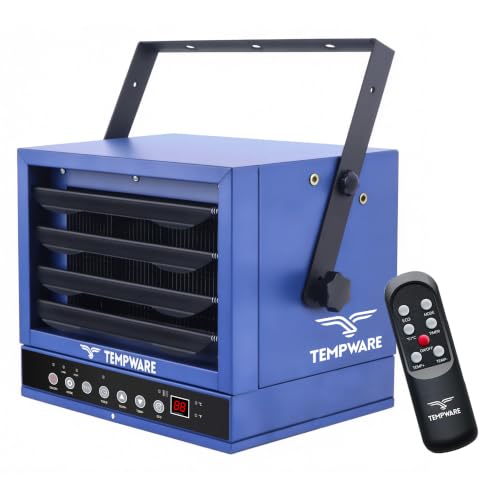
240V hardwired 7500W ceiling heater with 25,590 BTU, 45–95 F digital thermostat, ECO mode, remote and 12-hour timer.
Check price on Amazon$159.99 as of Oct 18, 2026 12:39 am GMT+0000 — prices change; see Amazon for current price.Why we like it
- Highest electric output on the shelf, adjustable 5000W to 7500W
- Stated coverage of 1,250 sq ft
- Digital thermostat from 45 to 95 F with ECO mode
- Listing requires a qualified electrician for install
| Specification | Details |
|---|---|
| Power / connection | 240V, hardwired; power cord not included |
| Output | 5,000 to 7,500 watts; 25,590 BTU stated |
| Controls | Digital thermostat 45–95 F, ECO mode, remote plus touch panel, 12-hour shutoff timer |
| Mounting | Multi-angle ceiling bracket included |
| Safety | Automatic overheat shutdown; steel housing; certification mark not stated in listing |
| Model / warranty | GR7500ER-EC; warranty not stated in listing |
TEMPWARE GR7500ER-EC — 240V hardwired, 5000–7500W, 25,590 BTU, 1,250 sq ft, 45–95 F thermostat, remote, 12-hr timer, ceiling mount
The Largest Stated Coverage Among the Electric Heaters
Four listings on the shelf are 240-volt electric garage heaters, and this is one of two rated at 7,500 watts. Its stated 1,250 sq ft coverage is the largest claim from any electric unit here. Oddly, the other 7,500-watt heater, the InoKraft in pick 3, claims only 750 sq ft for the same wattage. The heat output of the two should be essentially identical, so treat both coverage numbers as marketing estimates and size by insulation and climate instead.
The TEMPWARE is one of two hardwired units on the shelf, and its listing is direct that a qualified electrician has to install it. A 7,500-watt load at 240 volts draws a little over 31 amps, which is far more than any garage outlet circuit was built for. Expect a dedicated breaker and heavier wire; the manual sets the exact size.
The listing names no certification mark and states no warranty. Its 12-hour timer is framed as an automatic shutoff after you leave, which is the right habit for a garage that sits empty overnight.
Pros
- Most electric heat on the shelf
- Digital thermostat plus ECO mode
- Ceiling mount clears the floor for vehicles
Cons
- Requires a new dedicated 240V circuit
- No certification mark named in listing
- Warranty not stated
Check TEMPWARE 7500W price on Amazon
2. CTSC MGH1056-02 — Best 240V Plug-In With the Socket Included

5600W fan-forced 240V heater with NEMA 6-30P plug and matching socket, UL certification named, 1–10 hour timer.
Check price on Amazon$159.99 as of Oct 18, 2026 12:39 am GMT+0000 — prices change; see Amazon for current price.Why we like it
- Only listing on the shelf that names UL certification
- Ships with a matching 240V socket for the plug
- States a minimum 7.3-inch rear wall clearance
- Thermostat, remote and 1 to 10 hour timer
| Specification | Details |
|---|---|
| Power / connection | 240V; NEMA 6-30P (30A) plug, 6.2 ft cord, matching socket included |
| Output / coverage | 5,600 watts; 19,096 BTU; stated 560 sq ft |
| Controls | Built-in temperature sensor, AUTO mode via remote, 1–10 hour timer |
| Mounting / clearance | Horizontal or vertical bracket with lock; rear at least 7.3 in from wall without bracket |
| Noise / weight | 58 dB or less; 17 lb |
| Model / warranty | MGH1056-02; one-year limited warranty |
CTSC MGH1056-02 — 240V, 5600W, 19,096 BTU, NEMA 6-30P + socket, 560 sq ft, UL named, 58 dB, 17 lb, 1-yr warranty
The Only Garage Heater Listing That Names UL Certification
Among the ten garage and shop heaters on the shelf, two name ETL and one names UL: this CTSC. The others, including both 7,500-watt units and the gas heater, name no testing mark at all in their listings. The CDC advises buying only gas equipment carrying the seal of a national testing agency, and the same logic applies to a high-wattage electric heater bolted to the ceiling.
It is also the only listing that states a specific clearance figure for the electric heater itself: at least 7.3 inches from the back of the unit to the wall when the bracket is not used. That kind of number belongs in every listing and rarely appears. The plug-in design is a genuine convenience, since the matching socket comes in the box, but the socket still has to be installed on a properly sized 240V circuit. The listing itself recommends an electrician if that supply is not already there.
The listing frames this as a commercial heater, not a household one, and says it cannot plug into a standard 120V outlet.
Pros
- UL certification named
- Matching socket included
- States a rear clearance distance
- Quieter stated noise than the InoKraft
Cons
- Still needs a 240V circuit installed
- Thermostat range not stated
- One-year warranty
Check CTSC 5600W price on Amazon
3. InoKraft 7500W — Best for a Garage With an Existing 50-Amp Outlet

7500W 240V wall or ceiling heater with NEMA 14-50P plug, 8 AWG cord, 40–99 F thermostat and 24-hour timer.
Check price on Amazon$215.99 as of Oct 18, 2026 12:39 am GMT+0000 — prices change; see Amazon for current price.Why we like it
- NEMA 14-50P plug matches common EV and RV outlets
- Widest stated thermostat range: 40 to 99 F
- Longest timer among the 240V units: 24 hours
- Fan keeps running briefly to clear residual heat
| Specification | Details |
|---|---|
| Power / connection | 240V; NEMA 14-50P plug on 8.2 ft, 8 AWG cord |
| Output / coverage | 7,500 watts; stated 750 sq ft |
| Controls | Digital thermostat 40–99 F, high/low plus ECO, 1–24 hour timer, remote |
| Mounting | Wall or ceiling; five bracket angles; adjustable louvers |
| Noise / safety | 65 dB; overheat protection, automatic shutoff, fan delay; mark not stated |
| Model / warranty | IK05088001; warranty not stated in listing |
InoKraft IK05088001 — 240V 7500W, NEMA 14-50P, 750 sq ft, 40–99 F, 24-hr timer, ECO, fan delay, 65 dB
The Only Heater Here Built Around a 14-50 Receptacle
Two listings on the shelf are 240V heaters that plug in rather than hardwire. The CTSC uses a 30-amp 6-30 plug; this InoKraft uses a 14-50 plug, the same receptacle many Front Range garages already have for an EV charger or RV. If that outlet exists and is in good shape, this heater may not need new wiring at all. The catch is sharing: the heater and a charging car should not run on the same circuit at the same time unless the circuit and equipment are rated for it.
Its thermostat range and timer are the widest of the four 240V listings. The fan-delay feature, which keeps air moving after the elements shut off, helps the unit cool down without tripping its own overheat cutoff.
The listing says installation must be done by a professional electrician, which reads oddly next to a plug, but it is a reasonable caution for a 31-amp load. At 65 dB it is the loudest stated electric unit, and its 750 sq ft coverage claim is half the TEMPWARE’s for the same wattage.
Pros
- Uses an existing 14-50 outlet
- 40 to 99 F thermostat, 24-hour timer
- Wall or ceiling mounting
Cons
- Loudest stated noise at 65 dB
- No certification mark named
- Conflicts with EV charging on the same circuit
Check InoKraft 7500W price on Amazon
4. Omberr GHA40 — Best Compact 240V Heater for a One-Car Garage or Shop

4000W 240V hardwired heater with overheat alert code, 40–90 F thermostat, 0.5–9 hour timer and wall or table use.
Check price on Amazon$178.99 as of Oct 18, 2026 12:39 am GMT+0000 — prices change; see Amazon for current price.Why we like it
- Smaller 4,000W load suits lighter circuits
- Displays an H–1 code when it overheats
- Fan keeps running to cool after an overheat trip
- Four wall-mount angles plus table or floor use
| Specification | Details |
|---|---|
| Power / connection | 240V, hardwired, no plug supplied |
| Output | 4,000 watts (about 13,650 BTU by conversion); coverage not stated |
| Controls | 40–90 F thermostat, F or C display, 0.5–9 hour timer, remote |
| Mounting | Two height settings, four wall angles 0–40.5 degrees, louvers 0–130 degrees |
| Safety | Stops heating above 95 C internal, shows H–1, fan continues; mark not stated |
| Size / weight | About 21.7 x 7.6 x 5.4 in; 13.3 lb |
Omberr GHA40 — 240V hardwired 4000W graphene element, 40–90 F, 9-hr timer, H–1 overheat alert, wall/table, 13.3 lb
The Only Listing That Explains What Happens After an Overheat Trip
Every 240V heater here claims overheat protection, but the Omberr is the only listing that describes the sequence: heating stops above an internal 95 C, the display shows an H–1 alert and the fan keeps running to cool the housing. Knowing why a heater went cold saves a confused reset cycle, and it also tells you to check for a blocked intake or a mounting spot too close to the wall.
At 4,000 watts it draws under 17 amps at 240V, the lightest load of the four 240V units. That suits an insulated one-car garage, a detached shop or a heated workbench zone better than the 7,500-watt units. It is also the only 240V listing that says it can sit on a table or floor as well as mount on a wall.
The listing gives no coverage figure and no certification mark, and its warranty field contains a parts description rather than a term. Like the TEMPWARE, it is hardwired, so plan on an electrician.
Pros
- Clear overheat alert behavior
- Lighter 4,000W circuit load
- Flexible wall, table or floor placement
Cons
- No coverage figure stated
- Hardwired, needs an electrician
- Warranty and certification not stated
Check Omberr GHA40 price on Amazon
5. Mr. Heater F260550 — Best Gas-Fired Garage Unit Heater

50,000 BTU propane or natural gas ceiling unit heater, up to 1,667 sq ft; needs a 10 ft ceiling, 8 ft to floor.
Check price on Amazon$452.79 as of Oct 18, 2026 12:39 am GMT+0000 — prices change; see Amazon for current price.Why we like it
- Most heat on the shelf: 50,000 BTU
- Stated coverage of 1,667 sq ft, about three cars
- Runs on propane or natural gas
- High-limit switch plus flame-sensor gas shutoff
| Specification | Details |
|---|---|
| Fuel / output | Propane or natural gas; 50,000 BTU |
| Coverage | Up to 1,667 sq ft |
| Mounting / clearance | Ceiling; minimum 10 ft ceiling and 8 ft from heater base to floor |
| Controls | Works with standard 24-volt or Wi-Fi thermostats, sold separately |
| Safety | High-temperature shutoff switch; flame sensor gas shutoff |
| Size / weight | About 29 x 26 x 15 in; 60.3 lb; venting details not stated in listing |
Mr. Heater F260550 — 50,000 BTU propane/NG unit heater, 1,667 sq ft, 10 ft ceiling / 8 ft floor clearance, flame sensor, 60 lb
The Only Fuel-Burning Heater, and the Only One With a Stated Ceiling Requirement
This is the single gas heater among the ten garage units on the shelf. At 50,000 BTU it delivers roughly double the stated output of the 7,500-watt electric heaters, and gas is often cheaper per unit of heat than resistance electricity. It is also the only listing that sets hard installation geometry: a ceiling at least 10 feet high and 8 feet from the base of the heater to the floor. Many attached garages with 8- or 9-foot ceilings simply do not qualify.
Fuel-burning changes the safety picture. The listing does not describe how the unit vents its combustion gases, so confirm the vent kit and flue requirements in the installation manual before buying. Gas piping and venting should be installed and inspected by a licensed gas contractor; the CPSC notes that most fuel-burning appliances should be installed by qualified professionals and inspected annually.
The CDC lists gas furnaces and similar appliances among common household sources of carbon monoxide. Any garage with a gas heater needs a working CO alarm in the adjacent living space, and gasoline, paint and propane cylinders stored nearby should move to a detached shed, as the USFA recommends.
Pros
- Most heat output on the shelf
- Propane or natural gas
- Flame-sensor gas shutoff
Cons
- Needs a 10 ft ceiling
- Venting not described in listing
- Gas line and permit work required
- Thermostat sold separately
Check Mr. Heater 50,000 BTU price on Amazon
6. Shinic QGW15-602 2-Pack — Best 120V Ceiling Radiant Heater With a Work Light

Two 120V quartz radiant heaters, 1500W/750W, with halogen work light, 90-degree tilt, grounded plug and ETL listing.
Check price on Amazon$139.99 as of Oct 18, 2026 12:39 am GMT+0000 — prices change; see Amazon for current price.Why we like it
- Radiant quartz heat warms the person at the bench
- Plugs into standard 120V with a grounded plug
- Built-in halogen work light
- ETL listed, metal housing, overheat cutoff
| Specification | Details |
|---|---|
| Power / connection | 120V; 3-prong grounded plug |
| Output | 750W or 1,500W radiant quartz per heater; two heaters in the pack |
| Controls | Pull-string switch: low heat, high heat, either with work light, off |
| Mounting | Ceiling bracket, rotates up to 90 degrees |
| Safety / certification | Overheat auto-off; metal housing; ETL listed |
| Model / warranty | QGW15-602; warranty not stated in listing |
Shinic QGW15-602 — 2-pack 120V quartz radiant, 750/1500W, halogen light, 90° tilt ceiling mount, grounded plug, ETL
The Only Garage Heater Here With a Built-In Work Light
Several 120V heaters on the shelf are marketed for garages, and this pack is the only one that combines a ceiling bracket with a work light in the same fixture. Radiant quartz heat does not try to warm the air in a drafty garage; it warms the person and the bench in its beam. That is the realistic job for 1,500 watts in an uninsulated two-car garage with a leaky overhead door.
The two-pack lets you aim one heater at the workbench and another at a second station, but each heater draws a full 1,500 watts on high, so the two belong on separate 120V circuits. The ceiling mount keeps the hot face away from paint cans, rags and the dog, which matters given the USFA finding that garage fires spread farther and cause more injuries and loss than fires starting elsewhere in the home.
The listing names no thermostat or timer: the heater runs until you pull the string. It also gives no warranty term.
Pros
- Standard 120V grounded plug
- Ceiling mount keeps the floor clear
- Work light in the same fixture
Cons
- No thermostat or timer
- Heats a beam, not the whole garage
- Two units need two circuits
Check Shinic QGW15-602 price on Amazon
7. Dura Heat EUH1500 — Best Portable 120V Shop Heater

Steel-body forced-air 120V workspace heater, 5,120 BTU, thermostat, overheat shutoff, stated 250 sq ft.
Check price on Amazon$68.99 as of Oct 18, 2026 12:39 am GMT+0000 — prices change; see Amazon for current price.Why we like it
- Steel body suited to a dusty shop floor
- Built-in thermostat and overheat shutoff
- Adjustable stand aims heat where needed
- Runs on any standard grounded 120V outlet
| Specification | Details |
|---|---|
| Power / connection | 120V; 6 ft cord with polarized plug |
| Output / coverage | 5,120 BTU (about 1,500W); up to 250 sq ft |
| Controls | Built-in thermostat; range not stated |
| Construction | Steel body; adjustable stand; carry handle |
| Safety | Overheat shutoff; tip-over protection not stated in listing |
| Model / warranty | EUH1500; warranty term not stated in listing |
Dura Heat EUH1500 — 120V forced-air, 5,120 BTU, thermostat, overheat shutoff, steel body, 250 sq ft
A Steel Shop Heater With a Thermostat, on a Normal Outlet
The portable 120V garage heaters on the shelf split into PTC cubes marketed for patios and garages, an infrared panel and this steel-bodied forced-air unit. The Dura Heat is the only portable 120V garage listing that pairs a metal housing with a thermostat, which matters in a shop where a plastic case can be cracked by a dropped tool or softened by a nearby heat gun.
Its 250 sq ft rating is realistic for a single bay or a corner workbench, not a whole insulated two-car garage. Like any 1,500-watt heater, it should plug straight into a wall outlet, not into the extension cord that runs to the table saw. The USFA warns against extension cords and power strips for portable heaters.
The listing is short. It does not state tip-over protection, a thermostat range or a certification mark, so check the rating plate before leaving it running while you work.
Pros
- Steel body and adjustable stand
- Thermostat on a 120V portable
- No installation needed
Cons
- Tip-over protection not stated
- No certification mark named
- Heats a work zone, not a garage
Check Dura Heat EUH1500 price on Amazon
Sizing a garage heater: watts, BTU and Front Range winters
Electric heater output converts directly: one watt equals about 3.41 BTU per hour, so a 1,500-watt portable delivers roughly 5,100 BTU, a 4,000-watt unit about 13,650 BTU and a 7,500-watt unit about 25,600 BTU. The gas unit here makes 50,000 BTU. Coverage claims on listings vary wildly; two 7,500-watt heaters on this shelf claim 750 and 1,250 sq ft respectively.
What actually sets the size is how much heat the garage loses. On the Front Range, overnight lows below zero and dry Chinook winds pull heat through uninsulated overhead doors, bare stud walls and gaps around the door seal. An insulated, weatherstripped two-car garage can often hold workable temperatures with 4,000 to 5,600 watts. An uninsulated one with a thin steel door may struggle with 7,500. Insulating the door and sealing its perimeter will usually do more than stepping up to the next heater.
Altitude does not change electric output. It can affect gas appliances, which may need high-altitude adjustment, so confirm that with the installer for any fuel-burning unit at Front Range elevations.
240V circuits, plugs and permits
Garage heaters fall into three electrical camps, and choosing one is really choosing an install path:
- 120V portable or plug-in. No install, but limited to about 1,500 watts and best used as spot heat. Plug directly into a wall receptacle and avoid sharing the circuit with compressors or saws.
- 240V plug-in. The CTSC (6-30 plug) and InoKraft (14-50 plug) need a matching receptacle on a correctly sized dedicated circuit. If the outlet already exists, have someone confirm the breaker, wire gauge and receptacle condition before adding a heater’s continuous load.
- 240V hardwired. The TEMPWARE and Omberr connect directly to a circuit. Both listings call for a qualified electrician.
Adding a new 240V circuit generally requires an electrical permit in Front Range jurisdictions, and a panel that is already near capacity may need a load calculation first. For more on the heater types and running costs, see our garage heater guide, and for general room-heater rules, our space heater guide.
Clearances and fire safety in the garage
Garages hold the worst combination of heat and fuel in a house: gasoline, solvents, paint, oily rags, propane cylinders and cardboard. The USFA notes that garage fires tend to spread farther and cause more injuries and dollar loss than fires that start elsewhere, and recommends storing gasoline, paints, propane and varnishes in a shed away from the house.
- Keep anything that can burn at least three feet from heat-producing equipment, the clearance the USFA gives for furnaces, water heaters and similar appliances, and follow any larger distance in the heater’s manual.
- Mount ceiling heaters so the discharge does not blow directly onto a parked car, stored fuel or the overhead door opener.
- Respect stated geometry: the gas unit here requires a 10-foot ceiling and 8 feet to the floor; the CTSC states 7.3 inches minimum from the wall when unbracketed.
- The USFA recommends a heat alarm, not a smoke alarm, in the garage, and a self-closing, self-latching fire-rated door between garage and house.
Gas and propane garage heaters: venting and carbon monoxide
A fuel-burning garage heater has to get rid of combustion gases. The CPSC says never to operate unvented fuel-burning appliances in rooms where people sleep, and an attached garage shares air with the house through doors, attic hatches and wall penetrations. Portable propane heaters marketed for job sites are a different product with different limits; read our explainer on the ventless propane heater before using one in an attached garage.
The CDC’s guidance is blunt about garages: never run a car or truck inside a garage attached to the house, even with the door open. Install battery or battery-backup CO alarms near sleeping areas and on each level, and have any gas heater, its gas line and its vent serviced every year. For outdoor or open-sided spaces such as a carport or patio, see our patio heater guide instead.
When to call an electrician, gas fitter or inspector
Bring in an electrician for any new 240V circuit, for a panel that is already full, or when an existing 14-50 or 6-30 outlet shows heat discoloration or a loose fit. Bring in a licensed gas contractor for any gas unit heater, including the gas line, shutoff, venting and combustion air. If you are buying a home with an existing garage heater, ask whether it was permitted and look for a nameplate, clearances and a vent that terminates outdoors.
A home inspection covers the garage’s fire separation, visible wiring and any fuel-burning appliance. Our overview of heating and cooling inspection topics explains what inspectors look at.
Frequently asked questions
What size garage heater do you need for a two-car garage?
An insulated two-car garage of roughly 400 to 600 square feet is usually a 4,000- to 7,500-watt electric job, or a smaller gas unit heater. Uninsulated garages with thin steel doors lose heat much faster, so insulation and weatherstripping matter as much as heater size. Coverage claims on listings vary widely for the same wattage.
Can a garage heater plug into a regular outlet?
Only 120-volt heaters, which top out around 1,500 watts, plug into a standard outlet, and they work best as spot heat. Larger electric garage heaters run on 240 volts and either plug into a matching 6-30 or 14-50 receptacle or are hardwired on a dedicated circuit installed by an electrician.
Is a gas or electric garage heater better?
Gas unit heaters deliver more heat for the money and suit large or tall garages, but they need a gas line, a vent and professional installation, plus CO alarms in the house. Electric heaters produce no combustion gases and are simpler to install, but large ones need a 240-volt circuit and cost more to run.
How far should a garage heater be from stored items?
Follow the heater's manual first. As a baseline, the USFA advises keeping anything that can burn at least three feet from heat-producing equipment. In a garage that includes cardboard, rags, cars and fuel cans, and the USFA recommends storing gasoline, paint and propane in a separate shed.
Do you need a permit to install a garage heater?
A new 240-volt circuit or any gas line and vent work generally requires a permit in Front Range jurisdictions. Plugging a 120-volt heater into an existing outlet does not. Check with your city or county building department before work starts, especially if the panel is near capacity.
References
- Basement and Garage Fire Safety — U.S. Fire Administration
- Heating Fire Safety — U.S. Fire Administration
- Heater Fire Safety card (PDF) — U.S. Fire Administration
- Carbon Monoxide Poisoning Basics — Centers for Disease Control and Prevention
- Carbon Monoxide Questions and Answers — U.S. Consumer Product Safety Commission
Planning a heated garage or buying a Front Range home with one already wired in? Reach out through our contact page to connect with a vetted local inspector.