Best Energy Efficient Space Heater (2026): 6 Low-Waste Picks
Here is the honest starting point for anyone shopping for the best energy efficient space heater: every electric resistance heater on this shelf converts essentially all the electricity it draws into heat. The Department of Energy rates all-electric resistance heat at 95 to 100 percent efficient, because there is no flue to lose heat up. A 1,500-watt heater that costs a fortune and a 1,500-watt heater that costs very little produce the same heat per hour. So “efficient” cannot mean a better element. It can only mean using fewer kilowatt-hours: lower wattage settings, a thermostat that cycles the element off, a timer or schedule that stops it running in an empty room, and heating a person or one room instead of the whole house. Below are six picks chosen on exactly those controls. For an all-round comparison, see our main best space heater roundup.
Part of our Heating, Cooling & Ventilation guide — start there for the full picture →
As an Amazon Associate we earn from qualifying purchases.
How we compared: we compared 16 current Amazon listings returned for energy efficient space heaters on what each states: wattage settings, thermostat range and steps, timers, scheduling, auto-off, heating type and certification. All 16 are electric resistance heaters, from 500 to 1,500 watts. We did not lab-test or meter any heater, and we treat percentage savings claims as marketing unless a listing explains them. Prices and availability change, so check the current listing before buying.
Quick picks: the best energy efficient space heaters
| Product | Best for | Key features | Price | Buy |
|---|---|---|---|---|
| VOCRS PTC-903B | Best overall for using less |
| $ | Buy now →Check current price |
| DREO HSH009S Wall Heater | Scheduling by app |
| $$ | Buy now →Check current price |
| Gaiatop SH-02 | Lowest wattage, personal heat |
| $ | Buy now →Check current price |
| JIBUFI PTC-SL1702 | Low watts with oscillation |
| $ | Buy now →Check current price |
| WEWARM HT1198QX | Radiant heat for people |
| $$ | Buy now →Check current price |
| DREO Atom One (HSH004) | Compact thermostat heater |
| $ | Buy now →Check current price |
Price key: $ under $50 · $$ $50–150 · $$$ $150–500 · $$$$ $500+. Prices change often; check Amazon for today’s price. As an Amazon Associate we earn from qualifying purchases.
The 6 picks, compared listing by listing
1. VOCRS PTC-903B — Best Overall for Using Less Electricity

Compact ceramic heater with 700, 1,000 or 1,500 W, a thermostat with digital display and a 1–12 hour timer.
Check price on Amazon$26.59 as of Oct 17, 2026 11:41 pm GMT+0000 — prices change; see Amazon for current price.Why we like it
- 700-watt setting, under half a full heater
- Thermostat with a readable digital display
- Timer shuts it off automatically
- Small enough to heat only where you sit
| Specification | Details |
|---|---|
| Heat settings | 700 W, 1,000 W or 1,500 W PTC ceramic; ECO and fan modes |
| Thermostat / display | Thermostat; digital display shows temperature and status |
| Timer | 1–12 hours, then shuts off |
| Safety | Overheat protection and tip-over shut-off; ETL per listing |
| Controls | Remote (2 AAA, not included); carry handle |
| Size | About 8.5 x 5.8 x 5.5 in; non-oscillating; weight and noise not stated |
VOCRS PTC-903B — 700/1,000/1,500 W PTC, thermostat + digital display, 1–12 hr timer, remote, ETL per listing
The Only 700-Watt Heater That Shows You the Temperature
Among the 16 listings, low settings run from 500 watts (the Gaiatop) to 1,000 watts (DREO’s HSH003 ECO mode and the WEWARM). Two heaters offer 700 watts: this VOCRS and the JIBUFI. Of the two, only the VOCRS describes a digital display that shows the temperature, which makes the thermostat easier to set at a modest number rather than cranking it.
The math is simple. At 700 watts, an hour of heat uses 0.7 kWh; at 1,500 watts, 1.5 kWh. Multiply by your utility rate to see the difference. Combined with a thermostat that cycles the element off once the room is warm and a 1 to 12 hour timer that shuts it off entirely, this is the most complete “use less” control set among the compact heaters.
It does not oscillate, so it suits heating one person at a desk or chair rather than a whole room. The listing gives no noise figure, weight or warranty term beyond a 12-month exchange promise.
Pros
- 700 W low setting
- Display makes the thermostat easy to set
- Timer with auto-off
Cons
- No oscillation
- No noise or weight stated
- Warranty details limited
Check VOCRS PTC-903B price on Amazon
2. DREO HSH009S Smart Wall Heater — Best for Scheduling

Wall-mounted smart ceramic heater with app schedules, voice control, 41–95 F thermostat and 120-degree oscillation.
Check price on Amazon$116.96 as of Oct 17, 2026 11:41 pm GMT+0000 — prices change; see Amazon for current price.Why we like it
- Only listing with app scheduling
- Thermostat in 1 degree steps
- Off the floor, out of the way
- Display dims itself in low light
| Specification | Details |
|---|---|
| Heat | 1,500 W PTC ceramic; ECO mode per title |
| Smart features | DREO app schedules and remote access; Alexa and Google Home |
| Thermostat / timer | 41–95°F in 1°F steps; 24-hour timer per title |
| Airflow | 120-degree oscillation, top to bottom |
| Mounting | Wall-mounted; accessories and drilling guide included; power connection not described |
| Size / certification | About 13.4 x 20.1 x 4.7 in; 9.15 lb; certification not named in listing |
DREO HSH009S — 1,500 W PTC wall heater, app schedules, Alexa/Google, 41–95 F thermostat, 120-degree oscillation
The Only Listing on the Shelf With App Scheduling
The cheapest kilowatt-hour is the one a heater never uses. The HSH009S is the only listing among the 16 that can run on a schedule from an app, so it can warm a home office for the hours you work and stay off the rest of the day, or be shut off remotely when you forget. ENERGY STAR makes the same argument for smart thermostats: scheduling heat to when you are home and awake is where the savings come from.
It pairs the schedule with a thermostat in 1-degree steps and 120-degree oscillation. Mounted on a wall, it is off the floor and away from clutter, which also helps keep the 3-foot clearance the USFA recommends.
Two gaps. The listing does not say whether the heater plugs in or must be wired, so read the manual before buying; a wall heater near a receptacle still needs a direct wall connection, never an extension cord. And it does not name a testing laboratory’s mark; confirm one on the unit, as the USFA advises. At full output it is still a 1,500-watt heater.
Pros
- App schedules and remote shut-off
- Precise thermostat
- Off the floor
Cons
- Certification not named in listing
- Power connection not described
- No low-wattage setting stated
Check DREO HSH009S price on Amazon
3. Gaiatop SH-02 — Best Lowest-Wattage Personal Heater

500-watt ceramic desk heater, 5 inches tall, with 45-degree tip-over and overheat protection and V0 materials.
Check price on Amazon$16.99 as of Oct 17, 2026 11:41 pm GMT+0000 — prices change; see Amazon for current price.Why we like it
- 500 watts, a third of a full heater
- Heats a person, not a room
- 45-degree tip-over shut-off
- Fits on a desk or under it
| Specification | Details |
|---|---|
| Heat | 500 W PTC ceramic; single setting |
| Controls | Indicator light; no thermostat or timer described |
| Safety | 45-degree tip-over and overheat protection; V0 fire-resistant material |
| Certification | Not named in listing |
| Size | About 5 x 5 x 2.6 in; weight not stated |
| Use | Desks, dorms, small offices per listing |
Gaiatop SH-02 — 500 W PTC desk heater, 45-degree tip-over and overheat protection, V0 material, 5 in tall
The Lowest-Wattage Heater on the Shelf
Every other listing among the 16 is a 1,500-watt heater at full power. The SH-02 is the only one built around 500 watts, a third of the draw. At 0.5 kWh per hour, it is the closest thing to a genuinely low-energy heater, because it is designed to warm your hands and legs at a desk rather than the air in a room.
That is the most effective efficiency strategy in this whole category: heat the person, then lower the central thermostat for the rest of the house. A 500-watt unit under a desk, in a home where the furnace is set a few degrees lower during the workday, uses far less energy than heating a whole floor for one person.
It is basic. There is no thermostat or timer, so you must switch it off yourself, and the listing does not name a testing laboratory’s certification; look for a UL, ETL or CSA mark on the unit before buying. Do not run it under a desk with papers, bags or a blanket within 3 feet.
Pros
- 500 W draw
- Tiny footprint
- Tip-over and overheat protection
Cons
- No thermostat or timer
- Certification not named
- Too small for room heating
Check Gaiatop SH-02 price on Amazon
4. JIBUFI PTC-SL1702 — Best Low-Wattage Heater With Oscillation
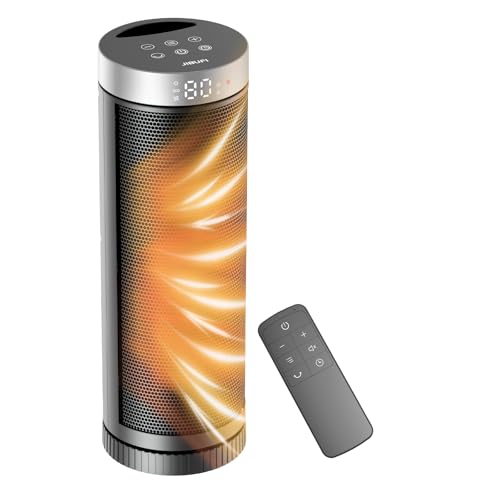
17-inch ceramic tower with 700, 1,000 or 1,500 W, 70-degree oscillation, thermostat, timer and a 24-hour auto-off.
Check price on Amazon$39.98 as of Oct 17, 2026 11:41 pm GMT+0000 — prices change; see Amazon for current price.Why we like it
- Only oscillating heater with a 700 W setting
- Thermostat adjusts output to the room
- 1 to 12 hour timer
- Shuts off after 24 hours with no input
| Specification | Details |
|---|---|
| Heat settings | 700 W, 1,000 W or 1,500 W PTC ceramic |
| Thermostat | Built-in, adjusts output to room temperature; range not stated |
| Timers | 1–12 hour timer; auto power-off after 24 hours without interaction |
| Oscillation | 70 degrees |
| Safety | Tip-over and overheat protection; flame-retardant plug; ETL per listing |
| Size / warranty | About 16.5 x 5.5 x 5.5 in; 1-year warranty |
JIBUFI PTC-SL1702 — 700/1,000/1,500 W PTC, thermostat, 1–12 hr timer, 24-hr auto-off, 70-degree oscillation, 1-yr warranty
The Only Oscillating Heater Here With a 700-Watt Setting
Oscillating heaters on this shelf mostly offer 1,500 watts and an ECO mode. The Comfort Zone CZ449E offers 750 watts with oscillation. The JIBUFI is the only one that oscillates and steps down to 700 watts, which makes it the low-draw choice for spreading heat across a small room rather than a single chair.
Its timers cover both bases: a 1 to 12 hour timer for planned shut-off and an automatic power-off after 24 hours without any button press. Both stop the most common energy waste, a heater left running in an empty room.
The thermostat range is not stated, nor are noise or weight. This model is in our parent roundup; here it earns its place for the 700-watt setting.
Pros
- 700 W with oscillation
- Two kinds of auto-off
- Slim tower
Cons
- Thermostat range not stated
- No noise figure
- 1-year warranty
Check JIBUFI PTC-SL1702 price on Amazon
5. WEWARM HT1198QX — Best Radiant Heater for Warming People

Infrared quartz cabinet heater with 1,000 W and 1,500 W settings, ECO mode, 50–90 F thermostat and TUV certification.
Check price on Amazon$65.99 as of Oct 17, 2026 11:41 pm GMT+0000 — prices change; see Amazon for current price.Why we like it
- Infrared warms people and objects directly
- 1,000-watt setting plus ECO mode
- Thermostat holds a set temperature
- Child lock and cool-touch exterior
| Specification | Details |
|---|---|
| Heat | Infrared, 6 quartz elements; 1,000 W, 1,500 W or ECO |
| Thermostat / timer | 50–90°F; 12-hour timer |
| Coverage / noise | Up to 300 sq ft; 34 dB |
| Safety | TUV certified; V-0 material; overheat, tip-over; cool-touch exterior; child lock per title |
| Controls | Remote with LED indicator |
| Size / weight | About 12.6 x 9.8 x 10 in; 6.39 lb; warranty not stated |
WEWARM HT1198QX — infrared quartz, 1,000/1,500 W + ECO, 50–90 F thermostat, 12-hr timer, 34 dB, TUV certified
The Only Infrared Listing That States a Low-Wattage Setting
Two infrared heaters appear among the 16: this WEWARM and the Dr. Infrared DR-968. The DR-968 offers “high and low” without saying what low is. The WEWARM states 1,000 and 1,500 watts plus an ECO mode, and it is also the only listing on the shelf naming TUV certification.
Infrared does not beat physics: 1,500 watts of infrared is still 1,500 watts of heat. What it changes is where the heat goes. Radiant output warms the people and objects in front of it, so sitting near it can feel warm at a lower room temperature, which can let you run the thermostat lower or the heater on its 1,000-watt setting.
The thermostat range is narrower than the DREO models, 50 to 90°F, and the timer is 12 hours. Warranty is not stated.
Pros
- Radiant warmth at a lower setting
- 1,000 W setting and thermostat
- TUV certified, child lock
Cons
- Bulkier cabinet
- Warranty not stated
- Thermostat starts at 50 F
Check WEWARM HT1198QX price on Amazon
6. DREO Atom One (HSH004) — Best Compact Thermostat Heater
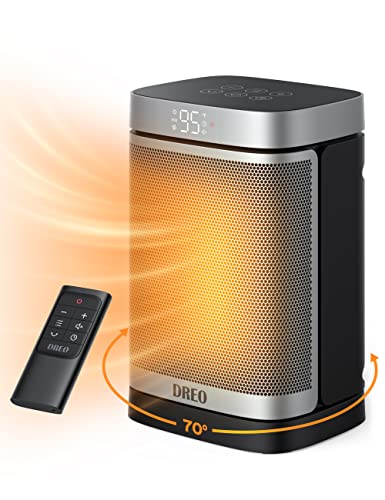
10-inch ceramic heater with ECO mode, a 41–95 F thermostat in 1 F steps, 70-degree oscillation and ETL listing.
Check price on Amazon$44.94 as of Oct 17, 2026 11:41 pm GMT+0000 — prices change; see Amazon for current price.Why we like it
- Thermostat set in single degrees
- ECO mode adjusts output automatically
- Smallest oscillating heater on the shelf
- ETL-listed, UL94 V-0 materials
| Specification | Details |
|---|---|
| Heat | Up to 1,500 W PTC ceramic; ECO mode |
| Thermostat | Digital, 41–95°F in 1°F increments |
| Oscillation / timer | 70 degrees; 12-hour timer per title |
| Safety | Tip-over and overheat protection; enhanced safety plug; UL94 V-0; ETL-listed |
| Noise | As quiet as 37.5 dB |
| Size / warranty | About 10.3 x 5.5 x 6.7 in; 3.86 lb; 12 months, extendable to 30 |
DREO Atom One (DR-HSH004) — 1,500 W PTC, ECO, 41–95 F thermostat in 1 F steps, 70-degree oscillation, 37.5 dB, ETL
The Smallest Oscillating Heater, With a Single-Degree Thermostat
Nine of the 16 listings oscillate. The Atom One has the smallest stated dimensions of them, about 10.3 by 5.5 by 6.7 inches, and it carries DREO’s 41 to 95°F thermostat in single-degree steps. That precision matters for energy use: holding a room at 66°F instead of letting it drift to 72 is where a thermostat earns its keep.
DREO says the heater is meant to sit at your feet or on a desk, which is the right way to use any space heater for efficiency: close to the person, at a modest setting. ECO mode adjusts heat to reach and hold the set temperature.
The listing does not state a low wattage, so the ECO mode’s actual draw is unknown. Its 37.5 dB noise figure is middle of the pack.
Pros
- Precise thermostat
- Compact with oscillation
- ETL-listed
Cons
- Low wattage not stated
- “Save on bills” claim unexplained
- No 24-hour auto-off described
Check DREO Atom One price on Amazon
Why every electric space heater is about 100 percent efficient
An electric resistance heater, whether ceramic, quartz, oil-filled or coil, turns current into heat in the room, and nothing escapes up a chimney. The Department of Energy’s HVAC guide rates all-electric resistance heating at 95 to 100 percent efficiency for that reason. Fans, displays and Wi-Fi chips use small amounts of power, but that energy ends up as heat in the room too.
So when a listing claims a heater is more efficient than others, it is talking about one of three things: lower wattage settings, smarter controls that run the element less, or heat directed at people instead of the ceiling. Those are real benefits, but they are control and placement benefits. Comfort Zone’s CZ449E listing, for example, claims “30% better energy efficiency” without saying compared to what. No resistance heater can convert electricity to heat 30 percent better than another.
An energy-saving setup checklist
- Pick the lowest wattage that keeps you comfortable. A 500 to 750 watt setting is often enough at a desk or reading chair once the room has warmed up.
- Use the thermostat, not the high switch. Set it a few degrees below what you would set a furnace, since the heater is close to you.
- Put it near the person, not the window. Heat aimed at a cold window or an exterior door mostly leaves the room.
- Close the door. Zone heating only works if the warm air stays in the zone.
- Lower the central thermostat. Without this step, a space heater adds energy use instead of shifting it.
- Use the timer every time. Most picks here offer one; the USFA also advises switching heaters off when you leave the room.
Home offices are the classic case, whether a spare bedroom or a basement room. Heating that one room for an eight-hour workday, with the rest of the house set back, is exactly the situation where a low-wattage, thermostat-controlled heater pays off.
How a space heater actually saves energy
Zone heating
The genuine saving comes from heating one occupied room or one person while the rest of the house runs cooler. That only works if you actually lower the central thermostat. A space heater added on top of a furnace running at the same setting adds energy use; it does not replace any. Whether this saves money also depends on the relative price of electricity and your home’s main heating fuel.
Wattage and run time
Energy used equals watts times hours. A 1,500-watt heater for 4 hours uses 6 kWh; a 700-watt setting for the same 4 hours uses 2.8 kWh. A thermostat that cycles the element off for part of each hour lowers that further. A timer or schedule that stops it after you leave the room is the biggest lever of all.
Thermostats, timers and schedules
ENERGY STAR’s smart thermostat guidance makes the same point for whole-house systems: scheduling heat to when you are home and awake saves energy. Apply it to a space heater with a timer or app schedule, and avoid units with only high and low switches and no thermostat when you plan to run them for hours.
Insulation and air sealing
A heater cannot outrun a drafty room. ENERGY STAR’s air sealing guidance notes that sealing and insulating are among the most cost-effective ways to improve comfort and reduce heating costs. Weatherstripping a door or sealing a window frame keeps every kilowatt-hour you buy inside the room.
When a space heater is the wrong tool
The Department of Energy’s HVAC guide notes that electric resistance room heaters are not typically a cost-effective way to heat a whole average or large house over the long term, and that a heat pump can cut the electricity used for heating by 30 to 40 percent compared with resistance heat. ENERGY STAR likewise points to switching from electric resistance heat to heat pumps to lower bills. If you are running several space heaters every winter, a ductless mini-split or a repair to the central system is likely the more efficient answer.
For rooms that do need permanent electric heat, a hardwired baseboard heater with a good thermostat is safer than a portable heater on a cord; see our guide to the baseboard heater thermostat. For a broader look at heater types and how they compare, read our space heater guide.
Safety does not change with wattage
A 500-watt desk heater can still start a fire. The USFA recommends a heater tested by a recognized laboratory, with automatic shut-off if it tips over, placed on a solid, flat surface and at least 3 feet from anything that can burn. Plug it directly into a wall outlet, never an extension cord or power strip, and do not put anything else on the same circuit. Turn it off when you leave the room or go to bed.
If one room always needs supplemental heat, the problem may be ductwork, insulation or an aging furnace. Our heating and cooling inspection hub explains what an HVAC evaluation covers. Buying on the Front Range and want the heating system and insulation checked before closing? Get in touch to connect with a vetted local inspector.
Frequently asked questions
What is the most energy efficient type of space heater?
All electric resistance heaters are close to 100 percent efficient at turning electricity into heat; the Department of Energy rates electric resistance heat at 95 to 100 percent. The most energy-saving heater is the one with a low-wattage setting, a thermostat and a timer, used to heat only the person or room that needs it.
Do infrared heaters use less electricity?
No. A 1,500-watt infrared heater uses the same electricity as a 1,500-watt ceramic heater. Infrared warms people and objects directly, so it can feel warmer at a lower setting, which may let you run it less.
Is it cheaper to run a space heater or central heat?
It can be cheaper to heat one room with a space heater only if you also lower the central thermostat. The answer depends on your electricity rate, your main heating fuel and how long the heater runs. Heating a whole house with space heaters is rarely cost-effective.
How much electricity does a space heater use?
Multiply watts by hours. A 1,500-watt heater uses 1.5 kWh per hour at full power; a 700-watt setting uses 0.7 kWh; a 500-watt desk heater uses 0.5 kWh. A thermostat that cycles the element off lowers actual use.
Are energy-saving claims on space heater listings true?
Claims about lower bills usually refer to ECO modes, thermostats or timers that run the heater less. Claims that one resistance heater converts electricity to heat more efficiently than another are not credible, because all of them convert nearly all their electricity into heat.
References
- Energy Renovations: HVAC Guide (PDF) — U.S. Department of Energy
- Smart Thermostats — ENERGY STAR
- Air-Source Heat Pumps — ENERGY STAR
- Why Seal and Insulate? — ENERGY STAR
- Heater Fire Safety card (PDF) — U.S. Fire Administration