Wago Connectors vs Wire Nuts: Lever Splices in Home Wiring
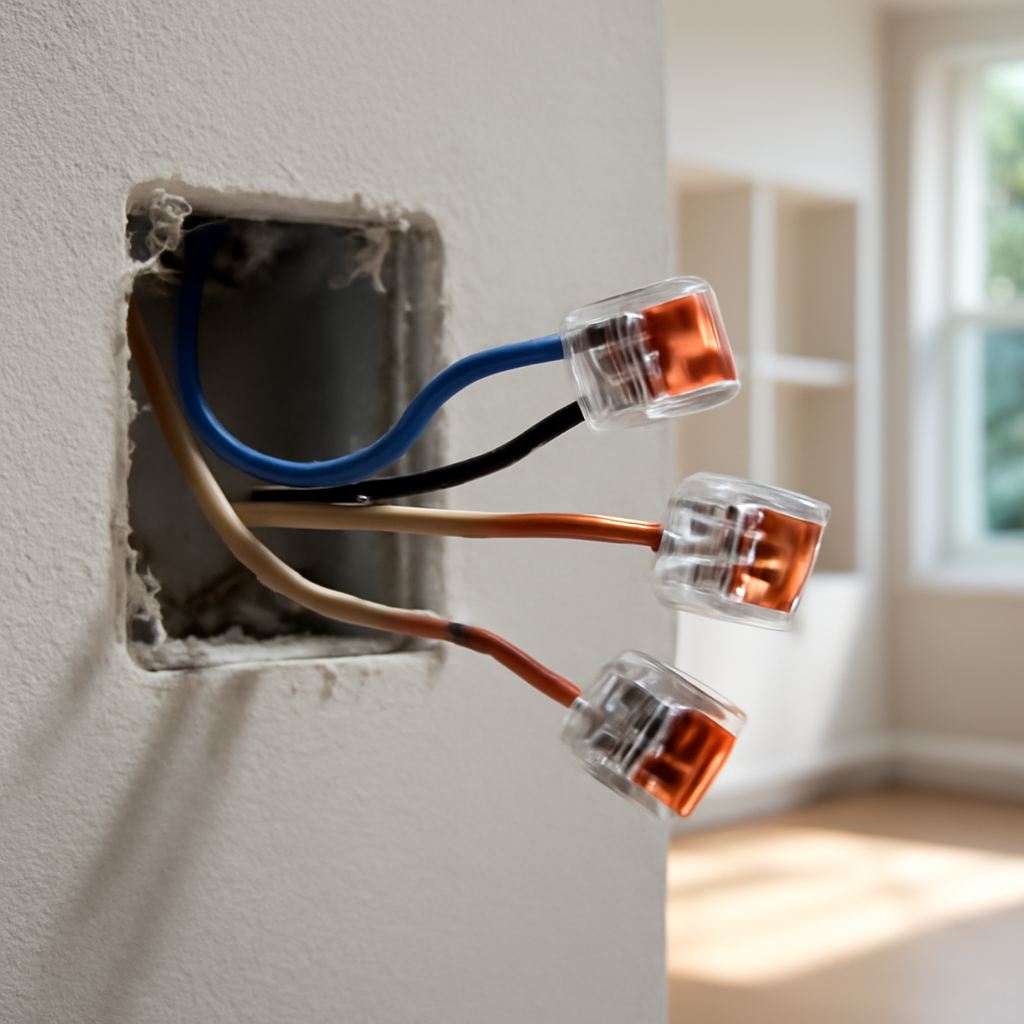
Lever-style wire connectors have gone from a niche European product to a fixture in North American hardware stores in a little over a decade. Many electricians now use them for light fixtures, device pigtails and junction box splices, and many homeowners reach for them because they look easier and more forgiving than twisting a wire nut. Wago connectors are the best-known brand, but the category includes several manufacturers and two main designs: lever-actuated connectors and push-in connectors. This guide explains how they work, how they compare with twist-on wire nuts, which conductor types and sizes they are rated for, why aluminum and very old wiring need extra care, and the splice defects home inspectors flag regardless of which connector was used. Listings, ratings and code adoption vary, so always follow the markings on the specific connector, the manufacturer’s instructions and local requirements.
Part of our Home Electrical guide — start there for the full picture →
What Wago Connectors Are and How They Work
A lever connector has a row of small clamping chambers, each with a hinged lever. With the lever raised, a stripped conductor slides into the chamber. Closing the lever presses a spring clamp against the wire and holds it against an internal current bar that joins all the conductors in the connector. Common versions accept two, three or five conductors. Because the lever can be reopened, the conductor can be removed and reinserted, which is useful when troubleshooting or replacing a fixture.
A push-in connector, sometimes called a push-wire connector, has no lever. A spring inside each port grips a solid conductor as it is pushed in. Removing the wire usually requires twisting and pulling, and many push-in connectors are intended for single use or for solid wire only.
Both types typically have a clear or translucent housing so the installer can see whether the conductor is fully seated, and many have a strip gauge molded on the side showing how much insulation to remove. Many lever models also include a test port for a meter probe, which lets an electrician check voltage without opening the splice.
Common product families
Wago’s lever-nut line, often referred to by series numbers such as 221, is the most widely recognized. Its push-in line, often called the 773 or 2773 series depending on the market, is designed for solid conductors. Ideal, Gardner Bender and other manufacturers sell their own lever and push-in connectors. Ratings differ between product lines, so the package and the connector body are the authority, not a general description.
Wago Connectors vs Wire Nuts
A twist-on wire nut holds conductors together with a tapered metal spring inside a plastic shell. When it is correctly sized and twisted down, the conductors are drawn together and held tightly. Twist-on connectors have been used for decades and remain fully acceptable when properly installed.
Where lever connectors have the edge
- Consistency. Each conductor gets its own clamp. With a wire nut, a short or poorly stripped wire can slip out of the bundle and go unnoticed.
- Mixed conductors. Many lever connectors are rated to join solid and stranded wire, such as a stranded fixture lead to solid house wiring. That combination is a frequent source of loose wire-nut splices.
- Visibility and testing. The clear housing and test port make it easier to verify seating and voltage.
- Reusability. Levers can be reopened, which helps with fixture swaps and troubleshooting.
Where wire nuts still make sense
- Box space. Lever connectors are often bulkier than a small wire nut, which matters in crowded boxes.
- Cost. Wire nuts are generally cheaper per splice.
- Conductor count and size. Some combinations of gauge and count fall outside a given lever connector’s rating but within a wire nut’s.
- Familiarity. Many electricians are fast and reliable with twist-on connectors.
Neither type is automatically better. The quality of the splice depends on choosing a connector rated for the conductors, preparing the wire correctly and installing the splice inside an approved enclosure.
Wire Gauge, Stranding and Metal Ratings
Every connector is listed for a range of conductor sizes, a maximum voltage, a temperature rating and specific conductor types. The markings matter more than the brand.
Gauge range
Common lever connectors used in homes are typically listed for a range that covers ordinary 14 and 12 AWG branch-circuit wiring, and some larger models accept 10 AWG. Fixture leads are often 16 or 18 AWG and may be stranded. Check the specific connector for the full range and whether mixed sizes are allowed in the same connector.
Voltage and temperature ratings
Connectors sold for building wiring in North America are typically marked with a maximum voltage, commonly 600 volts or less, and a maximum temperature. The temperature rating matters in places like light fixture canopies, where heat from the fixture adds to the heat of the splice, and in attic junction boxes that bake in summer. Fixture instructions sometimes call for conductors and connectors rated for a higher temperature. A connector that is fine in a basement box may not be the right choice inside a hot fixture canopy, so the fixture instructions and the connector marking should agree.
Solid vs stranded
Lever connectors are commonly rated for solid, stranded and fine-stranded copper. Many push-in connectors are rated for solid copper only, and pushing stranded wire into them can splay the strands and produce a weak grip. If a project involves stranded leads, a lever connector or a wire nut rated for that combination is generally the better match.
Copper only unless rated for aluminum
Most lever and push-in connectors sold for general use are listed for copper conductors only. Using them on aluminum branch wiring, or to join aluminum to copper, is not appropriate unless the specific connector is listed for that use and marked accordingly. Aluminum oxidizes, expands and contracts differently from copper, and connections not designed for it can loosen and overheat.
The Consumer Product Safety Commission’s publication on repairing aluminum wiring explains that the fire hazard occurs at connections with aluminum wire and that deterioration processes in those connections increase resistance and cause overheating. CPSC states that it approves only three methods for permanent repair: complete replacement with copper, pigtailing with the COPALUM crimp connector, and, where COPALUM is unavailable, pigtailing with the AlumiConn connector, a setscrew-type connector. CPSC staff also reported that twist-on connectors used for aluminum pigtails overheated severely in substantial numbers in testing and does not consider them an acceptable permanent repair. A general-purpose lever connector is not on that list. Our guide to aluminum wiring covers identification and remediation in more detail.
Knob-and-tube and old insulation
Homes with knob-and-tube wiring present a different set of concerns. Original conductors may have brittle cloth and rubber insulation, and the old splices were often soldered and taped in open air rather than in boxes. Adding modern connectors to that wiring does not solve the underlying issues of age, missing grounds and insulation condition, and disturbing brittle insulation can make things worse. These circuits should be evaluated by a licensed electrician before any connections are changed.
Strip Length, Boxes and Cable Types
Most connector failures come down to installation, not product choice.
Strip length matters
Lever and push-in connectors are designed for a specific strip length, often molded on the connector as a gauge. Too short and the clamp may grab insulation instead of copper, leaving a high-resistance connection. Too long and bare copper extends outside the housing, creating a shock and short-circuit risk. With a clear housing, a properly stripped conductor should be visible all the way to the end of the chamber, with no copper showing outside.
Splices belong in a box
Every splice, regardless of connector, generally must be contained in an approved enclosure: a junction box, a device box, a fixture canopy designed for splices, or a listed enclosure. The box must remain accessible, which means not buried behind drywall. A lever connector hanging in an attic or tucked into a wall cavity is still an exposed splice. Box fill limits also apply, and bulkier connectors make an overfilled box more likely.
Cable and raceway types
Most homes built in recent decades use nonmetallic sheathed cable, commonly called Romex, with solid copper conductors, which is well matched to typical lever connectors. Homes and garages with conductors in electrical conduit often use individual THHN conductors, which may be solid or stranded, especially in larger sizes. The connector must suit whichever is present.
OSHA’s booklet on controlling electrical hazards notes that insulated equipment grounding conductors are usually solid green or green with a yellow stripe, grounded conductors are generally white or gray, and ungrounded or hot conductors are often black or red. Keeping like conductors together in each connector, and not mixing a hot into a neutral splice, is basic but easy to get wrong in a crowded box.
Backstab Receptacles vs Screw Terminals
A related question involves the push-in holes on the back of many receptacles and switches, often called backstabs. They use a spring clip similar in concept to a push-in connector, and they are a common source of loose connections in older installations.
The CPSC guide to home wiring hazards notes that newer homes may have back-wire push-in connections to receptacles and switches rather than connections made by tightening a metal screw on a loop of wire, and that these connections may tend to loosen and overheat. It advises homeowners who know they have them to feel receptacle and switch faceplates regularly for overheating and to consult a qualified electrician if they detect it. The same guide lists hot faceplates as a potential fire hazard and advises discontinuing use of that receptacle or switch immediately.
Many electricians prefer side-wired screw terminals, or back-wire clamp terminals tightened by a screw, over spring backstabs. When devices are replaced, a common approach is to move conductors to the screw terminals or use a short pigtail joined in a connector. Our guide to light switch replacement covers device swaps, box condition and when to call an electrician.
What Inspectors Flag in Splices
Home inspectors do not open every junction box, but they see many splices in attics, basements, garages and crawl spaces, and they remove some cover plates and the panel dead front. Common findings include:
- Splices outside boxes. Connectors of any type in open air, inside walls without a box, or in insulation.
- Missing covers. Junction boxes without blank covers, leaving connectors exposed.
- Mixed metals. Aluminum spliced to copper with connectors not listed for it, or aluminum on devices not rated for it.
- Overfilled boxes. Too many conductors and connectors for the box volume, with conductors pinched by the cover or device.
- Bare copper outside the connector. Wire stripped too long, or a connector that is not fully seated.
- Heat damage. Discolored or melted connectors, scorched insulation or warm faceplates.
- Amateur extensions. Cable spliced to extend a circuit, often in a basement or garage, without boxes or protection.
Most of these lead to a recommendation that a licensed electrician evaluate and correct the wiring. A plug-in outlet tester can find some wiring faults at receptacles, such as reversed polarity or an open ground, but it cannot see a loose splice inside a box.
Why loose connections matter
A loose or undersized connection does not usually trip a breaker. Instead it creates resistance that turns current into heat right at the splice, and that heat can build slowly over months or years. The U.S. Fire Administration reports an estimated 24,200 residential building electrical fires in the United States in 2021, causing an estimated 295 deaths, 900 injuries and over $1.2 billion in property loss. Those figures cover all residential electrical fires rather than splices specifically, but they show why careful connections matter. USFA also advises replacing wall outlets if plugs do not fit snugly, a simple check homeowners can make room by room.
Common installation mistakes
- Using a push-in connector rated for solid wire on a stranded fixture lead.
- Leaving a lever partly open, so the clamp never fully engages.
- Stuffing more conductors into a connector than it has ports, or doubling two wires into one port.
- Reusing push-in connectors that are intended for one-time use.
- Folding connectors behind a device so tightly that conductors are strained at the entry.
Each of these can produce a connection that works when tested and then loosens later, which is why correct technique matters as much as the connector type.
Costs, Rewiring and When to Call a Pro
As a rough 2026 guide, lever connectors typically cost somewhat more per splice than wire nuts, but the connectors themselves are a minor part of any electrical job. Labor dominates:
- Correcting a few exposed splices with boxes and covers: often a modest service call, commonly in the low hundreds of dollars.
- Replacing backstabbed devices with screw-terminal connections: priced per device or by the hour, and often bundled with other work.
- Aluminum branch-wiring remediation with CPSC-recognized connectors: generally priced per connection and can add up across a whole house.
- Partial or full rewiring: a much larger project. Our house rewiring cost guide covers how scope, access and house size affect price.
OSHA lists deenergizing electric equipment before inspection or repair among the work practices that help prevent electrical accidents. Any splice work should begin with the breaker off and the conductors verified dead with a tested meter or voltage tester. Colorado requires electrical permits for much residential work, and Colorado law allows only limited homeowner electrical work under specific conditions, so check with the local building department first.
For buyers, splice quality is one of many items in the electrical portion of a home inspection. Our electrical inspection section explains what inspectors look at in panels, boxes and devices, and the main guide to hiring a home inspector explains how to choose an inspector and read the report.
More Questions About Wago Connectors
Are Wago lever connectors allowed by the electrical code?
Yes, Wago lever connectors are generally allowed by the electrical code when they are listed for the application and installed according to their instructions. The National Electrical Code requires splicing devices to be listed and used within their ratings, and Wago connectors sold in North America carry testing-laboratory listings.
Local inspectors enforce the edition of the code their jurisdiction has adopted, so acceptance can vary in practice. Check that the connector is marked for the wire size, conductor material and voltage involved, and keep every splice inside an accessible, covered box.
Can Wago connectors be reused?
Wago lever-style connectors can be reused, because opening the lever releases the wire without damaging the clamp. This makes them popular for fixture swaps and troubleshooting where splices are opened more than once.
Push-in Wago connectors are designed mainly for one-time use, although wires can sometimes be removed by twisting and pulling. Any connector that is cracked, discolored, scorched or loose should be discarded. Wire ends should also be re-stripped to a fresh, undamaged length rather than reusing nicked or bent copper.
How many wires can go in one Wago connector?
Each Wago connector holds one wire per port, and common lever models come in two-, three- and five-port versions. That lets a five-port connector join up to five conductors, more than many twist-on wire nuts handle comfortably.
Never double up two wires in one port. Unused ports can stay empty with the lever closed. Remember that every connector and conductor counts toward box fill, so a crowded box may need a larger box or extension ring. The ports must match the wire gauge range printed on the connector.
Can Wago connectors be used outdoors or in wet locations?
Standard Wago lever connectors are not rated for wet or damp locations on their own. Outdoor splices for landscape lighting, pumps or underground runs need connectors or enclosures listed for wet or direct-burial use.
Wago and other makers offer gel-filled boxes or housings that seal lever connectors for these applications. Inside a properly gasketed weatherproof box, standard connectors may be acceptable if the box keeps them dry, but water collecting in boxes is common. When in doubt, use connectors specifically marked for the location.
References
- Repairing Aluminum Wiring (Publication 516) — U.S. Consumer Product Safety Commission
- CPSC Guide to Home Wiring Hazards — U.S. Consumer Product Safety Commission
- Controlling Electrical Hazards (OSHA 3075) — Occupational Safety and Health Administration
- Appliance and Electrical Fire Safety — U.S. Fire Administration
Frequently asked questions
Are Wago connectors better than wire nuts?
Not automatically. Lever connectors make consistent, visible connections and handle solid-to-stranded splices well, while wire nuts are compact, inexpensive and reliable when correctly installed. The right choice depends on the conductors, the box space and the connector's rating.
Can Wago connectors be used on aluminum wire?
Only if the specific connector is listed and marked for aluminum. Most general-purpose lever and push-in connectors are copper only. CPSC recognizes complete copper replacement, COPALUM crimp connectors and, where COPALUM is unavailable, AlumiConn connectors for permanent aluminum repairs.
Do lever connectors need to be in a junction box?
Yes. Splices generally must be inside an approved, accessible enclosure such as a junction box, device box or listed fixture canopy, whatever connector is used.
Can Wago connectors join stranded and solid wire?
Many lever models are rated for solid, stranded and fine-stranded copper and can join them together. Many push-in connectors are rated for solid wire only. Check the markings on the specific connector.
Are backstabbed outlets a problem?
CPSC notes that back-wire push-in connections may loosen and overheat. Many electricians prefer screw terminals, and inspectors often flag warm faceplates or failing backstabbed devices for evaluation by an electrician.
Do professional electricians use Wago connectors?
Many professional electricians use Wago lever connectors, especially for fixture work, mixing solid and stranded wire, and tight boxes where speed and easy reopening help. Others still prefer twist-on wire nuts for cost or habit. Both are acceptable when listed and installed correctly.
Can Wago connectors be used for ceiling light fixtures?
Yes, Wago connectors are commonly used for ceiling light fixtures, especially to join a fixture's fine stranded leads to solid house wiring. Strip the wire to the length marked on the connector, insert fully, close the lever and tug-test. Make sure the circuit is off and verified dead before starting.
Can Wago connectors handle a 20-amp circuit?
Common Wago lever connectors sold in North America are rated for typical 15- and 20-amp household branch circuits when used with matching copper wire sizes. Check the current and wire-size rating printed on the connector itself, since ratings differ by model and region.
Found loose splices or an attic full of exposed connectors in a home you’re considering? Contact us and we can put you in touch with a Front Range inspector who documents wiring conditions clearly.