Gas Flex Lines: Appliance Connectors and Safety Checks
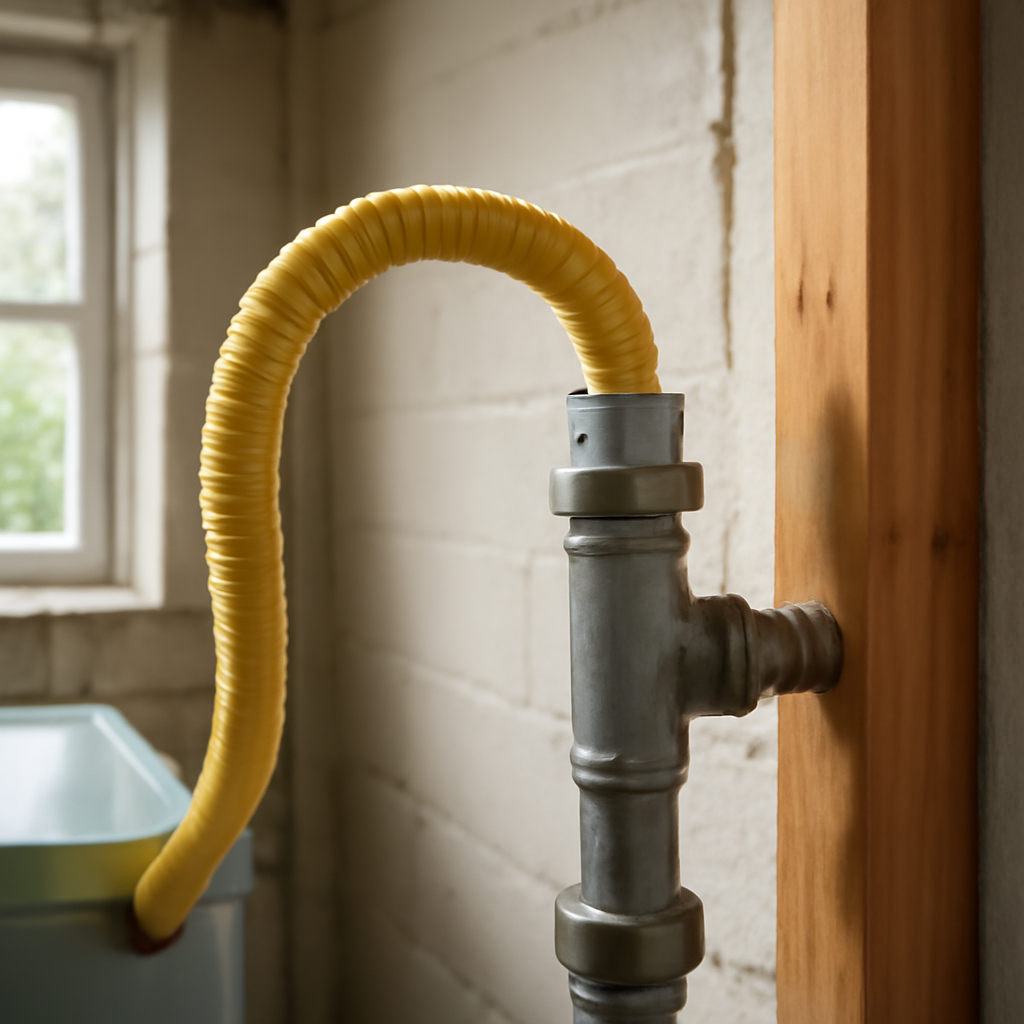
Pull a gas range or dryer away from the wall and there is usually a short, corrugated metal hose running from a valve on the wall or floor to the back of the appliance. That hose is the gas flex line, and it is one of the few gas components most homeowners can actually see. It is also a part that tends to be ignored for decades, moved carelessly during cleaning and reused when appliances are swapped. This guide explains what these connectors are, how they differ from the flexible gas piping inside walls, why some older connectors are a known hazard, the common rules around length and concealment, safe leak checks, hookups for dryers and stoves and what professional work generally costs.
Part of our Heating, Cooling & Ventilation guide — start there for the full picture →
What a Gas Flex Line Is
A gas flex line, more formally an appliance connector, is a short flexible tube that links a fuel gas appliance to the fixed gas piping of the house. It allows a range, dryer, water heater or similar appliance to be connected without a rigid pipe fitted exactly to its inlet, and it gives a little slack so the appliance can be moved slightly for installation or service.
Modern connectors are typically corrugated stainless steel with a protective coating, often yellow or gray, and flare nut fittings at each end. Coated brass connectors also exist. Each connector is sold as a complete assembly with a specified length and diameter, and the size chosen depends on the appliance’s gas demand and the distance it needs to span. The connector attaches to a shutoff valve on the house side and to the appliance inlet, often through adapters.
Appliance connectors versus CSST house piping
Appliance connectors are easy to confuse with corrugated stainless steel tubing, or CSST, because both are flexible and both are corrugated. They are different products for different jobs.
- Appliance connectors are short, factory-made assemblies that run from a shutoff valve to one appliance in the same room. They are meant to stay exposed.
- CSST is gas distribution piping that runs through walls, floors and attics to deliver gas throughout the house. It is installed as a system, with manufacturer-specific fittings, and has its own bonding and grounding requirements related to lightning protection.
Our guide to CSST gas line covers that piping system in detail, including the bonding questions inspectors often raise.
| Feature | Appliance connector | CSST house piping |
|---|---|---|
| Purpose | Final link from valve to one appliance | Distributes gas through the building |
| Typical length | Short; often a few feet (per manufacturer) | Long runs between manifold and outlets |
| Location | Exposed, in the same room as the appliance | Inside walls, floors, attics and crawlspaces |
| Fittings | Factory flare nuts on a complete assembly | System-specific fittings installed in the field |
| Bonding | Not the main concern for the connector | Bonding requirements apply per manufacturer and code |
| Reuse | Generally not recommended | Not applicable in the same way |
Old Uncoated Brass Connectors: A Known Hazard
Some older homes still have appliance connectors that predate current designs. The U.S. Consumer Product Safety Commission issued a warning in a news release dated October 10, 1996, about older, uncoated brass flexible gas connectors used most often with ranges, ovens and clothes dryers. According to that release, the fittings on these connectors were soldered onto a corrugated brass tube, and the CPSC believed the solder could fail, causing a break in the connector and a gas leak. The release reported that the agency had received 200 reports of these connectors failing, associated with 35 deaths and 59 injuries, and noted that these connectors had not been made for at least the previous 10 years at that time.
Because it is hard to tell by looking whether a connector is soldered, the CPSC recommended in that release that any uncoated brass connector be replaced with a new stainless steel connector or a new plastic-coated brass connector. It also warned consumers not to move their appliances to inspect connectors themselves, since a weakened connector could break if moved, and advised that connectors be inspected only by a professional service provider.
Practically, that means an old, dull, uncoated brass connector behind a long-installed range or dryer is worth a professional look and likely replacement. If one is spotted during a move-in walkthrough, leave the appliance where it is and call a qualified gas technician rather than sliding it out to get a better view.
Length, Concealment and Reuse Rules
Connector rules come from two places: the manufacturer’s installation instructions printed on the tag or package, and the fuel gas code adopted locally. The details below are commonly cited, but the exact limits depend on the product and the jurisdiction.
Length
Appliance connectors are intended to be short. Limits of a few feet are common for most appliances, with some codes allowing longer connectors for specific appliance types. A longer connector also restricts gas flow more than a short one of the same diameter, which can starve a high-demand appliance. If a connector cannot reach without stretching or kinking, the fix is usually to extend the rigid piping closer, not to buy a longer hose.
No concealing through walls, floors or cabinets
Connectors are generally not allowed to pass through walls, floors, ceilings or appliance cabinets, or to be concealed inside construction. The concern is that a connector hidden from view cannot be inspected and may be damaged by abrasion or movement. Where gas needs to pass through a wall or floor, rigid pipe or properly installed CSST is used, ending at a shutoff valve in the same room as the appliance.
Do not reuse connectors
Many manufacturers state that their connectors are for a single installation. Bending, flexing and tightening fittings can fatigue the corrugations and deform the flare seats. When an appliance is replaced, installing a new connector is the common practice and is a small cost compared with the risk of a leak. A connector should not be kinked, twisted, bent tightly or stretched, and it should not contact sharp edges or hot surfaces.
The shutoff valve at the appliance
Each gas appliance normally has its own accessible shutoff valve in the same room, upstream of the connector. That valve allows the appliance to be disconnected without shutting off gas to the whole house, and it lets someone stop gas flow quickly if a connector is damaged. Our guide to the gas shut-off valve explains how quarter-turn valves work and how to tell open from closed.
Leak Checks: Soap, Never a Flame
After a connector is installed or disturbed, the fittings are typically checked for leaks. The safe household method is a soap solution: a mix of dish soap and water, or a commercial leak-detection liquid, brushed or sprayed onto each joint with the gas on. Growing bubbles indicate a leak. If bubbles appear, shut the appliance valve and have the fitting corrected rather than simply tightening harder, since overtightening a flare fitting can damage it.
Never use a match, lighter or other flame to look for a gas leak. That method can ignite escaping gas. Electronic gas detectors are another tool that technicians use, and our guide to gas line leak detection covers the methods professionals rely on, from combustible gas detectors to pressure testing.
If you smell gas
A smell of gas inside the home calls for leaving, not investigating. Natural gas and propane are odorized so leaks can be noticed. If the odor is strong or you hear a hissing sound, get everyone out, avoid switching lights or appliances on or off and avoid using phones inside the building. Once outside and at a safe distance, call the gas utility emergency number or 911. Our guide to a gas leak smell walks through what to do, and our guide to a gas detector alarm explains how plug-in and hardwired detectors add another layer of warning.
Dryer and Stove Hookups
Most homeowners deal with a gas flex line when an appliance is delivered or replaced. Both hookups follow similar steps, though the appliance instructions take priority.
Gas dryers
Dryers are moved more often than most appliances, for lint cleaning and laundry room access, which puts repeated stress on the connector. Leaving enough slack without kinks and keeping the connector clear of the dryer vent duct helps. Our guide to a gas dryer hookup covers the connector, valve, venting and electrical requirements together.
Gas ranges and stoves
Ranges sit tight against the wall and often have an anti-tip bracket that must be reengaged after the range is pushed back. The connector needs to fold into the space behind the range without being crushed. Some ranges ship set up for natural gas and need conversion for propane, which is a job for a qualified technician. Our guide to gas stove installation covers clearances, conversion and the anti-tip device.
After the hookup
Once gas is restored, burners should light cleanly with a steady flame. A yellow, lazy or noisy flame can point to an adjustment or venting issue and should be checked.
Carbon Monoxide and Combustion Safety
A sound connector keeps gas inside the pipe, but gas appliances also produce combustion byproducts. The EPA lists gas stoves, back-drafting from furnaces and gas water heaters, and worn or poorly adjusted combustion devices among the sources of carbon monoxide in homes, and it advises keeping gas appliances properly adjusted and having a trained professional inspect, clean and tune up central heating systems annually. The CPSC describes carbon monoxide as a colorless, odorless, poisonous gas and recommends installing battery-operated CO alarms or alarms with battery backup on every level of the home and outside sleeping areas. If CO poisoning is suspected, the CPSC advises getting outside to fresh air immediately and then calling 911.
Our guide to carbon monoxide detector installation covers placement and testing. A gas detector and a CO alarm watch for different hazards, so many homes benefit from both.
Signs a Connector Needs Attention
Most connectors give no warning before trouble, which is why a periodic look during routine cleaning is worthwhile. With the appliance in place and a flashlight, it is often possible to see part of the connector from the side or through a lower drawer. Signs that call for a professional include:
- Uncoated brass: a bare, dull or tarnished metal tube with no plastic coating, especially on an appliance that has been in place for many years.
- Kinks or flattening: a crease where the connector was folded tightly or crushed behind the appliance.
- Damaged coating: cuts, cracks or melted spots in the coating, which can expose the metal beneath to corrosion.
- Corrosion at fittings: green or white deposits around the flare nuts, sometimes from cleaning chemicals or moisture.
- Contact with heat or edges: a connector resting against a dryer vent, a hot surface or a sharp sheet-metal edge.
- Passing through a cabinet or wall: a connector routed through a hole into the next room or through the back of a cabinet.
- No shutoff valve: a connector attached directly to the gas pipe with no accessible valve upstream.
Any faint gas odor near an appliance also warrants a call, even if the connector looks fine. Leaks can occur at the appliance inlet, at the valve or at adapters, not just in the tube.
Moves, remodels and appliance swaps
The riskiest moments for a connector are when appliances are moved. Flooring projects, kitchen remodels and moving day all involve sliding ranges and dryers in and out. Before that work starts, shut the appliance valve and have the connector disconnected and capped by a qualified person if the appliance will be fully removed. When the appliance returns, a new connector and a leak check are the safer path. Leaving an open, uncapped gas valve behind an empty space is a hazard if someone bumps the handle.
Hiring a Pro and Typical Costs
Gas work carries real risk, and many jurisdictions require gas work to be done by licensed professionals, with permits for some changes. A licensed plumber or gas fitter, or the appliance retailer’s installer, is the usual choice for replacing a connector, adding a shutoff valve, extending rigid piping or converting fuel type. If anything about the existing piping looks unusual, a gas line pressure test may be recommended before the system is put back in service.
Costs vary by region, access and what is found. A new connector itself is usually an inexpensive part, often tens of dollars. A professional connector replacement during an appliance installation may add a modest fee, while a standalone service call to replace a connector and leak-test the joints often falls in the low hundreds of dollars. Adding a new shutoff valve, extending rigid pipe or correcting a concealed connector costs more. Getting more than one quote is reasonable for anything beyond a simple swap.
What a Home Inspector Looks At
The ASHI Standard of Practice directs inspectors to inspect fuel storage and fuel distribution systems as part of the plumbing system, and to describe the location of main water and fuel shut-off valves. In practice, an inspector will usually note visible connectors, look for uncoated brass connectors, connectors passing through walls or cabinets, missing appliance shutoff valves and visible damage, and may recommend a qualified gas professional for follow-up. A general inspection does not typically include pressure testing the gas system or moving appliances to see behind them.
Because furnaces, boilers and water heaters are the largest gas users in most homes, our heating and cooling hiring hub covers when to bring in an HVAC or gas specialist alongside a general inspection. For credentials and scope questions, see our guide to hiring the right inspector.
More Questions About Gas Flex Lines
How long do gas flex lines last?
Coated stainless-steel gas flex lines are durable but are not intended to last forever, and many manufacturers and safety organizations recommend replacing them whenever an appliance is replaced or moved. Gas connectors can be damaged by kinking, repeated bending, corrosion from cleaning chemicals or contact with sharp edges, even if they look fine on the outside. Old uncoated brass connectors are a known hazard and should be replaced regardless of age. A connector that is cracked, kinked, discolored or shows corrosion should be replaced promptly. A date on the connector tag or install records helps track its age.
What size gas flex line is needed for an appliance?
The correct gas flex line size depends on the appliance’s BTU input, the connector length and the gas type, and it is chosen using the connector manufacturer’s capacity tables. Common appliance connectors come in nominal inside diameters such as 3/8, 1/2 and 5/8 inch. Ranges and dryers often use smaller connectors, while furnaces, water heaters and some high-output appliances need larger ones. An undersized connector can starve the appliance of gas, causing poor flame and incomplete combustion. The appliance installation manual and connector packaging list the requirements, and a licensed installer can confirm sizing.
Is yellow gas flex line different from stainless?
Yellow-coated gas flex lines are generally stainless-steel corrugated connectors with a yellow plastic coating, so they are not a different metal from uncoated stainless connectors. The coating protects the tubing from corrosion and abrasion and makes it easy to identify as a gas line. Yellow coating also appears on corrugated stainless steel tubing, or CSST, which is used for house gas piping and has its own installation and bonding requirements. Appliance connectors and CSST piping are different products that look similar, so the label and use should be checked. Bare brass connectors are the ones to watch for.
Can a gas flex line be used outdoors?
A gas flex line can be used outdoors only if the connector is specifically listed for outdoor use, such as connectors made for grills, patio heaters or outdoor kitchens. Indoor appliance connectors may not withstand sunlight, moisture and temperature changes. Outdoor connectors still should not be buried or run through walls. Portable propane grills use hoses and regulators supplied for that purpose, which differ from fixed connectors. A permanent outdoor gas appliance, such as a built-in grill or fire pit, usually needs proper gas piping to a shutoff valve installed by a licensed gas fitter.
References
- CPSC Warns About Dangerous Flexible Gas Connectors Used on Home Appliances — U.S. Consumer Product Safety Commission
- Carbon Monoxide Information Center — U.S. Consumer Product Safety Commission
- Carbon Monoxide’s Impact on Indoor Air Quality — U.S. Environmental Protection Agency
- ASHI Standard of Practice for Home Inspections — American Society of Home Inspectors
Frequently asked questions
Can a gas flex line be reused when replacing an appliance?
Many manufacturers say connectors are for one installation only, because flexing and retightening can fatigue the tube and fittings. Installing a new connector with each appliance is the common practice and a small cost.
Are old brass gas connectors dangerous?
Older uncoated brass connectors were the subject of a 1996 CPSC warning because their soldered fittings could fail. The CPSC advised replacing any uncoated brass connector and having a professional, not the homeowner, move the appliance to do it.
How do you check a gas connector for leaks?
Brush a soap and water solution on each fitting with the gas on and watch for growing bubbles. Never use a flame. If there is a gas smell, leave the home and call the gas utility or 911 from outside.
Can a gas flex line go through a wall?
Generally no. Appliance connectors are meant to stay exposed in the same room as the appliance. Rigid pipe or properly installed CSST carries gas through walls and floors to a shutoff valve near the appliance.
What is the difference between a gas flex line and CSST?
A flex line is a short appliance connector from a valve to one appliance. CSST is house gas piping that runs through walls and floors and has its own fittings and bonding requirements.
Can a gas flex line be bent?
A gas flex line can be bent gently to position an appliance, but it should not be kinked, twisted or bent repeatedly. Manufacturers specify minimum bend radii. Sharp bends can crack the tubing and cause leaks. Pushing an appliance back against a tightly coiled connector is a common cause of damage.
Do gas flex lines need thread sealant?
Gas flex line flare fittings typically do not need thread sealant at the flare connection itself, but the threaded adapter fittings that connect to the valve and appliance usually require a sealant rated for gas. Follow the connector manufacturer's instructions and leak-test all joints after installation.
Can a homeowner replace a gas flex line?
In some areas a homeowner may legally replace a gas appliance connector, while other jurisdictions require a licensed professional. Because leaks create fire and explosion risks, many homeowners hire a plumber or gas fitter. Anyone doing the work must use a new certified connector and leak-test the connections with soapy water.
Want someone to check the gas connections and appliances in a home before you close? Contact us today and we can point you to an inspector who pays attention to fuel systems.