What Thermal Imaging Binoculars See, and What They Miss
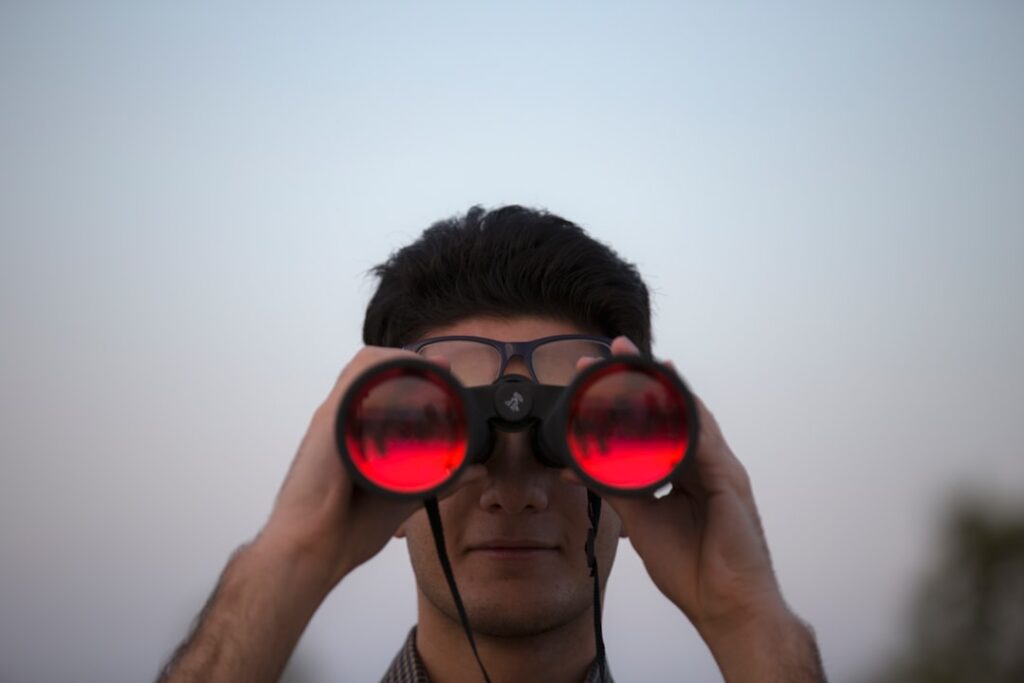
Thermal imaging binoculars detect heat instead of light, showing warm and cool objects as a false-color or grayscale image through two eyepieces. They are built for one job: spotting temperature differences across open distance in the dark. The sensor inside them is a close relative of the one in a building-diagnostic thermal camera, which is why the same specs that matter to a wildlife observer also decide whether any thermal device is worth its price. This guide explains what the numbers on a spec sheet actually mean, where thermal binoculars earn their place, and why they are the wrong tool for inspecting a house.
Part of our Thermal Imaging for Homes guide — start there for the full picture →
How they turn heat into a picture
Every object above absolute zero emits long-wave infrared radiation, roughly in the 8-to-14-micron band, and warmer objects emit more of it. Thermal binoculars use an uncooled microbolometer: a grid of tiny elements that heat up slightly when infrared lands on them. A processor reads the change at each element, maps it to a shade or color, and feeds the result to both eyepieces. Because the image is assembled from emitted heat rather than reflected light, it works in total darkness, light fog, and smoke. No cooling hardware means the device stays battery-powered and portable rather than tethered to a lab bench.
Two eyepieces instead of one reduce eye strain over a long watch and give a more natural, depth-aware view. Magnifying optics push the thermal image out to distance. That optical packaging is the only real difference between observation binoculars and a close-range inspection camera. Both read the same infrared signal; one is tuned for reach, the other for proximity.
The four specs that decide performance
Marketing leads with magnification, but the numbers that govern what you can actually see are these:
| Spec | What it controls | Typical range |
|---|---|---|
| Sensor resolution | Fine detail; a coarse sensor blurs a distant shape into a warm blob | 256×192 to 640×512 thermal pixels |
| Thermal sensitivity (NETD) | Smallest temperature difference the sensor can distinguish; lower is better | <50 mK (0.05 °C) on quality units |
| Refresh rate | How smoothly the image tracks motion | 9, 25, 30, 50, or 60 Hz |
| Detection range (DRI) | Distance at which you can detect, recognize, then identify a target | Vendor-published, per Johnson criteria |
Refresh rate carries a quirk buyers rarely know: U.S. export rules have long capped many consumer thermal devices at 9 Hz, because faster frame rates fall under stricter International Traffic in Arms Regulations controls. A 9 Hz unit shows a visibly stuttering image when you pan; a 30 or 50 Hz unit tracks a moving animal smoothly. Detection range is usually stated as three numbers under the Johnson criteria: the distance at which a target can be detected (something is there), recognized (it is an animal), and identified (it is a deer). Those distances drop sharply as sensor resolution falls, which is why resolution, not magnification, is the honest measure of reach.
Where thermal binoculars actually make sense
The device is at its best when the target is warm, the background is cool, and the distance is real:
- Wildlife observation and survey work. Biologists count and track animals at night without lights that would disturb them, over ranges a handheld camera cannot cover.
- Search and rescue. A person’s body heat stands out against a cold landscape, often through brush that hides them from ordinary sight.
- Perimeter and property security. A warm figure is obvious against cool surroundings in total darkness, where ordinary cameras and floodlights fail.
- Livestock monitoring. A feverish animal shows a different heat signature before visible symptoms appear.
If long-distance heat detection is the goal, the trade-offs of a binocular or monocular form are worth it, and the comparison is spelled out in our guide to long-range thermal imaging. The same heat-seeing principle also drives helmet- and head-mounted units, covered in the thermal goggles overview.
Why they are the wrong tool for a house
A home’s problems live up close, on walls, panels, and pipes, exactly where binoculars are awkward. Their magnification and narrow field of view are built to resolve a warm shape far away; point them at a wall from a few feet back and you frame a sliver of it and learn almost nothing. A diagnostic camera does the opposite job with a wide angle and close focus, taking in a whole surface from arm’s length.
The building faults worth finding all read as surface-temperature differences. A draft slipping past a worn window seal chills the wall along its path. Settled or missing insulation lets heat bleed through in a visible patch. A loose electrical connection runs hot under load. Moisture spreading behind a finish holds a temperature different from the dry material around it. The U.S. Department of Energy lists thermographic scanning as a standard method for locating air leaks and insulation gaps during an energy assessment, and the EPA cites thermal patterns as a clue when investigating hidden moisture. For that work you want the close-range form of the sensor, not the long-range one. Weigh those options in our overview of what a thermal imaging camera is and where it fits among other home inspection tools.
The limits that apply to every thermal device
No thermal device sees through walls. It reports surface temperature only, so it reveals the effect of something behind a surface, a cold draft path or a warm pipe, never the object itself. A colored patch is a temperature difference that a person then has to interpret.
Reflective surfaces lie. Polished metal, glass, and water reflect the heat of nearby objects instead of showing their own temperature, so they can read far too hot or cold. Most building materials sit near an emissivity of 0.95, which is why diagnostic cameras let you set emissivity while observation binoculars usually do not, since spotting wildlife rarely needs that precision. The universal check costs nothing: when a surface reads surprisingly hot or cold, shift your position and watch the bright spot. A reflection slides with your angle; a real temperature feature stays put. The International Association of Certified Home Inspectors makes the same point, that a thermal image is evidence to be confirmed, not a verdict.
The physics behind both forms of the tool is unpacked in our explainer on how thermography works. This guide reflects general Department of Energy and EPA guidance and is not a substitute for a professional assessment.
Common questions
Frequently asked questions
What do thermal imaging binoculars actually see?
They see emitted heat, not light, showing surface temperature differences through two eyepieces in total darkness. That makes them strong for spotting a warm animal or person against a cool background at distance. They cannot see through walls or objects; they only report the temperature of whatever surface they point at.
Can I use thermal binoculars to inspect my house?
They share the sensor technology, but their long-range optics and narrow field of view make them poor for close indoor work. Finding drafts, insulation gaps, and moisture on walls and panels calls for a handheld diagnostic thermal camera with a wide field and close focus. Binoculars would frame only a sliver of a wall and tell you little.
Why are so many thermal devices limited to 9 Hz?
U.S. export rules place thermal cameras with frame rates above 9 Hz under stricter controls, so many consumer units are capped at 9 Hz to stay freely exportable. A 9 Hz image stutters noticeably when you pan, while 30 to 60 Hz units track motion smoothly. It affects how the image moves, not the temperatures it reads.
Does higher magnification mean better range?
No. Sensor resolution, measured in thermal pixels, sets how far you can actually detect and identify a target, while magnification only enlarges whatever the sensor already resolves. A coarse sensor at high magnification just gives you a bigger blur. Compare resolution first, then thermal sensitivity, then refresh rate.
Thermal imaging cameras
Infrared cameras reveal hidden moisture, missing insulation, and air leaks. Phone-attachment models are the budget entry point; standalone units have higher resolution.
| Product | Why | Buy |
|---|---|---|
 FLIR ONE Pro (phone) FLIR ONE Pro (phone) | Plugs into iPhone/Android; inspector favorite. | Amazon — $349.00 |
 Topdon TC001 Topdon TC001 | High-res phone module at a low price. | Amazon — $199.99 |
 FLIR C5 Compact FLIR C5 Compact | Standalone pocket camera with Wi-Fi. | Amazon — $611.50 |