Long-Range Thermal Imaging: What It Sees and How Far
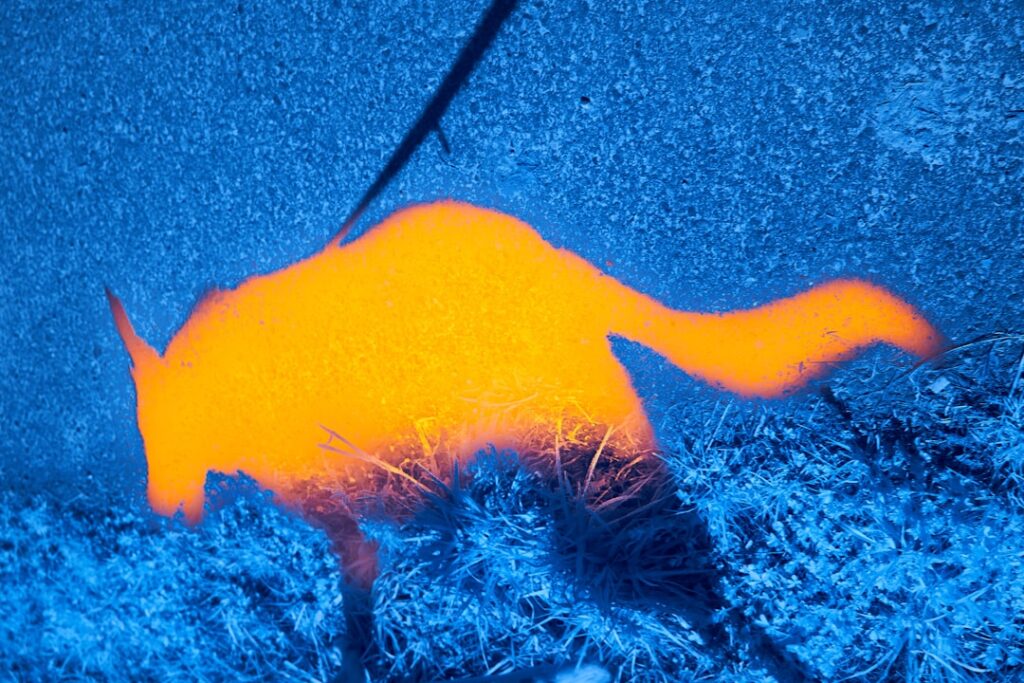
“Long-range thermal imaging” describes thermography where the target sits tens to hundreds of meters from the sensor, instead of the arm’s-length work a home inspector does against a drywall ceiling. The distance changes everything about the equipment: the sensor, the optics, the mount, and the price. This page explains how far a thermal camera can actually resolve a useful image, what hardware separates a long-range system from a handheld one, where the technology earns its keep, and the honest answer to whether any of it belongs on a residential inspection.
How far can a thermal camera actually see?
There is no single number, because “see” is three different jobs. Thermal-imaging performance at distance is usually described by the Johnson criteria, which split a task into detection (something warm is there), recognition (it is a person versus an animal), and identification (which specific object it is). Each step needs roughly four times more pixels on target than the one before it — a rough rule of about 2, 8, and 13 pixel pairs across the target’s critical dimension for the three tasks.
That is why range is set by pixels-on-target, not by lens power alone. A 640×480 detector with a 75 mm lens might detect a human at well over a kilometer but only identify a hot electrical connector at a fraction of that distance. Four things move the number:
- Detector resolution. Common formats step from 320×240 to 640×480 to 1280×1024. Doubling linear resolution roughly doubles usable range at equal optics.
- Focal length. A longer lens narrows the field of view and puts more pixels on the target. Operators swap lenses (for example 25 mm, 75 mm, telephoto) per task rather than zooming a fixed optic.
- Thermal sensitivity (NETD). Uncooled microbolometers typically resolve 30-50 millikelvin of temperature difference; cooled detectors reach below 20 mK, which preserves faint contrast that atmosphere would otherwise wash out at distance.
- The atmosphere itself. Water vapor, dust, and heat shimmer attenuate the signal over the path. Cool, dry, still air is the best long-range condition; fog and smoke can collapse effective range to near zero.
What actually separates a long-range rig from a handheld camera
The biggest divide is cooled versus uncooled detectors. A handheld inspection camera uses an uncooled vanadium-oxide or amorphous-silicon microbolometer sensitive in the long-wave infrared band, roughly 8-14 microns. High-end long-range systems often use cooled indium-antimonide (InSb) or mercury-cadmium-telluride detectors operating in the mid-wave band, about 3-5 microns, chilled near 77 kelvin by an integral cryocooler. Cooled sensors deliver far lower NETD and sharper long-distance imagery, but they cost an order of magnitude more, draw more power, need cool-down time, and the cooler is a wear item with a finite service life.
Everything else scales up from there. Long-range optics are motorized, often athermalized so the focus does not drift as outdoor temperatures swing through the day, and sometimes carry filter wheels tuned to a gas’s absorption band for optical gas imaging. Because hand shake that is invisible at two meters becomes severe motion blur at high magnification, these systems live on tripods, drone gimbals, vehicle mounts, or fixed pan-tilt towers with inertial stabilization. Handheld units start under $500; a capable long-range commercial system starts around $5,000 and cooled defense-grade platforms run into six figures. The physics of how thermography works is identical at both ends — only the engineering budget changes.
Where long-range thermography earns its keep
The through-line for every legitimate use is the same: the target cannot be safely approached, or the area is too large to walk.
- Electrical and utility infrastructure. Utilities scan energized substations from outside the fence and transmission lines from helicopters or drones. Loose or corroded connections run hot before they fail; a bolted joint 10-20 degrees above its neighbors flags a fault while the line stays in service. OSHA’s electrical safety standards make this non-contact distance a genuine safety benefit, not a convenience.
- Large commercial roofs. Warehouse and big-box roofs are scanned at night from a drone or lift. Wet insulation holds the day’s heat and glows against the cooled, dry membrane, so acres that would take days to probe by hand are surveyed in hours.
- Industrial process equipment. Refineries and cement plants monitor furnaces, kilns, and reactor shells from safe standoff, sometimes with fixed cameras and automated anomaly alarms.
- Optical gas imaging. Filtered mid-wave cameras make methane and other hydrocarbon leaks visible as plumes at pipelines and tank farms.
- Perimeter security. Fixed thermal cameras detect movement at data centers, ports, and power plants in total darkness, without the illumination a visible camera would need.
Does any of this apply to a house?
Almost never, and that is the useful takeaway. A home inspector can walk up to whatever needs looking at, so the diagnostic camera lives inches from the surface. The only residential situations that reach even mid-range distances are aerial: a drone-mounted thermal camera photographing a roof at 10-30 meters, a long roofline on an estate, or a ground-mount solar array too large to walk panel by panel. Those are mid-range jobs with residential-grade sensors — nowhere near the cooled, kilometer-class hardware this category is named for.
So if a service pitches “long-range” or “industrial-grade” thermal imaging for an ordinary home, the question to ask is direct: what specific finding requires it that a handheld scan or a short-range drone flight cannot produce? For a single-family house the answer is usually nothing. The Department of Energy’s guidance on thermographic inspections for homes assumes close, walk-the-wall scanning for exactly this reason, and InterNACHI’s infrared thermography practice for inspectors is built around the same short working distance. If you are comparing gear for that work, the home inspection tools hub covers the handheld cameras that actually fit the job.
Limits that don’t disappear at distance
Range magnifies the constraints of thermography rather than escaping them. A thermal camera reads surface temperature only — it never sees through a wall, and hidden conditions are always inferred from what they do to a visible surface. Absolute temperature measurement needs an emissivity correction, and at long range you must also correct for atmospheric attenuation along the path, which makes accurate radiometry harder, not easier. Weather is unforgiving: rain, fog, smoke, and dust degrade the image severely, and daytime solar loading masks anomalies the same way it does up close, which is why serious survey work happens after dark. And a scan almost never produces a final answer on its own; it flags anomalies that a closer, hands-on inspection then confirms.
Frequently asked questions
What distance counts as “long range”? There is no fixed cutoff, but the term generally means the target is beyond about 30 meters and often hundreds of meters or more — the zone where you need long optics, high resolution, and a stable mount rather than a handheld camera.
Do cooled cameras really see farther than uncooled ones? For faint targets, yes. Cooled mid-wave detectors reach lower NETD (below 20 mK) and hold contrast that atmosphere would erase, so they resolve subtle temperature differences at distance that an uncooled microbolometer cannot. For close residential work the difference is irrelevant.
Can a long-range thermal camera see through walls or roofs? No. It measures surface temperature. Longer lenses and higher resolution change how far and how sharply it images a surface, not its ability to see behind one.
Why is long-range scanning usually done at night? Sunlight heats target surfaces unevenly and masks the thermal patterns of interest. After dark, surfaces settle toward a baseline and the anomalies — wet roof insulation, hot connectors — stand out. The effect matters more at distance, where contrast is already scarce.
Should I pay for long-range thermal imaging on my house? For a normal home, no. Handheld thermography during an inspection or energy audit covers indoor and envelope work, and a short-range drone covers the roof. Long-range gear solves an access-and-area problem that single-family properties do not have.
This page draws on OSHA electrical-safety, U.S. Department of Energy, and InterNACHI guidance; it is educational and not a substitute for a certified thermographer’s on-site inspection.
Thermal imaging cameras
Infrared cameras reveal hidden moisture, missing insulation, and air leaks. Phone-attachment models are the budget entry point; standalone units have higher resolution.
| Product | Why | Buy |
|---|---|---|
 FLIR ONE Pro (phone) FLIR ONE Pro (phone) | Plugs into iPhone/Android; inspector favorite. | Amazon — $349.00 |
 Topdon TC001 Topdon TC001 | High-res phone module at a low price. | Amazon — $199.99 |
 FLIR C5 Compact FLIR C5 Compact | Standalone pocket camera with Wi-Fi. | Amazon — $449.00 |