FLIR Thermal Goggles: Why Home Inspectors Use Handhelds
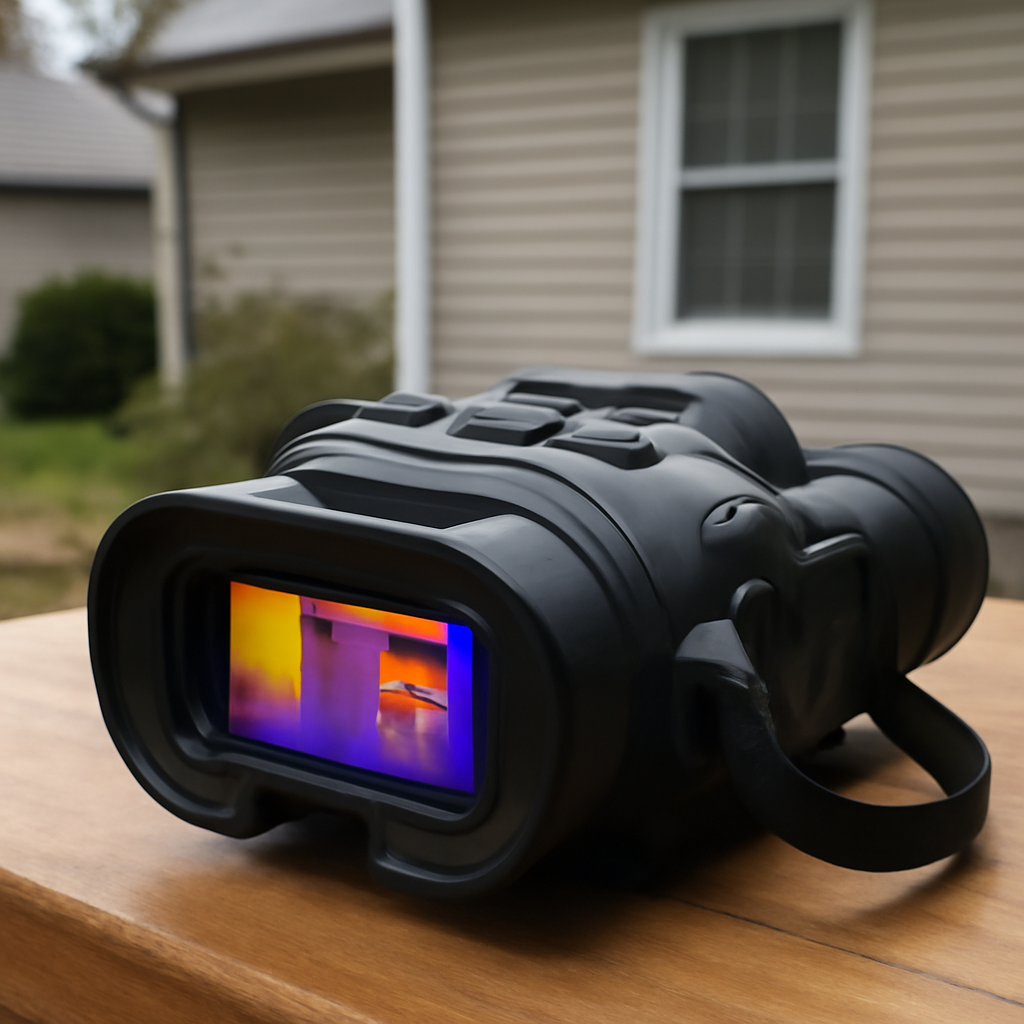
If you searched “FLIR thermal goggles,” here is the short version before you spend a dollar: head-mounted thermal goggles are a military, tactical, and hunting product category, and they are the wrong tool for a house. FLIR (now Teledyne FLIR) does not sell a goggle built for finding insulation gaps, plumbing leaks, or electrical hotspots. For every residential thermal job, what you actually want is a handheld thermal camera. This guide explains the distinction, names the real FLIR products in each category with their actual specs, and tells you what to buy for the problem that sent you here.
Part of our Thermal Imaging for Homes guide — start there for the full picture →
Does FLIR even make a thermal goggle?
Not a goggle in the strict sense. The closest FLIR product is the Breach PTQ136, a compact thermal monocular built on FLIR’s Boson core with 320×256 resolution, weighing about 7.4 ounces, that can be helmet-mounted for hands-free use. It is marketed to hunters, security, and tactical users, runs roughly $2,500–$3,000, and has no radiometric temperature-measurement or report-export features. It shows you heat; it does not tell you a wall cavity is 4°F colder than the studs around it.
True head-mounted thermal goggle systems — fused night-vision-and-thermal units like the military ENVG-B — are export-controlled under ITAR-adjacent rules and priced from five figures up. They exist to detect targets at range in the dark, not to document a moisture stain for a buyer’s report. Neither the Breach nor a military goggle fits how residential thermal work is actually done.
What a house actually needs: a handheld camera
Home-inspection thermal work is close, deliberate, and documented. You move the camera slowly across a wall, hold it steady on a suspect spot for a few seconds to read the temperature delta, capture a thermal-plus-visible image pair, and note the location for a report. A head-mounted sensor fights every one of those steps — it moves when your head moves, you cannot hold a fixed point steady, and capturing an image means fumbling for a button while your view drifts. Handhelds have a grip, a dedicated screen, and a capture trigger built for exactly this rhythm.
The U.S. Department of Energy’s guidance on professional home energy audits and its thermographic-inspection materials describe a workflow built entirely around handheld cameras paired with a blower-door test. ASHRAE’s building-assessment standards and InterNACHI’s Infrared Certified Inspector curriculum both assume the handheld form factor. There is no goggle track because the goggle does not match the job.
The three tiers that matter, with real FLIR examples
| Tier | Price | Example | Sensor / accuracy | Fits |
|---|---|---|---|---|
| Phone attachment | $250–$500 | FLIR ONE Edge Pro / Gen 3 | 160×120, ±3°C | DIY spot checks |
| Compact standalone | $600–$2,500 | FLIR C5 | 160×120, MSX fusion, full radiometric | Serious DIY, landlords |
| Professional | $2,500–$8,000 | FLIR Exx / E-series | 320×240 to 640×480, NETD 30–50 mK, ±1°C | Working inspectors |
The jump that matters most is not price — it is radiometric data and NETD (thermal sensitivity). A tactical monocular like the Breach and a $300 phone attachment both show heat, but only a radiometric camera lets you export a temperature reading a client can trust. Low NETD (30–50 mK on professional units) is what makes the small differentials of early moisture intrusion reliably visible instead of lost in noise. For a deeper walk through resolution, NETD, and fusion imaging, see what a thermal imaging camera is, and for real price bands across brands, how much a thermal camera costs.
What to buy for your specific problem
- Cold room / suspected insulation gap: any handheld with at least 160×120 resolution. A FLIR ONE or C5 scans an attic or wall run fine.
- Hidden plumbing leak: a handheld thermal camera plus a pin or pinless moisture meter to confirm — thermal finds the anomaly, the meter proves it is water.
- Overheating electrical connection: a radiometric handheld with accurate measurement, so you can compare a lug’s temperature against safe operating limits rather than guess from color.
- Moisture that could drive mold: thermal to locate, then confirmation testing. Chasing heat with a monocular tells you nothing measurable.
None of these benefit from a head-mounted device. If you are outfitting a kit rather than solving one problem, the home inspection tools guide covers where thermal fits alongside moisture meters and borescopes, and the best thermal imaging guide compares current handheld models head to head.
Where the “goggles” idea actually belongs
Head-mounted thermal does have legitimate homes — just not yours. Firefighting SCBA masks integrate thermal cameras so crews see through smoke hands-free. Search-and-rescue teams use head-mounted units for hands-free detection in the dark. Hunters use monoculars like the Breach for low-light wildlife. Those are the discussions that keep the “FLIR goggles” search alive, and consumer hunting-thermal marketing often uses goggle-like imagery even when the product is handheld. If your interest is genuinely the hunting side, see thermal imaging for hunting and thermal imaging binoculars. For a house, it is the wrong aisle.
Equipment does not replace interpretation
Whatever you buy, a thermal image is only as good as the person reading it. Distinguishing missing insulation from moisture, a real anomaly from a reflective-surface artifact, and emissivity differences between materials all take training. The Infrared Training Center Level I course and InterNACHI’s Infrared Certified designation are the two credential paths inspectors take. The American Society of Home Inspectors also publishes practice resources for members. No camera — and certainly no goggle — substitutes for knowing what the picture means.
Frequently asked questions
Frequently asked questions
Does FLIR make thermal goggles for home inspection?
No. FLIR's closest head-mounted product, the Breach PTQ136 monocular (320x256, helmet-mountable), is built for hunting and tactical use and has no radiometric measurement or reporting features. Home inspection uses handheld radiometric cameras like the FLIR C5 or Exx series.
Are military thermal goggles legal to buy?
Fused night-vision-and-thermal goggle systems are export-controlled and generally not available to civilians. Some hunting-market thermal monoculars are sold to civilians, but they are not designed for inspection work and lack temperature measurement.
What should I buy for thermal home inspection?
A handheld thermal camera. For occasional DIY use, a $250-$500 FLIR ONE phone attachment or a compact standalone works. Working inspectors use a $2,500+ radiometric unit with 320x240 or higher resolution and low NETD.
Will a hunting thermal monocular work on my house?
It will show obvious heat differences but cannot give you a trustworthy temperature reading or an exportable image for a report, and its form factor fights close indoor scanning. A radiometric handheld serves the job far better.
This guide summarizes U.S. Department of Energy and industry (ASHRAE, InterNACHI, ASHI) guidance on thermographic inspection; product specifications reflect manufacturer-published data and are subject to change.
Thermal imaging cameras
Infrared cameras reveal hidden moisture, missing insulation, and air leaks. Phone-attachment models are the budget entry point; standalone units have higher resolution.
| Product | Why | Buy |
|---|---|---|
 FLIR ONE Pro (phone) FLIR ONE Pro (phone) | Plugs into iPhone/Android; inspector favorite. | Amazon — $349.00 |
 Topdon TC001 Topdon TC001 | High-res phone module at a low price. | Amazon — $199.99 |
 FLIR C5 Compact FLIR C5 Compact | Standalone pocket camera with Wi-Fi. | Amazon — $611.50 |