FLIR Thermal Imager: Category Guide for Homeowners 2026
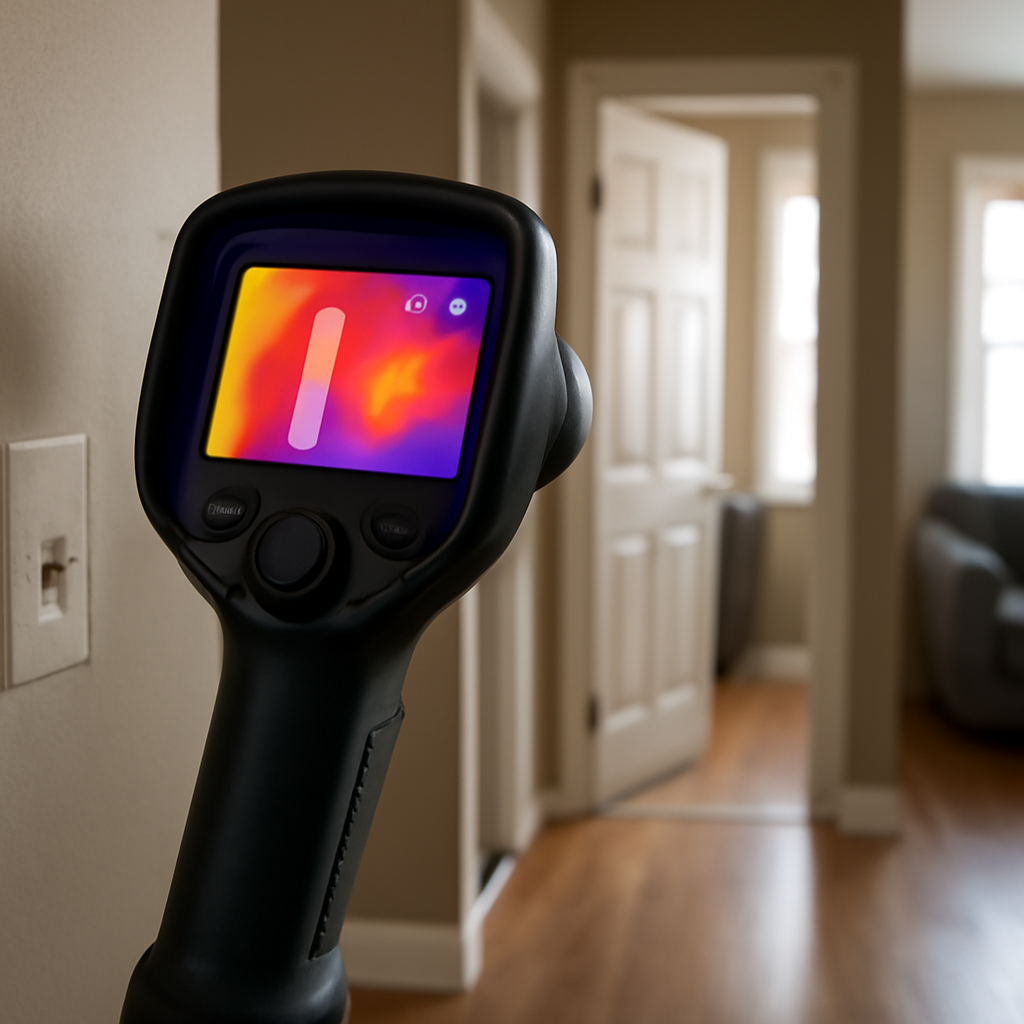
Homeowners shopping for a thermal imaging device almost always encounter the FLIR brand first. The phrase “FLIR thermal imager” has become a generic stand-in for any handheld infrared camera, much the way “Kleenex” stands in for facial tissue. This guide treats the segment generically, comparing the broader handheld-thermal category at a feature level — sensor resolution, thermal sensitivity, lens focus, and price tier — without recommending any single manufacturer. The aim is to give homeowners enough vocabulary to evaluate a unit against its peers, whether the badge on the housing reads FLIR, Seek, Hikmicro, Fluke, or Teledyne.
Part of our Thermal Imaging for Homes guide — start there for the full picture →
What a Handheld Thermal Imager Actually Does
A handheld thermal imager is a passive sensor. It collects long-wave infrared radiation in the 7-to-14-micron band — energy that every object above absolute zero emits as a function of its temperature and surface emissivity — and converts that radiation into a visible pseudo-color image called a thermogram. The image is not a photograph in the conventional sense; the colors are mapped to temperature ranges chosen by the operator. A warm electrical breaker shows as a hot spot, a missing batt of attic insulation shows as a cold stripe on the ceiling, and a wet drywall patch shows as a cooler region where evaporation is pulling heat from the surface.
The U.S. Department of Energy notes that thermal imaging is one of the most effective ways to identify air leaks and insulation gaps in residential buildings, because temperature differences across the building envelope reveal pathways that the naked eye cannot detect. For the typical homeowner, the practical applications fall into three buckets: energy audits (insulation, drafts), moisture detection (roof leaks, plumbing leaks behind walls), and electrical hot-spot screening on breaker panels and outlets.
Sensor Resolution: The First Specification That Matters
The most marketed specification on any thermal imager is detector resolution, measured in thermal pixels. Entry-level handhelds in the category typically ship with 80×60 or 120×90 detectors. Mid-tier models offer 160×120 or 240×180. Professional units climb to 320×240, 384×288, or 640×512. The price tier roughly doubles at each resolution step. A 160×120 detector produces 19,200 thermal pixels — adequate for spot-checking a single room or breaker panel from close range, but inadequate for resolving a fine moisture pattern from across a basement.
Visual-light resolution is a separate specification that some manufacturers conflate with thermal resolution in their marketing copy. The 1080p or 2K number sometimes printed on a spec sheet refers to the optional daylight camera mounted alongside the thermal sensor, which is used for picture-in-picture overlay. Do not confuse the two. Sensor resolution that matters for diagnostic work is the thermal-pixel count of the microbolometer array.
Thermal Sensitivity (NETD) and Why It Affects Image Quality
Noise-equivalent temperature difference, abbreviated NETD and quoted in millikelvin (mK), measures the smallest temperature differential the detector can resolve. Entry-level units in the category list NETD figures around 100 mK or higher. Mid-tier units hit 60-to-80 mK. Professional units claim 40 mK or better. A lower NETD produces a smoother image with less visual noise, which matters when the diagnostic target is a small temperature delta — for example, a developing moisture problem behind drywall, where the temperature difference between dry and wet zones can be less than half a degree Celsius.
How the Major Handheld Brands Compare at a Category Level
Several manufacturers compete in the consumer-and-prosumer handheld segment. Without endorsing any specific model, here is how the category typically stratifies:
Standalone Handheld Brands
Standalone handheld units from the major thermal manufacturers ship with a dedicated display, internal battery, and SD-card storage. Price tiers run from roughly $300 for an 80×60 entry unit to $4,000+ for a 640×512 professional unit with measurement-grade radiometric output. These devices target working inspectors, energy auditors, and electrical technicians who need both hands free and a ruggedized housing.
Phone-Attached Thermal Modules
A second category clips onto a smartphone via the USB-C or Lightning port and uses the phone screen as the display. Several brands offer 160×120 or 256×192 modules in this form factor, priced from roughly $200 to $800. The advantages are portability and lower cost. The disadvantages are battery drain on the host phone, occasional connectivity hiccups, and a smaller image area for diagnostic work in bright outdoor light.
Industrial and Test-Instrument Lines
Test-instrument manufacturers also offer handheld thermal cameras built into a multimeter form factor or as standalone diagnostic tools targeted at electrical contractors. These are typically priced in the $1,500-to-$5,000 range and include features like radiometric data export, on-camera annotation, and Bluetooth connectivity to a building-management platform. InterNACHI training resources note that radiometric data — the ability to assign a real temperature value to every pixel rather than just a relative color — is the dividing line between consumer-grade and inspection-grade thermal cameras.
Common Homeowner Applications
For a homeowner who wants to use a handheld thermal imager themselves rather than hire a thermographer, the realistic applications are narrow. Air-leak hunting around windows, doors, and rim joists on a cold winter day is the easiest win — pull a fan in the door, depressurize the house, and the cold-air infiltration shows up as a blue plume on the imager. Missing insulation in an unfinished attic or knee wall shows up the same way during heating or cooling season, when there is a temperature differential across the assembly. ASHRAE methodology guidance for building diagnostics emphasizes that a temperature delta of at least 10°F across the wall assembly is needed for confident interpretation of thermal images.
Moisture detection is the second-most-common application, though it is also the most easily misread. A cold spot on a ceiling could be a leak, but it could also be a thermal bridge through a steel beam, a missing patch of insulation, or HVAC duct chase behind the drywall. Pair the thermal imager with a pin-type moisture meter to confirm before pulling the drywall.
For deeper context on how the category fits into a full inspector toolkit, see our parent home inspection tools buyer’s guide, and for the device-level physics see how thermal imaging actually works.
What to Look For Before Buying
The single most useful screening question is: how far back will the operator typically be standing from the target? An attic-floor inspection where the operator is 8 feet from a ceiling needs 160×120 minimum to resolve individual stud bays. A breaker-panel inspection at arm’s length can be done well with 80×60. A rooftop survey from the ground or a drone needs 320×240 or higher. Field of view, expressed in degrees, also matters — a wider lens covers more wall in a single frame but compresses fine detail, while a narrow telephoto lens magnifies detail at the cost of needing more frames to cover a space.
Radiometric data export is the second screening question. If the goal is documentation for a real-estate transaction or an insurance claim, the camera must output radiometric thermal images that can be re-analyzed in desktop software. Non-radiometric units record only the rendered color image, which is fine for personal use but not for evidentiary reporting. For an in-depth comparison of category options see our infrared thermal imaging category overview.
Battery Life, Storage, and Ergonomics
Beyond the headline specifications, three practical factors separate a unit that gets used from one that ends up on the shelf. Battery life on most handheld thermal imagers runs 2 to 5 hours per charge, with professional units accepting hot-swappable battery packs for all-day fieldwork. A homeowner doing an occasional winter air-leak walk can manage with 2 hours; a working inspector needs 4+ hours or spare batteries. Internal storage of 4-16 GB on an SD card holds thousands of radiometric images, but video recording fills storage quickly, so plan card swaps if extensive video is part of the workflow.
Ergonomics matter more than buyers usually anticipate before purchase. A unit that requires two hands to operate is awkward in tight crawl spaces and on ladder work. A unit with a fixed rear screen is hard to use overhead. Higher-end models offer tilting or articulating screens, smartphone-app integration for remote viewing, and pistol-grip housings that feel natural during long workdays. Test the form factor in person if possible, or read reviews from working inspectors before committing to an unfamiliar housing style.
Software and Reporting Ecosystem
Most thermal-imager manufacturers ship desktop software with their hardware for editing radiometric images, generating client-ready PDF reports, and exporting findings into a database. The software ecosystem varies substantially across brands: some are intuitive and ship with annotated example reports; others are clunky relics that require multi-hour training to use. For inspectors planning to build a portfolio of thermal findings across many homes, software workflow is often more important than the marginal hardware difference between competing models. ASHRAE technical guidance on thermal imaging recommends standardized report formats with consistent metadata (date, ambient temperature, emissivity setting) for any thermography deliverable that will be referenced across multiple visits.
Cloud-based report sharing has become standard in the past several years, with most major manufacturers offering either their own cloud platform or integration with popular inspection-report platforms. This matters for inspectors who want to deliver thermograms inside their existing report-writing workflow rather than as separate PDF attachments.
When to Hire a Certified Thermographer Instead
A homeowner imager and a certified thermographer with a $4,000 professional unit will produce very different diagnostic reports. The training matters as much as the hardware. A Level I certified thermographer has been taught to control for emissivity, reflected apparent temperature, ambient conditions, and operator angle — variables that can turn an apparent “leak” into an artifact. For litigation-grade documentation, insurance claims involving hidden damage, or commercial-building energy audits, the right call is to hire a thermographer rather than buy a unit.
Maintenance and Calibration Over the Long Run
A well-cared-for handheld thermal imager lasts five to ten years in regular inspector use. Three maintenance practices extend that lifespan. First, keep the germanium lens clean using only the manufacturer-recommended cleaning solution and lens cloth — household glass cleaner can degrade anti-reflective coatings on long-wave optics. Second, store the unit in its hard-sided carrying case during transport; the lens is the most fragile component and a single drop can ruin a $1,000+ optic. Third, schedule annual or biennial recalibration through the manufacturer’s authorized service center if the imager is used for measurement-grade work. Calibration certificates document accuracy at reference points and matter if a thermal finding is later disputed in litigation or insurance review.
Battery aging is a separate concern. Lithium-ion batteries lose capacity after several hundred charge cycles, typically reaching 70-80% of original capacity around the three-year mark. Most manufacturers sell replacement batteries for $50-$200; the cost is part of long-run ownership. Some professional units accept third-party batteries at lower cost but with reduced warranty coverage on the camera.
Warranty and Support Considerations
Warranty terms vary significantly across the category. Entry-level consumer units typically ship with a 1-2 year limited warranty covering manufacturing defects. Professional units often include 3-10 year warranties on the detector specifically (the most expensive component) and 1-2 years on the rest of the unit. Read the warranty fine print before purchase. Some manufacturers void warranty coverage if the lens cap is missing during transport damage, or if the unit was used outside the stated operating temperature range. Trade-up programs from some manufacturers let inspectors swap a working older unit for credit toward a newer model, which can shift the long-run economics in favor of higher-end purchases.
References
- ENERGY STAR: Seal and Insulate — U.S. Environmental Protection Agency (ENERGY STAR)
- Infrared thermography certification — InterNACHI
- ASHRAE technical standards and guidelines — ASHRAE
- Energy efficiency and building envelopes — U.S. EPA
Frequently asked questions
Is a FLIR thermal imager better than other brands?
At a category level the major handheld brands compete on similar specifications: detector resolution, thermal sensitivity, and lens field of view. A 160x120 detector at 60 mK NETD from one manufacturer performs comparably to another at the same spec. The deciding factors are usually warranty, software ecosystem, and price.
What resolution thermal imager does a homeowner need?
For occasional air-leak or insulation checks, 80x60 to 160x120 is sufficient and runs $300-$800. For moisture diagnostics or documentation work, 240x180 or 320x240 is more appropriate and starts around $1,500.
Can a handheld thermal imager see through walls?
No. Thermal imagers detect surface temperature only. They cannot see through drywall, wood, or any opaque material. What they reveal are temperature patterns on the surface that suggest what is happening behind it — for example, a cold plume that hints at missing insulation or a wet zone.
Do I need a radiometric thermal imager?
Only if the images will be used for documentation, claims, or analysis in desktop software. Non-radiometric units display color but do not store per-pixel temperature data, which is fine for personal use and identifying obvious problems.
Thermal imaging cameras
Infrared cameras reveal hidden moisture, missing insulation, and air leaks. Phone-attachment models are the budget entry point; standalone units have higher resolution.
| Product | Why | Buy |
|---|---|---|
 FLIR ONE Pro (phone) FLIR ONE Pro (phone) | Plugs into iPhone/Android; inspector favorite. | Amazon — $349.00 |
 Topdon TC001 Topdon TC001 | High-res phone module at a low price. | Amazon — $199.99 |
 FLIR C5 Compact FLIR C5 Compact | Standalone pocket camera with Wi-Fi. | Amazon — $611.50 |