Pedestal vs Submersible Sump Pump: Which Should You Choose?
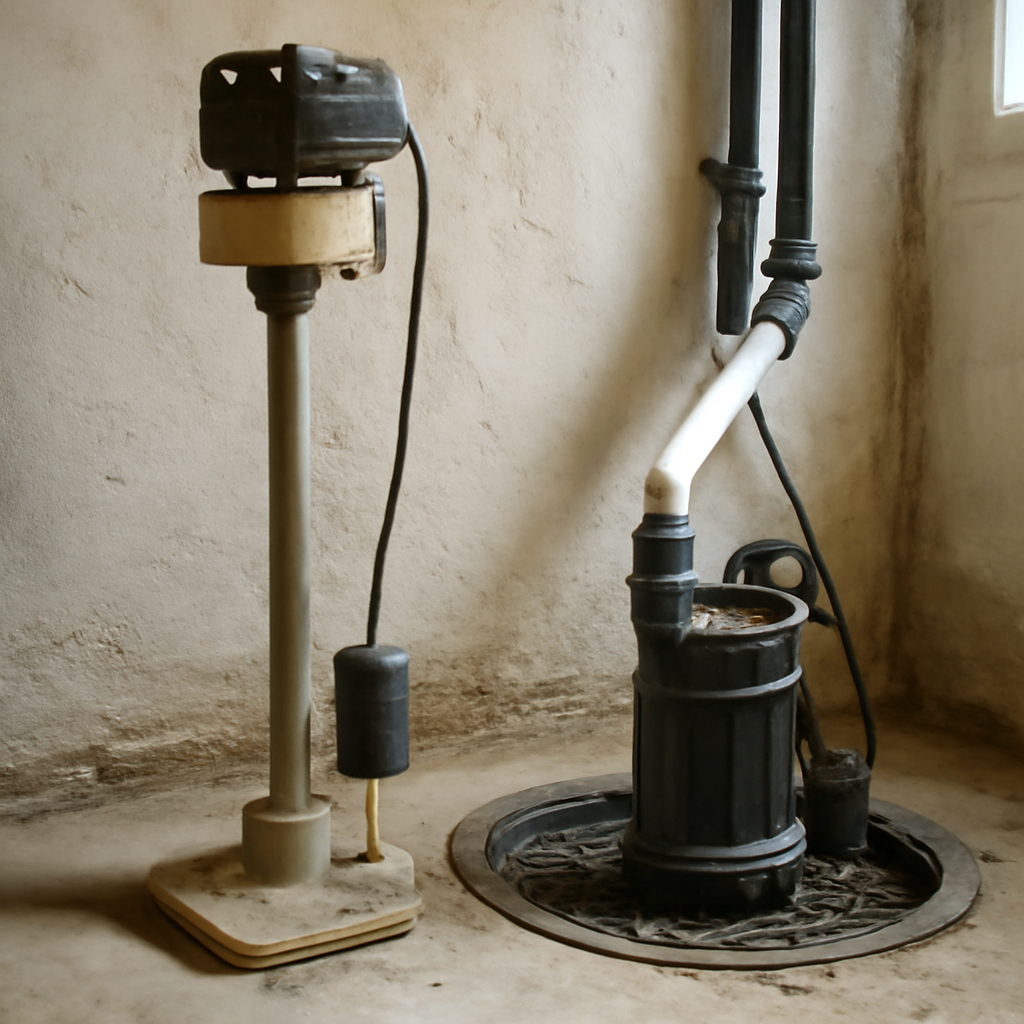
A submersible sump pump is the better choice for most finished basements and for any home with a sealed sump lid or a radon mitigation system, because it sits quietly inside the pit, handles more water and works cleanly under an airtight cover. A pedestal sump pump makes sense when the pit is too small or narrow for a submersible, in an unfinished utility area where noise does not matter, or when you want the lowest purchase price and the easiest motor access. Both types move water out of the same pit; the differences are where the motor sits, how loud it is, how long it tends to last, how easily it can be serviced, and how well it pairs with a battery backup and a sealed lid.
Part of our Crawl Space & Attic Guide guide — start there for the full picture →
This guide compares the two designs side by side, explains switch types and pit sizing, covers battery backup and radon considerations that matter in Front Range basements, and lists what a home inspector looks for. It reflects general guidance as of 2026. The pump manufacturer’s instructions, your radon mitigator’s system design and local plumbing code take priority for any specific installation.
Pedestal vs Submersible Sump Pump: Quick Comparison
The ranges below are typical for residential pumps. Individual models vary, so use the table to narrow the choice, then check the specifications of the pump you are considering.
| Factor | Pedestal | Submersible |
|---|---|---|
| Motor location | On a column above the pit, out of the water | Sealed inside the pump body, under water in the pit |
| Pit size | Fits small or narrow pits, including many older basins | Usually needs a wider pit, commonly around 18 inches or more across |
| Noise | Louder; motor noise carries into the basement | Quieter; water and lid muffle the motor |
| Typical lifespan | Often long, because the motor stays dry and air-cooled | Commonly cited around 7 to 10 years, varying with duty and build quality |
| Serviceability | Motor and switch are visible and easy to reach | Must be pulled from the pit to inspect or replace |
| Typical capacity | Usually lower; suited to light or moderate inflow | Wider range, including higher-capacity models for heavy inflow |
| Sealed or radon lid | Possible but awkward; the column must pass through the lid | Straightforward; only the discharge, cord and any vent pass through |
| Battery backup pairing | Space in a small pit may limit a second pump | Common pairing in a properly sized pit |
| Typical purchase price | Lower | Moderate to higher, depending on horsepower and materials |
If you have already decided, see our roundups of the best sump pumps overall and the best submersible sump pumps for specific models. The rest of this guide explains the trade-offs in more depth.
How Each Design Works
Pedestal pumps
A pedestal pump has a small impeller housing that sits on the bottom of the pit, connected by a vertical column to a motor mounted several feet above the floor of the pit, often above the basement slab. A float on a vertical rod rises with the water and flips a switch on the motor when the water reaches the set level. Because the motor never touches water, it runs cooler and is easy to see and reach. The trade-off is noise: the motor is out in the open, and its hum and switch click carry through a basement.
Submersible pumps
A submersible pump houses the motor in a sealed, waterproof casing that sits in the bottom of the pit. Many residential submersibles use an oil-filled motor housing that helps transfer heat to the surrounding water. The pump body sits under the water and a lid, so most of the noise is muffled. Submersibles come in a wider range of horsepower and flow ratings, and many models can pass small debris. Because they live under water, they are harder to inspect without pulling them out, and seal failure is a common end-of-life cause.
Our detailed guide to the submersible sump pump covers construction materials, horsepower and discharge sizing if you want to go deeper on that design.
Best Submersible Sump Pumps: our top 3 picks
| Product | Best for | Key features | Price | Buy |
|---|---|---|---|---|
| Wayne CDU980E | Best all-round cast iron pump |
| $189.00as of Oct 21, 2026 12:35 am GMT+0000 | Buy now →Check current price |
| Zoeller M98 Flow-Mate | Oil-filled cast iron workhorse |
| $320.72as of Oct 21, 2026 12:35 am GMT+0000 | Buy now →Check current price |
| AQUASTRONG 1/2 HP | Tethered float in wide pits |
| $119.99as of Oct 21, 2026 12:35 am GMT+0000 | Buy now →Check current price |


Prices are Amazon’s listed prices as of the time shown and change often; check Amazon for today’s price. As an Amazon Associate we earn from qualifying purchases.
Pit Size: The First Thing to Check
The size of the existing sump basin often makes the decision before anything else does. Measure the inside diameter of the pit and its depth from the slab to the bottom, and note any inlet pipes from the drain tile.
- Measure the diameter. Many older Front Range basements have narrow pits, sometimes little more than a foot across. A pedestal pump’s small base fits these well. Submersibles generally want more room, commonly an 18-inch or wider basin, so the float can move freely without catching on the pump body or the pit wall.
- Measure the depth. A deeper pit gives the pump a longer run between cycles, which reduces short-cycling wear. Pedestal columns come in fixed heights, so make sure the motor ends up at a sensible level above the slab.
- Leave room for a backup. If you plan to add a second pump for battery backup, both pumps and both floats need space to operate without interfering with each other.
- Consider enlarging the pit. If a submersible is the better fit but the pit is too small, a plumber can often install a larger basin. That adds labor and concrete work, and in a radon-mitigated home it should be coordinated with the mitigation contractor.
Also look at what the pit is made of and what flows into it. A solid-bottom plastic basin with perforated sides is common in newer homes, while some older pits are simply a concrete-lined hole with gravel at the bottom. Silt and gravel can be drawn into a submersible’s intake, so a pump that sits on a brick or a flat paver, or a model designed to pass small solids, holds up better in those pits.
As a rule of thumb, a pit under about 18 inches across points toward a pedestal pump or a compact submersible specifically designed for narrow basins, while a standard-size basin opens up the full range of submersible options.
Noise, Lifespan and Serviceability
Noise
In a finished basement with a bedroom, office or media room nearby, noise often decides the matter. A pedestal pump’s exposed motor is noticeably louder when it runs, and its switch makes an audible click. A submersible running under water and a closed lid is much quieter, although the check valve can still make a thump when the pump shuts off. A quieter check valve design can soften that.
Lifespan
Pedestal motors often last a long time because they stay dry and air-cooled. Submersibles are commonly said to last around 7 to 10 years, though that figure is a rough average rather than a rating, and actual life depends on how often the pump runs, water quality, debris, build materials and whether the pump ever runs dry. A cast-iron submersible with a quality switch can outlast a light-duty plastic model by years.
In much of the Front Range, the semi-arid climate means many sump pits are dry for most of the year and only take water during spring snowmelt or a heavy summer storm. A pump that rarely runs can still fail, because seals dry out, switches stick and debris settles. Testing it by pouring water into the pit a few times a year matters more than which design you own. A simple routine works for either design: lift the lid, pour a bucket or two of water slowly into the pit, confirm the switch starts the pump, watch the level drop and listen for the pump shutting off cleanly. Then go outside and confirm water is leaving the discharge line where it should. If the pump hums without moving water, trips the breaker, or the float hangs up, plan a repair or replacement before the next storm season rather than during it.
Serviceability
Pedestal pumps are the easier design to service. The motor and switch are in plain sight, and a worn switch or motor can often be replaced without disturbing the pit. Submersibles must be disconnected from the discharge line and lifted out, which is messier, especially in a sealed radon pit where the lid must be resealed afterward. A union fitting above the check valve makes removal much easier and is worth adding during any installation.
Switch Types and Why They Matter
The switch is the most common failure point on either type. Choosing a pump is partly choosing a switch.
- Rod-and-float (pedestal style). A ball float rides on a vertical rod with adjustable stops. Simple and visible, but the rod can bind if it rubs the pit wall or collects debris.
- Vertical float (submersible). A float rides up and down a short guide on the pump. It works well in narrower pits because it needs little side clearance.
- Tethered float (submersible). A float on a cord swings upward to turn the pump on. It allows a longer pumping cycle but needs a wide pit so the float does not catch on the wall, the discharge pipe or a backup pump.
- Diaphragm or pressure switch. Senses water depth through a sealed diaphragm. Compact, with no moving float to snag.
- Electronic sensors. Solid-state probes with no moving parts. They avoid mechanical sticking but depend on clean sensors and electronics.
Our guide to the sump pump float switch explains testing, adjustment and common failure symptoms in more detail. Whatever switch you choose, a separate high-water alarm adds a second warning in case the switch sticks.
Pairing With a Battery Backup
Power outages and pump failures tend to happen during the same storms that send the most water into a pit. A battery backup pump gives a second line of defense.
- Separate DC backup pump. The most common setup is a second, battery-powered pump installed in the same pit, usually set slightly higher than the primary so it only runs if the primary cannot keep up or loses power. This needs pit space, which is one reason submersible primaries in a full-size basin pair most easily.
- Combination systems. Some products package a primary and backup on one discharge assembly, which saves space in tighter pits.
- Pedestal pits. In a narrow pit with a pedestal primary, there may be no room for a separate backup pump. Options include a compact backup designed for small basins, enlarging the pit, or a backup system that mounts differently. Check fit before buying.
- Battery care. Backup batteries need periodic testing and replacement. A system with a charger alarm or app alert tells you when the battery is weak.
Our roundup of the best battery backup sump pumps compares specific systems, including options for smaller pits.
Sealed Lids and Radon-Mitigated Homes
Radon is a serious concern along the Front Range, where local geology produces elevated radon in many homes. The EPA states that radon exposure causes lung cancer in smokers and non-smokers alike, and lists radon alongside smoking and secondhand smoke as leading causes of the disease (EPA). An open sump pit connects the soil below the slab directly to the basement air, so radon-resistant construction guidance calls for sealing openings in the foundation floor (EPA).
In many radon-mitigated homes, the sump is part of the system. The EPA’s consumer guide to radon reduction describes sump-hole suction, in which the sump is capped so it can continue to drain water while also serving as the location for a radon suction pipe (EPA Consumer’s Guide to Radon Reduction). Even when the suction point is elsewhere, the pit is usually covered with an airtight lid so the system can maintain negative pressure under the slab.
This is where the two designs differ most:
- Submersible pumps sit entirely under the lid. Only the discharge pipe, the power cord and any radon pipe pass through sealed grommets. That makes an airtight seal straightforward.
- Pedestal pumps have a motor that sits above the pit on a column. The column and float rod must pass through the lid, or the motor must sit under a taller sealed enclosure. Either is harder to make airtight and harder to service without breaking the seal.
If you replace a pump in a radon-mitigated home, reseal the lid with the correct gaskets and caulk afterward, and confirm that the mitigation system’s manometer reading returns to normal. Our guide to the radon sump pump cover walks through lid types and sealing details. A short-term radon retest after significant pit work is a reasonable precaution.
What Sump Pumps Typically Cost
Prices change, so these are typical ranges rather than quotes.
- Pedestal pump: Usually the least expensive pump to buy. Cost drivers are horsepower, column material and switch quality.
- Submersible pump: Typically costs more than a comparable pedestal, with cast-iron, higher-horsepower and premium-switch models at the top of the range.
- Installation: A straightforward swap in an existing pit is the simplest job. Costs rise with a new or enlarged basin, new discharge piping, a new check valve, a dedicated circuit, or work on a sealed radon pit.
- Battery backup: A backup system adds the cost of the second pump, the battery, the charger and installation. Batteries need replacement every few years.
- Ongoing costs: Electricity use is modest in most Front Range homes because pumps run infrequently. The bigger costs are periodic switch, check valve and battery replacements.
Water Problems Beyond the Pump
A sump pump only manages water that reaches the pit. If water is reaching the basement in other ways, a better pump will not fix it. The EPA notes that the key to mold control is moisture control, and that water problems should be fixed promptly (EPA). Before upgrading the pump, check that gutters and downspouts carry roof water well away from the foundation, that soil slopes away from the house, and that the discharge line does not drain back toward the foundation or freeze shut in winter. In crawl space homes, the same principles apply; our crawl space hub covers moisture control, vapor barriers and drainage in that setting.
How to Decide: A Simple Checklist
- Measure the pit. Narrow or shallow points to pedestal or a compact submersible; a standard basin opens up any submersible.
- Consider noise. Finished living space nearby favors a submersible.
- Check for radon mitigation. A sealed or suction-connected pit strongly favors a submersible.
- Estimate inflow. A pit that fills quickly during storms needs more capacity, which submersibles offer more readily.
- Plan the backup. If you want a battery backup, make sure the pit can hold both pumps.
- Think about service. If you want to see and replace parts easily and noise is not a concern, a pedestal remains a sensible, low-cost choice.
When to Call a Pro or an Inspector
Call a plumber, waterproofing contractor or certified radon mitigator, as appropriate, if the pump runs constantly or never runs during heavy rain, the pit overflows, the pump cycles on and off rapidly, the discharge freezes or drains back toward the house, or the pit is part of a radon system and needs to be opened. A home inspector checks the visible condition of the pump, the switch, the discharge line and check valve, the electrical connection and the lid, and flags water staining or efflorescence that suggests drainage problems.
If you are buying a Front Range home with a sump pit, a radon system or signs of past basement water, contact our team to schedule an inspection and radon test.
References
- Consumer’s Guide to Radon Reduction — U.S. Environmental Protection Agency
- Radon-Resistant Construction Basics and Techniques — U.S. Environmental Protection Agency
- Health Risk of Radon — U.S. Environmental Protection Agency
- A Brief Guide to Mold, Moisture and Your Home — U.S. Environmental Protection Agency
Frequently asked questions
Which lasts longer, a pedestal or submersible sump pump?
Pedestal pumps often last longer because the motor stays dry and air-cooled. Submersibles are commonly cited at around 7 to 10 years, but actual life depends on build quality, how often the pump runs and how well it is maintained.
Is a submersible sump pump quieter than a pedestal pump?
Yes. A submersible runs under water and a lid, which muffles most motor noise. A pedestal pump's motor sits above the pit in open air, so it is noticeably louder.
What size pit does a submersible sump pump need?
Many submersibles need a basin around 18 inches or more across so the float moves freely. Narrower pits often suit a pedestal pump or a compact submersible built for small basins.
Can a pedestal sump pump be used with a radon system?
It can, but it is harder to seal because the motor column and float rod must pass through the lid. A submersible sits fully under an airtight lid, which is why it is usually preferred in radon-mitigated homes.
Can a battery backup be added to a pedestal sump pump?
Sometimes. A separate backup pump needs space in the pit, and narrow pedestal pits may not have it. Options include compact backup units, combination systems or enlarging the pit.
Buying a home with a sump pit or radon system? Get in touch with our team to arrange a Front Range inspection.