Best Submersible Sump Pumps (2026): 6 Compared by Build

Picking the best submersible sump pump is mostly a question of what it is made of and how its switch works, because both decide how long it survives sitting underwater in a dark pit. A cast iron pump sheds motor heat into the water and shrugs off years of cycling. Stainless and thermoplastic bodies are lighter and resist corrosion differently. The float switch matters just as much: a vertical float fits a narrow pit, a tethered float needs room to swing, and a mechanical arm sits behind a guard. Front Range basements also bring a radon wrinkle, since many sump pits sit under sealed lids. Below are six submersible pumps compared on build and switch design, then a buying guide on materials, floats, sizing and installation.
Part of our Crawl Space & Attic Guide guide — start there for the full picture →
As an Amazon Associate we earn from qualifying purchases.
How we compared: we compared 16 current Amazon listings returned for submersible sump pumps on what each listing states: horsepower, flow, housing and impeller materials, switch type, thermal protection, discharge size, cord length and warranty. Seven of the 16 were portable utility, transfer or pool-cover pumps without an automatic pit float, so the picks come from the remaining automatic pumps. We did not lab-test, install or handle any of them. Prices and availability change, so check the current listing before buying.
Quick picks: the best submersible sump pumps by build
| Product | Best for | Key features | Price | Buy |
|---|---|---|---|---|
| Wayne CDU980E | Best all-round cast iron pump |
| $189.00as of Nov 11, 2026 4:01 am GMT+0000 | Buy now →Check current price |
| Zoeller M98 Flow-Mate | Oil-filled cast iron workhorse |
| $309.17as of Nov 11, 2026 4:01 am GMT+0000 | Buy now →Check current price |
| AQUASTRONG 1/2 HP | Tethered float in wide pits |
| $119.99as of Nov 11, 2026 4:01 am GMT+0000 | Buy now →Check current price |
| LANCHEZ 1.6 HP | High flow, stainless body |
| $105.49as of Nov 11, 2026 3:01 am GMT+0000 | Buy now →Check current price |
| Zoeller M53 Mighty-mate | Compact all-cast-iron pump |
| $203.72as of Nov 10, 2026 6:44 pm GMT+0000 | Buy now →Check current price |
| Wayne CDU790 | Light-duty pit with narrow float |
| $135.92as of Nov 11, 2026 7:07 am GMT+0000 | Buy now →Check current price |
Prices are Amazon’s listed prices as of the time shown and change often; check Amazon for today’s price. As an Amazon Associate we earn from qualifying purchases.
The six picks, compared listing by listing
1. Wayne CDU980E — Best Submersible Sump Pump Overall

3/4 HP cast iron and stainless submersible with a narrow-pit vertical float, top suction and 5-year warranty.
Check price on Amazon$189.00 as of Nov 11, 2026 4:01 am GMT+0000 — prices change; see Amazon for current price.Why we like it
- Cast iron and stainless steel construction
- 3/4 HP covers wet springs with margin
- Vertical float fits narrow pits
- Five-year warranty, tied for longest
| Specification | Details |
|---|---|
| Motor | 3/4 HP |
| Flow stated | Up to 5,490 GPH (lift height not stated) |
| Housing | Cast iron and stainless steel |
| Switch | Integrated vertical float |
| Design | Top suction, anti-airlock; no weep hole |
| Weight / warranty | About 12 lb listed; 5-year manufacturer’s warranty; assembled in USA |
Wayne CDU980E — 3/4 HP, 5490 GPH max, cast iron + stainless, vertical float, top suction, 5-yr warranty
The Most Capacity in a Metal Body With a Narrow-Pit Float
Nine of the 16 listings are automatic pit pumps, and only one of them sits at 3/4 HP. The CDU980E fills the gap between the many 1/2 HP pumps and the larger 1 HP and 1.6 HP models, which is where a pit that runs often in spring but not year-round fits best. It pairs that motor with cast iron and stainless steel construction and a vertical float that rides close to the pump.
That float choice matters more than it sounds. Older Front Range basins are often narrow, and a tethered float needs clear room to swing up without catching on the pit wall or discharge pipe. A vertical float rides up and down a fixed rod, so it works in tight pits where a tethered design would jam.
The five-year warranty matches the longest on the shelf. The listing gives no flow at a stated lift height, and its 12-pound listed weight is surprisingly light for a cast iron 3/4 HP pump, so confirm specs with Wayne before relying on that figure.
Pros
- Cast iron and stainless build
- 3/4 HP sits between common sizes
- Vertical float for tight pits
- Five-year warranty
Cons
- No flow at a stated lift
- Listed weight looks low for the build
- May short-cycle in a slow, small pit
Check Wayne CDU980E price on Amazon
2. Zoeller M98 Flow-Mate — Best Oil-Filled Cast Iron Pump

1/2 HP oil-filled cast iron pump with snap-action float, vortex impeller and a power-indicator plug.
Check price on Amazon$309.17 as of Nov 11, 2026 4:01 am GMT+0000 — prices change; see Amazon for current price.Why we like it
- Only listing naming an oil-filled cast iron motor
- LED plug shows power at a glance
- Stainless float guard and switch arm
- Vortex impeller passes solids
| Specification | Details |
|---|---|
| Motor | 1/2 HP, oil-filled; 115 V |
| Flow stated | Up to 4,320 GPH |
| Housing / hardware | Cast iron housing; stainless steel hardware, float guard and switch arm |
| Switch | Built-in snap-action float switch |
| Impeller / cord | Non-clogging plastic vortex impeller; 9 ft cord with LED plug |
| Weight / warranty | About 31 lb; 12 months from installation or 18 months from manufacture |
Zoeller M98 Flow-Mate (98-0001) — 1/2 HP oil-filled cast iron, snap-action float, vortex impeller, 4320 GPH, LED plug, 31 lb
Oil-Filled Motor Plus a Plug That Tells You It Has Power
The M98 is the only listing on the shelf that describes an oil-filled motor inside a cast iron housing. Oil carries heat from the windings to the cast iron shell, which then sheds it into the pit water, and the listing ties that to longer motor life. At about 31 pounds it also has the heaviest stated weight among the picks, which reflects how much metal is in it.
Its plug has an LED that lights when the outlet is live. That sounds minor until you remember the most common reason a sump pump fails to run is a tripped GFCI or breaker. A glance at the plug during a storm answers the question. The mechanical snap-action float sits on a stainless arm behind a float guard, which keeps debris and the pit wall from interfering with it.
The warranty is the main drawback: 12 months from installation or 18 from manufacture. Cast iron Wayne models on this shelf carry three to five years. The listing does not state the switch’s on and off levels or flow at a given lift.
Pros
- Oil-filled cast iron motor
- LED plug confirms power
- Guarded stainless float arm
- Heaviest stated weight of the picks
Cons
- Short warranty for the class
- Mechanical arm needs pit width
- No lift-height flow stated
Check Zoeller M98 Flow-Mate price on Amazon
3. AQUASTRONG 1/2 HP — Best Tethered-Float Pump for Wide Pits

1/2 HP pump with cast iron volute, adjustable tethered float and piggyback plug for 18 in basins.
Check price on Amazon$119.99 as of Nov 11, 2026 4:01 am GMT+0000 — prices change; see Amazon for current price.Why we like it
- Only pick with an adjustable tethered float
- Piggyback plug allows manual override
- Thermal overload protects against dry running
- Longest cord among the picks, 20 ft
| Specification | Details |
|---|---|
| Motor / flow | 1/2 HP; up to 3,450 GPH; lifts to 25 ft |
| Housing | Stainless steel and thermoplastic with a cast iron volute |
| Switch | Adjustable tethered float with piggyback plug; tether length set with a cable lock |
| Protection | Built-in thermal overload |
| Discharge / cord | 1-1/2 in NPT; 20 ft UL power cable |
| Fit / warranty | Basins 18 in diameter or larger; 1-year warranty |
AQUASTRONG 1/2 HP — 3450 GPH, stainless/thermoplastic + cast iron volute, tethered piggyback float, thermal overload, 18 in+ basin
The Only Pick Where You Set the Pumping Range
Every other pump among the picks uses a fixed switch: a vertical float, a mechanical arm or an integrated float with set on and off levels. The AQUASTRONG is the only one with an adjustable tethered float and a piggyback plug. Shortening or lengthening the tether with its cable lock changes how far the water rises before the pump starts, so you can trade fewer, longer cycles against a lower water level in the pit.
The piggyback plug is the other advantage. The float plugs into the outlet and the pump plugs into the float, so you can bypass the switch for manual pumping or swap a failed float without replacing the pump. It is also one of only two automatic pit pumps on this shelf that state thermal overload protection.
The trade-off is space. The listing calls for an 18-inch or wider basin, the only minimum basin size stated among the picks, because a tethered float has to swing freely. Its housing mixes stainless and thermoplastic around a cast iron volute rather than full cast iron, and the warranty is 1 year.
Pros
- Adjustable pumping range
- Piggyback plug for manual override
- Thermal overload protection
- 20 ft cord
Cons
- Needs an 18 in or wider basin
- Not full cast iron
- 1-year warranty
Check AQUASTRONG 1/2 HP price on Amazon
4. LANCHEZ 1.6 HP — Best High-Flow Stainless Pump

1.6 HP stainless submersible with integrated float, 6000 GPH max, IPX8 rating and thermal overload.
Check price on Amazon$105.49 as of Nov 11, 2026 3:01 am GMT+0000 — prices change; see Amazon for current price.Why we like it
- Highest stated flow and head on the shelf
- Full stainless steel casing, IPX8 rated
- Passes solids up to 4/5 in
- Thermal overload and mechanical seal
| Specification | Details |
|---|---|
| Motor / flow | 1.6 HP; up to 6,000 GPH; 30 ft maximum head |
| Housing / impeller | Stainless steel casing; PA66 bottom impeller; mechanical seal |
| Switch | Integrated float; minimum start level about 5.3 in; can be held upright for manual running |
| Protection / rating | Automatic thermal overload; IPX8 |
| Solids / discharge | Passes particles up to 4/5 in; 1-1/2 in NPT plus hose adapters |
| Cord / warranty | 16 ft cord; warranty not stated in listing |
LANCHEZ 1.6 HP (Q1100B56) — 6000 GPH max, 30 ft head, stainless, integrated float, IPX8, thermal overload, 4/5 in solids
The Biggest Pump Here, and the Only Full Stainless Body
Among the nine automatic pit pumps, the LANCHEZ claims the most power and flow: 1.6 HP, 6,000 GPH and 30 feet of maximum head. It is also the only one described as having a full stainless steel casing, rather than cast iron or a mix of materials. Stainless resists rust without relying on a coating, and the listing adds an IPX8 waterproof rating and a mechanical seal.
Its solids handling, particles up to 4/5 inch, is the only solids size stated among the picks, which helps in pits that collect gravel and silt from older drain tile. The listing also names sewage and multi-use settings, so it is more of a heavy utility-and-sump hybrid than a dedicated basement pump.
That versatility comes with caveats. The float startup note says to tilt the float to 45 degrees before first use, and the listing gives no warranty term. A 1.6 HP pump in a typical Front Range pit is likely oversized; it suits basements with heavy groundwater or as a strong secondary pump during major melt.
Pros
- Highest stated flow and head
- Full stainless casing, IPX8
- Large solids passage
Cons
- Likely oversized for most pits
- No warranty term stated
- Float setup less straightforward
Check LANCHEZ 1.6 HP price on Amazon
5. Zoeller M53 Mighty-mate — Best Compact All-Cast-Iron Pump
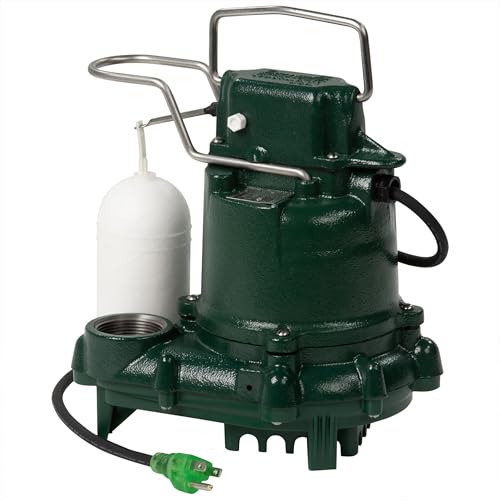
1/3 HP submersible with a cast iron motor, pump housing and switch case, float-activated switch and vortex impeller.
Check price on Amazon$203.72 as of Nov 10, 2026 6:44 pm GMT+0000 — prices change; see Amazon for current price.Why we like it
- Cast iron switch case as well as housing
- Compact, about 7.75 in wide
- Vortex impeller resists clogging
- Proven 1/3 HP size for light inflow
| Specification | Details |
|---|---|
| Motor | 1/3 HP |
| Housing | Cast iron switch case, motor and pump housing; plastic base |
| Switch | Automatic, float-activated |
| Impeller | Non-clogging vortex |
| Size / weight | About 10.25 x 10.25 x 7.75 in; 21 lb |
| Flow / warranty | Not stated in listing |
Zoeller M53 Mighty-mate (53-0001) — 1/3 HP, cast iron motor/housing/switch case, float switch, vortex impeller, 21 lb
Cast Iron Even Around the Switch
Eight of the 16 listings mention cast iron somewhere, but for most of them it is the volute around the impeller. The M53 is the only listing that names cast iron for the switch case too, along with the motor and pump housing. The switch is the most failure-prone part of any sump pump, and a metal enclosure is less likely to crack or warp than a plastic one over years underwater.
At about 7.75 by 10.25 inches, it is compact enough that a small pit may still have room for a second backup pump later.
The listing does not state flow, discharge size, switch type or warranty. For a home with light, occasional inflow, the build quality speaks for itself; for heavier inflow, step up to the CDU980E or M98.
Pros
- All-cast-iron including switch case
- Compact footprint
- Vortex impeller
Cons
- No flow or warranty stated
- 1/3 HP limits lift
- Switch type not specified
Check Zoeller M53 Mighty-mate price on Amazon
6. Wayne CDU790 — Best for Light-Duty Pits With a Narrow Float

1/3 HP submersible with a cast iron volute, epoxy-coated steel housing and a vertical float tested to 1 million cycles.
Check price on Amazon$135.92 as of Nov 11, 2026 7:07 am GMT+0000 — prices change; see Amazon for current price.Why we like it
- Float switch tested to 1 million cycles
- Vertical float for narrow pits
- Top suction keeps sediment out
- Three-year limited warranty
| Specification | Details |
|---|---|
| Motor / flow | 1/3 HP; up to 4,600 GPH |
| Housing | Epoxy-coated steel motor housing; cast iron volute; stainless fasteners |
| Switch | Integrated vertical float, tested to 1 million cycles |
| Design | Top suction; no weep hole; indoor use only |
| Weight | About 16.4 lb |
| Warranty | 3-year limited; assembled in USA |
Wayne CDU790 — 1/3 HP, 4600 GPH max, epoxy-coated steel + cast iron volute, vertical float (1M cycles), 3-yr warranty
A Documented Switch on a Budget-Size Pump
Among the picks, the CDU790 is the only one that states a switch test figure: 1 million cycles on its vertical float. For a small pump that may sit idle for months and then run hard during melt, a switch with a stated life is a reasonable thing to prioritize.
Its construction sits in the middle of the shelf. The motor housing is epoxy-coated steel and the volute is cast iron, so it is sturdier than an all-plastic utility pump but depends on its coating to resist rust around the motor. Compared with the all-cast-iron M53 at the same horsepower, it gives you a stated flow figure, a documented switch and a 3-year warranty, but less metal.
As with most listings here, its flow figure has no stated lift, and 1/3 HP loses capacity quickly as lift rises.
Pros
- 1M-cycle vertical float
- Three-year warranty
- Top suction design
Cons
- Coated steel motor housing
- 1/3 HP limits high lifts
- No lift-height flow stated
Check Wayne CDU790 price on Amazon
Cast iron, stainless or thermoplastic: what the housing changes
A submersible pump lives underwater, so its body does two jobs: protect the motor and carry heat away from it.
- Cast iron is the traditional choice for a primary pump. It conducts heat well, which keeps the motor cooler during long runs, and its weight keeps the pump planted. It can rust over time, especially if the coating chips. Most cast iron pumps here use it for the volute and motor housing; the Zoeller M53 extends it to the switch case.
- Stainless steel resists corrosion without a coating and is lighter than cast iron. The LANCHEZ uses a full stainless casing; Wayne’s CDU980E pairs stainless with cast iron.
- Thermoplastic is light and inexpensive and does not rust, but it insulates rather than conducts heat, so motors run warmer in long cycles. On this shelf thermoplastic shows up mostly in utility pumps and in mixed housings such as the AQUASTRONG.
For a primary pump that may cycle hundreds of times in a wet spring, cast iron or a cast iron and stainless mix is the safer bet. Thermoplastic suits light-duty pits and backup roles.
Float switch types for submersible pumps
Vertical floats
A vertical float rides up and down a rod attached to the pump. It needs little side clearance, which makes it the best choice for narrow pits. Wayne’s CDU980E and CDU790 use one.
Tethered floats
A tethered float hangs on its cord and tips upward as water rises. Its pumping range is adjustable by changing tether length, but it needs a wider pit, 18 inches or more per the AQUASTRONG listing, and can snag on pipes or the pit wall.
Mechanical arms and snap-action switches
A hinged float on a rigid arm triggers a snap-action switch. Zoeller’s M98 uses this design with a stainless float guard. It is reliable and well protected, but needs room for the arm to swing.
Check the switch, not just the pump
Whatever the type, test it every few months by pouring water into the pit until the pump starts. Our float switch guide explains how to tell a stuck float from a failed switch, and our sump pump maintenance guide covers the full routine.
Sizing a submersible pump
Sizing depends on how fast your pit fills and how high the pump has to lift the water. Time the fill rate during a heavy rain or melt, and measure from the pump to the highest point of the discharge pipe. Most dry-climate basements do well with 1/3 to 1/2 HP; 3/4 HP suits frequent spring inflow; 1 HP and up is for high water tables or long, high discharge runs.
Listings mostly quote maximum flow at zero lift. Across the listings on these shelves that state both numbers, flow at 10 feet runs roughly 15 to 40 percent below the zero-lift figure, so compare manufacturer pump curves when you are between sizes. Avoid large pumps in small pits; frequent short cycles wear the switch and motor faster than steady runs. For a full comparison against other pump types, see our submersible sump pump guide.
Installation and electrical notes
- Dedicated outlet. Plug the pump directly into a grounded outlet near the pit. The USFA advises plugging major appliances directly into a wall outlet and never using an extension cord with them, and a sump pump that runs unattended deserves the same care. If the outlet is GFCI-protected, check it after storms.
- Check valve and discharge. A check valve stops water in the discharge pipe from falling back into the pit. Route discharge well away from the foundation; the EPA recommends that ground slope away from the house so water does not collect around it. Our check valve guide covers installation.
- Pit base. Set the pump on a solid, level surface such as a paver, not on loose gravel or silt, so debris is not drawn into the intake.
- Backup. Even the best cast iron pump fails during a power outage. Consider a battery backup and high-water alarm; see our guide to sump pump battery backups.
Front Range notes: snowmelt, frozen lines and sealed radon lids
In most Front Range basements, the sump pump runs hardest from March through June, when snowmelt and spring storms soak soils that may have been dry for months. The EPA notes that drying wet areas within 24 to 48 hours usually prevents mold growth, so a submersible pump that fails quietly in April can mean a much bigger repair.
Winter brings frozen discharge lines. A line that freezes while the pump runs forces the motor to push against a blockage. Cast iron pumps tolerate the heat buildup better than thermoplastic ones, but no pump should run against a frozen line for long.
Radon is the Colorado-specific factor. A sump pit is an opening to the soil, and the CDC notes that radon enters homes through cracks and openings and that sealing them makes mitigation systems more effective. In homes with active mitigation, the submersible pump sits under an airtight lid with sealed pass-throughs, which is one reason submersibles are preferred over pedestal pumps here. When you replace a pump, restore that seal. Our guides to radon sump pump covers and radon and sump pumps explain how the two systems work together.
When to call a professional
Call a plumber or waterproofing contractor if water enters the basement somewhere other than the pit, if the pump runs constantly in dry weather, if the pit is too small or shallow for a modern pump, or if you need a new discharge line. In a home with a radon system, have a certified mitigator reseal the lid and retest after any pump work.
A home inspection is a good way to assess an existing sump system: pump age, switch operation, check valve, discharge routing and lid seal. For more on basement moisture and foundations, see our crawl space and basement hub. Front Range homeowners looking for a qualified local inspector can get in touch here.
Frequently asked questions
Is a cast iron submersible sump pump better than plastic?
For a primary pump that runs often, usually yes. Cast iron conducts heat into the pit water, keeping the motor cooler, and its weight keeps the pump stable. Thermoplastic pumps are lighter and do not rust but run warmer during long cycles, so they suit light-duty pits and backup roles.
What is the difference between a vertical and tethered float switch?
A vertical float rides on a rod beside the pump and fits narrow pits. A tethered float hangs on its cord and swings up as water rises; its range is adjustable but it needs a wider pit, often 18 in or more. Mechanical arm floats sit behind a guard and also need some swing room.
What horsepower submersible sump pump do I need?
Most basements need 1/3 to 1/2 HP. Step up to 3/4 HP for frequent spring inflow and 1 HP or more only for high water tables or high, long discharge runs. Oversized pumps short-cycle in small pits and wear out faster.
How often should a submersible sump pump be tested?
Test it every few months and before spring melt by pouring water into the pit until the pump starts and empties it. Listen for humming without pumping, check that the float moves freely and confirm the discharge line is clear and not frozen.
Can a submersible sump pump work with a radon mitigation system?
Yes. Submersibles are preferred because the pit can be fully sealed. The lid must be airtight with sealed pass-throughs for the pipe and cord, since the CDC notes that sealing openings makes radon systems more effective. Retest radon after replacing the pump.
References
- A Brief Guide to Mold, Moisture and Your Home — U.S. Environmental Protection Agency
- Reducing Radon Levels in Your Home — Centers for Disease Control and Prevention
- Electrical and Appliance Fire Safety — U.S. Fire Administration