Best Battery Backup Sump Pumps (2026): 7 Systems Compared
The best battery backup sump pump is the one that is still pumping at 3 a.m. when the power has been out for six hours and the pit is filling from snowmelt. That takes three things: a backup pump or inverter that actually moves water at your lift height, a battery sized for a long outage, and an alarm loud enough to wake you when something is wrong. Backups come in three forms: complete combo systems that replace your primary pump, standalone DC pumps that sit beside your existing pump, and inverter units that run your current pump from a battery. Below are seven picks across all three, followed by a buying guide on runtime, battery types, alarms and installation.
Part of our Crawl Space & Attic Guide guide — start there for the full picture →
As an Amazon Associate we earn from qualifying purchases.
How we compared: we compared 13 current Amazon listings for battery backup sump pump systems on what each listing states: system type, primary and backup flow (especially at 10 feet of lift), switch design, monitoring and alarms, battery compatibility and whether a battery is included. One listing was a battery alone, so we used its stated runtimes as reference rather than as a pick. We did not lab-test or install any of these systems, and we did no hands-on handling. Prices and availability change, so check the live listing before buying.
Quick picks: the best battery backup sump pumps by setup
| Product | Best for | Key features | Price | Buy |
|---|---|---|---|---|
| Basement Watchdog CITS-50 | Complete combo with remote alerts |
| $449.99as of Oct 20, 2026 7:55 pm GMT+0000 | Buy now →Check current price |
| Zoeller 508 ProPak | Self-testing combo system |
| $859.00as of Oct 20, 2026 10:47 pm GMT+0000 | Buy now →Check current price |
| Wayne WSS30VN | Drop-in combo for 16 in pits |
| $549.99as of Oct 20, 2026 7:55 pm GMT+0000 | Buy now →Check current price |
| Basement Watchdog Special BWSP | Add-on backup to an existing pump |
| $279.00as of Oct 20, 2026 7:55 pm GMT+0000 | Buy now →Check current price |
| Wayne ESP25n | Budget standalone backup |
| $299.99as of Oct 20, 2026 10:47 pm GMT+0000 | Buy now →Check current price |
| Basement Watchdog CITE-33 | Small 12 in pits |
| $349.01as of Oct 20, 2026 7:55 pm GMT+0000 | Buy now →Check current price |
| VEVOR 1500W inverter | Run your existing pump on battery |
| $124.38as of Oct 20, 2026 10:47 pm GMT+0000 | Buy now →Check current price |
Prices are Amazon’s listed prices as of the time shown and change often; check Amazon for today’s price. As an Amazon Associate we earn from qualifying purchases.
The seven picks, compared listing by listing
1. Basement Watchdog CITS-50 — Best Battery Backup Sump Pump System Overall
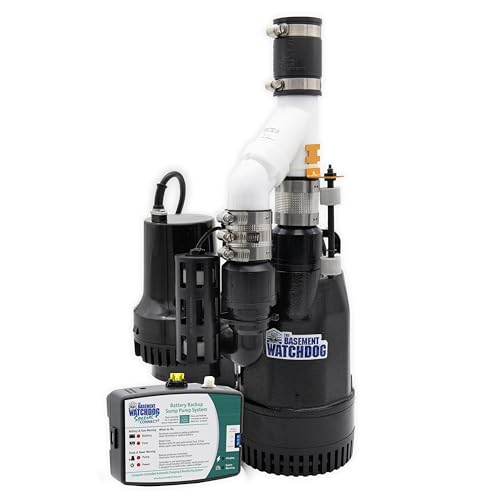
Preassembled 1/2 HP primary plus battery backup combo with dual floats, alarmed controller and optional Wi-Fi alerts.
Check price on Amazon$449.99 as of Oct 20, 2026 7:55 pm GMT+0000 — prices change; see Amazon for current price.Why we like it
- Highest stated backup flow at 10 ft of lift
- Dual float switches on both pumps
- Controller alarms and explains what to fix
- Two batteries can run in parallel
- Wi-Fi text and app alerts with add-on
| Specification | Details |
|---|---|
| System type | Combo: preassembled, preplumbed primary and battery backup |
| Primary pump | 1/2 HP copper-wound PSC motor; 4,400 GPH at 0 ft, 3,540 GPH at 10 ft |
| Backup pump | 2,890 GPH at 0 ft; 2,150 GPH at 10 ft |
| Monitoring | 24-hour monitoring of pump, power and battery; alarm, warning light and on-screen guidance |
| Battery | Works with maintenance-free AGM or wet-cell; two in parallel for double runtime |
| Connectivity | Wi-Fi capable with the separate BW-WiFi2 CONNECT module (text, email, push, app) |
Basement Watchdog CITS-50 — 1/2 HP PSC primary (3540 GPH at 10 ft), backup 2150 GPH at 10 ft, dual floats, alarmed controller, Wi-Fi capable
The Strongest Backup Flow at a Realistic Lift
Four listings on the shelf state backup pump flow at 10 feet of lift, which is a reasonable stand-in for a typical basement discharge. The CITS-50 leads them at 2,150 GPH. The Watchdog Special add-on manages 1,730, Wayne’s ESP25n 1,680 and the smaller CITE-33 combo 1,500. During a long outage the backup pump is doing all of the work, so that number matters more than the primary’s headline flow.
It also has the most layered switch design: dual floats on both the primary and the backup, so a single stuck float does not take out either pump. The controller watches pump, power and battery around the clock and both sounds an alarm and tells you what needs attention. Add Basement Watchdog’s separate CONNECT module and those alerts reach your phone by text, email or app.
The listing does not say a battery is included or give a runtime of its own. Basement Watchdog’s separate AGM battery listing states up to 48 hours of protection on the CITS-50 at a 10 percent duty cycle, meaning the pump runs about 6 minutes per hour. The Wi-Fi module is an extra purchase.
Pros
- 2,150 GPH backup flow at 10 ft
- Dual floats on primary and backup
- Alarmed controller with guidance
- Parallel batteries for long outages
Cons
- Battery not stated as included
- Wi-Fi alerts need a separate module
- Replaces your existing primary pump
Check Basement Watchdog CITS-50 price on Amazon
2. Zoeller 508 ProPak — Best Self-Testing Combo System
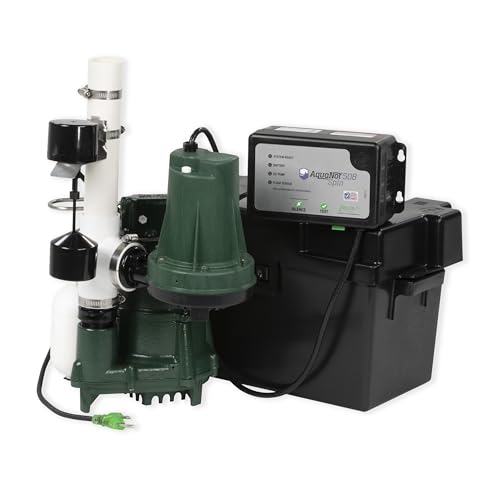
Complete kit with a 1/2 HP M98 cast iron primary, 12 V DC backup, self-testing controller, check valve and PVC piping.
Check price on Amazon$859.00 as of Oct 20, 2026 10:47 pm GMT+0000 — prices change; see Amazon for current price.Why we like it
- Only listing whose controller tests itself
- Cast iron M98 primary included
- Check valve and PVC discharge included
- Alerts for outages, high water and switch faults
| Specification | Details |
|---|---|
| System type | Combo: M98 primary, AquaNot Spin 508 controller and 12 V DC backup |
| Primary pump | Zoeller M98, 1/2 HP cast iron |
| Backup runtime stated | Up to 6 hours continuous, or 48+ hours at a 10 percent duty cycle, on a fully charged battery |
| Monitoring | Continuous self-testing; alerts for power outage, high water, switch obstruction and pump faults |
| Included plumbing | Pre-plumbed 1-1/2 in Schedule 40 PVC, check valve, float switch(es) |
| Backup flow | Not stated in listing |
Zoeller 508-0007 ProPak — M98 1/2 HP primary, 12 V DC backup, self-testing controller, check valve, 6 h continuous backup stated
The Only Controller That Says It Tests the System for You
Most backup controllers here watch for a problem and sound an alarm. The ProPak’s controller is the only one on the shelf described as continually testing its own functionality. Its alerts cover power outages, high water, switch obstructions and pump faults, which is the widest list of named conditions among the 13 listings.
It is also the most complete box. You get Zoeller’s cast iron M98 as the primary, the DC backup, a check valve, float switches and pre-plumbed Schedule 40 PVC. It is also the only listing to state a continuous-run figure, up to 6 hours, alongside the more flattering 48-plus hours at a 10 percent duty cycle. The continuous figure is the one to plan around for a storm that keeps the pit filling steadily.
The gaps: the listing gives no backup flow figure and does not say whether a battery is included or which type it expects.
Pros
- Self-testing controller
- Cast iron primary pump included
- Check valve and piping in the box
- States a continuous-run figure
Cons
- No backup GPH stated
- Battery type and inclusion not stated
- No remote or phone alerts mentioned
Check Zoeller 508 ProPak price on Amazon
3. Wayne WSS30VN — Best Drop-In Combo for Standard Pits

Preassembled 1/2 HP primary and 12 V backup combo for 16 in or larger basins; 75 Ah battery sold separately.
Check price on Amazon$549.99 as of Oct 20, 2026 7:55 pm GMT+0000 — prices change; see Amazon for current price.Why we like it
- Preassembled for a stated 15-minute drop-in
- System tested to 1 million cycles
- Primary rated up to 5,100 GPH
- Three-year warranty, assembled in USA
| Specification | Details |
|---|---|
| System type | Combo: preassembled primary and 12 V battery backup |
| Primary pump | 1/2 HP with integrated vertical float; up to 5,100 GPH |
| Backup capacity stated | Up to 10,000 gallons on one charge with Wayne’s WSB1275 75 Ah battery |
| Battery | Required, not included |
| Fit / install | 16 in diameter or larger basins; no weep hole; 8 ft SJTW cord |
| Weight / warranty | About 44 lb; 3-year warranty |
Wayne WSS30VN — 1/2 HP primary (5100 GPH), 12 V backup, 10,000 gal per charge stated w/ 75 Ah battery, 16 in+ basin, 3-yr warranty
A Stated Gallons-Per-Charge Figure Tied to a Named Battery
Runtime claims on this shelf come in different units: hours at a duty cycle, hours continuous, or vague “days of protection.” The WSS30VN states total gallons, up to 10,000 on a single charge, and ties it to a specific 75 amp-hour Wayne battery. Gallons is the most useful unit, because you can compare it directly to how much water your pit sees in a storm.
For example, a pit that takes in 10 gallons a minute during heavy melt moves about 600 gallons an hour, so 10,000 gallons covers roughly 16 hours at that rate. Slower inflow stretches it much further.
Two caveats. The listing does not give backup pump flow, so you cannot compare its pumping rate against the Watchdog systems. And it needs at least a 16-inch basin, wider than the 12 inches the CITE-33 accepts. The battery is a separate purchase.
Pros
- Gallons-per-charge figure stated
- Fast preassembled install
- System tested to 1 million cycles
Cons
- No backup GPH figure
- Needs a 16 in or wider basin
- Battery required, sold separately
Check Wayne WSS30VN price on Amazon
4. Basement Watchdog Special BWSP — Best Add-On Backup for an Existing Pump

Standalone DC backup with controller, charger, dual float switch and battery box; monitors battery fluid level.
Check price on Amazon$279.00 as of Oct 20, 2026 7:55 pm GMT+0000 — prices change; see Amazon for current price.Why we like it
- Keeps your current primary pump in place
- Only listing that monitors battery fluid level
- Dual float switch on the backup
- Compact enough for narrow pits
| Specification | Details |
|---|---|
| System type | Standalone DC backup pump added beside an existing primary |
| Backup flow | 2,500 GPH at 0 ft; 1,730 GPH at 10 ft |
| Monitoring | Control panel with warning lights and maintenance guidance; battery fluid level sensor |
| Included | Controller, charger, dual float switch, pump and battery box |
| Battery | Sold separately |
| Weight / warranty | About 12 lb; 2-year warranty; Wi-Fi capable with add-on module |
Basement Watchdog Special BWSP — DC backup, 1730 GPH at 10 ft, dual float, fluid-level sensor, battery box, 2-yr warranty
The Only Listing That Watches Battery Fluid Levels
Two listings on the shelf are standalone DC backup pumps meant to sit alongside the primary you already have. Of those two, the BWSP has the higher flow at 10 feet (1,730 versus 1,680 GPH) and the only battery fluid sensor on the whole shelf. That matters if you use a less expensive flooded wet-cell battery, which loses water over time and quietly loses capacity when it runs low.
A small inconsistency is worth flagging: the title says 2,890 GPH while the feature list says 2,500 GPH at zero lift. The 10-foot figure of 1,730 GPH is the one to plan around.
Adding a backup beside your existing pump only works if the pit is wide enough for both pumps and their floats without the floats touching. The listing says the pump is compact enough for small or narrow pits, but it gives no minimum diameter.
Pros
- Works with your existing primary
- Battery fluid level monitoring
- Dual float switch
- Phone alerts possible with module
Cons
- Title and features disagree on max GPH
- Battery sold separately
- No minimum pit size stated
Check Basement Watchdog Special BWSP price on Amazon
5. Wayne ESP25n — Best Budget Standalone Backup

12 V coated steel and cast iron backup pump with reed float and a battery case with LED display and alarm.
Check price on Amazon$299.99 as of Oct 20, 2026 10:47 pm GMT+0000 — prices change; see Amazon for current price.Why we like it
- Flow stated at both 0 and 10 ft
- Reed float switch with few moving parts
- Battery case has LED display and audible alarm
- Coated steel and cast iron build
| Specification | Details |
|---|---|
| System type | Standalone 12 V DC backup pump |
| Backup flow | 2,700 GPH at 0 ft; 1,680 GPH at 10 ft |
| Switch | Reed float switch |
| Alarm | Battery case with LED display and audible alarm |
| Battery | Wayne WSB1275 recommended, not included; up to 10,000 gallons per charge stated |
| Weight / warranty | About 13.5 lb; 2-year limited warranty |
Wayne ESP25n — 12 V DC, 2700/1680 GPH at 0/10 ft, coated steel + cast iron, reed float, LED + audible alarm, 2-yr warranty
The Alarm Lives on the Battery Case
Several systems here put their alarm in a separate wall-mounted controller. The ESP25n builds the LED display and audible alarm into the protective battery case, which keeps the install simple: pump in the pit, battery case on the floor beside it.
Its reed float switch is a sealed magnetic design with fewer exposed moving parts than a mechanical float arm. That suits a backup pump, which may sit unused for months and then has to work on the first try.
The listing describes capacity as “up to 10,000 gallons of water per hour on a single battery charge,” which reads like a mix-up between flow and total volume. Its own stated maximum is 2,700 GPH, so treat 10,000 gallons as the per-charge figure, matching Wayne’s combo listing. The recommended battery is not included.
Pros
- Flow stated at 10 ft of lift
- Alarm and display on battery case
- Sealed reed float switch
Cons
- Capacity wording is confusing
- Battery not included
- No phone alerts mentioned
Check Wayne ESP25n price on Amazon
6. Basement Watchdog CITE-33 — Best Combo for Small Pits

Compact 1/3 HP primary plus battery backup combo with dual floats on both pumps, fitting pits as small as 12 in across.
Check price on Amazon$349.01 as of Oct 20, 2026 7:55 pm GMT+0000 — prices change; see Amazon for current price.Why we like it
- Smallest stated pit size, 12 in diameter
- Dual floats on primary and backup
- Controller with lights and alarms
- Flow stated at 10 ft for both pumps
| Specification | Details |
|---|---|
| System type | Combo: preassembled, preplumbed |
| Primary pump | 1/3 HP copper-wound PSC; 3,720 GPH at 0 ft, 3,100 GPH at 10 ft |
| Backup pump | 2,500 GPH at 0 ft; 1,500 GPH at 10 ft |
| Monitoring | 24/7 controller with lights and alarms |
| Battery | 0.4 A charger; compatible with Basement Watchdog BW-27AGM |
| Fit / weight | Pits as small as 12 in diameter; about 27 lb |
Basement Watchdog CITE-33 — 1/3 HP primary (3100 GPH at 10 ft), backup 1500 GPH at 10 ft, dual floats, alarmed controller, 12 in pits
The Only Combo That Fits a 12 Inch Pit
Older Front Range basements often have small sump crocks, sometimes only 12 to 14 inches across, which rules out most combo systems. The CITE-33 is the only listing that states fit in a pit as small as 12 inches. Wayne’s combo needs 16 inches or more.
The trade is capacity. Its primary is 1/3 HP and its backup moves 1,500 GPH at 10 feet, the lowest backup figure among the four listings that give one. In exchange, the small motor stretches the battery: Basement Watchdog’s AGM battery listing claims up to 80 hours at a 10 percent duty cycle on the CITE-33, versus 48 hours on the larger CITS-50.
The 0.4-amp charger is slow, so a deeply drained battery can take a long time to recover after an outage. The listing does not say whether a battery is included.
Pros
- Fits 12 in pits
- Dual floats on both pumps
- Long runtime from a small motor
Cons
- Lowest backup flow of the four with 10 ft data
- Slow 0.4 A charger
- Battery inclusion not stated
Check Basement Watchdog CITE-33 price on Amazon
7. VEVOR 1500W Inverter — Best Way to Run Your Existing Pump on Battery

1500 W pure sine inverter for sump pumps up to 3/4 HP, with LCD and three-stage charging; battery not included.
Check price on Amazon$124.38 as of Oct 20, 2026 10:47 pm GMT+0000 — prices change; see Amazon for current price.Why we like it
- Runs your existing AC pump during outages
- States a pump size limit: up to 3/4 HP
- Charges lead-acid, AGM, gel or LiFePO4
- Three-prong plug, no hardwiring
| Specification | Details |
|---|---|
| System type | Battery inverter (UPS) that powers an existing AC sump pump |
| Output | 1,500 W pure sine wave; AC outlet and USB port |
| Pump size stated | Built for sump pumps of 3/4 HP or less |
| Charging | Three-stage (bulk, absorption, float); 12 V lead-acid, AGM, gel or LiFePO4 |
| Protection / display | Overcurrent, overvoltage, short circuit, reverse polarity and high-temperature protection; circuit breaker; LCD and LEDs |
| Battery / efficiency | Battery not included; 85 percent or better at full load stated |
VEVOR SGPC-1500W — 1500 W pure sine inverter, pumps up to 3/4 HP, 3-stage charger, AGM/gel/LiFePO4, battery not included
The Only Inverter Listing That States Which Pumps It Can Run
Five of the 13 listings are inverter backups rather than pumps. They keep your existing primary pump running from a 12-volt battery, so the full-power pump keeps working in an outage instead of a smaller DC backup. Of those five, the VEVOR is the only one that states a maximum pump size, 3/4 HP. That is the key compatibility question, because a pump’s startup surge can trip an undersized inverter.
It also lists lithium iron phosphate (LiFePO4) among compatible batteries, along with lead-acid, AGM and gel. LiFePO4 batteries are lighter and handle deep discharges better, at a higher price.
The big limitation is the one every inverter shares: it does nothing if the primary pump itself fails. An inverter protects against outages, not against a stuck switch or a burned-out motor. It also sounds no high-water alarm, so pair it with a separate pit alarm.
Pros
- Keeps your full-size pump running
- States a 3/4 HP pump limit
- LiFePO4-compatible charging
Cons
- No protection if the primary pump fails
- No high-water alarm
- Battery not included
Check VEVOR 1500W inverter price on Amazon
Combo, standalone or inverter: which backup type fits your home
The 13 listings on this shelf split into five combo systems, two standalone DC backup pumps, five inverter units and one battery. Each type solves a different problem.
- Combo systems replace your primary with a matched primary and backup on one preplumbed assembly. They are the cleanest choice when your primary pump is old anyway, and they usually share one controller and alarm.
- Standalone DC backups add a second pump beside your existing primary, with its own float and check valve. They protect against both outages and primary pump failure, but need a pit wide enough for two pumps.
- Inverter backups keep your existing primary running from a battery. They move more water during an outage than a small DC pump, but offer no protection if the primary itself fails.
For most basements, a second pump in the pit, whether from a combo or a standalone backup, is the stronger protection, because it covers both failure modes. Our guide to sump pump battery backups covers wiring and plumbing for each type.
Runtime, batteries and duty cycle
Read runtime claims carefully
Runtime figures on this shelf use different units. “48 hours at a 10 percent duty cycle” means the pump runs about 6 minutes per hour, which fits a pit with light inflow. Zoeller’s “6 hours continuous” is the worst case. Gallons per charge, as Wayne states, is easiest to compare with your pit’s real inflow.
Battery types
- Flooded wet-cell deep-cycle batteries are the least expensive but need periodic distilled water and vent small amounts of gas while charging. A fluid-level sensor, as on the Watchdog BWSP, helps.
- AGM batteries are sealed and maintenance-free. Basement Watchdog’s own AGM battery listing quotes runtimes of 40 to 80 hours at a 10 percent duty cycle depending on the system.
- LiFePO4 lithium batteries are lighter and tolerate deep discharges, but only some chargers support them. Four of the five inverter listings name lithium or LiFePO4 compatibility.
Use a true deep-cycle battery, not a car starting battery, and replace it on the manufacturer’s schedule. Keep it off the bare floor in a battery box, and test the backup by unplugging the primary and filling the pit a few times a year.
Why the alarm matters most
A backup pump buys time; an alarm tells you to use it. The CITS-50, CITE-33 and ESP25n listings name audible alarms, and the ProPak controller sends alerts. Wi-Fi alerts matter if you travel, since a pit can fill and a battery drain while no one is home to hear a beep. See our guide to sump pump alarms for standalone options.
Outage safety: generators and battery systems
A battery backup is the safe way to keep a sump pump running in an outage. Generators are the risky way. The CPSC warns never to use a portable generator inside a home, garage, basement or crawl space, even with doors or windows open, and to run it outdoors at least 20 feet from the house with exhaust directed away from windows, doors and vents. The CDC adds that anyone running a generator should have a battery-powered or battery-backup CO detector in the home. Do not run a generator in the basement to power the sump pump.
Wiring matters too. An inverter that hardwires into a circuit, as some listings on this shelf describe, should be installed by an electrician. Simple plug-in units like the VEVOR avoid that step.
Front Range notes: spring storms, outages and radon
Along the Front Range, the riskiest window for a basement is spring, when heavy wet snow and April-to-June storms can bring down power lines just as melt saturates the soil. High-wind days can also mean outages. That timing is exactly why a backup matters here even in a semi-arid climate. The EPA notes that drying water-damaged areas within 24 to 48 hours usually prevents mold, so even a few hours of standing water in a finished basement is costly.
Radon adds a Colorado-specific requirement. Many Front Range homes route radon mitigation through the sump pit, and the CDC notes that sealing openings makes mitigation systems more effective. A combo system or second pump means more pipes and cords through the lid, and every pass-through has to be sealed. Our guide to radon mitigation with a sump pump explains how the two systems share a pit, and our radon sump cover guide covers airtight lids.
When to call a professional
Call a plumber or waterproofing contractor if your pit is too narrow for a second pump, if you need a separate discharge line for the backup, or if the primary runs often in dry weather. If the pit is part of a radon system, have a certified mitigator reseal the lid after installation and retest radon afterward. Our sump pump installation guide lists the steps either way.
A home inspection is a good time to check backup systems: battery age, charger status, alarm function and check valves on both pumps. For moisture and foundation context, visit our crawl space and basement hub. If you are in the Denver metro or along the Front Range and want a qualified inspector to look at your basement and sump system, reach out through our contact page.
Frequently asked questions
What is the best type of battery backup sump pump?
For most homes, a second pump in the pit is the strongest protection, either from a combo system or a standalone DC backup. It covers both power outages and primary pump failure. Inverter units keep your existing pump running in an outage but do nothing if that pump fails.
How long will a battery backup sump pump run?
It depends on battery size and how often the pump runs. Listings here quote up to 6 hours of continuous pumping, up to 10,000 gallons per charge, or 40 to 80 hours at a 10 percent duty cycle. Size the battery for your pit's inflow during a heavy storm, not an average day.
What battery should I use for a sump pump backup?
Use a deep-cycle battery the manufacturer approves, never a car starting battery. AGM batteries are sealed and maintenance-free; flooded wet-cell batteries cost less but need water checks; LiFePO4 lithium is lighter but needs a compatible charger. Replace the battery on the maker's schedule and test the system a few times a year.
Can I run my sump pump on a generator during an outage?
Only with the generator outdoors. The CPSC says never to run a portable generator in a home, basement, garage or crawl space, and to keep it at least 20 feet from the house with exhaust pointed away. A battery backup avoids carbon monoxide risk entirely.
Does a battery backup sump pump work with radon mitigation?
Yes, but the pit lid must stay airtight. A backup adds a pipe and cord through the lid, and each pass-through needs sealing. The CDC notes that sealing openings makes radon systems more effective, so have the lid resealed and retest radon after installation.
References
- CPSC Warns of Generator, Carbon Monoxide and Fire Hazards — U.S. Consumer Product Safety Commission
- Carbon Monoxide Poisoning Basics — Centers for Disease Control and Prevention
- A Brief Guide to Mold, Moisture and Your Home — U.S. Environmental Protection Agency
- Reducing Radon Levels in Your Home — Centers for Disease Control and Prevention