Best Sump Pumps (2026): 5 Picks Compared by HP and Switch
The best sump pump for your basement is not the biggest one on the shelf. It is the one sized to how fast water enters your pit, how high it has to lift that water and how reliably its switch turns on. That means comparing horsepower against real flow at height, choosing a float switch that fits your pit, and deciding whether a cast iron or thermoplastic body makes sense. Along the Front Range, sump pumps mostly earn their keep during spring snowmelt and late-spring storms, and in many homes the same pit is part of a radon mitigation system. Below are five picks, each matched to a job, then a buying guide on pump types, sizing, switches and installation.
Part of our Crawl Space & Attic Guide guide — start there for the full picture →
As an Amazon Associate we earn from qualifying purchases.
How we compared: we compared 14 current Amazon listings returned for sump pumps on what each listing states: horsepower, gallons per hour, flow at a stated lift height, housing materials, switch type, discharge size and warranty. Seven of the 14 turned out to be portable utility or transfer pumps with no automatic float, so the picks come from the seven automatic pit pumps. We did not lab-test or install any of them, and we did no hands-on handling. Prices and availability change often, so check the current listing before buying.
Quick picks: the best sump pumps by job
| Product | Best for | Key features | Price | Buy |
|---|---|---|---|---|
| Wayne CDU800 | Most basements |
| $197.99as of Oct 20, 2026 5:55 pm GMT+0000 | Buy now →Check current price |
| Zoeller M53 Mighty-mate | Proven 1/3 HP cast iron pump |
| $213.08as of Oct 20, 2026 5:55 pm GMT+0000 | Buy now →Check current price |
| Wayne CDU1000 | Heavy inflow and high water tables |
| $254.99as of Oct 20, 2026 7:27 pm GMT+0000 | Buy now →Check current price |
| Wayne SPF50 | Budget pick with honest flow data |
| $163.98as of Oct 21, 2026 12:00 am GMT+0000 | Buy now →Check current price |
| Wayne CDU790 | Light inflow and small pits |
| $137.08as of Oct 21, 2026 12:00 am GMT+0000 | Buy now →Check current price |
Prices are Amazon’s listed prices as of the time shown and change often; check Amazon for today’s price. As an Amazon Associate we earn from qualifying purchases.
The five picks, compared listing by listing
1. Wayne CDU800 — Best Sump Pump for Most Basements

1/2 HP cast iron and steel submersible sump pump with a vertical float tested to 1 million cycles and a 3-year warranty.
Check price on Amazon$197.99 as of Oct 20, 2026 5:55 pm GMT+0000 — prices change; see Amazon for current price.Why we like it
- 1/2 HP suits typical residential inflow
- Float switch tested to 1 million cycles
- Top suction resists clogging and air lock
- Code-standard 1-1/2 in NPT discharge
| Specification | Details |
|---|---|
| Motor | 1/2 HP |
| Flow stated | Up to 5,100 GPH (lift height for that figure not stated) |
| Housing | Cast iron with corrosion-resistant steel |
| Switch | Integrated vertical float, tested to 1 million cycles |
| Discharge / design | 1-1/2 in NPT; top suction, no weep hole needed |
| Weight / warranty | About 12 lb; 3-year warranty; assembled in USA |
Wayne CDU800 — 1/2 HP, 5100 GPH max, cast iron/steel, vertical float (1M cycles), top suction, 1-1/2 in NPT, 3-yr warranty
The Middle of the Range, With a Switch Spec Most Listings Skip
Of the seven automatic pit pumps on the shelf, two are 1/3 HP, three are 1/2 HP, one is 3/4 HP and one is 1 HP. A 1/2 HP pump is where most basements land: enough capacity for a wet spring without the short-cycling a larger pump can cause in a pit that only sees a modest trickle. Among the three 1/2 HP pumps, the CDU800 pairs cast iron construction with the highest stated maximum flow, 5,100 GPH.
It is also one of only two listings that put a number on switch life: the vertical float is described as tested to 1 million cycles. Switches are the most common failure point on a sump pump, so a stated test figure is more useful than “reliable” or “heavy duty.” The top-suction design draws water from above the pit floor, which keeps sediment out and removes the need to drill a weep hole.
The main gap is lift data. The 5,100 GPH figure is a maximum without a stated lift height, so it will be noticeably lower once the pump is pushing water up 8 to 10 feet to a basement rim joist. The listing also does not state the turn-on and turn-off water levels.
Pros
- Right-sized 1/2 HP for most homes
- Switch tested to a stated cycle count
- Cast iron and steel construction
- No weep hole needed
Cons
- No flow figure at a stated lift
- Switch on/off levels not stated
- 3-year warranty, shorter than the CDU1000
Check Wayne CDU800 price on Amazon
2. Zoeller M53 Mighty-mate — Best Proven 1/3 HP Cast Iron Pump
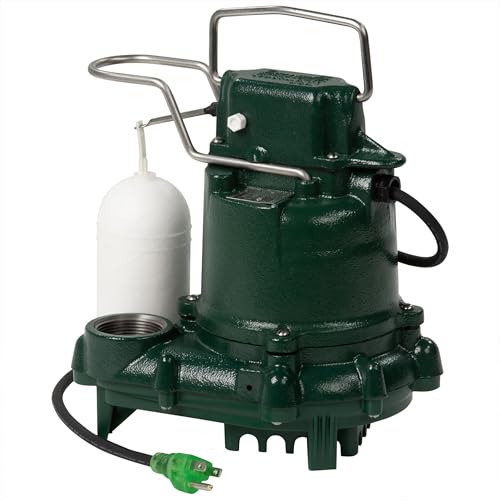
1/3 HP float-operated submersible sump pump with a cast iron motor, pump housing and switch case and a vortex impeller.
Check price on Amazon$213.08 as of Oct 20, 2026 5:55 pm GMT+0000 — prices change; see Amazon for current price.Why we like it
- Cast iron motor, pump housing and switch case
- Non-clogging vortex impeller passes debris
- Compact footprint, about 7.75 in wide
- Heaviest 1/3 HP pump listed, at 21 lb
| Specification | Details |
|---|---|
| Motor | 1/3 HP |
| Flow stated | Not stated in listing |
| Housing | Cast iron switch case, motor and pump housing; plastic base |
| Switch | Automatic, float-activated |
| Impeller | Non-clogging vortex design |
| Size / weight / warranty | About 10.25 x 10.25 x 7.75 in; 21 lb; warranty not stated in listing |
Zoeller M53 Mighty-mate (53-0001) — 1/3 HP, cast iron motor/housing/switch case, float switch, vortex impeller, 21 lb
The Only Pick With a Cast Iron Switch Case
Several pumps on this shelf use cast iron for the volute, the part around the impeller. The M53 is the only listing that says the switch case is cast iron too, along with the motor and pump housing. Metal around the motor helps carry heat away into the surrounding water, and a metal switch housing is less likely to crack than a plastic one after years in a pit.
It is the heavier of the two 1/3 HP pumps: 21 pounds versus 16.4 for the Wayne CDU790. That extra mass reflects more cast iron, and it keeps the pump sitting still on the pit floor when it kicks on.
The listing is thin, though. It states no GPH figure, no lift performance, no discharge size and no warranty term, and it describes the switch only as “float activated” without saying what type. Check the manufacturer’s spec sheet for the pumping curve before deciding whether 1/3 HP covers your lift.
Pros
- Cast iron switch case, motor and housing
- Vortex impeller handles debris
- Compact enough for smaller pits
Cons
- No GPH or lift data in listing
- Switch type not specified
- Warranty term not stated
Check Zoeller M53 Mighty-mate price on Amazon
3. Wayne CDU1000 — Best for Heavy Inflow and High Water Tables
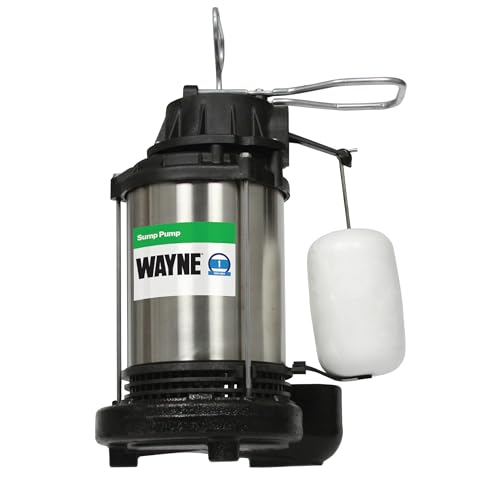
1 HP sump pump with stainless motor housing, cast iron volute, vertical float, 6100 GPH max and 5-year warranty.
Check price on Amazon$254.99 as of Oct 20, 2026 7:27 pm GMT+0000 — prices change; see Amazon for current price.Why we like it
- Highest horsepower and stated GPH on the shelf
- Stainless motor housing, cast iron volute
- Space-saving float fits narrow pits
- Five-year warranty, tied for longest
| Specification | Details |
|---|---|
| Motor | 1 HP |
| Flow stated | Up to 6,100 GPH (lift height not stated) |
| Housing | Stainless steel motor housing; cast iron volute |
| Switch | Integrated vertical float |
| Discharge / design | 1-1/2 in NPT; top suction, no weep hole |
| Weight / warranty | About 19 lb; 5-year warranty; assembled in USA |
Wayne CDU1000 — 1 HP, 6100 GPH max, stainless motor housing, cast iron volute, vertical float, 1-1/2 in NPT, 5-yr warranty
The Most Capacity Among the Automatic Pit Pumps
At 1 HP and 6,100 GPH maximum, the CDU1000 tops the seven automatic pumps on both horsepower and stated flow. It also shares the longest warranty term on the shelf, five years, with Wayne’s 3/4 HP CDU980E. That pairing makes it the pick for basements that see water most of the spring, homes near a high groundwater table, or pits that also collect a long run of foundation drain tile.
Bigger is not automatically better. A 1 HP pump in a small pit with light inflow empties the pit in seconds and then restarts minutes later, and that short-cycling wears the switch and motor. If your pit takes longer than a few minutes to fill during a storm, a 1/2 HP pump is usually enough.
The listing does not give flow at a stated lift height, amperage or the switch’s on/off levels, which matter when matching a 1 HP pump to a backup system or a dedicated circuit.
Pros
- Highest HP and GPH listed
- Stainless and cast iron construction
- Five-year warranty
Cons
- Can short-cycle in a small, slow pit
- No lift-height flow or amperage stated
- Overkill for most dry-climate basements
Check Wayne CDU1000 price on Amazon
4. Wayne SPF50 — Best Budget Pick With Honest Flow Data

1/2 HP coated steel and thermoplastic sump pump that states flow at both 0 ft and 10 ft of lift, with a vertical float.
Check price on Amazon$163.98 as of Oct 21, 2026 12:00 am GMT+0000 — prices change; see Amazon for current price.Why we like it
- Only pit pump listing flow at 10 ft of lift
- Vertical float for narrow pits
- Top suction, no weep hole
- Lighter coated steel and thermoplastic body
| Specification | Details |
|---|---|
| Motor | 1/2 HP |
| Flow stated | 4,300 GPH (72 GPM) at 0 ft; 3,360 GPH (56 GPM) at 10 ft |
| Housing | Corrosion-resistant coated steel and thermoplastic |
| Switch | Vertical float |
| Discharge / design | 1-1/2 in NPT; top suction; indoor use only |
| Weight / warranty | About 14 lb; 1-year limited warranty |
Wayne SPF50 — 1/2 HP, 4300 GPH at 0 ft / 3360 GPH at 10 ft, coated steel + thermoplastic, vertical float, 1-yr warranty
The Only Pit Pump That Tells You Flow at a Real Lift
Every other automatic pump here quotes a single maximum GPH. The SPF50 is the only one of the seven that also states flow at 10 feet of lift, and it explains why: zero feet of head is the best-case number, while 10 feet is closer to what a basement pump actually faces. Its own figures show a drop of about 22 percent, from 4,300 to 3,360 GPH.
That is the most useful number on this shelf, because it lets you sanity-check the others. If a cast iron 1/2 HP pump loses a similar share at height, its real-world flow will also land well below its headline figure.
The cost of the lower price is construction and warranty. The body is coated steel and thermoplastic rather than cast iron, and the 1-year warranty is about as short as any stated among the pit pumps (Zoeller lists 12 months from installation on the M98). For a basement that runs the pump a few times a year, that is a fair trade; for a pit that runs daily in spring, a cast iron model will likely outlast it.
Pros
- States flow at 0 and 10 ft of lift
- Vertical float and top suction
- Lighter to handle during install
Cons
- Thermoplastic, not cast iron
- Only a 1-year warranty
- Switch cycle rating not stated
Check Wayne SPF50 price on Amazon
5. Wayne CDU790 — Best for Light Inflow and Small Pits

1/3 HP pump with cast iron volute, epoxy-coated housing and a vertical float tested to 1 million cycles.
Check price on Amazon$137.08 as of Oct 21, 2026 12:00 am GMT+0000 — prices change; see Amazon for current price.Why we like it
- Float switch tested to 1 million cycles
- Cast iron volute, stainless fasteners
- Listed install time of about 15 minutes
- Three-year limited warranty
| Specification | Details |
|---|---|
| Motor | 1/3 HP |
| Flow stated | Up to 4,600 GPH (lift height not stated) |
| Housing | Epoxy-coated steel motor housing; cast iron volute; stainless fasteners |
| Switch | Integrated vertical float, tested to 1 million cycles |
| Design | Top suction; no weep hole; indoor use only |
| Weight / warranty | About 16.4 lb; 3-year limited warranty; assembled in USA |
Wayne CDU790 — 1/3 HP, 4600 GPH max, epoxy-coated steel + cast iron volute, vertical float (1M cycles), 3-yr warranty
The Only 1/3 HP Pump With a Stated Switch Test
Two 1/3 HP pumps made the list. The CDU790 is the one with a documented switch: the same 1-million-cycle vertical float as the CDU800, plus a stated maximum flow of 4,600 GPH. The Zoeller M53 states neither. For a basement where the pump runs only during spring melt, 1/3 HP with a well-specified switch is often all that is needed.
Its housing is a mix: epoxy-coated steel around the motor and cast iron around the impeller. That is sturdier than an all-thermoplastic body but not quite the all-cast-iron build of the M53. Stainless fasteners help when the pump has to be pulled for service years later.
As with most listings here, the flow figure has no stated lift height, and a 1/3 HP pump loses capacity quickly as lift increases. If your discharge rises more than about 10 feet, compare manufacturer curves before choosing 1/3 HP.
Pros
- Documented 1M-cycle float switch
- Cast iron volute, stainless fasteners
- Quick drop-in installation
Cons
- 1/3 HP limits high-lift performance
- No lift-height flow stated
- Steel motor housing relies on its coating
Check Wayne CDU790 price on Amazon
Pedestal vs submersible: which type do you need?
All seven automatic pumps on this shelf are submersible, which reflects the market: submersible pumps sit at the bottom of the pit, underwater, and are now the standard for finished and unfinished basements. They are quieter because the water muffles the motor, they allow a sealed lid over the pit, and they cool themselves in the water they pump.
Pedestal pumps keep the motor on a column above the pit, with only the intake down in the water. They are easier to service, often last a long time because the motor stays dry, and fit narrow or shallow pits where a submersible will not. The downsides are noise, an exposed motor and a pit that is harder to seal. In homes with radon mitigation, a sealed lid is part of the system, which makes a submersible the practical choice. Our submersible sump pump guide goes deeper on the trade-offs.
Be careful with search results, too. Half of the 14 listings here are portable utility pumps meant for draining a hot tub or a flooded window well. Several are labeled “sump pump,” but most run only while plugged in and have no float switch to turn themselves on. They are handy to keep on a shelf for emergencies but are not a substitute for an automatic pit pump.
Sizing: horsepower, GPH and lift
Start with your inflow
The best sizing test is simple. During a heavy rain or snowmelt, time how long the pit takes to fill from the pump’s shutoff level to its turn-on level, and measure that volume. A pit that fills in a few minutes needs more capacity than one that takes half an hour. Most basements in dry climates are well served by 1/3 to 1/2 HP; 3/4 to 1 HP is for high water tables, large drain-tile systems or long, high discharge runs.
Then check flow at height
Total lift is the vertical distance from the pump to the highest point of the discharge pipe, plus an allowance for pipe length and fittings. Listings usually quote maximum GPH at zero lift. The Wayne SPF50’s stated drop of about 22 percent between 0 and 10 feet is a reasonable reminder that real flow at height is much lower than the headline. Ask for the manufacturer’s pump curve if your lift exceeds 10 feet.
Avoid oversizing
An oversized pump in a small pit short-cycles, starting and stopping many times an hour, which wears the switch and motor faster. If you upgrade horsepower, consider whether the pit itself is large enough to give the pump a reasonable run time.
Switch types: vertical, tethered and mechanical floats
The switch is the part most likely to fail, and the type you choose depends on your pit.
- Vertical float switches ride up and down on a rod beside the pump. They suit narrow pits because they need little side clearance. Five of the seven pit pumps here, all Wayne, use one.
- Tethered floats hang on a cord and swing upward as water rises. They need a wider pit, at least 18 inches across in most cases, and can catch on the pit wall or a discharge pipe if crowded.
- Mechanical float arms and snap-action switches use a hinged float on a rigid arm. They are common on cast iron pumps and are usually protected by a float guard.
- Electronic switches use sensors with no moving float. None appear on this shelf, but they are worth knowing about for pits with debris problems.
Whatever the type, test it every few months by pouring a bucket of water into the pit. Our sump pump float switch guide explains how to diagnose a stuck or failed switch.
Installation details that make or break a sump pump
A good pump in a bad install still floods a basement. The parts that matter most:
- Check valve. Without one, water in the discharge pipe falls back into the pit each cycle, forcing the pump to move the same water again. See our check valve guide.
- Discharge routing. The EPA’s mold guidance recommends making sure the ground slopes away from the foundation so water does not collect around it. Send sump discharge well away from the house, not onto a driveway or into a neighbor’s yard, and check local rules; many utilities prohibit connecting sump discharge to the sanitary sewer. Our discharge line guide covers freeze protection.
- Power. Plug the pump directly into a grounded outlet. The USFA advises plugging major appliances directly into a wall outlet and never running them on an extension cord, and a sump pump deserves the same treatment.
- Backup and alarm. A primary pump does nothing during an outage. A high-water alarm and a battery backup cover the two most common failure modes; see our guide to sump pump battery backups.
Front Range notes: snowmelt, clay soils and radon
Most Front Range basements are dry for much of the year. The pump earns its keep in spring, when snowmelt and April-to-June storms saturate the soil around foundations. Expansive clay soils common in parts of Douglas, Arapahoe and Jefferson counties swell when wet, which is one more reason to keep water away from the foundation. The EPA notes that drying water-damaged areas within 24 to 48 hours usually prevents mold growth, so a pump that fails quietly during a storm can mean a much bigger cleanup.
Winter brings a different problem: discharge lines that freeze solid. A frozen line can force the pump to run against a blockage until it overheats. Use a discharge setup that drains back after each cycle, and check it during cold snaps.
Radon is the Colorado-specific issue. Sump pits open directly to the soil beneath the slab, and the CDC notes that radon enters homes through cracks and openings and that sealing them makes a mitigation system work better. In a home with active radon mitigation, the pit needs an airtight lid with sealed pass-throughs for the discharge pipe and cord. Replace a pump in a way that restores that seal. Our guides to radon sump pump covers explain what an airtight lid involves.
When to call a professional
Call a plumber or waterproofing contractor if the pit is undersized for the inflow, if the pump runs constantly in dry weather, if water enters the basement somewhere other than the pit, or if you need a new discharge line through the rim joist. If the pit is part of a radon system, involve a certified radon mitigator so the lid and any suction point are resealed correctly, then retest radon afterward.
A home inspection is a good time to check the sump system. Inspectors look at pump age, switch operation, check valves, discharge routing and whether the lid is sealed. For broader foundation and moisture context, see our crawl space and basement moisture hub. If you are buying in the Denver metro or anywhere along the Front Range and want a qualified inspector to look at the basement, connect with us here.
Frequently asked questions
What size sump pump do most homes need?
Most basements do well with a 1/3 or 1/2 HP pump. Choose 3/4 to 1 HP only if your pit fills in a few minutes during storms, you have a high water table or the discharge lifts well over 10 feet. An oversized pump in a small pit short-cycles and wears out faster.
Is a cast iron sump pump better than thermoplastic?
Cast iron is heavier, sheds motor heat into the water and generally lasts longer under frequent use. Thermoplastic pumps are lighter and cheaper and suit basements that run the pump only a few times a year. On this shelf, the cast iron Wayne models carry 3 to 5 year warranties; the thermoplastic SPF50 carries 1 year.
Should I get a pedestal or submersible sump pump?
Submersible pumps are quieter, allow a sealed pit lid and are the standard choice today, especially in homes with radon mitigation. Pedestal pumps keep the motor above water, are easy to service and fit narrow pits, but are louder and harder to seal.
How long do sump pumps last?
Life depends on how often the pump runs, water quality and switch type. The switch usually fails first. Test the pump every few months by filling the pit with a bucket of water, and replace a pump that hums without pumping, cycles constantly or runs with no water coming in.
Does a sump pump pit need a sealed lid for radon?
In a home with radon mitigation, yes. The pit is an opening to the soil, and the CDC notes that sealing openings makes mitigation systems more effective. Use an airtight lid with sealed pass-throughs for the pipe and cord, and retest radon after any pump replacement.
References
- A Brief Guide to Mold, Moisture and Your Home — U.S. Environmental Protection Agency
- Reducing Radon Levels in Your Home — Centers for Disease Control and Prevention
- Electrical and Appliance Fire Safety — U.S. Fire Administration