Best Home Battery Backup (2026): Power Stations and UPS Units

The best home battery backup for most households is not a wall-mounted battery wired into the main panel. It is a plug-in power station big enough to keep the refrigerator, internet, a few lights and a furnace blower running through an outage, or a computer-grade UPS that rides through the flickers that crash a home office. Installed whole-home batteries exist, but they are a solar-contractor project, and none appears on this shelf. What does appear is a useful spread: large LiFePO4 power stations that switch over in milliseconds, one designed to hide behind the fridge, and the classic tower UPS. These picks separate those jobs and explain what each can and cannot carry during a Front Range outage.
Part of our Home Electrical guide — start there for the full picture →
As an Amazon Associate we earn from qualifying purchases.
How we compared: we compared 18 current Amazon listings returned for home battery backup on what each listing states: capacity, continuous and surge output, battery chemistry, switchover time, expansion options, standby draw, outlets, weight and warranty. Eight are portable power stations, eight are computer-style UPS units and two are books, which we set aside. No installed whole-home battery systems appeared. We did not lab-test or measure any of these units. Prices and availability change often, so check the current listing before buying.
Quick picks: the best home battery backup by job
| Product | Best for | Key features | Price | Buy |
|---|---|---|---|---|
| Jackery HomePower 3600 Plus | Best overall home essentials |
| $1,709.00as of Oct 21, 2026 2:02 am GMT+0000 | Buy now →Check current price |
| EcoFlow Delta 3 Ultra | Large UPS-style backup |
| $1,349.00as of Oct 20, 2026 5:28 pm GMT+0000 | Buy now →Check current price |
| Anker SOLIX S2000 | Longest stated battery life |
| $699.99as of Oct 21, 2026 2:02 am GMT+0000 | Buy now →Check current price |
| BLUETTI FridgePower | Dedicated refrigerator backup |
| $898.97as of Oct 21, 2026 2:02 am GMT+0000 | Buy now →Check current price |
| Anker SOLIX C2000 Gen 2 | Fastest recharge |
| $899.98as of Oct 21, 2026 2:02 am GMT+0000 | Buy now →Check current price |
| CyberPower CP1500PFCLCD | Computers and networking |
| $239.95as of Oct 21, 2026 2:02 am GMT+0000 | Buy now →Check current price |
| APC BX1500M | UPS with replaceable battery |
| $189.99as of Oct 21, 2026 2:02 am GMT+0000 | Buy now →Check current price |
Prices are Amazon’s listed prices as of the time shown and change often; check Amazon for today’s price. As an Amazon Associate we earn from qualifying purchases.
The seven picks, compared listing by listing
1. Jackery HomePower 3600 Plus — Best Overall Home Battery Backup

3,584 Wh LFP power station with 3,600 W output, expansion to 21 kWh, 240 V in parallel and Jackery MTS pairing.
Check price on Amazon$1,709.00 as of Oct 21, 2026 2:02 am GMT+0000 — prices change; see Amazon for current price.Why we like it
- Largest base capacity among our picks
- Expands to 21 kWh per unit
- Pairs with a transfer switch for house circuits
- Stated cold operation down to minus 4°F
| Specification | Details |
|---|---|
| Capacity / chemistry | 3,584 Wh LFP; expandable to 21 kWh per unit, 43 kWh with multiple units |
| Output | 3,600 W; 7,200 W and 120/240 V when two units run in parallel |
| Battery life | 6,000 cycles, 10-year lifespan stated |
| Charging | 0 to 100% in 2 h hybrid AC plus DC; 2.5 h AC; 4 h solar; gas generator input |
| Home connection | Plug-and-play with Jackery MTS |
| Model / warranty | JHP-3600A; 77.16 lb, wheeled; 5-year manufacturer warranty |
Jackery HomePower 3600 Plus — 3,584 Wh LFP, 3,600 W, expandable 21 kWh, MTS-ready, -4°F rated, 77 lb, 5-yr
The Pick That Comes Closest to an Installed Home Battery
Four of the eight power stations describe expansion batteries, but the two HomePower 3600 Plus listings (with and without panels) are the only ones that also describe a transfer switch connection, through Jackery’s MTS. That combination makes it the nearest thing on the shelf to an installed home battery: start at 3.6 kWh, add packs toward 21 kWh, and feed selected circuits such as the furnace, refrigerator and well pump through a switch instead of extension cords.
It is also the only model that states cold-weather operation, claiming reliable use at minus 4°F. That matters in the Front Range, where outages often coincide with arctic air and the unit may live in an attached garage. Jackery also describes ceramic membrane cells tested at 302°F to resist thermal runaway.
The listing does not describe UPS switchover, so it starts working when you switch it on or when the transfer switch moves the load, not invisibly in milliseconds. The MTS is sold separately and needs an electrician. At 77 lb, it rolls on wheels rather than carrying.
Pros
- Large, expandable capacity
- Transfer switch integration
- Stated cold-weather operation
- 5-year warranty
Cons
- No UPS switchover described
- 240 V only with two units
- 77 lb
Check Jackery HomePower 3600 Plus price on Amazon
2. EcoFlow Delta 3 Ultra — Best Large UPS-Style Backup

3,072 Wh LFP power station with 3,600 W output, 7,200 W surge, under 10 ms switchover and 25 dB under load.
Check price on Amazon$1,349.00 as of Oct 20, 2026 5:28 pm GMT+0000 — prices change; see Amazon for current price.Why we like it
- Largest capacity with sub-10 ms switchover
- 3,600 W runs heaters, microwaves and tools
- Quietest stated noise level, 25 dB
- 5-year manufacturer warranty
| Specification | Details |
|---|---|
| Capacity / chemistry | 3,072 Wh; LiFePO4, built for 10 years of daily use |
| Output | 3,600 W continuous, 7,200 W surge |
| Switchover | Automatic, under 10 ms |
| Noise | 25 dB under load stated |
| Charging | Wall, solar, car or EcoFlow Smart Generator |
| Model / warranty | EF-DL-H01-3U; 72.1 lb; 5-year manufacturer warranty |
EcoFlow Delta 3 Ultra — 3,072 Wh LFP, 3,600 W / 7,200 W surge, under 10 ms UPS, 25 dB, 72.1 lb, 5-yr
The Biggest Battery That Switches Over Without You Noticing
Four of the eight power stations describe UPS-style switching: the Anker S2000, both BLUETTI models and this EcoFlow. The Delta 3 Ultra is the largest of the four at 3,072 Wh, which means it can sit plugged into the wall with a refrigerator, router and sump pump controller connected, and keep them running when the grid drops without a reset.
The 3,600 W output and 7,200 W surge also cover heavier loads than most power stations, from a microwave to a portable electric heater for a short time. Electric heat empties a battery quickly, so treat that as a short-term comfort measure, not a furnace replacement.
The listing does not mention expansion batteries or 240 V output, and it does not state a cycle count. EcoFlow’s 25 dB figure is the only noise level stated for a power station on the shelf.
Pros
- Sub-10 ms switchover at 3 kWh
- High continuous and surge output
- Very quiet stated operation
Cons
- No expansion described
- No 240 V output
- Cycle count not stated
Check EcoFlow Delta 3 Ultra price on Amazon
3. Anker SOLIX S2000 — Best for Long Battery Life and Efficiency

2,010 Wh LFP power station with 1,500 W output, 6 W idle draw, 10,000 cycles stated and under 10 ms UPS.
Check price on Amazon$699.99 as of Oct 21, 2026 2:02 am GMT+0000 — prices change; see Amazon for current price.Why we like it
- 10,000 cycles and 15-year life stated
- 6 W idle draw stretches runtime
- Under 10 ms UPS for home office gear
- 35.7 lb, smallest 2 kWh unit per listing
| Specification | Details |
|---|---|
| Capacity / chemistry | 2,010 Wh; 314Ah LFP cells; 10,000 cycles, 15-year lifespan stated |
| Output | 1,500 W continuous, 3,000 W peak |
| Efficiency | 6 W idle draw; up to 35 hours of fridge backup stated |
| Switchover / outlets | Under 10 ms UPS; 8 outlets front and rear; no 12 V DC port |
| Charging | Up to 400 W solar; AC, generator, alternator or car |
| Model / warranty | AS220; 35.7 lb; 5-year warranty |
Anker SOLIX S2000 — 2,010 Wh LFP, 1,500 W / 3,000 W, 6 W idle, 10,000 cycles, under 10 ms UPS, 35.7 lb
The Highest Cycle Claim, and an Honest Note About Idle Draw
Where other power stations on the shelf state cycle life at all, the figures are 4,000 to 6,000. The S2000 claims 10,000 cycles and a 15-year lifespan, the highest on the shelf. For a battery that may be cycled every time the power blips and kept plugged in as a UPS, longevity is worth paying attention to.
Idle draw is the other number that matters during an outage. Every power station consumes some energy just to stay on, and the listings that state it range from 4 W on the BLUETTI FridgePower to 9 W on the Anker C2000. Anker states 6 W here and claims up to 35 hours of refrigerator backup, though runtime depends on the fridge, its settings and room temperature.
The listing is upfront that there is no 12 V DC port. Its 1,500 W output is lower than the 3,000 W-class picks, so it suits a fridge, router and lights rather than a microwave and heater together.
Pros
- Highest stated cycle life
- Low idle draw
- UPS switchover and 5-year warranty
Cons
- 1,500 W output limit
- No 12 V DC port
- No expansion described
Check Anker SOLIX S2000 price on Amazon
4. BLUETTI FridgePower — Best Dedicated Refrigerator Backup

2,016 Wh slim LFP power station built to sit beside a fridge, with 10 ms UPS, 4 W self-consumption and wall mounting.
Check price on Amazon$898.97 as of Oct 21, 2026 2:02 am GMT+0000 — prices change; see Amazon for current price.Why we like it
- 75 mm thick, fits beside or behind a fridge
- Lowest stated self-consumption, 4 W
- Returns to grid power if the unit fails
- Storm alerts trigger fast charging
| Specification | Details |
|---|---|
| Capacity / chemistry | 2,016 Wh LFP; expandable to 8,064 Wh with BlueCell 200 batteries |
| Output | 1,800 W continuous, 3,600 W surge |
| Switchover | 10 ms UPS; four modes including PV priority and time of use |
| Form factor | 75 mm thick; freestanding or wall-mounted; brackets and anchors included |
| Smart features | App storm alerts with automatic fast charging; Alexa and Google Home |
| Model / warranty | FridgePower; 41.9 lb; warranty not stated in listing |
BLUETTI FridgePower — 2,016 Wh LFP, 1,800 W, 10 ms UPS, 4 W standby, 75 mm slim, wall mount, 41.9 lb
The Only Power Station Designed Around One Appliance
Food loss is the most common real cost of a multi-hour outage. The FridgePower is the only listing on the shelf built specifically for that job: a 75 mm slim battery that mounts on a wall or slides into the gap beside a refrigerator, stays plugged in and switches the fridge to battery in about 10 ms. BLUETTI says it auto-returns to grid power if the unit itself fails, which addresses the main worry about putting a device between the fridge and the outlet.
Its 4 W self-consumption is the lowest idle figure stated on the shelf, and BLUETTI claims up to 4 days of fridge runtime with expansion batteries. The app’s storm alert, which starts fast charging when severe weather is forecast, is a feature no other listing describes.
Two cautions. The listing does not state a warranty. And a slim unit tucked behind a refrigerator still needs ventilation; follow the manual’s clearance guidance rather than wedging it into a tight cabinet gap.
Pros
- Purpose-built for fridge backup
- Lowest stated idle draw
- Fails safe to grid power
Cons
- Warranty not stated
- Mostly a single-appliance device
- Clearance needs checking in tight spaces
Check BLUETTI FridgePower price on Amazon
5. Anker SOLIX C2000 Gen 2 — Best for Fast Recharge
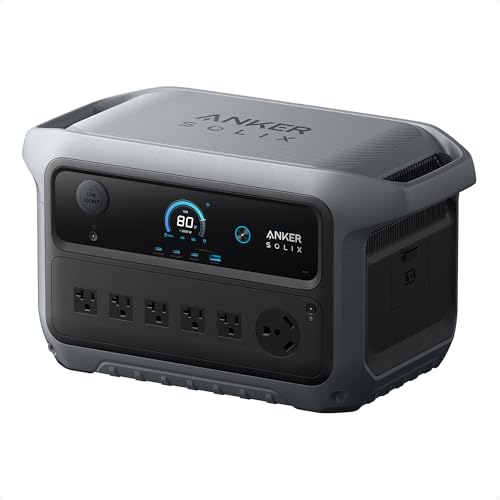
2,048 Wh LFP power station with 2,400 W output, full AC and solar charge in 58 minutes and 800 W alternator charging.
Check price on Amazon$899.98 as of Oct 21, 2026 2:02 am GMT+0000 — prices change; see Amazon for current price.Why we like it
- Full recharge in 58 minutes stated
- 800 W alternator charging from a vehicle
- 2,400 W output handles window AC units
- Expands to 4 kWh
| Specification | Details |
|---|---|
| Capacity / chemistry | 2,048 Wh LiFePO4; expandable to 4 kWh |
| Output | 2,400 W rated, 4,000 W peak |
| Charging | 100% in 58 min with AC plus solar; 100% in 3 h via 800 W alternator charger |
| Efficiency | 9 W standby; up to 32 h on a dual-door fridge stated |
| Switchover | Not clearly described in listing |
| Model / warranty | A1783; 41.7 lb; 5-year warranty |
Anker SOLIX C2000 Gen 2 — 2,048 Wh LFP, 2,400 W / 4,000 W, 58 min recharge, 800 W alternator, 41.7 lb, 5-yr
Refill Between Rolling Outages or From the Car
Fast recharge matters when outages are intermittent, or when you can top up from a running car, a neighbor’s generator or a few hours of grid power. The C2000 Gen 2 claims a full charge in 58 minutes with AC and solar combined, the fastest full-charge figure among the power stations. Its 800 W alternator charging option, which Anker says is 8 times faster than a standard car socket, turns an idling vehicle outdoors into a charging source.
That alternator method means running a vehicle, so it must stay outside and never in an attached garage. The CDC warns never to run a car or truck inside a garage attached to a house, even with the door open.
The listing’s 9 W standby draw is the highest stated on the shelf, and its UPS capability is unclear: the title mentions “USP,” which may be a typo for UPS, but no switchover time is given.
Pros
- Fastest stated full recharge
- Alternator charging option
- 2,400 W output, expandable
Cons
- Highest stated standby draw
- UPS switchover not stated
- Alternator charger sold separately
Check Anker SOLIX C2000 Gen 2 price on Amazon
6. CyberPower CP1500PFCLCD — Best UPS for Computers and Networking
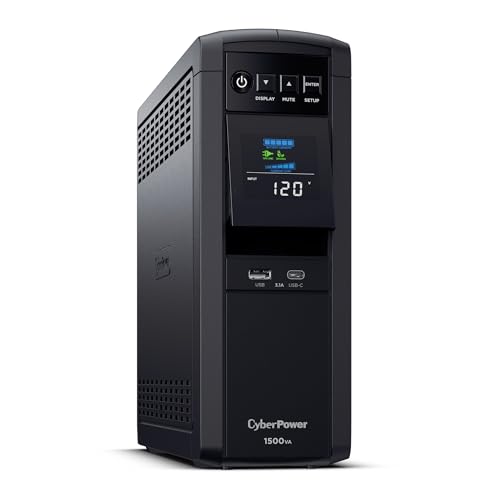
1500VA/1000W sine wave tower UPS with AVR, 12 outlets, color LCD and a 3-year warranty that covers the battery.
Check price on Amazon$239.95 as of Oct 21, 2026 2:02 am GMT+0000 — prices change; see Amazon for current price.Why we like it
- Sine wave output for active PFC power supplies
- AVR corrects minor fluctuations without battery
- Highest watt rating among the tower UPS units
- Warranty explicitly includes the battery
| Specification | Details |
|---|---|
| Rating | 1500VA / 1000W, PFC sine wave |
| Outlets | 12 NEMA 5-15R: 6 battery backup plus surge, 6 surge only; USB-A and USB-C charging |
| Voltage regulation | Automatic voltage regulation (AVR) |
| Display | Color LCD, tilts up to 22 degrees |
| Certification | UL safety certified per listing |
| Model / warranty | CP1500PFCLCDA; 24.9 lb; 3-year warranty including battery |
CyberPower CP1500PFCLCD — 1500VA/1000W sine wave, AVR, 12 outlets, color LCD, UL, 3-yr incl. battery
A Different Job: Riding Through Flickers, Not Outages
A tower UPS is not a power station. Its battery is sized to keep a desktop computer, monitor, modem and router running for minutes, long enough to save work and shut down or bridge a brief flicker, not hours. Eight of the 18 listings are UPS units like this, and seven of them state UL certification.
Within that group, the CP1500PFCLCD is one of the 1500VA models and lists 1000 W, the highest wattage among the tower units. It is the only UPS listing here that describes true sine wave output, which matters for computers with active PFC power supplies; the other two CyberPower listings that mention waveform state simulated sine wave. Automatic voltage regulation corrects minor sags and surges without draining the battery.
The listing does not state runtime at a given load. Only 6 of its 12 outlets have battery backup.
Pros
- Sine wave output and AVR
- 1000 W rating
- Battery covered by 3-year warranty
Cons
- Minutes of runtime, not hours
- Runtime not stated in listing
- Only half the outlets have battery backup
Check CyberPower CP1500PFCLCD price on Amazon
7. APC BX1500M — Best UPS With a Replaceable Battery

1500VA/900W UPS with AVR, 10 outlets, coax and Ethernet surge protection, user-replaceable battery and ENERGY STAR.
Check price on Amazon$189.99 as of Oct 21, 2026 2:02 am GMT+0000 — prices change; see Amazon for current price.Why we like it
- Battery is user-replaceable
- ENERGY STAR certified UPS
- Coax and Ethernet surge protection
- Stated 68 minutes at 100 W
| Specification | Details |
|---|---|
| Rating | 1500VA / 900W |
| Outlets | 10: 5 battery backup, 5 surge only; 789 joule surge rating |
| Voltage regulation | AVR corrects brownouts from 88 V and surges of plus or minus 13% |
| Runtime | 68 minutes at 100 W stated in title |
| Battery / efficiency | User-replaceable APCRBC124 battery; ENERGY STAR certified, 92%+ efficiency |
| Model / warranty | BX1500M; 28.44 lb; 3-year warranty |
APC BX1500M — 1500VA/900W, AVR, 10 outlets, 789 J, replaceable battery, ENERGY STAR, 68 min at 100 W
The Only UPS That Calls Out a User-Replaceable Battery
UPS batteries eventually wear out, and when they do, the question is whether you replace the battery or the whole unit. The BX1500M is the only listing on the shelf that describes a user-replaceable battery and names the replacement part. It is also one of two APC listings that state ENERGY STAR certification.
It gives a useful runtime figure, 68 minutes at 100 W, which is roughly a modem, router and small network switch with room to spare. A gaming PC and monitor drawing several hundred watts would get far less. The AVR range is stated precisely, correcting low voltage from 88 V.
The listing does not say whether the output is pure or simulated sine wave. Coax and Ethernet surge ports protect a cable modem and wired network, but they only help if those lines run through the UPS.
Pros
- User-replaceable battery
- ENERGY STAR and AVR
- Stated runtime at 100 W
Cons
- Waveform not stated
- Replacement battery sold separately
- Short runtime at higher loads
Check APC BX1500M price on Amazon
Power station, UPS or installed battery: which do you need?
“Home battery backup” covers three different products:
- Computer UPS units hold a few hundred watt-hours at most and bridge minutes. They protect computers and networks from flickers and give time to shut down.
- Portable power stations hold roughly 2 to 4 kWh in the picks above, expandable on some, and can run a refrigerator, lights, internet and other essentials for hours to days. Some switch over automatically; some pair with a transfer switch.
- Installed home batteries mount on a wall, connect to the main or a critical-loads panel and are often paired with rooftop solar. They are installed by solar or electrical contractors, not bought on Amazon, and none appears on this shelf.
The U.S. Department of Energy describes battery storage paired with solar as a way to use energy when it is needed most, including when the power goes out. Our main guide to home battery backup compares installed systems in more detail.
How to size a battery for an outage
Start with a list of what you must keep running, then estimate daily energy:
- Refrigerator: check the EnergyGuide label for annual kWh; divide by 365 for daily use.
- Gas furnace blower and controls: a few hundred watts while running. A furnace on a dedicated circuit needs a transfer switch or a properly installed inlet to run from a battery.
- Sump pump: high starting load and unpredictable runtime in a wet spring. A dedicated sump pump battery backup may be the better tool.
- Internet, phone charging and lights: small loads that add up to a few hundred watt-hours a day.
- Medical devices: follow the device maker’s power guidance and plan for longer than you expect.
Then add standby draw. Listings here state idle consumption from 4 W to 9 W, which works out to roughly 100 to 215 Wh a day just to keep the unit on.
Switchover time and why it matters
A UPS-style power station keeps devices plugged into it and switches to battery automatically when the grid drops. The listings that state a time give 10 ms or less for the EcoFlow, Anker S2000 and BLUETTI units. Fast switchover keeps routers, computers and many refrigerators running without a restart. Power stations without UPS mode are fine for loads you can plug in after the outage starts, but they will not protect a desktop computer from a flicker.
Safety: no exhaust, but not no risk
Battery backup’s main safety advantage is that it produces no carbon monoxide. The CPSC says portable generators are one of the leading causes of post-storm CO deaths and must run outdoors, at least 20 feet from homes. A power station can sit in the kitchen.
Batteries still need care:
- Use heavy enough cords and do not overload them. The U.S. Fire Administration warns against overloading power strips, using damaged extension cords and running cords under rugs.
- Keep vents clear and follow the manual’s charging temperature range, especially in an unheated garage.
- Do not stack items on top of a unit while it charges.
- Keep working CO alarms with battery backup, as the CPSC and CDC advise. If anyone in the neighborhood runs a generator, or you charge from an idling car, CO is still a risk. Our guide to the battery carbon monoxide detector covers outage-ready alarms.
Connecting a battery to house circuits
To run hardwired loads like a furnace or well pump from a power station, the safe route is a transfer switch or interlock with an inlet, installed by a licensed electrician. Jackery describes its MTS for the HomePower 3600 Plus; other brands sell their own. The same rule applies as with a generator: never connect any source to house wiring with a double-ended cord.
When to call an electrician or inspector
Call a licensed electrician for any transfer switch, inlet or installed battery, and a solar contractor for battery storage tied to rooftop panels. If you are buying a home with an installed battery, solar system or generator inlet, ask for permits and service records and have the installation checked. Our electrical systems hub explains what to ask, and Front Range buyers and homeowners can connect with a vetted local inspector through our contact page.
Frequently asked questions
What is the best home battery backup for a refrigerator?
A power station of about 2,000 Wh or more with UPS-style switchover keeps a refrigerator running through most outages without a restart. On this shelf, one unit is built specifically to sit beside a fridge with 4 W standby draw. Check the fridge's EnergyGuide label to estimate daily energy use.
How long will a home battery backup last in an outage?
It depends on capacity and load. A 2,000 to 3,600 Wh power station can often run a refrigerator, internet and lights for a day or more, while a computer UPS lasts minutes to about an hour at light load. Standby draw of 4 to 9 W also reduces runtime.
Is a power station the same as a home battery?
Not quite. A power station is portable and plugs in, though some pair with a transfer switch for house circuits. An installed home battery mounts on a wall, connects to the electrical panel and is often paired with rooftop solar by a contractor. None of the listings here are installed systems.
Can a home battery backup run a furnace?
It can run a gas furnace's blower and controls if it has enough output and the furnace is connected safely, usually through a transfer switch or inlet installed by an electrician. Electric furnaces and heat strips draw far more power than portable batteries can supply for long.
Is a battery backup safer than a generator?
A battery produces no carbon monoxide, so it can be used indoors, while fuel-burning generators must run outside at least 20 feet from the house. Batteries still require proper cords, ventilation and charging conditions, and homes should keep battery-backup CO alarms.
References
- Homeowner’s Guide to Going Solar — U.S. Department of Energy
- Solar Integration: Solar Energy and Storage Basics — U.S. Department of Energy
- CPSC Warns of Generator Carbon Monoxide and Fire Hazards (2026) — U.S. Consumer Product Safety Commission
- Carbon Monoxide Poisoning Basics — Centers for Disease Control and Prevention
- Appliance and Electrical Fire Safety — U.S. Fire Administration