Best Chainsaw (2026): 7 Gas, Corded and Battery Saws Compared

For most homeowners, the best chainsaw is the one that matches the wood you actually cut: storm-broken limbs after a heavy spring snow, a dead tree near the fence, a season of firewood, or brush cleared for defensible space. That choice starts with the power source (gas, corded electric or battery), then bar length, then the safety features that keep a kickback from becoming an emergency room visit. Below are seven full-size chainsaws, each matched to a specific homeowner job, plus a buying guide on bar sizes, battery platforms, safety gear, carbon monoxide and when a tree is a job for a professional.
Part of our Structure & Exterior guide — start there for the full picture →
As an Amazon Associate we earn from qualifying purchases.
How we compared: we compared 8 current Amazon listings for full-size chainsaws with 12- to 20-inch bars, out of 17 listings returned for the search; the other 9 were 6- to 10-inch mini pruning saws, which we discuss in the buying guide but did not rank. We compared what each listing states: power source and rating, bar length, chain brake and kickback features, oiling, chain tensioning, weight and warranty. We did not lab-test or handle any of these saws. Prices and availability change often, so check the current listing before buying.
Quick picks: the best chainsaws by homeowner job
| Product | Best for | Key features | Price | Buy |
|---|---|---|---|---|
| Husqvarna 130 16 in. | Best overall gas saw |
| $259.99as of Nov 11, 2026 9:51 am GMT+0000 | Buy now →Check current price |
| Oregon CS1500 18 in. | Best corded, self-sharpening |
| $133.00as of Nov 11, 2026 9:51 am GMT+0000 | Buy now →Check current price |
| CRAFTSMAN CMECS600 16 in. | Best budget and lightest |
| — | Buy now →Check current price |
| Husqvarna 120 Mark III | Gas saw for 14 to 18 in. bars |
| $219.99as of Nov 11, 2026 9:51 am GMT+0000 | Buy now →Check current price |
| DEJUNPIOOL 16 in. (DeWalt battery) | For DeWalt 20V/60V owners |
| $81.99as of Nov 11, 2026 9:51 am GMT+0000 | Buy now →Check current price |
| FXAFXA 12 in. 20V kit | Battery kit for light cleanup |
| $95.99as of Nov 11, 2026 9:51 am GMT+0000 | Buy now →Check current price |
| VEVOR 62 cc 20 in. | Large trunks and rural lots |
| $115.90as of Nov 11, 2026 9:51 am GMT+0000 | Buy now →Check current price |
Prices are Amazon’s listed prices as of the time shown and change often; check Amazon for today’s price. As an Amazon Associate we earn from qualifying purchases.
The 7 picks, compared listing by listing
1. Husqvarna 130 16-Inch — Best Gas Chainsaw for Most Homeowners

38 cc, 2 HP gas saw with a 16 in. bar, inertia-activated chain brake, fuel pump, LowVib and a stated 2-year warranty.
Check price on Amazon$259.99 as of Nov 11, 2026 9:51 am GMT+0000 — prices change; see Amazon for current price.Why we like it
- Inertia chain brake named in the listing
- Fuel pump plus combined choke/stop for easier starts
- Air injection pre-cleans intake air
- Only gas saw here with a stated warranty
| Specification | Details |
|---|---|
| Power | 38 cc 2-cycle X-Torq engine, 2 HP |
| Bar | 16 in. included; rated for 14 to 16 in. bars |
| Safety | Inertia-activated chain brake |
| Starting | Fuel pump and combined choke/stop control |
| Comfort | LowVib dampeners; automatic oiler |
| Warranty | 2 years |
Husqvarna 130 — 38 cc, 2 HP, 16 in. bar, inertia chain brake, fuel pump, auto oiler, LowVib, 2-yr warranty
The Only Gas Saw on the Shelf With a Stated Warranty
Four of the 8 full-size listings are gas saws, and this Husqvarna is the only one whose listing states a warranty (two years). For a 2-stroke engine that may sit unused for months between storms, a warranty from a brand with a dealer network is worth more than a slightly bigger engine.
It is also one of two gas saws, both Husqvarna, that name an inertia-activated chain brake, the feature designed to stop the chain when kickback snaps the saw back toward the operator. The 62 cc VEVOR describes a stop lever and a chip guard, which is not the same thing. Combined with the fuel pump and choke/stop control, which the listing says reduce the risk of flooding the engine, this is the most homeowner-friendly gas saw on the shelf.
The 130 is rated for 14 to 16 in. bars only, so it is a limbing, storm-cleanup and firewood saw, not a felling saw for big trunks. The listed 5.67 lb weight looks low for a 38 cc saw and likely excludes the bar, chain and fuel, so budget for more in the hands.
Pros
- Inertia chain brake
- Easy-start features named
- 2-year warranty and dealer support
- Vibration dampening
Cons
- Maxes out at a 16 in. bar
- Gas and 2-stroke oil to store
- Listed weight likely excludes bar and fuel
Check Husqvarna 130 price on Amazon
2. Oregon CS1500 18-Inch — Best Corded Chainsaw With Self-Sharpening
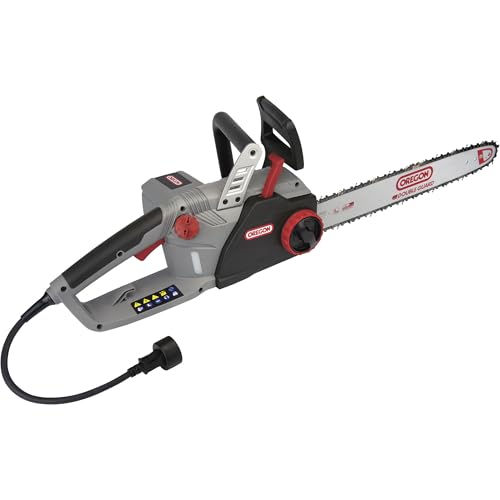
15 A corded electric saw with an 18 in. bar, built-in PowerSharp self-sharpening, chain brake and UL certification.
Check price on Amazon$133.00 as of Nov 11, 2026 9:51 am GMT+0000 — prices change; see Amazon for current price.Why we like it
- Only saw with built-in chain sharpening
- Longest bar among the electric saws
- Chain brake and low-kickback chain
- Only listing that states UL certification
| Specification | Details |
|---|---|
| Power | 15 A corded electric |
| Bar | 18 in. |
| Sharpening | Integrated PowerSharp system; listing says 3 to 5 seconds |
| Safety | Chain brake; low kickback; UL certified |
| Maintenance | Tool-free tensioning; automatic oiling |
| Weight / warranty | 12.6 lb; 2 years |
Oregon CS1500 — 15 A corded, 18 in. bar, PowerSharp self-sharpening, chain brake, UL certified, 12.6 lb, 2-yr warranty
The Only Self-Sharpening Saw, and the Only One Naming UL Certification
A dull chain is the most common reason a homeowner’s saw starts to smoke, bind and push back, and most people do not own a file guide. The CS1500 is the only listing of the 17 with a built-in sharpening system. The CDC’s chain saw safety guidance lists properly sharpened teeth and correct bar-and-chain lubrication among the first steps before cutting, and this design makes the first one much easier to keep up with.
It is also the only one of the 8 full-size listings that states UL certification, and it pairs a chain brake with a low-kickback chain. At 18 in. it has the longest bar of the four electric saws, and its 15 A motor is the strongest corded rating on the shelf (the Craftsman is 12 A).
The obvious limit is the cord. A corded saw works within reach of an outlet and a heavy-gauge outdoor extension cord, so it suits suburban lots more than acreage. It is also the heaviest electric saw listed at 12.6 lb.
Pros
- Self-sharpening keeps cuts efficient
- Chain brake and low-kickback chain
- No fuel, no pull-starting
- UL certified, 2-year warranty
Cons
- Tethered to an outlet
- Heaviest electric saw here
- Needs a heavy-duty extension cord
Check Oregon CS1500 price on Amazon
3. CRAFTSMAN CMECS600 16-Inch — Best Budget and Lightest Chainsaw

12 A corded saw with a 16 in. low-kickback bar and chain, auto oiling, tool-free tensioning and a 3-year warranty.
Check price on AmazonWhy we like it
- Lightest full-size saw listed, about 6.2 lb
- Low-kickback bar and chain
- Longest stated warranty at 3 years
- Oil window and tool-free tensioning
| Specification | Details |
|---|---|
| Power | 12 A corded electric |
| Bar | 16 in. low-kickback bar and chain |
| Oiling | Automatic, no priming; oil level window |
| Tensioning | Tool-free |
| Weight | About 6.2 lb |
| Chain brake / warranty | Chain brake not stated in listing; 3-year limited |
CRAFTSMAN CMECS600 — 12 A corded, 16 in. low-kickback bar/chain, auto oiler, tool-free tension, about 6.2 lb, 3-yr warranty
The Lightest Full-Size Saw and the Longest Stated Warranty
At about 6.2 lb, the CMECS600 has the lowest stated weight of the 8 full-size saws (setting aside the Husqvarna 130’s figure, which appears to exclude the bar and fuel). Light weight matters for a homeowner who cuts a few times a year: less fatigue means better control, and control is the core of safe chainsaw use.
Its 3-year limited warranty is the longest of the three stated on the full-size shelf (the Husqvarna 130 and Oregon list two years). The bar and chain are both described as low kickback, one of two listings (with the Oregon) to say so.
What it does not state is a chain brake. A low-kickback chain reduces the chance of kickback, while a chain brake stops the chain if it happens; check the manual before buying if you want both. The 12 A motor is a step below the Oregon’s 15 A, so plan on a slower pace in hardwood.
Pros
- Light and easy to control
- Low-kickback bar and chain
- 3-year limited warranty
Cons
- Chain brake not mentioned
- Corded only
- Weaker motor than the Oregon
Check CRAFTSMAN CMECS600 price on Amazon
4. Husqvarna 120 Mark III — Best Gas Saw for Flexible Bar Lengths

38 cc, 1.8 HP gas saw with a 16 in. bar, air purge, inertia chain brake, LowVib and a 14 to 18 in. bar range.
Check price on Amazon$219.99 as of Nov 11, 2026 9:51 am GMT+0000 — prices change; see Amazon for current price.Why we like it
- Rated for bars from 14 to 18 in.
- Air purge and combined choke/stop
- Inertia-activated chain brake
- Centrifugal air cleaning for the filter
| Specification | Details |
|---|---|
| Power | 38 cc 2-cycle X-Torq engine, 1.8 HP |
| Bar | 16 in. included; 14 to 18 in. recommended range |
| Safety | Inertia-activated chain brake |
| Starting | Air purge and combined choke/stop |
| Weight | About 10.7 lb |
| Warranty | not stated in listing |
Husqvarna 120 Mark III — 38 cc, 1.8 HP, 16 in. bar (14–18 in. range), inertia chain brake, air purge, about 10.7 lb
The Only Gas Saw Rated for an 18-Inch Bar Below 60 cc
Both Husqvarnas use a 38 cc engine, but the 120 Mark III’s listing recommends bars from 14 to 18 in., while the 130 tops out at 16 in. That flexibility lets you run a shorter bar for limbing and a longer one for the occasional larger log. The only other gas saw on the shelf with a bar over 16 in. is the 62 cc VEVOR.
The trade is power: the 120 Mark III lists 1.8 HP against the 130’s 2 HP, and an 18 in. bar on a small engine cuts slowly in big hardwood. It uses an air purge primer rather than the 130’s fuel pump, and the listing does not state a warranty.
For a homeowner who cuts firewood from the same few trees every year, it is a sensible alternative to the 130. Check your wood before burning it; a firewood moisture meter tells you whether a split is seasoned enough for a clean burn.
Pros
- Accepts bars up to 18 in.
- Inertia chain brake
- LowVib dampening
Cons
- Less power than the 130
- No warranty stated
- Heavier than the corded picks
Check Husqvarna 120 Mark III price on Amazon
5. DEJUNPIOOL 16-Inch for DeWalt Batteries — Best for DeWalt 20V/60V Owners

Third-party 16 in. brushless saw built to run on DeWalt 20V and 60V packs; tool only, with 3 chains and a battery gauge.
Check price on Amazon$81.99 as of Nov 11, 2026 9:51 am GMT+0000 — prices change; see Amazon for current price.Why we like it
- Runs on DeWalt 20V and 60V batteries
- 16 in. bar, the longest battery bar here
- Emergency chain brake and safety lock
- Three chains and safety glasses in the box
| Specification | Details |
|---|---|
| Power | 1200 W brushless; DeWalt 20V/60V batteries (not included) |
| Bar / capacity | 16 in.; listing says cuts up to 13 in. diameter |
| Safety | Emergency brake, safety lock, overload and overheat protection |
| Maintenance | Auto oiler; tool-free chain tensioning |
| Weight | 7.7 lb without battery |
| Warranty | not stated in listing |
DEJUNPIOOL JY-CH1201 — 16 in., 1200 W brushless, DeWalt 20V/60V compatible, chain brake, auto oiler, 7.7 lb tool only
The Only Full-Size Saw Built Around a Major Brand’s Battery Platform
If you already own DeWalt 20V MAX packs for a drill or impact driver, battery compatibility matters more than small spec differences. This is the only full-size saw of the 8 designed to take batteries from a major tool platform; the FXAFXA ships with its own packs. Note that it is a third-party tool built to fit DeWalt batteries, not a DeWalt product, so DeWalt’s tool support does not apply to the saw itself.
It names an emergency chain brake and a safety lock, which puts it with the Husqvarnas and the Oregon among the four full-size listings that describe a brake. It also includes three chains, a bar cover and safety glasses, but no battery or charger, and the listing advises packs of 4.0Ah or larger for heavy cutting.
A battery saw starts with a trigger, makes no exhaust and is quiet between cuts, which suits suburban storm cleanup. Runtime depends entirely on the pack you own.
Pros
- Uses batteries you may already own
- Chain brake and safety lock
- Extra chains included
- No fuel or exhaust
Cons
- Third-party tool, not DeWalt
- Battery and charger not included
- No warranty stated
Check DEJUNPIOOL 16 in. chainsaw price on Amazon
6. FXAFXA 12-Inch 20V Kit — Best Battery Kit for Light Storm Cleanup

12 in. brushless 20V saw sold with two 4.0Ah batteries and a charger, auto oiler, tool-free tension, two-button start.
Check price on Amazon$95.99 as of Nov 11, 2026 9:51 am GMT+0000 — prices change; see Amazon for current price.Why we like it
- Two 4.0Ah batteries and charger included
- Brushless motor with overload protection
- Two-button start against accidental triggering
- Hand guard and tool-free tensioning
| Specification | Details |
|---|---|
| Power | 20V brushless; listing states 2.56 HP and 12,000 RPM |
| Bar | 12 in. |
| Batteries | Two 4.0Ah packs plus charger |
| Safety | Hand guard; lock button plus start button |
| Maintenance | Auto oiler with 140 ml tank; dial tensioning |
| Weight / warranty | About 8.2 lb; warranty not stated in listing |
FXAFXA MS-101 — 12 in., 20V brushless, 2 x 4.0Ah batteries + charger, auto oiler, hand guard, about 8.2 lb
The Only Full-Size Battery Saw Sold Complete With Batteries
Two of the 8 full-size listings are battery saws, and this is the only one that arrives ready to cut, with two 4.0Ah packs and a charger. For a homeowner without an existing battery platform, that is the simplest route to a cordless saw.
A 12 in. bar is the shortest among the full-size saws, which is fine for limbs, fence-line brush and small downed trees but slow on a large trunk. The listing describes a hand guard and a lock-then-start sequence, but not a chain brake, which the four brake-equipped saws on the shelf do name. If kickback protection matters to you, and for an occasional user it should, weigh that gap.
The platform is the other catch. These batteries are specific to this brand, so they will not carry over to drills, blowers or trimmers you may buy later. The horsepower figure on a battery tool is a manufacturer claim and not comparable to gas engine ratings.
Pros
- Batteries and charger included
- Light, quiet and fuel-free
- Two-step start lock
Cons
- Chain brake not mentioned
- Short 12 in. bar
- Batteries don’t fit a major platform
Check FXAFXA 12 in. cordless chainsaw price on Amazon
7. VEVOR 62cc 20-Inch — Best for Large Trunks and Rural Lots
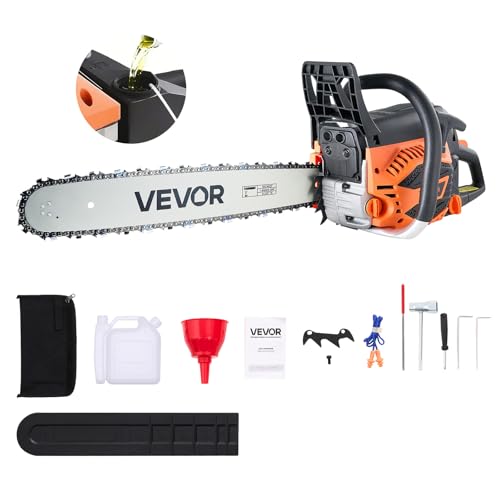
62 cc, 3.8 HP gas saw with a 20 in. bar rated to cut up to 18 in. diameter, cold/hot start and a stop lever.
Check price on Amazon$115.90 as of Nov 11, 2026 9:51 am GMT+0000 — prices change; see Amazon for current price.Why we like it
- Biggest engine and longest bar on the shelf
- Listing rates cuts up to 18 in. diameter
- Separate cold and hot start settings
- Large fuel and chain-oil tanks
| Specification | Details |
|---|---|
| Power | 62 cc 2-stroke, 3.8 HP; 12,000 RPM max |
| Bar / capacity | 20 in.; cuts up to 18 in. diameter |
| Fuel | 40:1 mix; 550 ml fuel tank, 260 ml oil tank |
| Safety | Emergency stop lever; chip guard; chain brake not stated |
| Weight | About 16.1 lb |
| Warranty | not stated in listing |
VEVOR CN-62G — 62 cc, 3.8 HP, 20 in. bar, 18 in. max cut, 40:1 fuel, about 16.1 lb
The Largest Engine and Bar of the 8 Full-Size Saws
The VEVOR is the outlier on the shelf: 62 cc and 3.8 HP against 38 cc and 2 HP or less for the Husqvarnas, and a 20 in. bar against 16 to 18 in. on everything else. If you own acreage on the eastern plains or in the foothills, have a windbreak of mature trees or cut a lot of firewood from large rounds, it is the only listing here with the capacity for big trunks.
That size comes with real caveats for a homeowner. At about 16.1 lb it is the heaviest saw by far, and the listing describes an emergency stop lever and a chip guard but does not name a chain brake. A long bar on a powerful saw makes kickback more violent, so this is a saw for experienced users wearing full protective gear, not a first chainsaw.
The listing does not state a warranty, and it asks buyers to contact customer service for starting issues, which suggests support runs through the seller rather than a dealer network.
Pros
- Most power and bar length here
- Handles trunks up to 18 in.
- Large tanks for long sessions
Cons
- Chain brake not stated
- Heaviest saw compared
- No dealer network or stated warranty
- Too much saw for most suburban yards
Check VEVOR 62 cc chainsaw price on Amazon
Gas, corded or battery: choosing a power source
Gas
Gas saws give the most power and unlimited runtime with a fuel can, which is why they dominate rural properties and heavy firewood cutting. The costs are noise, exhaust, fuel mixing and maintenance. Two-stroke engines that sit for months with old fuel are notoriously hard to start, and in the Front Range a saw may go a full year between big storms. Carbureted engines can also run differently at high elevation, so check the manual for altitude guidance or ask a service dealer.
Corded electric
Corded saws are light, inexpensive, start instantly and never need fuel or batteries. For a suburban lot where most cutting happens within 100 feet of an outlet, they are often the smartest buy. OSHA’s power tool guidance recommends keeping cords away from the cutting surface of a saw, removing damaged cords and tools from use, and using a ground-fault circuit interrupter (GFCI) as protection where cords can be damaged. With a chainsaw, keeping the cord behind you and away from the chain is a constant job.
Battery
Battery saws combine the convenience of electric with the freedom of gas, at the cost of runtime and up-front battery expense. The key question is the platform. If you already own 20V packs from one brand, a saw that shares them is far cheaper and simpler than starting a second battery system. Our guides to the best cordless drill and impact drivers cover platform lock-in in more depth.
Mini pruning saws
More than half the listings returned for “chainsaw” were 6- to 10-inch mini saws with one-hand grips. They are handy for shrubs and small branches, but they are not substitutes for a full-size saw on a downed tree, and their one-handed use invites cuts above shoulder height. Treat them as pruning tools.
Bar length, chain and the features that prevent kickback
Bar length sets the largest log you can cut in one pass, roughly the bar length minus a couple of inches. For homeowners, 14 to 16 in. handles limbs, fence-line clearing and most firewood. An 18 in. bar is useful for occasional bigger rounds, and 20 in. and longer belongs on powerful saws in experienced hands.
Kickback happens when the upper tip of the bar touches wood or another object and the saw is thrown back toward the operator. The features that reduce it:
- Chain brake. Four of the 8 full-size listings name one: both Husqvarnas, the Oregon and the DEJUNPIOOL. The CDC lists a chain brake among the safety features to look for, along with front and rear hand guards, a stop switch, a chain catcher and a spark arrester.
- Low-kickback bar and chain. Named by the Craftsman and the Oregon.
- Sharp chain and correct tension. A dull chain forces you to push, and a loose chain can derail. Tool-free tensioning is stated on the Craftsman, Oregon, DEJUNPIOOL and FXAFXA.
- Automatic oiler. Every full-size saw here lists one; keep the reservoir full of bar-and-chain oil.
Safety gear, carbon monoxide and safe cutting
The CDC reports that about 36,000 people are treated in emergency departments each year for chain saw injuries, and that the risk rises after storms when chain saws are widely used to clear fallen trees. Its recommended gear: hard hat, safety glasses, hearing protection, heavy work gloves, chain saw chaps that run from the waist to the top of the foot, and boots that cover the ankle. Gas chainsaws are loud; OSHA notes that noise above 85 decibels can damage hearing and that noise-induced hearing loss is permanent, so ear protection is not optional.
Other CDC points that apply directly to homeowners:
- Cut at waist level or below, and keep bystanders at least 30 feet away while limbing and at least two tree lengths away during felling.
- Stay away from power lines until they are confirmed de-energized; storm-downed limbs often hang on service drops.
- Be careful with spring poles, branches bent under tension that can whip free when cut, and shave the underside slowly rather than cutting straight through.
Carbon monoxide. The CDC lists small engines among the fuel-burning sources of CO, a colorless, odorless gas that can build up indoors. Never run a gas chainsaw in a garage, shed or basement, even with the door open, and do not warm one up inside before heading out. The CPSC and CDC give the same warning for portable generators that often run during storm cleanup: operate them outdoors only, at least 20 feet from the house.
How Front Range homeowners use a chainsaw
The biggest chainsaw days along the Front Range follow wet snowstorms in spring and fall, when heavy snow lands on trees still in leaf and snaps limbs onto roofs, fences and driveways. Check the roof and gutters after the cleanup; our storm damage roof guide covers what to look for. High winds along the foothills bring down dead wood year-round.
In wildland-urban interface neighborhoods, a saw is also a fire-safety tool. Thinning trees, removing ladder fuels and clearing dead branches near the house are the core of defensible space; our defensible space guide explains the zones. Many homeowners also cut their own firewood for a wood stove, where well-seasoned wood burns cleaner and builds less creosote.
Dry conditions raise the fire stakes for gas saws in summer; the CDC’s list of safety features includes a spark arrester, so check whether your saw has one before cutting in dry grass, and observe any local fire restrictions.
When to hire an arborist or call an inspector
The CDC recommends that felling and limb removal be done by an operator with training and experience in safe chain saw use whenever possible. Hire a certified arborist or tree service when:
- A tree or large limb is leaning on the house, a fence, a vehicle or power lines.
- The work requires cutting above shoulder height or from a ladder.
- The trunk is larger than your bar length or the tree is under tension in several directions.
- You would need to fell a tree near structures.
Trees close to a house also affect foundations, sewer lines and roofs over time; our tree roots guide covers what to watch for. After a big storm or before buying a wooded lot, an inspection can document roof, gutter, siding and grading damage; see our structure and exterior inspection hub for what an inspector checks. If you are on the Front Range and want a vetted local inspector, contact us here.
Frequently asked questions
What is the best chainsaw for a homeowner?
For most homeowners, a 14- to 16-inch saw with a chain brake covers storm cleanup, limbing and firewood. A corded electric saw is the simplest choice for suburban lots near an outlet, a battery saw makes sense if you already own a compatible battery platform, and a mid-size gas saw suits larger properties and frequent cutting.
What size chainsaw do I need?
Match the bar to the wood. A 12-inch bar handles branches and small trees, 14 to 16 inches covers most homeowner jobs, and 18 to 20 inches is for large rounds on a powerful saw. Longer bars are heavier and more dangerous in a kickback, so buy the shortest bar that handles your typical cut.
Are battery chainsaws as good as gas?
For homeowner jobs, often yes. Battery saws start instantly, make no exhaust and need little maintenance, but runtime is limited by the pack and they have less power for large trunks. Gas saws remain the better tool for heavy firewood cutting or acreage.
Can a gas chainsaw be used in a garage?
No. Gas chainsaws are small engines that produce carbon monoxide, which can build up indoors to dangerous levels. Start and run them outdoors only, away from doors and windows, and never warm one up in a garage, shed or basement.
What safety gear do I need to run a chainsaw?
The CDC recommends a hard hat, safety glasses, hearing protection, heavy work gloves, chain saw chaps from waist to the top of the foot, and boots that cover the ankle. Read the manual, check the chain brake and chain tension before every use, and keep bystanders at least 30 feet away.
References
- Chain Saw Safety — Centers for Disease Control and Prevention
- Carbon Monoxide Poisoning Basics — Centers for Disease Control and Prevention
- Carbon Monoxide Information Center — U.S. Consumer Product Safety Commission
- Occupational Noise Exposure — Occupational Safety and Health Administration
- Electrical Incidents: Power Tools — Occupational Safety and Health Administration