Hygrometer Guide: Reading Indoor Humidity the Right Way
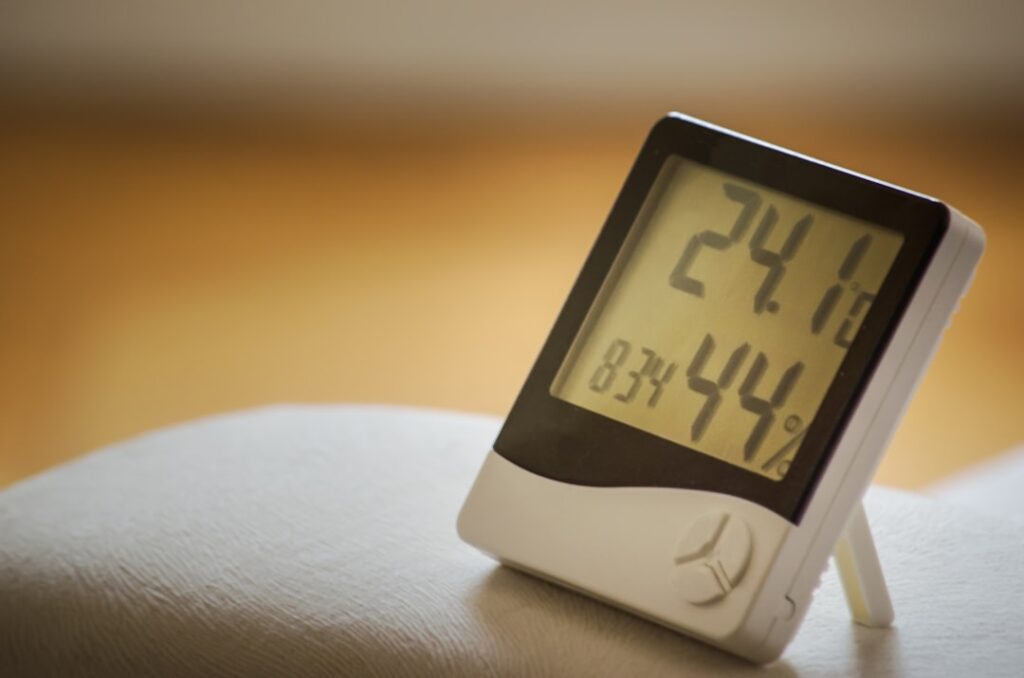
A hygrometer is the simplest tool for answering a question that sits behind a lot of household problems: how much moisture is in the air? Condensation on windows, a musty basement, static shocks in January, cracked wood trim and mold on a closet wall all trace back to humidity that is too high or too low. This guide explains what a hygrometer measures, how digital and analog models differ, how to check accuracy, where to put one, and how to read the numbers in a Colorado Front Range home. It also clears up the common mix-up between a hygrometer and a hydrometer. It summarizes EPA and CDC guidance current as of 2026 for general education and does not replace advice from a qualified inspector or HVAC professional.
Part of our Home Inspection Tools guide — start there for the full picture →
What a Hygrometer Measures
A hygrometer measures humidity, the amount of water vapor in the air. Almost every household model reports relative humidity (RH), shown as a percentage. Relative humidity compares the water vapor actually in the air with the maximum the air could hold at that temperature. Warm air can hold more water vapor than cold air, so the same amount of moisture produces a lower RH reading in a warm room and a higher reading in a cool one. That is why a basement often reads more humid than the floor above it even when no water is getting in, and why RH tends to climb on cold surfaces like window glass and foundation walls.
Most digital units also show temperature, and some calculate dew point, the temperature at which water vapor starts condensing into liquid. Dew point is useful because condensation, not humidity alone, is what wets surfaces and feeds mold. The guide to the hygrometer definition covers the terminology in more detail, and the broader home inspection tools pillar shows where a hygrometer fits among the instruments inspectors carry.
EPA’s Brief Guide to mold, moisture and the home describes relative humidity as something that can be measured with a moisture or humidity meter, which it calls a small, inexpensive instrument available at many hardware stores. EPA’s page on home humidifiers similarly notes that hygrometers are available at local hardware stores and may be used to measure humidity levels. A hygrometer is not a specialist tool; it is an inexpensive household instrument with real diagnostic value.
Hygrometer vs Hydrometer: Not the Same Tool
The two words differ by one letter and get swapped constantly. A hygrometer measures moisture in the air. A hydrometer measures the density or specific gravity of a liquid. Hydrometers are floated in a liquid and read against a scale; they are used for things like checking battery electrolyte, antifreeze, brewing and winemaking. A hydrometer cannot tell anything about room humidity, and a hygrometer cannot measure a liquid’s density. For a home with condensation, mold or dry-air complaints, the hygrometer is the right tool.
The confusion is understandable because both come from the Greek roots for water and moisture, and both are inexpensive instruments sold in hardware stores. When shopping, check that the product description mentions relative humidity, RH or a percentage scale. A device described with specific gravity, density or a floating glass bulb is a hydrometer.
Digital Versus Analog Hygrometers
Household hygrometers come in two broad styles.
- Digital hygrometers use an electronic sensor, commonly a capacitive or resistive element that changes its electrical properties as it absorbs moisture. They show a number on a screen, often with temperature, minimum and maximum readings and sometimes dew point. Many log data over time or send readings to a phone. Digital units are generally easier to read and track trends with.
- Analog (dial) hygrometers traditionally use a material that expands and contracts with moisture, such as a coiled strip or a hair or synthetic fiber, linked to a needle. They need no batteries and look at home on a shelf or in a humidor, but they are often slower to respond and can drift more over time. Many can be adjusted with a small screw on the back.
Neither type is automatically more accurate. Sensor quality varies within each style, and inexpensive units of both kinds can read several percentage points off. The practical difference is that digital models make it easier to watch trends, record minimums and maximums, and compare rooms. For moisture troubleshooting, a min/max feature is especially useful because it shows what happened overnight or during a shower rather than only the moment of reading.
Some homes use several inexpensive digital units, one per problem area, rather than one expensive meter. That approach often reveals more than precision does. A basement reading 15 points higher than the main floor tells a clear story even if both numbers are a few points off.
Accuracy, Calibration and Response Time
Every hygrometer has some error, and many drift as sensors age or are exposed to extremes. Checking accuracy now and then keeps readings useful.
The salt test
The most common home check is the saturated salt test. A small amount of ordinary table salt is mixed with just enough water to make a damp slurry, not a solution, and placed in a sealed container or zip-top bag with the hygrometer, without touching it. After several hours at a stable room temperature, the air in the container is generally expected to settle near 75% RH. If the hygrometer reads, say, 71% or 79%, that offset can be noted or, on adjustable models, corrected.
The salt test is a rough field check, not a laboratory calibration. Results are affected by temperature swings, how well the container seals, how much time is allowed and whether the slurry is truly saturated. Many people let it sit overnight. It also checks only one point on the scale, so a meter that is accurate near 75% may still be off near 30%. For general household use, though, knowing that a meter reads roughly 3 points high is enough to interpret its readings sensibly. If a meter’s instructions describe a different check procedure, follow the manufacturer’s method instead.
Placement
Placement causes more bad readings than sensor error. A hygrometer should sit away from direct sunlight, heating vents, exterior doors, humidifier mist, kettles, showers and exterior walls. It should be at roughly breathing height in the middle of the room rather than on a cold windowsill or next to a radiator. A unit on a cold exterior wall will read higher RH than the room as a whole because the air beside it is cooler. That local reading is not wrong, but it describes a spot rather than the room.
Response time
Hygrometers do not respond instantly. After a meter is moved from one room to another, or out of the salt container, it may need 15 to 30 minutes or longer to settle, and analog units often take longer. Readings taken immediately after moving a meter can be misleading. For room-to-room comparisons, carrying one meter around works only if each reading is given time to stabilize; leaving separate meters in place is simpler.
Target Indoor Humidity: What EPA and CDC Say
The two most-cited federal targets differ slightly, and both are worth knowing.
- EPA, in its Brief Guide to mold, moisture and the home, says that if possible indoor humidity should be kept below 60 percent, ideally between 30 and 50 percent relative humidity.
- CDC, on its mold page, advises keeping humidity levels in the home as low as possible, no higher than 50%, all day long, and notes that an air conditioner or dehumidifier will help keep the level low.
- EPA’s humidifier guidance says not to humidify to indoor relative humidity levels exceeding 50 percent, because higher levels may encourage the growth of biological organisms in the home.
Put together, a reasonable working range for most homes is 30 to 50% RH, with readings that stay above 60% treated as a warning sign. The guide to what humidity mold grows at explains why sustained high humidity matters more than short spikes, and mold and humidity covers the relationship in more depth. Mold still needs moisture to grow, as the guide on whether mold can grow without moisture explains, and humid air often supplies that moisture through condensation on cool surfaces.
Short spikes after showers, cooking or laundry are normal. What matters is how high the reading goes, how long it stays there and whether it comes back down. A bathroom that hits 80% during a shower and returns to 45% within half an hour with the fan running is behaving well. A bedroom that sits at 62% all week is not.
Reading the numbers
| RH reading | What it usually means | Suggested action |
|---|---|---|
| Below 25% | Very dry air, common in Front Range winters; static, dry skin, wood shrinkage | Consider modest humidification, but watch windows for condensation |
| 25–30% | Dry side of normal; often typical in cold weather | Usually acceptable; avoid pushing humidity high to compensate |
| 30–50% | EPA’s ideal range; within CDC’s limit | Maintain; keep exhaust fans and ventilation working |
| 50–60% | Above CDC’s 50% limit but below EPA’s 60% ceiling | Check for moisture sources, run fans longer, consider a dehumidifier |
| Above 60% | Above EPA’s guidance; condensation and mold risk rise | Find the source, dehumidify, dry wet materials, inspect for mold |
| Spikes then drops | Normal response to showers, cooking or laundry | Confirm it returns to normal within a reasonable time |
| High in one room only | Local source: leak, plants, aquarium, unvented appliance, cold walls | Investigate that room; check with a moisture meter |
Colorado’s Dry Winters: Too Little Humidity
Along the Front Range, the bigger humidity problem for much of the year is air that is too dry rather than too wet. Cold outdoor air holds little water vapor, and when it is heated indoors its relative humidity drops sharply. It is common for Denver-area homes to read in the teens or low 20s on cold winter days. Low humidity is linked to static shocks, dry skin and eyes, scratchy throats, gaps opening in wood floors and trim, and cracking in some finishes. EPA’s humidifier page notes that the moisture humidifiers add can help with winter-heating nuisances such as static electricity, peeling wallpaper and cracks in paint and furniture.
The trap is overcorrecting. A humidifier that pushes indoor RH to 45 or 50% when it is well below freezing outside can cause heavy condensation on windows, because window glass and frames are the coldest surfaces in the room. Water running down the glass soaks sills and frames and can lead to mold, peeling paint and wood decay. EPA’s humidifier guidance says that if water condenses on windows, walls or pictures, the humidifier should be relocated, its humidistat setting lowered, or its use reduced. The guide to window condensation covers causes and fixes.
A hygrometer makes this balancing act manageable. In very cold weather, many homes find they can only run RH in the high 20s to mid 30s before windows start sweating. As outdoor temperatures rise, a little more humidity can be tolerated. Watching the hygrometer alongside the windows on the coldest mornings shows where a given house’s limit sits.
Humidifiers also need care. EPA recommends emptying, drying and refilling portable humidifier tanks daily, cleaning portable units every third day, and using water with low mineral content to reduce scale and minerals released into the air. A neglected humidifier can spread microorganisms, which defeats the purpose of adding moisture for comfort.
Basements, Crawl Spaces and Seasonal Swings
Basements and crawl spaces behave differently from upper floors. They sit against cool soil, so their air is often cooler and their RH higher, especially in late spring and summer when warm, moister outdoor air comes in and cools against foundation walls. EPA’s mold course lists condensation from high humidity or cold spots as a common source of indoor moisture, and its Brief Guide shows mold on a suitcase stored in a humid basement.
A hygrometer left in a basement for a few weeks is one of the cheapest ways to decide whether a dehumidifier is needed. If the min/max record shows RH regularly above 60% during warm months, moisture control is warranted. The guide to basement humidity explains sources and fixes, and the guide to crawl space moisture control covers vapor barriers, drainage and conditioning approaches for crawl spaces.
Front Range homes can swing seasonally: dry upstairs in January, damp downstairs in June. A single reading in one season does not capture the whole picture. Logging readings across a year, or at least spot-checking monthly, gives a far better sense of whether a basement is truly damp or only humid during a few weeks of summer storms.
A hygrometer near the ceiling and another near the floor in a basement can also reveal stratification. Cool, damp air settles low, so a meter on a high shelf may understate conditions at floor level where stored boxes sit against the slab.
Using a Hygrometer With Moisture Meters
A hygrometer measures air. It does not say whether a wall, floor or subfloor is wet. For that, inspectors pair it with a moisture meter. EPA’s mold course notes that moisture meters can be used on materials such as carpet, wallboard, wood, brick and concrete, and can help locate hidden areas where mold may be growing.
- A pinless moisture meter scans drywall, wood and flooring without leaving holes, which suits a quick sweep of a suspicious wall.
- A masonry moisture meter is designed for concrete, block and brick, which suits basement walls and slabs.
- An infrared moisture meter or thermal camera can flag cool, possibly damp areas that are then confirmed with a contact meter.
A typical sequence: the hygrometer shows a room running humid; the inspector looks for condensation and cold spots; then a moisture meter confirms whether materials are actually wet. High RH with dry materials points to ventilation or dehumidification. Normal RH with one wet wall points to a leak or water intrusion rather than humidity. The inspection tools hub covers the wider kit.
How to Use a Hygrometer at Home
- Check the meter first. Run a salt test, or compare several meters side by side for a few hours to spot an outlier.
- Place it well. Mid-room, away from vents, sun, windows, exterior doors and moisture sources.
- Let it settle. Give it at least 15 to 30 minutes after moving.
- Record a baseline. Note readings morning and evening for a week in each area of concern, including outdoor temperature.
- Watch the extremes. Use min/max memory to see overnight highs and how quickly spikes recover.
- Compare rooms. A single outlier room usually points to a local moisture source.
- Act on trends, not single numbers. Sustained readings above 60%, or regular condensation, warrant action even if daytime readings look fine.
Features worth paying for
Price is a weak guide to usefulness. For household moisture work, a few features matter more than brand or styling:
- Min/max memory that can be reset, so overnight highs and post-shower peaks are captured.
- Stated accuracy in the specifications, typically given as plus or minus a few percent RH. Wider tolerances are common in the cheapest units.
- Dew point display, which makes condensation risk easier to judge on windows and foundation walls.
- Data logging or app history for basements and crawl spaces, where a week of readings is far more informative than a single glance.
- Remote sensors for places that are awkward to visit daily, such as a crawl space or attic hatch area.
A handful of modest digital units with min/max memory usually serves a homeowner better than one premium meter carried from room to room.
Common Reading Mistakes
- Reading right after a shower or cooking. Spikes are expected; judge the recovery.
- Trusting an uncalibrated meter blindly. A meter reading 8 points low can hide a real problem.
- Placing the meter on a cold surface. It reports local conditions rather than the room.
- Chasing a number in winter. Pushing RH to 45% in subzero weather can soak windows.
- Ignoring the basement. Upstairs may be dry while the basement runs damp.
- Treating a humidity reading as a mold test. A hygrometer shows conditions that favor mold; it does not show whether mold is present.
When readings stay high despite dehumidification, or when a musty smell, stains or visible growth appear, a professional evaluation is worth considering. A home inspector or mold professional can combine humidity, moisture and visual evidence to find the source. Questions about a specific home can go through our contact page.
References
- U.S. EPA. A Brief Guide to Mold, Moisture and Your Home
- Centers for Disease Control and Prevention. Mold: About Mold
- U.S. EPA. Use and Care of Home Humidifiers
- U.S. EPA. Mold Course Chapter 1: Introduction to Molds
- U.S. EPA. Mold Course Chapter 3: Investigating Mold Problems
Frequently asked questions
What is the difference between a hygrometer and a hydrometer?
A hygrometer measures humidity, the water vapor in the air, usually as relative humidity. A hydrometer measures the density or specific gravity of a liquid, such as battery fluid or brewing wort. For condensation, mold or dry-air problems, a hygrometer is the right tool.
What humidity should a hygrometer read indoors?
EPA recommends keeping indoor humidity below 60 percent, ideally between 30 and 50 percent. CDC advises no higher than 50 percent. In very cold Colorado weather, many homes need to stay in the high 20s to mid 30s to avoid window condensation.
How can hygrometer accuracy be checked?
The common home method is a saturated salt test: a damp salt slurry sealed in a container with the meter, which generally settles near 75 percent RH after several hours at stable temperature. It is a rough single-point check, not a lab calibration.
Where should a hygrometer be placed?
Mid-room at about breathing height, away from sunlight, vents, windows, exterior doors, showers and humidifier mist. Give it 15 to 30 minutes to settle after moving it.
Can a hygrometer detect mold?
No. It shows humidity conditions that can favor mold, but not whether mold is present. Musty odors, stains or visible growth call for a closer inspection, often with a moisture meter.
Readings that will not come down, or a basement that smells musty no matter what the meter says? Tell us what the hygrometer is showing and we can help work out where the moisture is coming from.