FLIR T1020: What Homeowners Should Know
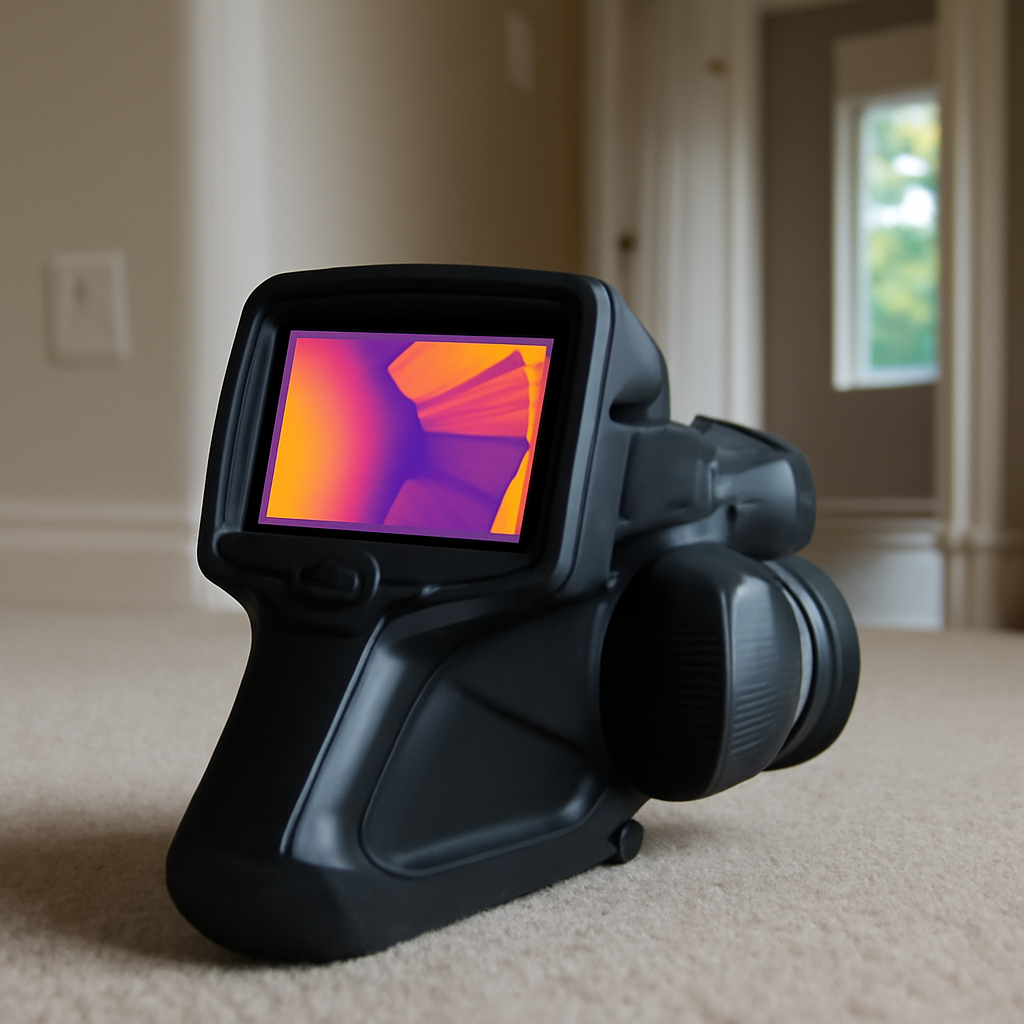
The FLIR T1020 sits near the top of FLIR’s handheld thermal camera range, a high-definition instrument built for professionals who need the sharpest possible thermal image. For most homeowners it is far more camera than a house requires, but understanding what its specifications deliver clarifies why some inspectors and engineers pay for this tier. This overview summarizes manufacturer specifications and trade-body guidance current as of 2026, and places the camera within the broader gear set covered in our home inspection tools guide.
What the FLIR T1020 is
The FLIR T1020 is a high-definition handheld thermal imaging camera in FLIR’s T-series flagship line. Its headline feature is a 1024 x 768 thermal detector, which is HD-class resolution for an infrared camera and many times the pixel count of the cameras most home inspectors carry. It pairs that detector with a rotating optical block, interchangeable lenses, and FLIR’s UltraMax and MSX image-enhancement features. UltraMax combines multiple frames to effectively increase resolution and reduce noise, while MSX embosses visible-light edge detail onto the thermal image so structures stay legible.
The design targets users who must measure precise temperatures at distance or resolve very small thermal detail: research labs, electrical substation crews, building-science consultants, and industrial inspectors. The ergonomics, including the rotating lens platform and a large viewfinder, reflect long professional use rather than occasional checks.
It helps to place the T1020 in context. Thermal cameras span an enormous range, from sub-$300 smartphone attachments with coarse 80 x 60 or 160 x 120 detectors to research instruments costing far more than the T1020. The flagship handheld tier the T1020 occupies is where image quality stops being the limiting factor in a diagnosis and the operator’s interpretation becomes the main variable. That is a meaningful threshold: below it, a camera can miss or blur a real anomaly, while at this level the camera reliably shows whatever thermal pattern exists, and the question becomes what that pattern means.
Key specifications
The T1020’s specifications explain its position and its price.
- Thermal resolution: 1024 x 768 native detector, about 786,000 measured pixels, with UltraMax processing that further sharpens detail.
- Thermal sensitivity (NETD): better than 20 mK, resolving temperature differences finer than 0.02 degrees C, which exposes very subtle anomalies.
- Temperature range: broad, spanning well below freezing to several hundred degrees C, with high-temperature options available.
- Interchangeable lenses: wide, standard, and telephoto options for everything from a whole wall to a distant transmission line.
- Rotating optical block: the lens platform pivots for comfortable framing of overhead or low targets.
- Connectivity: wifi and Bluetooth for image transfer and reporting integration.
The 1024 x 768 detector and sub-20 mK sensitivity are the defining numbers. Together they let the camera resolve small temperature differences across a fine grid, which is exactly what high-stakes diagnostic work demands.
Spatial resolution, often expressed as the instantaneous field of view, is the spec that ties resolution to real measurement. It describes the smallest area each pixel covers at a given distance, and it determines how small a target the camera can measure accurately rather than merely detect. A high pixel count combined with a good lens gives a fine spatial resolution, which is why the T1020 can put enough pixels on a small distant object to read its temperature truly. For buyers comparing flagship cameras, spatial resolution and the available lens options matter as much as the headline detector size.
Professional use cases
The T1020’s resolution earns its keep where detail and distance matter. In building science, it documents fine patterns of moisture intrusion, thermal bridging, and insulation defects across a large facade in a single frame, which a lower-resolution camera would render as a vague blur. In electrical inspection, the high resolution and telephoto lens let a crew measure the temperature of an overhead connection from a safe distance, supporting the kind of standoff inspection OSHA’s electrical-safety guidance encourages.
For residential work specifically, the same capabilities reveal moisture behind drywall, missing insulation, and air leakage with exceptional clarity, but the findings are the same ones a mid-tier camera flags. The DOE treats infrared scanning as a core method for locating insulation and air-sealing deficiencies during energy assessments, and the T1020 performs that job superbly, just at a price most home inspections cannot justify. Inspectors comparing tiers can review our overview of the FLIR E5 Pro at the entry end of the same family.
Where the resolution genuinely pays off
The T1020’s detail changes outcomes in specific situations rather than across the board. Measuring a small, distant target is the clearest example: a telephoto lens combined with the high pixel count lets a crew read the temperature of a single bolted connection on an overhead bus or a distant rooftop component accurately, where a low-resolution camera would average that hot spot with cooler surroundings and understate it. The principle is that accurate temperature measurement requires the target to fill enough pixels, so more pixels means accurate measurement of smaller or farther objects.
Large-area building diagnostics also benefit. Scanning an entire commercial facade or a flat roof in a single frame, then zooming into the high-resolution image afterward to study a suspicious pattern, is far more efficient than walking a low-resolution camera across the surface in dozens of small frames. For a building-science consultant documenting envelope performance across a big structure, that workflow advantage is real and recurring.
Interchangeable lenses and the rotating block
The lens system is part of what justifies the tier. A wide-angle lens captures a whole room or facade from a short standoff, a standard lens suits general work, and a telephoto lens reaches distant targets while keeping them large enough in the frame to measure. Swapping lenses tailors the same camera to jobs that would otherwise require different instruments. The rotating optical block adds practical comfort: it lets the operator aim at overhead connections or low foundation details without contorting, which matters over a full day of inspection. These are professional-workflow features, not gimmicks, and they are absent from the fixed-lens mid-tier cameras most inspectors carry.
Pricing
The T1020 is a five-figure instrument. New configurations commonly run well over $20,000 depending on lenses and options, placing it in a different financial universe from the $2,500 to $3,500 mid-tier Exx cameras and the few-hundred-dollar smartphone attachments.
That price makes sense for organizations whose work depends on the highest image quality, where a single missed defect costs far more than the camera. For a home inspector documenting residential moisture and insulation, the cost is rarely recoverable, which is why this tier is uncommon in routine home inspection. Buyers weighing the consumer end of thermal imaging can review our best inspection camera guide.
Renting is worth mentioning as an alternative to buying at this tier. A consultant facing a single large project that genuinely needs flagship resolution can rent a T1020 for the duration rather than committing to the purchase, which spreads the cost across the job that requires it. For organizations that need the capability only occasionally, renting or sharing one instrument across a region often makes more financial sense than every team owning one.
How it compares to mid-tier cameras
The contrast with FLIR’s own mid-range cameras is the most useful comparison. A FLIR E6 Pro offers a 240 x 180 detector; the FLIR E8 offers 320 x 240. The T1020’s 1024 x 768 detector resolves roughly ten to twenty times more measured points than those cameras, which translates into far finer thermal detail and the ability to measure smaller targets accurately at greater distance.
The question for any buyer is whether that detail changes the outcome. For locating a wet wall or a cold insulation gap in a house, a 240 x 240-class camera typically finds the problem, and the T1020’s extra resolution mainly produces a prettier image of the same finding. For measuring a small distant electrical connection or documenting subtle building-envelope patterns across a large structure, the resolution is the whole point. The honest buying test is the smallest target you must measure and the distance you must measure it from. Most homes do not require the T1020; specialized commercial and industrial work sometimes does.
What it is like to own and operate
A flagship thermal camera is a substantial tool in both size and workflow. The T1020 is larger and heavier than a pocketable mid-tier camera, built to be carried with a strap and operated with two hands, with a bright viewfinder for use in daylight where a rear screen washes out. Its battery supports extended field sessions, and it stores high-resolution images along with the matched visible photos that a defensible report needs. The reporting workflow integrates with FLIR’s desktop software, where the high pixel count allows zooming and re-analysis after the visit rather than requiring every measurement on site.
That capability comes with responsibility. A camera at this price is typically an organizational asset rather than a personal purchase, often shared across a team, which means tracking calibration status, lens inventory, and image archives matters. Users coming from a mid-tier camera find the controls familiar but the measurement options deeper, with adjustable emissivity, reflected-temperature compensation, and atmospheric correction available for situations where accuracy to a fraction of a degree is the goal.
How the buying decision actually breaks down
For a prospective buyer, the decision rarely comes down to whether the T1020 is a good camera, because it plainly is. It comes down to whether the work requires the top tier. Three questions settle it. What is the smallest target you must measure accurately, and from how far? If the answer involves small components at distance, the resolution earns its cost. How large are the areas you scan in one session? Big building envelopes favor the high pixel count. And does the work justify a five-figure instrument economically, through billable inspections, research output, or risk avoided? For industrial NDT, electrical utilities, and building-science consulting the math often works. For residential home inspection it usually does not, which is why the mid-tier Exx cameras dominate that field.
A homeowner is almost never the right buyer at this tier. The same budget covers a decade of professional thermal scans, and the casual questions a homeowner has about insulation or a draft are answered by a far cheaper camera or by hiring a professional once. The T1020 rewards the specialist whose findings depend on the finest available image, and it is overbuilt for everyone else.
Calibration, maintenance, and limitations
A high-end camera demands disciplined use. Periodic factory calibration keeps measurements traceable, which is essential when readings appear in formal reports or support warranty and insurance decisions. Lenses must be kept clean and stored carefully, since the optics are a significant share of the camera’s value, and the instrument should acclimate to ambient temperature before precise measurement.
The core limitation is universal to thermal imaging: the camera measures surface temperature, not the cause behind it. A cool patch could be moisture, a draft, or a thermal bridge, and reflective surfaces such as glass and polished metal mirror other temperatures and mislead the reading. Emissivity settings must match the material being measured for accurate temperatures. Even at this resolution, a thermal finding should be confirmed by other means, typically a moisture meter for damp surfaces. The T1020 makes anomalies easier to see; it does not remove the need to interpret them correctly.
The throughline for any prospective buyer is that the T1020 is a tool for specialists whose findings depend on the finest available image, and it is overbuilt for everyone else. Its resolution, sensitivity, lenses, and measurement options are genuine advantages where small or distant targets, large areas, or precise temperatures matter, and they are largely wasted on the routine moisture and insulation findings of a typical home. Matching the instrument to the demands of the work, and renting rather than buying when the need is occasional, is how the cost of this tier gets justified. For most home inspection, a mid-tier camera remains the rational choice.
References
- Home Energy Assessments — U.S. Department of Energy
- Electrical Safety — Occupational Safety and Health Administration
- Standards of Practice — International Association of Certified Home Inspectors
Thermal imaging cameras
Infrared cameras reveal hidden moisture, missing insulation, and air leaks. Phone-attachment models are the budget entry point; standalone units have higher resolution.
| Product | Why | Buy |
|---|---|---|
 FLIR ONE Pro (phone) FLIR ONE Pro (phone) | Plugs into iPhone/Android; inspector favorite. | Amazon — $349.00 |
 Topdon TC001 Topdon TC001 | High-res phone module at a low price. | Amazon — $199.99 |
 FLIR C5 Compact FLIR C5 Compact | Standalone pocket camera with Wi-Fi. | Amazon — $449.00 |