FLIR TG165-X: What Homeowners Need to Know
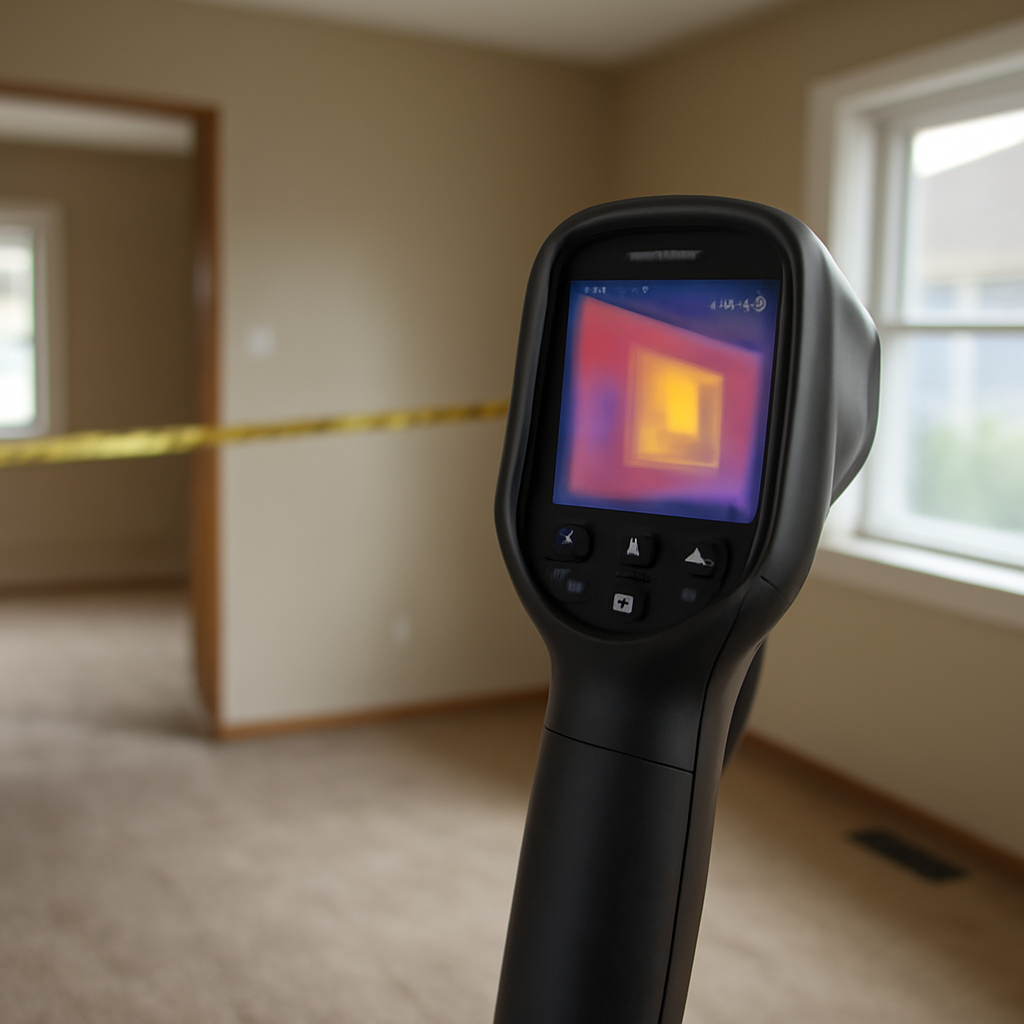
The FLIR TG165-X is a thermal spot camera — a handheld device that combines an infrared imager with a laser-guided non-contact thermometer, aimed at homeowners and tradespeople who need to find hot or cold spots quickly. It bridges the gap between a simple point-and-read infrared thermometer and a full thermal imaging camera, giving a thermal picture plus a precise spot temperature reading. This guide explains how the TG165-X works, what its specifications mean, where it helps in a home inspection, and how it stacks up against alternatives, leaning on inspection-standards guidance rather than promotional claims.
What the FLIR TG165-X is
The TG165-X belongs to a category often called the “thermal camera with a spot meter.” Where a basic infrared thermometer gives a single temperature number for wherever its laser points, the TG165-X adds a thermal image so the user can actually see the temperature pattern across a surface, then zero in on a point for an exact reading. It has a built-in color display, its own battery, and onboard image storage, so it operates standalone without a phone.
This makes it more capable than a spot thermometer but simpler than a high-resolution imaging camera. The design suits quick diagnostic work — finding which breaker is hot, where a draft enters, or whether a wall area reads cooler than its surroundings. It is one rung up from the most basic tools in our home inspection tools hub and a sensible first standalone thermal device for many homeowners.
The value of the spot-meter pairing becomes obvious in practice. A plain infrared thermometer tells you the temperature of one point but gives no context — you might be measuring the hot breaker or the cool wall an inch away without knowing it, because the laser dot does not show the surrounding pattern. The TG165-X shows the whole thermal field, so you can see the hot spot, place the measurement point exactly on it, and read a trustworthy number. That combination of image plus measurement is what makes it genuinely more useful than a thermometer for diagnostic work, even at the same modest resolution.
Because it is fully standalone, the TG165-X does not depend on a phone the way a clip-on attachment does. It powers on, scans, stores images, and reads temperatures on its own, which suits field use where juggling a phone is awkward. The trade-off is a smaller built-in screen than a phone provides, but for the quick checks this class of tool is built for, the standalone convenience usually wins.
Specifications that matter
The TG165-X is defined by a modest but practical set of specs. Understanding them sets realistic expectations:
- Thermal resolution — 80×60 native, enhanced with FLIR’s MSX visible-light overlay for added edge detail. This is entry-level resolution, suited to short-range scanning rather than fine, distant detail.
- Spot temperature accuracy — the device measures non-contact surface temperature across a wide range, commonly cited from roughly -25°C to 300°C (about -13°F to 572°F).
- Field of view — wide enough to capture a wall section or appliance at close range.
- MSX enhancement — overlays visible-light outlines onto the low-resolution thermal image to make it readable.
- Storage and battery — onboard image storage and a rechargeable battery for standalone field use.
The 80×60 resolution is the headline constraint. It is fine for locating a hot breaker or a cold draft, but it will not resolve the subtle, fine-grained moisture patterns a 320×240 camera reveals. Homeowners weighing resolution tiers can compare options in our handheld thermal imaging camera guide.
The spot-temperature accuracy is the spec that matters most for this tool’s strongest use, electrical work. Being able to point at a breaker and read a calibrated surface temperature — then compare it to the breaker beside it — turns a vague “that looks warm” into a documented number. The MSX overlay does meaningful work too: by laying crisp visible-light edges over the blocky 80×60 thermal image, it lets the user tell exactly which component the heat belongs to, something a bare low-resolution thermal image struggles to convey. Without MSX, an 80×60 image of a panel can be hard to map to the real components in front of you.
Real home-inspection uses
Within its class, the TG165-X handles a useful slice of inspection tasks:
- Electrical spot checks — pinpointing an overheating breaker, outlet, or connection by both image and exact temperature.
- Air-leak and draft detection — seeing cold streaks around windows, doors, and outlets in cold weather.
- Insulation screening — spotting cooler areas where insulation is missing or settled.
- Moisture leads — flagging cooler patches on drywall that warrant a moisture-meter check.
- HVAC and plumbing checks — reading register temperatures or tracing a warm pipe.
The spot-temperature feature is what distinguishes it. For diagnosing an electrical hot spot, having a verified temperature number alongside the image is genuinely useful. The Department of Energy recognizes thermographic scanning for finding heat loss, and standards bodies treat infrared as a screening aid the inspector verifies — guidance that applies fully here. A documented thermal imaging inspection still requires confirming findings with appropriate tools.
A realistic homeowner routine with the TG165-X starts at the electrical panel, scanning each breaker and connection for one running hotter than its neighbors, with the spot meter confirming the temperature. From there, a cold-weather sweep of exterior walls reveals drafts and insulation gaps as cool streaks, and a pass under sinks and around the water heater flags cool damp patches worth a moisture-meter check. The tool excels at the first task and is merely adequate at the moisture screening, which is the honest summary of where its 80×60 sensor sits. For electrical and energy work it is a strong value; for moisture detective work it is a starting point, not a final answer.
Pricing and comparisons
The TG165-X typically sells in the range of roughly $300 to $450, placing it between basic infrared thermometers (often under $100) and mid-range imaging cameras ($500 to $2,000). For that price, the combination of a thermal image and a spot meter is the main draw.
Against a smartphone attachment of similar resolution, the TG165-X offers standalone operation, a dedicated display, and onboard storage, at the cost of a slightly higher price. Against the related TG267 — which adds a true non-contact spot thermometer with a tighter measurement spot and similar imaging — the choice often comes down to whether you prioritize the measurement spec or the price. Against higher-resolution cameras, the TG165-X trades detail for affordability and simplicity. For occasional electrical and energy checks it is well matched; for serious moisture diagnostics, a higher-resolution unit is the better investment.
Stepping up to a 160×120 or 320×240 imaging camera changes what the tool can find. The added pixels resolve the subtle, fine-grained temperature gradients that mark a slow leak or a thin wet streak — patterns the 80×60 sensor blurs into a single soft blob. For a homeowner whose main worry is hidden moisture rather than electrical heat, that resolution jump is the more important upgrade than any spot-meter refinement. The honest framing is that the TG165-X is a thermal-aware diagnostic thermometer first and a thermal imager second, and buyers should choose it for the former.
Limitations, maintenance, and buying notes
The TG165-X carries the standard thermal limitations, magnified by its 80×60 resolution. It reads surface temperature only and cannot see through walls or detect moisture directly. It needs a temperature differential to reveal insulation and leak issues, so it shows little in mild weather. Reflective and shiny surfaces can throw off readings, and emissivity matters for accurate spot temperatures on materials like polished metal. The low resolution means working close to the target for any fine detail.
Maintenance is minimal: keep the lens clean using approved methods, store the camera dry and protected from impact, charge and store the battery per the manufacturer’s guidance, and follow any recommended periodic calibration so the spot readings stay accurate. When buying, decide honestly whether 80×60 resolution fits your needs — for electrical and draft work it is plenty, for moisture detective work it is marginal. Buy from authorized retailers, and treat the readings as solid for spot checks but indicative rather than laboratory-grade for whole-house diagnostics. Verified against a moisture meter and used within its lane, the TG165-X is a practical, durable first thermal tool.
Where the TG165-X shines and where it does not
The clearest way to judge any tool is to name the jobs it does well and the ones it does poorly. The TG165-X shines at electrical diagnostics, where its combination of a thermal image and a calibrated spot reading lets a user find and quantify an overheating breaker or connection. It shines at quick energy checks in cold weather, flagging drafts and insulation gaps as cool streaks. It is good at HVAC spot work, reading register temperatures and confirming whether a supply is delivering heated or cooled air. And it is good at general triage — getting a fast read on whether a wall, appliance, or fixture is running hot or cold.
It does poorly at fine moisture mapping, where its 80×60 resolution blurs the subtle gradients that mark a slow leak. It does poorly at scanning large areas from a distance, since low resolution forces close work. And it does nothing a thermal device cannot do — it will not see through walls, detect mold directly, or measure depth. A buyer who keeps these strengths and weaknesses straight will be satisfied; one who expects whole-house moisture diagnostics from a spot camera will not.
Buying advice for homeowners
The honest recommendation depends on the primary task. If electrical safety, energy checks, and quick spot diagnostics top the list, the TG165-X is a durable, affordable, well-suited choice that many homeowners keep for years. If finding hidden water and moisture is the main goal, the money is better spent on a 160×120 or 320×240 imaging camera, even at a higher price, because resolution is the spec that task demands. And for a one-time need such as a pre-purchase inspection, hiring a trained inspector with calibrated equipment usually beats buying any entry-level device. Bought for the right reasons and verified with a moisture meter when moisture is in question, the TG165-X is a sensible first step into thermal diagnostics rather than a do-everything solution.
It is worth appreciating why a spot-meter-plus-image design has stayed popular even as full imaging cameras have come down in price. Many real household questions are spot questions: is this breaker too hot, is this register delivering cold air, is this pipe the hot-water line. For those, a precise temperature reading paired with just enough image to aim it is exactly the right amount of capability, and adding resolution would not change the answer. The TG165-X is built around that reality. It does not try to be a survey instrument; it tries to answer pointed diagnostic questions quickly and accurately, and within that scope it does the job well for years of routine use.
References
- Home Energy Assessments and Thermographic Inspections — U.S. Department of Energy
- Infrared Thermal Imaging in Home Inspections — InterNACHI
- Standard of Practice — American Society of Home Inspectors
Thermal imaging cameras
Infrared cameras reveal hidden moisture, missing insulation, and air leaks. Phone-attachment models are the budget entry point; standalone units have higher resolution.
| Product | Why | Buy |
|---|---|---|
 FLIR ONE Pro (phone) FLIR ONE Pro (phone) | Plugs into iPhone/Android; inspector favorite. | Amazon — $349.00 |
 Topdon TC001 Topdon TC001 | High-res phone module at a low price. | Amazon — $199.99 |
 FLIR C5 Compact FLIR C5 Compact | Standalone pocket camera with Wi-Fi. | Amazon — $560.00 |