Best Flir Camera for Home Inspection

Choosing the best FLIR camera for home inspection comes down to which part of the FLIR lineup fits the way an inspector works. FLIR sells spot-IR imagers that behave like smart thermometers, pocket handhelds built around cloud reporting, an E-series handheld with the highest native resolution in the current Amazon set, and phone modules for iPhone and wireless use. Every FLIR listing here carries the same 2-year camera and 10-year detector warranty and the same MSX image overlay, so the real choices are resolution, form factor and how images get into a report. Below are all seven current FLIR listings ranked for inspection work, with honest notes on where non-FLIR cameras on the same shelf state stronger specs.
Part of our Thermal Imaging for Homes guide — start there for the full picture →
As an Amazon Associate we earn from qualifying purchases.
How we compared: we compared 24 current Amazon thermal camera listings, 7 from FLIR and 17 from other brands for context, on what each listing states: native resolution, upscaling, temperature range and accuracy, MSX, cloud and Wi-Fi features, targeting aids, durability and warranty. One borescope listing that appeared in the same search was set aside. We did not lab-test or handle any unit. Prices and availability change, so check the current listing before buying.
Quick picks: FLIR cameras for home inspection by role
| Pick | Best for | Key spec | Key detail |
|---|---|---|---|
| FLIR E6 Pro | Full-time inspectors | 240×180 native (43,200 pixels) | Wi-Fi, Ignite cloud, over-the-air updates |
| FLIR C5 | Pocket camera with emailed reports | 160×120 native (19,200 pixels) | Ignite upload, reports emailed to clients |
| FLIR Edge Pro | Wireless scans around corners | 160×120 native, 480×360 enhanced | Bluetooth link to iOS or Android |
| FLIR One Pro | iPhone-based inspectors | 160×120 native, 480×360 enhanced | In-app inspection guides |
| FLIR TG268 | Spot IR with a visual camera | 160×120 native, 320×240 enhanced | 640×480 visual camera, laser |
| FLIR TG165-X | Budget spot-IR backup | 80×60 (4,800 pixels) | Bullseye laser, IP54 |
| FLIR One | Entry-level iPhone module | 80×60 native, 240×180 enhanced | Inspection guides; 1.5 m drop rating |
The seven FLIR picks, compared listing by listing
1. FLIR E6 Pro — Best FLIR for Full-Time Home Inspectors

240×180 handheld with MSX, Wi-Fi, FLIR Ignite cloud storage and over-the-air updates, -4°F to 1022°F.
Check price on Amazon$2,199.00 as of Oct 10, 2026 10:17 pm GMT+0000 — prices change; see Amazon for current price.| Specification | Details |
|---|---|
| Resolution | 240×180 thermal resolution (43,200 pixels), no upscaling claimed |
| Range | -4°F to 1022°F (-20°C to 550°C) |
| Image detail | MSX embosses visible-light edges on the thermal image |
| Connectivity | Wi-Fi; FLIR Ignite cloud for automatic storage, editing and sharing; over-the-air firmware updates |
| Size / weight | Listed dimensions about 9.6 × 3.7 × 5.5 in; listed weight 1.27 lb |
| Model / warranty | 13302-0201; 2 years parts and labor, 10 years on the detector |
FLIR E6 Pro 13302-0201 — 240×180 native (43,200 px), -4–1022°F, MSX, Wi-Fi, Ignite cloud, OTA updates, 2-10 warranty
The Highest Native Resolution of Any FLIR Listing Here
Four of the seven FLIR listings use a 160×120 detector and two use 80×60. The E6 Pro is the only FLIR at 240×180, which is 43,200 measured pixels, more than double the 19,200 on the C5. Unlike four of the other FLIR listings, it does not lean on Vivid IR upscaling; the number quoted is the detector’s own.
It is also the only FLIR listing that states an upper limit of 1022°F, and the only listing on the entire shelf that mentions over-the-air updates. Ignite cloud storage means images are off the camera and backed up before the inspector leaves the driveway, which matters when a report is due that evening. Our FLIR infrared camera overview covers the broader lineup.
Context from the rest of the shelf is worth stating plainly. Four non-FLIR listings, two handhelds and two phone modules, state a 256×192 native sensor, slightly above the E6 Pro’s figure, and 13 non-FLIR listings publish a NETD while no FLIR listing does. The E6 Pro’s case rests on FLIR’s ecosystem and warranty as much as on raw specs.
Pros
- 240×180 native, highest of any FLIR here
- Ignite cloud and Wi-Fi for fast report handoff
- Over-the-air updates
- 2-year camera, 10-year detector warranty
Cons
- NETD not stated in listing
- No laser or battery runtime described
- Heaviest FLIR listing at 1.27 lb
2. FLIR C5 — Best Pocket FLIR With Emailed Reports

Pocket 160×120 FLIR with MSX, Wi-Fi, Ignite cloud upload and reports emailed straight to clients.
Check price on Amazon$611.50 as of Oct 10, 2026 10:17 pm GMT+0000 — prices change; see Amazon for current price.| Specification | Details |
|---|---|
| Resolution | 160×120 true thermal resolution (19,200 pixels) |
| Range | -4°F to 752°F (-20°C to 400°C) |
| Image detail | MSX visible-edge overlay |
| Reporting | Uploads directly to FLIR Ignite; create professional reports and email them to customers |
| Size / weight | About 5.4 × 3.3 × 0.94 in; 0.42 lb |
| Model / warranty | 89401-0202; 2 years parts and labor, 10 years on the detector |
FLIR C5 89401-0202 — 160×120 native, -4–752°F, MSX, Wi-Fi, Ignite upload and email reports, 0.42 lb, 2-10 warranty
The Only Listing on the Shelf That Describes Emailing Reports to Clients
Seven listings among the 24 describe report generation, but the C5 is the only one that describes the full loop: capture, upload to the cloud, build a professional report and email it to the customer. For a solo inspector who delivers same-day reports, that workflow is the point of the camera.
It is also the lightest standalone FLIR listed, at 0.42 lb, compared with 0.8 lb for the TG268, 0.87 lb for the TG165-X and 1.27 lb for the E6 Pro. Its 160×120 detector is stated as true resolution, without upscaling. That puts it in the middle of the shelf: above the five listings at 96×96 or below, well below the four at 256×192.
The listing dates from 2020 and states a 752°F ceiling, lower than the 1022°F common on newer cameras but well above anything a residential panel should show. No NETD, battery runtime or laser is described.
Pros
- Only listing describing emailed client reports
- Lightest standalone FLIR at 0.42 lb
- True 160×120 resolution with MSX
Cons
- 752°F upper limit
- NETD and battery life not stated
- Older 2020 listing; no laser
3. FLIR Edge Pro — Best for Wireless Scans Around Corners
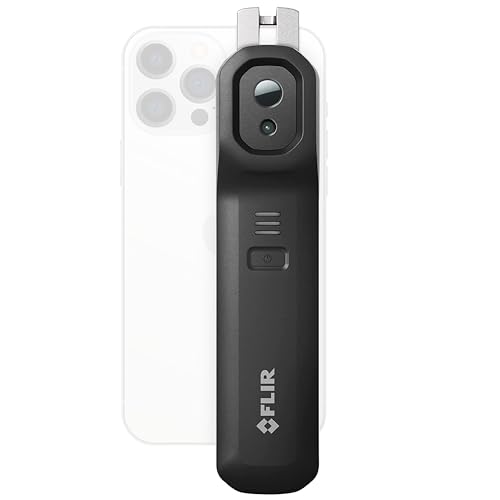
Wireless FLIR that links to iOS or Android over Bluetooth, 160×120 upscaled to 480×360, with MSX and Ignite.
Check price on Amazon$529.00 as of Oct 10, 2026 10:17 pm GMT+0000 — prices change; see Amazon for current price.| Specification | Details |
|---|---|
| Connection | Bluetooth to Android or iOS phones and tablets; no cable to the phone |
| Resolution | 160×120 native, Vivid IR upscaling to 480×360; MSX |
| Accuracy | ±3°C or ±5% when the unit is 15–35°C and the scene is 5–120°C |
| Cloud | FLIR Ignite upload, organization and sharing |
| Size / weight | About 5.87 × 1.38 × 1.48 in; 0.33 lb |
| Model / warranty | 11002-0201; 2-10 thermal camera warranty |
FLIR Edge Pro 11002-0201 — Bluetooth to iOS/Android, 160×120 native (480×360), MSX, Ignite, 0.33 lb, 2-10 warranty
The Only Wireless Phone-Linked Camera on the Shelf
Nine listings among the 24 are phone modules that plug into a USB-C or Lightning port. The Edge Pro is the only camera that connects over Bluetooth instead, so the camera and the phone can be in different places. FLIR’s own description is seeing into tight spaces and around corners, which in a house means behind a water heater, up into an attic hatch or under a kitchen sink while the phone stays in hand.
It also avoids the compatibility traps that run through the plug-in listings. Several state they do not work with Macs, a specific Android version or older iPhones; the Edge Pro says it works with any Android or iOS device over Bluetooth.
The trade-offs are stated accuracy and native resolution. Its ±3°C or ±5% figure, under specific conditions, is looser than the ±2°C or 2% many non-FLIR listings state, and the 480×360 output is processed from a 160×120 detector. The listing does not give a temperature range or runtime.
Pros
- Only Bluetooth-linked camera on the shelf
- Works with any iOS or Android device per listing
- Ignite cloud and MSX
Cons
- Looser stated accuracy
- Temperature range and runtime not stated
- 480×360 is upscaled from 160×120
4. FLIR One Pro — Best FLIR for iPhone-Based Inspectors
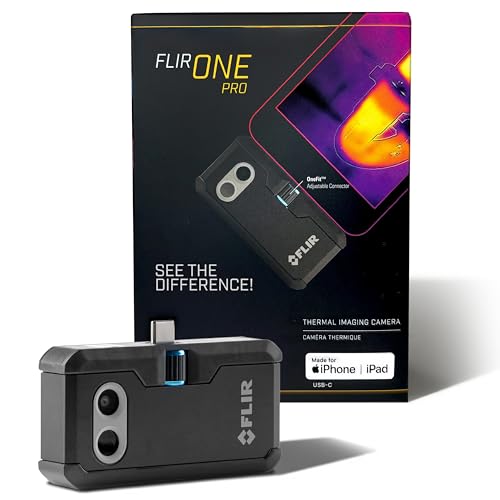
USB-C iPhone module, 160×120 upscaled to 480×360, MSX, in-app inspection guides and 1.5 m drop rating.
Check price on Amazon$349.00 as of Oct 10, 2026 10:17 pm GMT+0000 — prices change; see Amazon for current price.| Specification | Details |
|---|---|
| Compatibility | iPhone 15 and newer with a USB-C port |
| Resolution | 160×120 native, Vivid IR to 480×360; MSX |
| Guidance | Step-by-step inspection guides in the FLIR One app for air leaks, moisture and other faults |
| Accuracy | ±3°C or ±5% within stated unit and scene temperatures |
| Durability | 1.5-meter drop rating |
| Model / warranty | 435-0008-03 (2025 listing); 2-10 thermal camera warranty |
FLIR One Pro 435-0008-03 — USB-C iPhone 15+, 160×120 native (480×360), MSX, inspection guides, 1.5 m drop, 2-10 warranty
The Highest-Resolution FLIR Phone Module, With Built-In Inspection Guides
Three listings describe in-app inspection guides: the two FLIR One models and the TOPDON TC001 Mini. The One Pro has the largest native sensor of the three at 160×120, double the pixel count of the TC001 Mini’s 96×96 and four times the 80×60 FLIR One. Its 2025 release date is also the most recent among the FLIR listings that state one.
For inspectors already carrying a USB-C iPhone, the One Pro turns the phone into a FLIR with the same 10-year detector coverage as the handhelds. Guides help newer inspectors build a consistent routine for air leaks and moisture.
Non-FLIR phone modules on the shelf state more aggressive specs. Two state a 256×192 native sensor and seven state a NETD of 40mK, while the One Pro states neither a NETD nor a full temperature range. The comparison is FLIR’s app and warranty against raw numbers. Our roundup of the best infrared cameras includes those alternatives.
Pros
- 160×120 native, highest of the FLIR phone modules
- In-app inspection guides
- 10-year detector coverage
Cons
- USB-C iPhones only
- NETD and temperature range not stated
- Looser stated accuracy than most competitors
5. FLIR TG268 — Best Spot-IR Imager With a Visual Camera
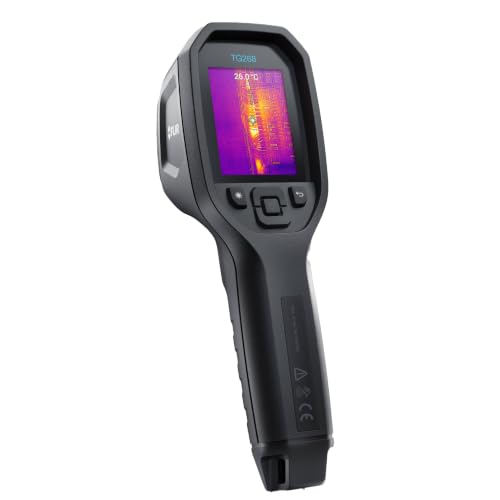
Spot-IR imager with 160×120 sensor upscaled to 320×240, 640×480 visual camera for MSX, bullseye laser and IP54.
Check price on Amazon$571.50 as of Oct 10, 2026 10:17 pm GMT+0000 — prices change; see Amazon for current price.| Specification | Details |
|---|---|
| Resolution | 160×120 native, Vivid IR upscaling to 320×240 |
| Visual camera | 640×480 visual camera that drives MSX |
| Targeting | Laser pointer indicates the size of the measurement area |
| Durability | Drop-tested; IP54 against dirt, dust and oil |
| Size / weight | About 8.2 × 2.6 × 2.5 in; 0.8 lb |
| Range / warranty | Temperature range not stated in listing; 2-10 warranty |
FLIR TG268 — 160×120 native (320×240), 640×480 visual camera, MSX, laser spot sizing, IP54, 0.8 lb, 2-10 warranty
The Only FLIR Listing That States Its Visual Camera Resolution
All seven FLIR listings mention MSX, which needs a visible-light image to emboss onto the thermal picture. The TG268 is the only FLIR listing that gives that visual camera a resolution, 640×480. It is also one of two FLIR listings, with the TG165-X, that include a laser pointer, and one of five laser-equipped cameras across all 24 listings.
Compared with its TG165-X sibling, the TG268 has four times the native pixels (160×120 against 80×60), which makes it a real imaging tool rather than only a smart thermometer. The pistol-grip spot-IR style suits electrical and HVAC spot checks, where the laser marks the breaker or register being read.
The listing does not state a temperature range, storage or any reporting path. For report-driven inspection work, the C5 or E6 Pro fits better; for quick, rugged spot checks with images, the TG268 is the stronger of the two TG models.
Pros
- 160×120 native with a 640×480 visual camera
- Laser shows measurement area
- IP54 and drop-tested
Cons
- Temperature range not stated
- No storage, Wi-Fi or reporting described
- 320×240 output is upscaled
6. FLIR TG165-X — Best Budget Spot-IR Backup

80×60 spot-IR imager with MSX, laser for spot sizing, IP54 drop-tested housing and -13°F to 572°F range.
Check price on Amazon$399.00 as of Oct 10, 2026 10:17 pm GMT+0000 — prices change; see Amazon for current price.| Specification | Details |
|---|---|
| Resolution | 4,800-pixel infrared sensor (80×60) |
| Range | -13°F to 572°F (-25°C to 300°C) |
| Image detail | MSX visible-edge overlay |
| Targeting | Laser pointer indicating measurement area size |
| Durability | Drop-tested; IP54 enclosure |
| Model / warranty | 87501-0101; 0.87 lb; 2-10 warranty |
FLIR TG165-X 87501-0101 — 80×60 (4,800 px), -13–572°F, MSX, laser, IP54, 0.87 lb, 2-10 warranty
The Coldest Stated Lower Limit on the Shelf
Most listings that state a range start at -4°F. The TG165-X starts at -13°F, the lowest lower limit among all 24 listings. For a Front Range inspector checking exterior penetrations or a garage on a January morning, that extra margin is a small but real advantage.
Everything else is modest. At 80×60, it ties with the FLIR One for the lowest native resolution on the shelf, and its 572°F upper limit is the lowest stated. It works as a spot-IR tool, a step above an infrared thermometer because it shows a coarse image around the reading. See infrared thermometer guns for the tool it most resembles.
Many inspectors carry a spot-IR imager like this in addition to a main camera, for quick panel and HVAC checks where a full scan is not needed.
Pros
- -13°F lower limit, coldest stated on the shelf
- Laser and IP54 housing
- FLIR 2-10 warranty
Cons
- 80×60, tied for lowest native resolution
- 572°F upper limit, lowest stated
- No storage or reporting described
7. FLIR One — Best Entry-Level FLIR for iPhone

Entry USB-C iPhone module, 80×60 upscaled to 240×180, MSX, in-app inspection guides and 1.5 m drop rating.
Check price on Amazon$249.00 as of Oct 10, 2026 10:17 pm GMT+0000 — prices change; see Amazon for current price.| Specification | Details |
|---|---|
| Compatibility | iPhone 15 and newer with USB-C |
| Resolution | 80×60 native, Vivid IR to 240×180; MSX |
| Guidance | Step-by-step inspection guides in the FLIR One app |
| Accuracy | ±3°C or ±5% within stated conditions |
| Durability | 1.5-meter drop rating |
| Model / warranty | 435-0010-03; 2-10 thermal camera warranty |
FLIR One 435-0010-03 — USB-C iPhone 15+, 80×60 native (240×180), MSX, inspection guides, 1.5 m drop, 2-10 warranty
The Lowest-Resolution FLIR Module, but With the Same Guides and Warranty
The FLIR One shares nearly every bullet with the One Pro: same app, same inspection guides, same accuracy statement, same drop rating and the same 2-10 warranty. The difference is the sensor, 80×60 against 160×120, which leaves it tied with the TG165-X for the lowest native count among the 24 listings.
That makes it a fit for homeowners who want to look for drafts and wet spots before calling an inspector, or for an agent who wants a quick look during a walkthrough. It is not a primary inspection camera. The FLIR One’s 240×180 output is upscaled, and fine detail across a ceiling will be limited.
Homeowners using it should read our guide to an infrared scan in a home inspection to understand what a professional scan adds.
Pros
- Same inspection guides as the One Pro
- FLIR 2-10 warranty
- Pocketable iPhone module
Cons
- 80×60 native resolution
- USB-C iPhones only
- No NETD or range stated
How the FLIR lineup maps to inspection work
The seven listings fall into three practical tiers. Spot-IR imagers (TG165-X, TG268) are pistol-grip tools for checking a breaker, a register or a pipe, with lasers but no reporting. Pocket and E-series handhelds (C5, E6 Pro) are built around cloud upload and reports, which is how inspection images reach clients. Phone modules (One, One Pro, Edge Pro) put FLIR’s sensor and app on a device the inspector already carries.
For most full-time inspectors, the decision is between the C5 and the E6 Pro. The C5 is lighter and its listing describes an end-to-end email report flow; the E6 Pro has more than twice the native pixels and a higher upper temperature limit. Our best thermal imagers guide compares these against non-FLIR handhelds.
What FLIR listings do and do not tell you
MSX and the visible image
All seven FLIR listings describe MSX, which embosses edges from a visible camera onto the thermal image. In a report, that is the difference between a colored blob and a recognizable window corner. Non-FLIR cameras offer similar fusion under other names, but MSX is consistent across the FLIR line.
Native resolution vs Vivid IR
Four FLIR listings quote Vivid IR upscaled figures (480×360, 320×240, 240×180). Native detectors on the FLIR listings are 80×60, 160×120 or 240×180. Compare cameras on native pixel counts, and treat upscaled output as a display convenience.
NETD is missing
None of the seven FLIR listings state thermal sensitivity, while 13 of the 17 non-FLIR listings do, at 40mK to 60mK. That does not mean FLIR sensors are worse, only that the listing does not let a buyer compare. FLIR’s own datasheets are the place to check before buying.
Warranty
FLIR’s 2-10 warranty, two years on the camera and ten on the detector, appears on all seven FLIR listings and on no other brand’s listing in this set. For a working inspector, ten years of detector coverage is a meaningful part of the value.
How inspectors use a FLIR on Front Range homes
Thermal imaging supports, but does not replace, the visual inspection. The ASHI Standard of Practice describes a home inspection as not technically exhaustive and lists the extensive use of advanced instruments as part of what technically exhaustive means. A FLIR scan is therefore an added layer that inspectors describe separately in their reports.
Typical targets are moisture under bathrooms and roof valleys, insulation voids in exterior walls and attics, and warm breakers. The EPA notes that controlling moisture is the key to controlling mold and that wet materials should be dried within 24 to 48 hours. ENERGY STAR lists drafty rooms, uneven temperatures and ice dams as signs of air leaks and missing insulation, all of which show up on a winter scan.
Timing matters along the Front Range. Insulation and air-leak scans need a clear indoor-outdoor temperature difference, which cold mornings in the heating season provide; summer afternoons and sun-loaded walls can hide patterns. Local pages such as thermal imaging inspection in Niwot describe service in specific areas.
Limits of a FLIR in untrained hands
A FLIR camera reads surface temperature only. It does not see through walls, detect mold or measure moisture content. Reflections, framing and sunlight all produce patterns that look like defects. Every suspect area should be confirmed with a moisture meter or further investigation before it appears in a report as a defect.
Electrical scanning adds risk. OSHA identifies electric shock, electrocution, fires and explosions as the dangers its electrical standards address and highlights arc flash near energized equipment. Panel covers should be removed only by trained inspectors or electricians.
A homeowner with a FLIR One can find spots worth asking about. An inspector with training, a moisture meter and the right conditions can tell which ones matter. When a scan turns up something real, or when buying a home where moisture or insulation is a concern, reach out through our contact page to connect with a Front Range inspector who offers thermal imaging. Our home inspection tools guide covers the rest of the kit.
References
- ASHI Standard of Practice for Home Inspections — American Society of Home Inspectors
- A Brief Guide to Mold, Moisture and Your Home — U.S. Environmental Protection Agency
- Attic Air Sealing Project — ENERGY STAR
- Electrical Safety Overview — Occupational Safety and Health Administration
Frequently asked questions
Which FLIR camera is best for home inspection?
For full-time inspectors, the FLIR E6 Pro offers the highest native resolution in the current FLIR listings at 240×180, with Wi-Fi and Ignite cloud. The FLIR C5 is lighter and its listing describes emailing reports to clients. Phone modules like the FLIR One Pro suit inspectors who prefer working from an iPhone.
Is the FLIR One Pro good enough for professional inspections?
It has a 160×120 native sensor, MSX and in-app inspection guides, which is enough for many residential findings. Its limits are a phone-dependent setup, looser stated accuracy than many competitors and no stated NETD. Many inspectors use it as a backup to a dedicated handheld.
What is FLIR's 2-10 warranty?
FLIR's current listings describe two years of parts and labor coverage on the camera and ten years on the detector. In this comparison, it appeared on every FLIR listing and on no other brand's listing.
What does MSX mean on a FLIR camera?
MSX is FLIR's technique for embossing edges from a visible-light camera onto the thermal image. It makes thermal photos easier to interpret in reports because outlines of windows, outlets and framing remain visible.
Can a FLIR camera find mold or see through walls?
No. A FLIR reads surface temperature only. Moisture often makes surfaces cooler, so a FLIR can point to areas worth checking, but a moisture meter and, if needed, mold sampling or a professional inspection must confirm the cause.
Buying or selling on the Front Range and want a FLIR thermal scan as part of the inspection? Reach out through our contact page to connect with a vetted local inspector.
Thermal imaging cameras
Infrared cameras reveal hidden moisture, missing insulation, and air leaks. Phone-attachment models are the budget entry point; standalone units have higher resolution.
| Product | Why | Buy |
|---|---|---|
 FLIR ONE Pro (phone) FLIR ONE Pro (phone) | Plugs into iPhone/Android; inspector favorite. | Amazon — $349.00 |
 Topdon TC001 Topdon TC001 | High-res phone module at a low price. | Amazon — $199.99 |
 FLIR C5 Compact FLIR C5 Compact | Standalone pocket camera with Wi-Fi. | Amazon — $611.50 |