Thermal Imaging Inspection Niwot, CO | InspectandTest

A thermal imaging inspection uses an infrared camera to reveal temperature differences across a home’s surfaces, exposing problems that a standard visual inspection can miss, hidden moisture, missing insulation, air leaks, and overheating electrical components. In Niwot, the affluent unincorporated Boulder County community southeast of Longmont, the housing ranges from late-1800s Old Town cottages to large custom homes on rural acreage, where infrared is especially useful for finding concealed issues. This page explains what thermal imaging inspection niwot homeowners and buyers should expect, why local conditions make it valuable, and what it covers. Infrared is a powerful diagnostic add-on, though it reads surface temperature patterns rather than seeing through walls directly.
Part of our Thermal Imaging for Homes guide — start there for the full picture →
Thermal imaging inspection in Niwot: what to know
A thermal imaging inspection uses an infrared camera to detect subtle temperature variations on building surfaces. Because moisture, missing insulation, air movement, and electrical heat all change surface temperature, the camera reveals their thermal signatures even when nothing is visible to the eye. The inspector interprets these patterns, then confirms findings with a moisture meter or other tools, since infrared shows a temperature anomaly rather than naming its cause directly.
In Niwot, the technology suits the housing well. A century-old Old Town Niwot cottage may have inconsistent insulation and hidden moisture behind layers of remodeling, while a large custom home on acreage has extensive wall and ceiling area where infrared efficiently surveys for energy loss and leaks. Because the camera scans quickly and non-invasively, it covers far more area than spot-checking by hand. Our guide to hiring a home inspector explains how thermal imaging fits alongside a standard inspection as a diagnostic enhancement.
Thermal imaging is most often an add-on to a general or pre-purchase inspection rather than a standalone service. It strengthens those inspections by catching conditions a visual-only assessment would miss, which is why many Niwot buyers and homeowners request it specifically when the home’s age, size, or a suspected problem makes hidden issues likely.
Why Niwot homes need thermal imaging
Local conditions give infrared specific work to do. The Front Range’s cold winters, Chinook winds, and sharp freeze-thaw cycles stress a home’s building envelope, and thermal imaging reveals where insulation has settled or is missing and where air leaks let conditioned air escape, both common in older Old Town homes and in large acreage properties with extensive exterior surface. Energy efficiency matters in Niwot’s climate, and the camera maps exactly where a home is losing heat.
Moisture detection is the other major use. Spring snowmelt, occasional heavy summer storms, and the freeze-thaw cracking of roofs and foundations all create paths for water intrusion, and infrared finds the cool, damp signatures of hidden moisture behind walls and ceilings before visible staining or mold appears. On a rural Niwot property with private well plumbing, the camera can also help locate a slow concealed leak by its temperature signature. Catching moisture early protects both the structure and indoor air quality.
Electrical safety rounds out the value. Overloaded circuits, loose connections, and failing components generate heat before they fail, and a thermal scan of the electrical panel and accessible wiring can reveal hot spots that signal a hazard. In an Old Town Niwot home with aged or repeatedly modified electrical systems, this is a meaningful safety check. Across moisture, insulation, and electrical concerns, thermal imaging gives a Niwot homeowner a view into conditions that would otherwise stay hidden until they caused damage.
What a Niwot thermal imaging inspection covers
A thermal scan covers the accessible interior and exterior surfaces, with the inspector interpreting anomalies and confirming them with supporting tools.
Moisture and insulation scanning
The inspector scans walls, ceilings, and floors for the temperature signatures of hidden moisture and for gaps or missing insulation that show up as thermal irregularities. Findings are verified with a moisture meter so a cool spot from dampness is distinguished from one caused by an air draft or a thermal bridge. In a Niwot home, this catches concealed leaks and energy-loss areas a visual inspection would pass over.
Electrical and air-leak detection
The camera scans the electrical panel and accessible circuits for overheating connections and components, flagging potential fire-safety hazards for evaluation by an electrician. It also reveals air leakage around windows, doors, outlets, and envelope penetrations, mapping where a Niwot home loses conditioned air. The inspector documents these thermal images alongside the standard inspection report, giving the homeowner a clear visual record of where hidden problems and energy losses exist.
Thermal imaging inspection cost in Niwot
Thermal imaging in the Niwot and Boulder County market is usually offered as an add-on to a home or pre-purchase inspection, commonly adding about $100 to $250 to the inspection fee. As a standalone targeted scan, for instance to investigate a specific suspected leak or an electrical concern, it may run roughly $200 to $400 depending on scope.
Larger custom homes on Niwot acreage and complex Old Town floor plans sit at the higher end because there is more surface to scan and interpret. The technology’s value scales with the home’s age and size, since older and larger homes hide more of the conditions infrared is good at finding.
The cost is reasonable against what it catches. A hidden moisture intrusion found early, before it rots framing or feeds mold, saves far more than the scan costs, and an overheating electrical connection caught before it fails can prevent a fire. For a Niwot buyer, infrared findings during a pre-purchase inspection can also become negotiating points. The camera does not find everything, and it is a diagnostic aid rather than a guarantee, but for the modest add-on price it surfaces problems a visual-only inspection would leave hidden.
Niwot regulations and disclosure
Colorado does not license home inspectors or specifically regulate thermal imaging, so the inspector’s training and experience with infrared interpretation are what matter. A poorly interpreted thermal image can mislead as easily as inform, so look for an inspector with documented infrared training rather than someone who simply owns a camera. Certification bodies like InterNACHI offer infrared training that signals competence.
Thermal imaging findings can inform a Colorado Seller’s Property Disclosure indirectly, since a scan that reveals a hidden moisture problem documents a condition a seller may need to disclose or a buyer may raise during a contingency. Because Niwot is unincorporated, any repairs prompted by thermal findings run through Boulder County permitting. The technology itself carries no special regulatory requirement, but using a properly trained inspector ensures the findings are credible enough to act on.
Neighborhoods and areas served
Thermal imaging inspection serves all of Niwot’s housing: historic Old Town Niwot cottages, upscale subdivisions like Somerset, Lake Valley, and Niwot Highlands, and large custom homes on rural acreage. Coverage typically extends to adjacent Longmont, Boulder, Gunbarrel, and Hygiene, which share Niwot’s Front Range climate and building-envelope challenges.
Thermal imaging works best paired with a full home inspection in Niwot, which provides the systems-level assessment the infrared scan enhances, and neighboring thermal imaging inspection in Longmont reflects the same climate-driven energy and moisture concerns just across the boundary.
How to choose a Niwot thermal imaging provider
Ask whether the inspector has documented infrared training, uses a quality thermal camera, and confirms thermal findings with a moisture meter or other tools rather than relying on the image alone. A good thermal inspector explains what each anomaly likely means and distinguishes a genuine moisture or electrical concern from a harmless thermal-bridge effect, which is where interpretation skill matters most.
For a Niwot home, confirm the inspector will scan the areas most relevant to the property, the building envelope and electrical panel on any home, plus concealed plumbing on a rural well property. Pairing the scan with a standard inspection gives the most value, since the thermal findings make sense in the context of the home’s overall condition. A provider who treats infrared as a precise diagnostic tool, with honest limits, rather than a magic see-through camera, is one whose findings you can rely on.
What thermal imaging can and cannot tell a Niwot homeowner
Setting honest expectations is part of using infrared well. The camera is excellent at revealing patterns, the cool blush of evaporative moisture on a ceiling, the dark void where insulation is missing in a wall, the bright glow of an overheating breaker, but it shows a temperature difference, not a diagnosis. A cool spot on a Niwot basement wall could be hidden moisture, or it could be a thermal bridge where a framing member conducts cold, or simply a draft from an air leak. Distinguishing these requires the inspector to combine the thermal image with a moisture meter reading, a visual check, and knowledge of how the home is built.
Conditions also matter. Infrared works by detecting temperature contrast, so it performs best when there is a meaningful difference between indoors and outdoors, a cold Niwot winter day against a heated interior makes insulation gaps and air leaks stand out vividly. On a mild day with little temperature differential, the same problems may not register. A skilled inspector knows to account for this, noting when conditions limited what the scan could reveal rather than implying the camera found everything. The technology cannot see through walls, cannot detect a leak that is not currently wet, and cannot find a problem that is not producing a temperature signature at the moment of the scan.
Understanding these limits actually makes infrared more valuable, not less. A Niwot homeowner who knows the scan is a powerful but bounded tool will pair it with a full inspection, schedule it when conditions favor good contrast, and trust an inspector who confirms findings rather than one who treats every thermal anomaly as a crisis. Used this way, thermal imaging reliably surfaces hidden moisture, energy losses, and electrical hazards that a visual-only inspection would miss, which is exactly the value it is meant to provide.
Energy savings from a Niwot thermal scan
Beyond catching defects, thermal imaging has a practical payback in comfort and utility cost, which matters in Niwot’s demanding climate. The same scan that documents missing insulation and air leaks for an inspection report doubles as an energy audit, mapping precisely where a home loses heat in winter and gains it in summer. For a large Niwot Highlands or Somerset home with extensive wall and ceiling area, those losses add up, and seeing them in thermal images tells a homeowner exactly where to direct improvement dollars rather than guessing.
Common findings translate directly into fixes. A thermal void above a finished basement ceiling or in an attic kneewall points to insulation that settled or was never installed, and adding it there yields a measurable comfort gain. Bright streaks around windows, doors, electrical outlets, and the rim joist reveal air leaks that simple sealing and weatherstripping can close, reducing the drafts that make a room feel cold even when the thermostat says otherwise. The U.S. Department of Energy recognizes infrared scanning as a useful component of a home energy assessment for exactly this reason. For a Niwot homeowner facing Chinook winds and long heating seasons, a thermal scan that turns into a targeted air-sealing and insulation project can improve comfort and trim energy use, so the inspection add-on pays dividends well beyond the day of the scan.
References
- Infrared thermography certification — International Association of Certified Home Inspectors
- Standard of Practice — American Society of Home Inspectors
- ENERGY STAR: Seal and Insulate — U.S. Environmental Protection Agency (ENERGY STAR)
Frequently asked questions
What does a thermal imaging inspection find in a Niwot home?
Infrared reveals hidden moisture behind walls and ceilings, missing or settled insulation, air leaks in the building envelope, and overheating electrical connections, conditions a standard visual inspection often cannot detect.
How much does thermal imaging cost in Niwot?
As an add-on to a home or pre-purchase inspection it typically adds $100 to $250. A standalone targeted scan runs roughly $200 to $400, with larger custom and Old Town homes at the higher end.
Can infrared see through walls?
No. The camera reads surface temperature patterns, not what is behind a wall directly. A trained inspector interprets those patterns and confirms findings with a moisture meter, so infrared is a diagnostic aid rather than an x-ray.
Is thermal imaging worth it for an older Old Town Niwot home?
Often, yes. Older homes hide inconsistent insulation, concealed moisture from decades of remodeling, and aged electrical systems, all conditions infrared is well suited to find before they cause damage.
Do I need a standalone thermal scan or an add-on?
Most homeowners add infrared to a full home or pre-purchase inspection, since the thermal findings are most useful in the context of the home's overall condition. A standalone scan suits investigating one specific suspected problem.
In Niwot’s older and larger homes, infrared surfaces the hidden moisture, insulation gaps, and electrical heat a visual inspection alone would miss. To connect with a vetted Boulder County inspector trained in thermal imaging, get in touch through our contact page.
Thermal imaging cameras
Infrared cameras reveal hidden moisture, missing insulation, and air leaks. Phone-attachment models are the budget entry point; standalone units have higher resolution.
| Product | Why | Buy |
|---|---|---|
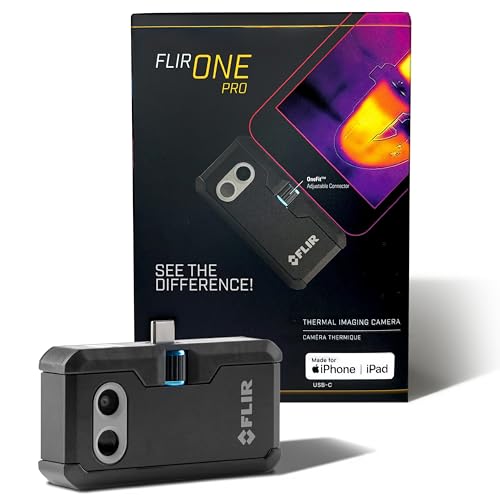 FLIR ONE Pro (phone) | Plugs into iPhone/Android; inspector favorite. | Amazon — $296.65 |
 Topdon TC001 | High-res phone module at a low price. | Amazon — $249.00 |
 FLIR C5 Compact | Standalone pocket camera with Wi-Fi. | Amazon — $593.99 |