Electrical Tape: Proper Uses and Why It Isn’t a Splice

Nearly every toolbox has a roll of black vinyl electrical tape, and nearly every home inspector has opened a ceiling or looked into a basement and found wires joined with nothing but a few wraps of it. That gap between what the tape is for and how it gets used is the subject of this guide. Electrical tape is a legitimate, listed product with real jobs: marking conductors, bundling, insulating some connections inside a proper enclosure and protecting cable jackets from minor scuffs. It is not a way to join wires by itself, and it does not turn a loose splice in a wall cavity into a safe one. Below, homeowners and buyers will find how tape is rated, the color code, where tape is acceptable, why tape-only splices get written up, alternatives like rubber splicing tape and heat-shrink, and what an inspector checks. Wiring repairs belong with a licensed electrician.
Part of our Home Electrical guide — start there for the full picture →
Electrical problem? Talk to a licensed electrician.
📞 Call (877) 560-2714What Electrical Tape Is and What It Is Rated For
Standard electrical tape is a thin, stretchy vinyl (PVC) film with a pressure-sensitive rubber-based adhesive. It is designed to stretch and conform around a conductor, stick to itself and resist moisture, abrasion and many chemicals. Quality tapes are listed by a recognized testing laboratory and carry printed ratings on the roll or packaging.
The two ratings that matter most:
- Voltage rating. General-purpose vinyl tapes are commonly rated for up to 600 volts per layer, which covers residential branch circuits. The rating assumes the tape is applied as directed, usually half-lapped in multiple layers.
- Temperature rating. Many general-purpose tapes are rated in the range of about 80 degrees Celsius (176 degrees Fahrenheit), while premium tapes may be rated higher, often around 105 degrees Celsius. Above the rating, the adhesive softens, the tape can unwind, and the vinyl may become brittle over time.
Cheap unlisted tapes may not meet these ratings at all. Common signs of poor or aged tape are gummy residue, flagging (loose ends peeling away), cracking, and wraps that have slid off the conductor. Tape in attics, near light fixtures, in panels next to warm breakers and in outdoor locations ages faster.
Thickness and grade
Electrical tapes are sold in several grades. Thinner, economy tapes are fine for marking and bundling. Thicker professional grades are designed for better conformability in cold weather, better adhesion and higher temperature tolerance. Cold-weather performance matters in Colorado garages, crawl spaces and outdoor boxes, where some vinyl tapes get stiff and hard to apply in winter.
Acceptable Uses of Electrical Tape
Within its ratings and inside proper enclosures, electrical tape has several accepted roles.
Color-coding and marking conductors
Colored vinyl tapes are widely used to identify conductors. In typical U.S. residential wiring, black and red usually indicate ungrounded (hot) conductors, white or gray indicates the grounded (neutral) conductor, and green or bare copper indicates the equipment grounding conductor. Larger conductors, such as service and feeder cables, often have only black insulation, and electricians mark them with colored tape at terminations to identify phases or the neutral. Blue, yellow, brown, orange and violet tapes are also sold for commercial phase marking.
A common residential example is re-identifying a white conductor. In some switch loops and 240-volt circuits wired with standard two-conductor cable, the white wire is used as a hot conductor. Electrical codes generally allow this in specific situations only if the white conductor is permanently re-identified, often with black or red tape, at every location where it is visible and accessible. The exact rules depend on the code edition adopted locally, so this is something an electrician should confirm. Missing re-identification is a frequent finding when inspectors remove a switch cover or panel deadfront; it does not always mean the wiring is unsafe, but it makes the next person’s work riskier.
Bundling and harnessing
Tape can bundle low-voltage cables, organize conductors inside a panel or enclosure, and hold wires together during installation. Cable ties and listed bundling methods are often preferred for long-term work, because tape adhesive can fail with heat and age.
Minor jacket and insulation repair
Tape can protect a cable jacket that has a small, superficial scuff. It is not a cure for insulation that is cracked, melted, brittle or cut down to the copper. Many manufacturers and electricians consider damaged conductor insulation a reason to cut back to sound wire and make a new connection in a box, or to replace the cable. Appliance and extension cords with damaged insulation should be replaced rather than taped; the U.S. Fire Administration advises replacing an appliance with a cracked, damaged or loose cord and replacing worn or damaged extension cords right away.
Supplementing listed connectors
Some electricians add a wrap of tape over a twist-on connector or around the terminal screws of a receptacle or switch. This is a supplement, not a substitute. A properly installed listed connector should hold and insulate the splice on its own. Tape around device terminals can help in crowded boxes, but it should not be needed to make an installation safe.
How tape is applied correctly
Where tape is appropriate, technique matters as much as the product. Manufacturers generally describe a similar method:
- Start on clean, dry insulation, not on dust, oil or old adhesive residue.
- Stretch the tape moderately as it is applied so it conforms, but do not stretch it to the point of thinning or necking.
- Half-lap each wrap, so every turn overlaps the previous one by about half its width, and build up the number of layers the manufacturer specifies.
- Finish the last wrap without tension so the end does not flag or creep loose.
- Choose a colored tape for marking and a temperature-rated tape for warm locations.
Even a perfect wrap remains a covering. If the wires under it are not joined by a listed connector inside a box, the installation is still incomplete, which is the subject of the next section.
Best Electrical Tape: our top 3 picks
| Product | Best for | Key features | Price | Buy |
|---|---|---|---|---|
| 3M Scotch Super 33+ | Premium all-weather tape |
| — | Buy now →Check current price |
| Scotch 700 | General-purpose single roll |
| $3.28as of Nov 6, 2026 5:13 am GMT+0000 | Buy now →Check current price |
| 3M Temflex 175 | Bulk rolls with UL 510 named |
| $30.42as of Nov 6, 2026 5:13 am GMT+0000 | Buy now →Check current price |

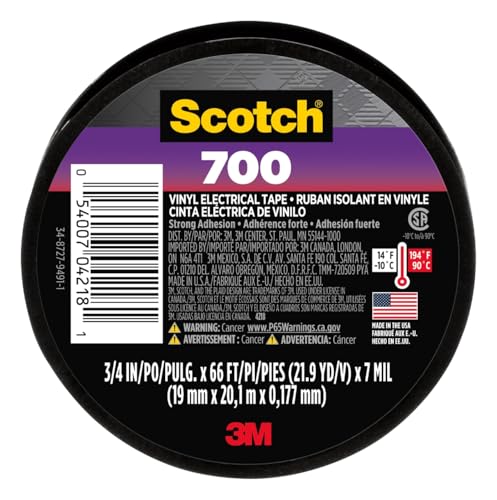

Prices are Amazon’s listed prices as of the time shown and change often; check Amazon for today’s price. As an Amazon Associate we earn from qualifying purchases.
Why Tape Is Not an Acceptable Splice by Itself
The most important point in this guide: a splice made by twisting wires together and wrapping them in tape, with no listed connector and no enclosure, is not an acceptable method in residential wiring. Inspectors and electricians see it constantly, and it is one of the more common electrical findings in home inspection reports.
Two separate requirements are being skipped.
1. Splices need a listed connection method
Electrical codes generally require conductors to be joined with devices identified for the purpose. In homes that usually means twist-on wire nuts, push-in or lever-style Wago connectors, crimp sleeves or other listed connectors sized for the number and gauge of conductors. A connector maintains mechanical pressure on the conductors. Tape cannot do that; it only insulates. A twisted splice held only by tape can loosen as conductors heat and cool, and a loose connection creates resistance, heat and, potentially, arcing.
2. Splices need an accessible enclosure
Splices belong inside an approved box, typically a junction box with a cover, that remains accessible without removing finished surfaces. The box contains heat and sparks if a connection fails and protects the splice from physical damage. A tape-wrapped splice buried in a wall, floating in an attic or stuffed into insulation has none of that protection, and nobody can find or inspect it later.
Both requirements apply even if the tape is high quality and the splice looks neat. A listed connector in an open ceiling is still a defect without a box, and a box with a tape-only splice inside is still a defect without a connector.
Why it matters: fires and shock
The U.S. Fire Administration reports that in 2021 an estimated 24,200 residential building electrical fires were reported to U.S. fire departments, causing an estimated 295 deaths, 900 injuries and over $1.2 billion in property loss. That figure covers all electrical fires, not tape-only splices specifically, and no public data isolates splice-related fires as a category. But loose and unprotected connections are a recognized hazard, and CPSC’s electrical safety alert lists warning signs such as dimming or flickering lights, sizzling or buzzing sounds, the odor of overheated plastic, and hot switch plates and outlet covers. It recommends having a licensed electrician check a home’s electrical system if any of those signs appear.
Alternatives: Friction, Rubber Splicing Tape and Heat-Shrink
Several products are sometimes confused with standard vinyl electrical tape. Each has its own job.
Friction tape
Friction tape is a cloth tape impregnated with a rubber-based compound. It is tacky on both sides and has been used for decades as a protective outer wrap, for example over rubber splicing tape, for tool handle grips and for mechanical protection. It is not a primary insulator, and its presence in an old house is often a clue to older wiring work.
Rubber splicing tape
Self-fusing rubber (often ethylene propylene rubber) splicing tape is stretched as it is applied and fuses into a solid, void-free mass. It is used for insulating and moisture-sealing splices and terminations on larger conductors, often in utility and commercial work, and is usually covered with a vinyl tape jacket for abrasion and UV protection. It still does not replace the mechanical connector; it insulates over one.
Heat-shrink tubing
Heat-shrink tubing is slid over a crimped or soldered connection and shrunk with a heat gun. Adhesive-lined versions seal out moisture. It is common on low-voltage, automotive, landscape-lighting and equipment wiring, and on some listed splice kits. Like tape, it insulates a connection; it does not join the wires.
Mastic and listed splice kits
For underground or wet locations, such as a buried feeder or a well pump circuit, manufacturers sell listed splice kits that combine a connector with resin, gel or heat-shrink sealing. Where such a splice is needed, the kit’s listing and instructions govern, not a roll of tape.
Old Wiring, Conduit and Where Tape Shows Up
Tape turns up most often in places where wiring has been modified over decades. Several situations deserve extra caution.
- Knob-and-tube wiring. Original knob-and-tube wiring used soldered splices wrapped in rubber and friction tape, supported on porcelain. Those splices were accepted methods at the time, but the insulation is now very old, and later additions are frequently spliced in with tape and no box.
- Aluminum branch wiring. Homes with aluminum wiring need connectors specifically listed for aluminum, or for aluminum-to-copper connections. Tape does nothing to address the connection problems associated with aluminum branch circuits.
- Conduit systems. In electrical conduit, splices generally must be made in boxes or fittings, not inside the conduit run. Tape is commonly used to mark conductors in conduit, which is fine.
- DIY additions. Basement finishes, attic lighting, garage outlets and under-cabinet lighting are common places to find unboxed taped splices.
Front Range housing stock spans Victorian-era homes in older Denver neighborhoods, postwar ranches in Arapahoe and Jefferson counties, and newer subdivisions in Douglas and El Paso counties. Older homes are more likely to have layers of modifications, but improper taped splices show up in houses of every age.
Testing, Switch Work and When to Call an Electrician
Homeowners can do some basic checks. A plug-in outlet tester can flag common wiring faults such as reversed polarity or an open ground at receptacles. It cannot find a taped splice inside a wall, and it cannot confirm that a connection is tight.
During simple device replacements, such as light switch replacement, homeowners often discover taped connections, unmarked white conductors used as hots or damaged insulation. That is a good moment to stop and call an electrician, not to add more tape. OSHA’s electrical safety materials, written for workplaces, describe electricity as a long-recognized serious hazard that exposes people to electric shock, electrocution, fires and explosions. The same physics applies at home: turn off the circuit, verify it is dead with a tester and work only within skill and permit limits.
Call a licensed electrician when:
- Splices are found outside boxes, in insulation or in wall cavities.
- Insulation is brittle, cracked, melted or discolored from heat.
- Tape is the only thing holding a connection together.
- There are signs of overheating: scorch marks, a burning smell, warm cover plates.
- The home has knob-and-tube or aluminum branch wiring.
Widespread problems can point toward partial or full rewiring. Our guide to house rewiring cost covers what drives those numbers.
What Home Inspectors Check and What Repairs Cost
The ASHI Standard of Practice lists conductors, service equipment, interior components of panels and subpanels, overcurrent protection devices, and a representative number of lighting fixtures, switches and receptacles among the electrical items an inspector inspects. It also requires the inspector to describe the predominant branch circuit wiring method. Inspectors are not required to measure amperage, voltage or impedance, and they generally do not open walls or remove every cover plate.
Within those limits, inspectors frequently report taped splices visible in unfinished basements, attics, crawl spaces and garages; open junction boxes without covers; white conductors used as hots without re-identification; and tape on damaged service-entrance or appliance cables. Because an inspector sees only accessible areas, one taped splice may suggest more. Our electrical inspection guides explain the rest of the electrical portion, and the main guide to hiring a home inspector covers choosing an inspector.
Typical repair costs
Costs depend on access and the number of problems, so treat these as broad, hedged 2026 ranges:
- Correcting a single accessible taped splice by adding a box, cover and listed connectors: often a modest charge, commonly within a service-call minimum plus materials.
- Several splices in finished areas: more, since walls or ceilings may need to be opened and patched.
- Systemic problems with old or damaged wiring may lead to circuit replacement or rewiring, which can run into the thousands.
A roll of quality electrical tape costs a few dollars. It is a useful tool, but its job ends at insulating, marking and protecting; the connection itself has to come from a listed connector inside a box.
References
- Appliance and Electrical Fire Safety — U.S. Fire Administration
- Electrical Safety — U.S. Consumer Product Safety Commission
- Electrical Safety Overview — Occupational Safety and Health Administration
- ASHI Standard of Practice for Home Inspections — American Society of Home Inspectors
Frequently asked questions
Can I splice wires with just electrical tape?
No. Splices need a listed connector, such as a wire nut, lever connector or crimp sleeve, inside an accessible covered box. Tape only insulates; it does not hold conductors under pressure, and an unboxed taped splice is a common inspection defect.
What voltage is electrical tape rated for?
Many general-purpose vinyl electrical tapes are rated for up to 600 volts, applied in overlapping layers as directed. Check the roll for the listing, voltage and temperature rating, since cheaper unlisted tapes may not meet them.
Why is there black tape on a white wire?
A white conductor used as a hot, such as in some switch loops or 240-volt circuits, is generally required to be permanently re-identified with tape or marking. Rules depend on the locally adopted code, so have an electrician confirm the circuit.
Is it safe to tape a damaged extension cord?
It is not recommended. The U.S. Fire Administration advises replacing worn or damaged extension cords right away and replacing appliances with cracked or damaged cords, rather than relying on tape repairs.
What is the difference between electrical tape and friction tape?
Vinyl electrical tape is a listed insulating tape. Friction tape is a cloth tape treated with rubber compound, used mainly as an outer protective wrap and for grip. Friction tape is not a primary insulator.
Found taped splices in a basement or attic of a home you are buying? Get in touch and we can connect you with a Front Range inspector who documents electrical defects clearly.