Crawl Space Dehumidifier Cost: 2026 Price and Sizing Guide
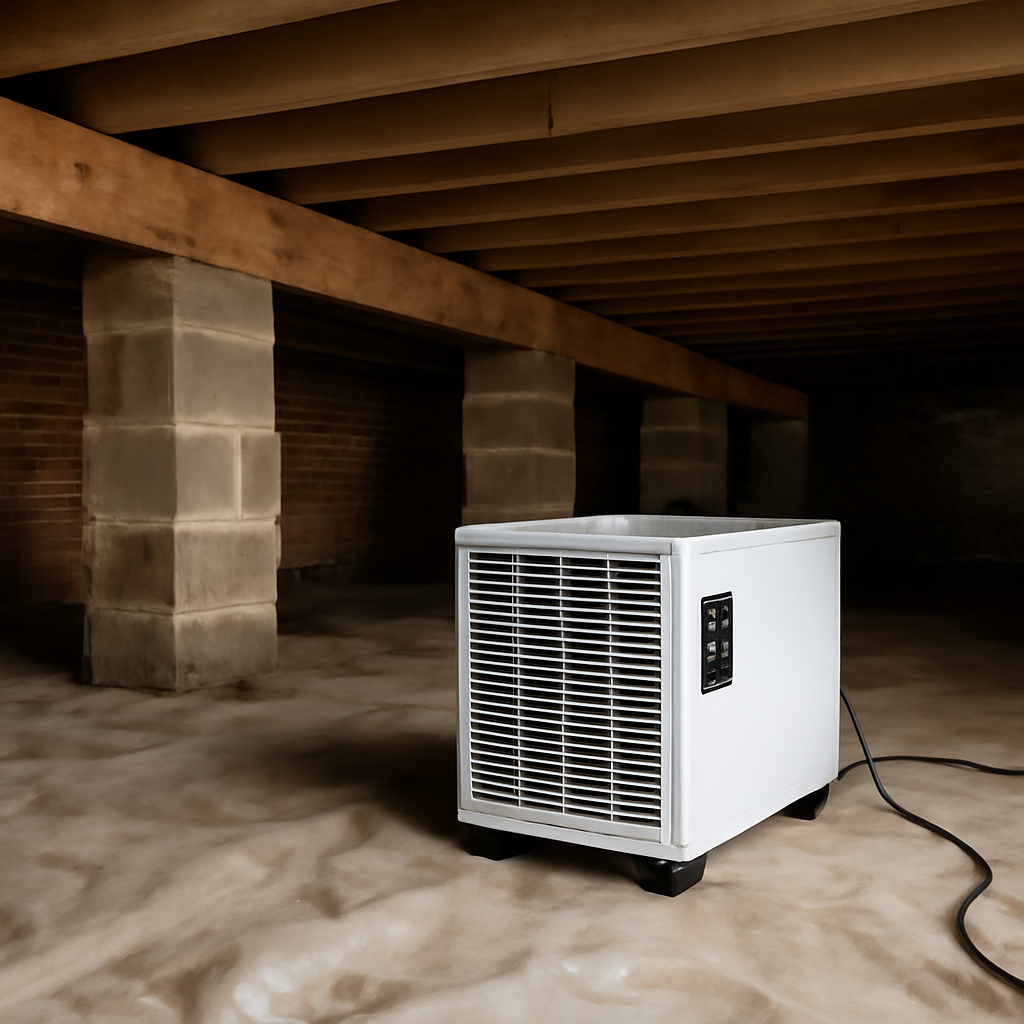
The total crawl space dehumidifier cost is more than the price tag on the unit. A finished installation includes the machine, a way to get the condensate out, a dedicated power source, labor, and years of electricity. Some crawl spaces also need sealing work before a dehumidifier makes sense at all. This guide breaks those pieces down with hedged price ranges, explains how to size a unit, covers when one is needed and when it is not, and compares a dehumidifier with the supply-air approach that some builders use instead. It pays particular attention to the Colorado Front Range, where the semi-arid climate changes the math compared with humid regions. Prices below are planning ranges current as of 2026, not quotes, and local labor rates, access, and brand will move them.
Part of our Crawl Space & Attic Guide guide — start there for the full picture →
Dealing with mold or water damage? Talk to a remediation pro now.
📞 Call (833) 723-1134Crawl Space Dehumidifier Cost Breakdown
The table below separates the main cost components. Ranges reflect what crawl-rated equipment and installation commonly run in the U.S.; a specific bid can fall outside them, especially for tight or hard-to-reach crawl spaces.
| Component | Typical range (hedged) | What drives the number |
|---|---|---|
| Crawl-rated dehumidifier unit (residential grade) | Roughly $900 to $1,600 | Capacity in pints per day, low-temperature performance, efficiency, warranty |
| Commercial-grade or high-capacity unit | Roughly $1,500 to $2,800+ | Larger capacity, heavier build, ducting options, longer warranty terms |
| Professional installation labor | Roughly $300 to $1,200 | Access height, distance from entry, hanging versus floor placement, ducting |
| Gravity condensate drain line | Roughly $50 to $300 | Distance to an approved drain point, need for wall or rim penetration |
| Condensate pump (if no gravity path) | Roughly $75 to $350 installed | Pump quality, safety switch, length of discharge line |
| Dedicated electrical outlet | Roughly $150 to $500 | Distance to the panel, circuit availability, local permit rules |
| Remote humidity monitor or control | Roughly $25 to $250 | Simple hygrometer versus a connected sensor or wall control |
| Annual operating cost | Estimate with the method below | Unit wattage, run hours, local electric rate, how well the crawl is sealed |
Adding those lines together, many professionally installed systems land somewhere in the low thousands of dollars, with commercial-grade units, long drain runs, and new circuits pushing the figure higher. A homeowner comfortable with a straightforward placement and an existing outlet and drain can cut labor, but the unit itself remains the largest single line.
Why Crawl-Rated Units Cost More Than Basement Units
A portable bucket dehumidifier from a big-box store is much cheaper, and owners often ask why it cannot simply sit on the crawl space floor. The differences are practical. Crawl spaces run cool, and ENERGY STAR notes that when air temperature falls below 65 degrees Fahrenheit, frost can form on a dehumidifier’s condensing coils, causing the compressor to cycle without removing much moisture. Crawl-rated units are designed for lower temperatures and higher humidity, include a continuous drain fitting, are built to sit unattended for months, and often have a compact, low-profile housing that fits under joists. Many also allow ducting so a single unit can serve a larger or segmented crawl. More detail on product differences is in the guide to the best crawl space dehumidifier options.
Estimating Annual Operating Cost
Running cost depends too heavily on local conditions for a single number to be useful, but the estimate is straightforward:
- Find the unit’s rated power draw in watts from the spec sheet or nameplate.
- Estimate daily run hours. A unit in a sealed crawl in a dry climate may run only a few hours a day in some seasons; a unit fighting an open or wet crawl may run nearly continuously.
- Multiply watts by hours, divide by 1,000 to get kilowatt-hours per day, and multiply by the number of days in the season.
- Multiply the result by the electric rate on the utility bill, in dollars per kWh.
A connected plug-in energy meter can replace the guesswork after a month of operation. ENERGY STAR measures dehumidifier efficiency with the integrated energy factor, in liters of water removed per kilowatt-hour, where a higher number means a more efficient machine, and says certified models remove the same moisture as similar conventional units while using about 20 percent less energy. Comparing the integrated energy factor between models is the most direct way to compare long-term running cost.
Example Scenarios
Three simplified scenarios show how the same line items combine differently. They are illustrations of how costs stack up, not quotes or typical outcomes.
- Sealed crawl, easy access, existing outlet and sump. A residential crawl-rated unit sits on blocks near the sump, drains by gravity into the pit, and plugs into a GFCI outlet already in place. Cost is mostly the unit plus modest labor, and a handy owner may place it without help.
- Sealed crawl, no drain point, no outlet. The same unit now needs a condensate pump with a discharge line routed out through the rim joist to a drain point, plus an electrician to run a new receptacle. Those two add-ons can approach the cost of the unit itself.
- Large or segmented crawl with ducts. A higher-capacity or commercial-grade unit is hung from the joists and ducted to reach separate bays. Labor, ducting, and mounting hardware rise, and the larger unit draws more power.
In each case, the cost of making the space ready, such as a liner, sealed vents, and drainage corrections, usually sits on a separate line and can exceed the dehumidifier package.
DIY Versus Professional Installation
Some owners install crawl dehumidifiers themselves, and the labor savings are real. The trade-offs are access, safety, and accountability. Crawl spaces can hold sharp debris, pests, old insulation, and in older homes, materials that should not be disturbed without testing. Electrical work is often permit-controlled and best left to a licensed electrician. Condensate routing must discharge to an acceptable location, not onto the soil inside the crawl or against the foundation. A professional installer also typically handles warranty registration and may include a follow-up humidity check. For owners who do proceed themselves, reading the manufacturer’s installation manual before buying confirms clearances, mounting options, and drain requirements.
Sizing: Pints Per Day and What It Means
Dehumidifier capacity is stated in pints of water removed per 24 hours. ENERGY STAR explains that the right capacity depends on two things: the size of the space and how damp it is without dehumidification. For portable models it offers a chart that, for spaces under about 2,000 square feet, suggests roughly 20 to 30 pints per day for a slightly to moderately damp space at 50 to 75 percent relative humidity, 25 to 40 pints for a very damp space at 75 to 90 percent, and 30 to 50 pints for a wet space at 90 to 100 percent. It also states that it is better to oversize than undersize.
Two caveats apply to crawl spaces. First, ENERGY STAR notes that capacity ratings have changed, as newer test procedures rate units under different conditions. A unit labeled under the older method may show a higher pint number than an equivalent unit rated under the current method, so compare models rated the same way. Rating methods are generally based on AHAM test conditions, and crawl-rated units sometimes publish capacity at more than one condition; read the fine print. Second, an unsealed crawl space connects to outdoor air and soil moisture, so no reasonably sized unit can hold humidity down if the space is wide open. Sizing assumes the crawl has been sealed first.
A rough approach many installers use is to start with crawl floor area and condition, then adjust for how well the space is sealed, the presence of standing water, and ductwork that leaks humid air. For hands-on placement and setup details, the crawl space dehumidifier installation guide walks through mounting, drainage, and controls.
When a Crawl Space Dehumidifier Is Actually Needed
A dehumidifier is a moisture-control tool, not a first step. Most building-science guidance treats it as the last piece of a sequence: fix bulk water, cover the ground, seal the space, then control residual humidity mechanically.
After Encapsulation or a Sealed Vapor Barrier
Once a crawl is encapsulated, with vents closed, walls sealed, and a continuous ground liner, it no longer dries by outdoor air exchange. Some form of conditioning or dehumidification is usually part of the design. Costs for the sealing work itself are covered in the guide to crawl space encapsulation cost, and a lighter-weight ground cover project is explained in crawl space vapor barrier installation. ENERGY STAR’s basement and crawlspace project page points homeowners to Department of Energy Building America resources on enclosed crawlspaces and notes that planning should consider the area’s climate zone and weather conditions.
Signs That Point Toward Dehumidification
- A hygrometer in the crawl reads consistently above 60 percent relative humidity after sealing.
- Condensation appears on ducts, pipes, or the underside of the liner.
- Musty odors reach the living space, or wood shows surface mold or high moisture content.
- Floors above feel damp or cupped hardwood appears.
The EPA’s Brief Guide to Mold, Moisture and Your Home advises keeping indoor humidity below 60 percent if possible, ideally between 30 and 50 percent, and notes that relative humidity can be measured with an inexpensive moisture or humidity meter. Many crawl space programs target the same general band, often aiming to stay comfortably below 60 percent. Before buying anything, place a logging hygrometer in the crawl for a few weeks across different weather; it is the cheapest way to learn whether the problem exists. A deeper look at symptoms and fixes is in the guide to crawl space moisture control.
Colorado Crawl Spaces: Many May Not Need One
The Front Range is semi-arid, with low outdoor humidity for much of the year. That changes the picture compared with the Southeast, where crawl dehumidifiers are routine. In many Colorado homes, a sealed crawl with a good ground liner may stay below the target humidity range most of the year without a dedicated machine, especially if it receives a small amount of conditioned air. That is a general tendency, not a rule: specific crawls can still run damp.
Conditions that raise the odds of needing a unit in Colorado include:
- Poor grading or downspouts discharging near the foundation, which wets the soil around the crawl.
- Expansive clay soils that hold moisture and may push water through cracks.
- Irrigation systems spraying the foundation or flowerbeds along the wall.
- Plumbing leaks, a high water table, or a crawl that floods during spring runoff or heavy summer storms.
- Humid summer monsoon periods, when open vents admit moist air that condenses on cool surfaces.
Readings tell the story. If a sealed Front Range crawl reads well inside the target band through a full summer, the money may be better spent on grading, gutters, or radon mitigation, which is common in Colorado and sometimes paired with crawl space sealing.
Drainage and Power: The Hidden Line Items
ENERGY STAR notes that whole-home dehumidifiers are usually equipped only with a drain, which should be routed to a floor drain or condensate pump during installation. Crawl units work the same way. If the crawl has a sump or an exterior grade lower than the unit, a gravity line is cheapest. Otherwise a condensate pump lifts water to a drain point. Units with built-in pumps exist; the guide to a crawl space dehumidifier with pump explains the trade-offs. A pump with an overflow safety switch that shuts off the dehumidifier is worth the small premium.
Power is the other line many owners overlook. Crawl spaces often lack a convenient outlet, and running a unit on an extension cord is a fire and code concern. An electrician may need to add a GFCI-protected receptacle, sometimes on a dedicated circuit. Costs rise when the panel is full or far from the crawl access.
Rebates and Incentives
ENERGY STAR maintains a rebate finder for certified dehumidifiers, searchable by ZIP code. Utilities sometimes offer rebates on certified portable or whole-home units, and availability changes year to year. Crawl-rated models are not always ENERGY STAR certified, so check the specific model before assuming a rebate applies. Separately, some air sealing and insulation work may qualify for federal tax credits or utility programs; ENERGY STAR’s seal and insulate resources link to current information.
Dehumidifier Versus the Supply-Air Alternative
Some builders condition a sealed crawl by delivering a small amount of supply air from the home’s HVAC system, with a pathway back to the house, rather than installing a standalone dehumidifier. The comparison is worth understanding before buying.
| Factor | Standalone dehumidifier | Supply air from HVAC |
|---|---|---|
| Upfront cost | Unit, drain, outlet, and labor | Usually a duct branch, damper, and return path; often lower |
| Moisture removal | Active, controlled by a humidistat | Depends on HVAC run time and how dry the house air is |
| Works when HVAC is idle | Yes | Limited, since air moves mainly when the system runs |
| Fit for dry climates | May be more than needed | Often adequate where house air is dry, as in much of Colorado |
| Ongoing maintenance | Filter, coil, drain, pump checks | Part of normal HVAC maintenance |
| Code and design notes | Needs proper drain and electrical | Must follow local code for conditioned crawl spaces |
Neither choice is universally better. In a humid climate or a crawl with persistent moisture sources, a dedicated dehumidifier offers more reliable control. In a dry climate with a well-sealed crawl, supply air may be enough. An HVAC contractor or home performance professional can evaluate the specific house. The background guide on running a dehumidifier in a crawl space covers how the two approaches perform over time.
Maintenance and Long-Term Cost
A crawl dehumidifier runs out of sight, which makes neglect easy. A simple maintenance routine protects the investment:
- Filter. Check and clean or replace per the manufacturer, often every few months. A clogged filter reduces airflow and capacity.
- Coil and housing. Inspect annually for dust buildup or corrosion.
- Drain line and pump. Confirm water is flowing and the safety switch works. Algae and sediment can block lines.
- Humidity readings. Use a remote sensor to verify the unit is holding the target range, so a failure is noticed quickly.
- Liner and sealing. Look for tears, open seams, or new water entry that would increase the load.
Crawl-rated units are typically warrantied for several years, and lifespan depends on run hours, dust, and maintenance. Budget for an eventual replacement and for occasional pump replacement, which tends to be the shorter-lived component. For general background on how the equipment works, see the overview of the crawl space dehumidifier.
Mold and Moisture Context
The EPA states that the key to mold control is moisture control and recommends drying water-damaged areas and items within 24 to 48 hours to prevent mold growth. A dehumidifier helps keep the crawl dry over time, but it does not remove existing mold. If mold growth is already present on joists or subfloor, address it first; the guide to local crawl space mold removal covers that step. Broader background is on the mold inspection pillar and the crawl space hub.
How Inspections Address Crawl Space Moisture
A home inspection is a reasonable point to learn whether a crawl needs attention. The ASHI Standard of Practice defines an under-floor crawlspace as the area within the foundation and between the ground and the underside of the floor, and it describes home inspections as not technically exhaustive. Its heating section states that inspectors are not required to inspect humidifiers and dehumidifiers. In practice, that means an inspector may note visible moisture, staining, condensation, or an installed dehumidifier, but evaluating its sizing or performance is outside the standard scope.
For a buyer, practical steps include asking the seller for any dehumidifier or encapsulation warranties, asking the inspector to note the liner condition and any standing water, and placing a hygrometer in the crawl after closing to confirm conditions over the first season.
Getting Accurate Bids
- Ask each contractor to specify the unit model, its rated capacity and rating method, and the integrated energy factor.
- Confirm how condensate will be handled and whether a pump with a safety switch is included.
- Confirm whether a new outlet or circuit is included or priced separately.
- Ask whether humidity readings were taken and what target the system is designed to hold.
- For dry-climate homes, ask whether supply air or simple sealing would achieve the same target.
A contractor who recommends a large unit without measuring humidity first, especially in a dry climate, is selling equipment rather than solving a measured problem.
References
- Dehumidifiers — ENERGY STAR
- Basement and Crawlspace Air Sealing and Insulating Project — ENERGY STAR
- A Brief Guide to Mold, Moisture and Your Home — U.S. Environmental Protection Agency
- ASHI Standard of Practice for Home Inspections — American Society of Home Inspectors
Frequently asked questions
How much does a crawl space dehumidifier cost installed?
Many professionally installed crawl-rated systems fall in the low thousands of dollars once the unit, labor, drain or condensate pump, and any new outlet are included. Commercial-grade units, long drain runs, and new circuits push the total higher. Treat these as planning ranges, not quotes.
What size dehumidifier does a crawl space need?
Capacity is rated in pints per day. ENERGY STAR sizing depends on the area and how damp the space is, and it recommends oversizing rather than undersizing. Compare models rated under the same test method, since capacity ratings have changed over time.
What humidity should a crawl space stay at?
The EPA advises keeping indoor humidity below 60 percent if possible, ideally 30 to 50 percent. Many crawl space programs aim to stay comfortably below 60 percent. A logging hygrometer over several weeks shows whether a dehumidifier is needed.
Do Colorado crawl spaces need a dehumidifier?
Not always. The Front Range climate is dry, and many sealed crawls stay in range without one. Drainage problems, expansive soils, irrigation near the foundation, or flooding can still make a unit necessary, so measure before buying.
How much does it cost to run a crawl space dehumidifier?
Multiply the unit's wattage by daily run hours, divide by 1,000 for kilowatt-hours, multiply by days in the season, then by the electric rate. Units with a higher integrated energy factor remove more water per kilowatt-hour.
Unsure if your crawl space needs a dehumidifier or just better sealing? Reach out with your humidity readings and we can suggest the next sensible step.
Dehumidifiers for damp basements
Holding relative humidity under ~50% is the single most effective way to keep mold from taking hold in a basement or crawlspace.
| Product | Why | Buy |
|---|---|---|
 hOmeLabs 4,500 sq ft hOmeLabs 4,500 sq ft | Popular large-basement unit. | Amazon — $269.99 |
 Frigidaire High-Humidity Frigidaire High-Humidity | Continuous-drain option. | Amazon — $279.99 |