Best Crawl Space Dehumidifier: A 2026 Buyer’s Guide
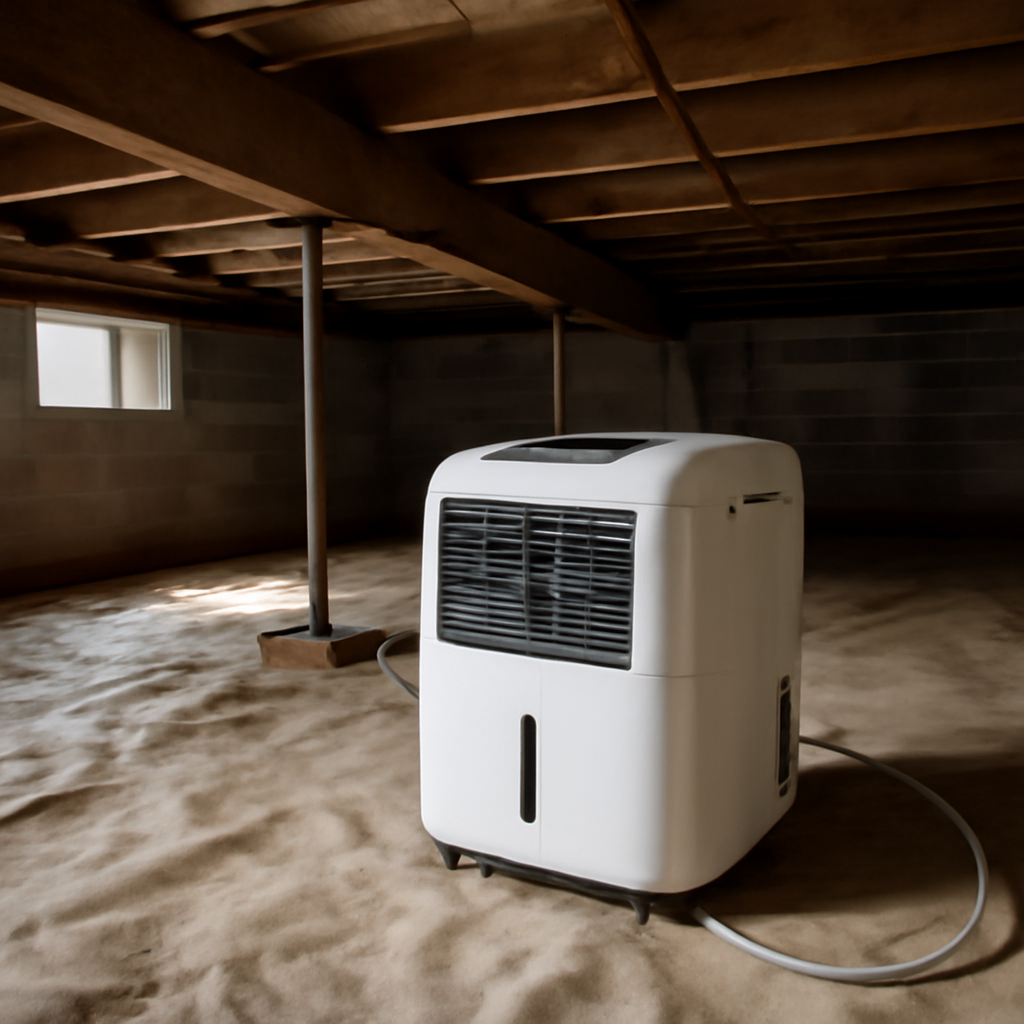
The best crawl space dehumidifier is a low-profile, tankless unit that drains itself, keeps working when the crawl space is cool, and is sized for the actual moisture load rather than the biggest number on the box. It is also, for many Colorado homes, a purchase to make only after measuring. Front Range crawl spaces are usually far drier than the humid-climate crawl spaces most of these machines are marketed for, and a dehumidifier will not fix a grading or plumbing leak. Below are seven crawl-space-specific picks, each matched to a different situation, followed by a buying guide on pints-per-day ratings, drainage, low-temperature operation, Energy Star and when a dehumidifier is not the answer.
Part of our Crawl Space & Attic Guide guide — start there for the full picture →
As an Amazon Associate we earn from qualifying purchases.
How we compared: we compared 24 current Amazon listings returned for crawl space, basement-with-pump and commercial crawlspace dehumidifier searches on what each listing actually states: capacity ratings and test conditions, drainage, pump lift, defrost and low-temperature operation, housing, certifications and warranty. Fourteen are low-profile, tankless crawl space or commercial units; the other 10 are upright home dehumidifiers about 15 to 24 inches tall with water tanks, which suit basements better than crawl spaces. We did not lab-test any of these units or use them hands-on. Prices and availability change often, so check the current listing before buying.
Dealing with mold or water damage? Talk to a remediation pro now.
📞 Call (833) 723-1134Quick picks: the best crawl space dehumidifiers by situation
| Pick | Best for | Key spec | Key detail |
|---|---|---|---|
| AlorAir Sentinel HD55S | Best overall for a sealed crawl space | 55 pints/day (AHAM); 1,300 sq ft | Energy Star claim plus ETL listing |
| AlorAir Sentinel HS35 | Smaller or moderately damp Colorado crawl spaces | 35 pints/day (AHAM); 11.4 in tall | Under 50 dB; simple knob controls |
| AlorAir Helios MP35 | No floor drain nearby | 35 pints/day (AHAM) | Pump lift stated at 19.6 ft |
| BaseAire AirWerx 35P | Tightest clearance with a pump | 15.2 x 11.2 x 11.4 in | Hanger option for posts |
| Waykar AFW1.5DPM | Energy Star with a pump | 70 pints/day saturated | 10–90% RH setpoint range |
| Prikod 155 | Cold crawl spaces, transparent specs | 48 pints/day at 65°F/60% RH | Operating range stated as 41–95°F |
| Airecoler GT-XP9 | Large or wet crawl spaces | 73 pints/day (AHAM); 285 CFM | Built-in pump; metal casing |
The seven picks, compared listing by listing
1. AlorAir Sentinel HD55S — Best Overall for a Sealed Crawl Space
Metal-cased crawlspace unit: 55 pints/day at AHAM, up to 1,300 sq ft, auto defrost, Energy Star claim and ETL listing.
Check price on Amazon| Specification | Details |
|---|---|
| Capacity | 55 pints/day at AHAM conditions; 120 pints/day at saturation |
| Coverage | Up to 1,300 sq ft |
| Drainage | Continuous drain outlet, no tank; built-in pump not stated in listing |
| Cold operation | Low-temperature operation with sensor-controlled auto defrost |
| Build / certifications | Metal housing; MERV-1 filter; Energy Star certified per listing; cETL listed |
| Size / warranty | 19.2 x 12.2 x 13.3 in, 41.7 lb; 6-year limited warranty (first 2 years full) |
AlorAir Sentinel HD55S — 55 PPD AHAM / 120 saturated, 1,300 sq ft, gravity drain, auto defrost, Energy Star, cETL
The Only Crawl Space Listing That Pairs an Energy Star Claim With ETL Safety Listing
Five of the 14 crawl space listings claim Energy Star certification, and four (all AlorAir) state ETL or cETL listing. The HD55S is the only one with both, and it also gives an AHAM-condition capacity rating, which only 8 of the 14 provide. That combination makes it the easiest listing on the shelf to verify against independent programs.
Its 55 pints per day at AHAM conditions sits in the middle of the shelf, which is where most sealed crawl spaces under about 1,300 square feet belong. The 120-pint figure in the title is a saturation number measured at hot, near-saturated conditions that a Colorado crawl space will rarely see.
The listing does not mention a built-in pump, only a continuous drain outlet, so it needs a gravity path to a floor drain or sump, or an add-on condensate pump. AlorAir’s own warranty text in the listing details shorter terms for parts and labor than the “6-year” headline, so read it before buying.
Pros
- Only listing with both Energy Star and ETL
- AHAM rating stated, not just a saturation number
- Metal housing and auto defrost for crawl conditions
- Coverage suits most sealed crawl spaces
Cons
- No built-in pump stated
- Headline warranty has fine-print limits
- Over 19 inches long for tight access hatches
2. AlorAir Sentinel HS35 — Best for Smaller or Moderately Damp Colorado Crawl Spaces
Compact 35 pints/day (AHAM) crawlspace unit, 11.4 in tall, under 50 dB, knob controls, auto defrost, ETL listed.
Check price on Amazon| Specification | Details |
|---|---|
| Capacity | 35 pints/day at AHAM conditions; 70 pints/day at saturation |
| Coverage / airflow | Up to 1,000 sq ft; 115 CFM |
| Drainage | 6.5-ft hose for continuous gravity drainage; no pump |
| Controls / noise | Manual humidity knobs; under 50 dB; memory restart after power loss |
| Cold operation | Auto defrost for cooler conditions |
| Size / safety | 15.35 x 11.2 x 11.4 in, 37.8 lb; ETL listed; washable MERV-1 filter |
AlorAir Sentinel HS35 — 35 PPD AHAM, 1,000 sq ft, 115 CFM, gravity drain, <50 dB, 11.4 in tall, ETL
The Lightest and Quietest-Rated Unit Among the Crawl Space Listings
The HS35 is the only one of the 14 crawl space listings that gives a noise figure, under 50 dB, and at 37.8 pounds it is the lightest of those that state a weight. It ties the BaseAire for the lowest stated height, 11.4 inches. Its 35-pint AHAM rating is the smallest on the shelf, tied with the Helios MP35.
Small is the point. Many Front Range crawl spaces are dry most of the year and only need help during spring snowmelt, summer storms or after a sprinkler problem. An oversized unit in a modest crawl space short-cycles, and a smaller, simpler machine that holds the space below 60 percent humidity is a better match. The analog knob controls also suit a unit that will be set once and left.
The cons are drainage and control. There is no pump, so it needs a gravity drain path, and knobs give no humidity readout, so pair it with a separate hygrometer.
Pros
- Only crawl space listing with a noise rating
- Lightest stated weight; tied for lowest height
- Right-sized for modest moisture loads
- ETL listed, auto defrost, memory restart
Cons
- No pump
- No digital humidity display
- Undersized for wet or large crawl spaces
3. AlorAir Helios MP35 — Best Built-In Pump for Crawl Spaces Without a Drain
35 pints/day (AHAM) R32 crawlspace unit with a built-in pump stated to lift water 19.6 ft, plus gravity drain.
Check price on Amazon| Specification | Details |
|---|---|
| Capacity | 35 pints/day at AHAM conditions; 70 pints/day at saturation |
| Coverage | Up to 1,000 sq ft; R32 refrigerant |
| Drainage | Built-in pump stated to lift up to 19.6 ft; gravity hose included |
| Controls | Auto defrost, GPP mode, pump mode; restarts with saved settings after outages |
| Build / safety | Corrosion-resistant casing; ETL listed |
| Size / warranty | 16.1 x 11.8 x 13.1 in; 6-year limited warranty, first 2 years full |
AlorAir Helios MP35 — 35 PPD AHAM, 1,000 sq ft, built-in pump 19.6 ft lift, auto defrost, ETL, 6-yr limited
The Highest Stated Pump Lift of All 24 Listings
Eight of the 14 crawl space listings include a built-in pump, and most state a vertical lift of about 16.4 feet. The MP35’s stated 19.6 feet is the highest among all 24 listings, crawl space and upright alike. Most crawl spaces sit below the nearest drain, laundry sink or exterior exit, so lift and hose length decide whether a unit can drain unattended.
It pairs that pump with the same modest 35-pint AHAM rating as the HS35, which makes it a good fit for small to medium sealed crawl spaces that have no floor drain. GPP mode, which controls by grains per pound of moisture rather than relative humidity alone, is a feature mostly seen on professional equipment and is listed on this unit only.
The listing does not give weight, noise or airflow, and the hanging kit, remote and stable mounting kit are sold separately.
Pros
- Highest stated pump lift on the shelf
- Pump and gravity drainage options
- Only listing with a GPP control mode
- ETL listed with auto defrost
Cons
- Weight, noise and airflow not stated
- Mounting accessories cost extra
- Modest capacity for wet spaces
4. BaseAire AirWerx 35P — Best Compact Unit With a Pump for Tight Clearances
Compact 70 PPD crawlspace unit with pump, 15.2 x 11.2 x 11.4 in, digital humidistat, auto defrost and hanger option.
Check price on Amazon| Specification | Details |
|---|---|
| Capacity | 70 pints/day per title; test conditions and AHAM rating not stated in listing |
| Coverage | Up to 1,000 sq ft per title |
| Drainage | Pump version per title and size option; pump lift not stated in listing |
| Controls | Built-in humidity sensor and digital control panel with automatic start/stop |
| Mounting | Flat surface, or optional hanger for a crawlspace post or attic; adjustable feet |
| Size / support | 15.2 x 11.2 x 11.4 in, 38.2 lb; 5-year limited support |
BaseAire AirWerx 35P — 70 PPD (title), pump, 1,000 sq ft, 11.4 in tall, digital humidistat, auto defrost
The Smallest Stated Footprint Among Crawl Space Units With a Pump
Of the eight crawl space listings with a built-in pump, the BaseAire is the shortest and smallest at 15.2 by 11.2 by 11.4 inches. Every other pump-equipped crawl space unit on the shelf is at least 13 inches tall. In a crawl space with an 18-inch clearance under ducts and joists, those inches decide whether a unit fits and can be serviced.
The optional hanger for a crawlspace post is also useful: suspending a unit keeps it out of any standing water and off a vapor barrier that people crawl across.
This is the thinnest listing among the picks. It does not give an AHAM rating, the test conditions behind its 70-pint figure, pump lift, airflow or noise, and it mentions the pump only in the title and size option. Ask the seller for the spec sheet before buying.
Pros
- Most compact pump-equipped crawl space unit
- Digital humidistat with automatic control
- Post-hanger option keeps it off the floor
Cons
- No AHAM rating or test conditions
- Pump lift not stated
- Sparse listing overall
5. Waykar AFW1.5DPM — Best Energy Star Crawl Space Unit With a Pump
2025 Energy Star 70-pint (95°F/90% RH) unit with a 16.4 ft pump, gravity hose, metal casing and 10–90% RH control.
Check price on Amazon| Specification | Details |
|---|---|
| Capacity | 70 pints/day at 95°F and 90% RH; AHAM rating not stated in listing |
| Coverage / airflow | Up to 5,000 sq ft per listing; 158 CFM |
| Drainage | Pump with 16.4-ft vertical lift and hose; 6.6-ft gravity hose |
| Humidity control | Adjustable from 10% to 90% RH; touchscreen; optional remote |
| Build / efficiency | Metal casing; 2025 Energy Star per listing; TUV electrical compliance |
| Size / warranty | 15.8 x 13.6 x 13.15 in; 2-year coverage, 5-year compressor |
Waykar AFW1.5DPM — 70 PPD at 95°F/90%, Energy Star, 16.4 ft pump, 10–90% RH, metal casing, 5-yr compressor
One of Only Two Crawl Space Listings Claiming Both Energy Star and a Built-In Pump
Five crawl space listings claim Energy Star, and eight have a pump, but only two have both: this Waykar and the much larger Airzentti 155, which weighs about 59 pounds and stands 15 inches tall. For an average crawl space that needs a pump and will run for months each year, the Waykar is the more practical size.
Its 10 to 90 percent humidity setpoint range is wider than most, and the optional remote lets the setting be changed without crawling under the house.
Two gaps matter for Colorado. The listing does not mention automatic defrost; 12 of the 14 crawl space listings do, and the two that do not are both Waykar. It also gives capacity only at 95°F and 90 percent humidity, not at AHAM conditions, and the 5,000-square-foot coverage claim is far above what any 70-pint unit should be expected to handle in a damp space. Confirm Energy Star status on the Energy Star product finder before buying.
Pros
- Energy Star claim plus built-in pump
- 16.4-ft pump lift and gravity option
- Wide 10–90% RH setpoint range
- Metal casing
Cons
- No automatic defrost mentioned
- No AHAM capacity figure
- Coverage claim is optimistic
6. Prikod 155 — Best Stated Low-Temperature Spec for Cold Crawl Spaces
155-pint unit with internal pump, auto defrost down to 41°F, stated wattage and a 1.80 L/kWh efficiency figure.
Check price on Amazon| Specification | Details |
|---|---|
| Capacity | 155 pints/day at 95°F/90% RH; 48 pints/day at 65°F/60% RH |
| Power / efficiency | 510 W at 65°F/60% RH; 1,050 W at full load; 1.80 L/kWh stated |
| Cold operation | Auto defrost; operating range stated as 41–95°F |
| Drainage | Internal condensate pump with 16.5-ft hose; gravity port |
| Other | Duct connection port; 24-hour timer; auto restart; leveling feet |
| Size / warranty | 23.2 x 14.2 x 14.8 in, 70.6 lb; 5-year warranty |
Prikod 155 — 48 PPD at 65°F/60% RH, 155 at 95°F/90%, 41–95°F operation, pump, 1.80 L/kWh, ductable
The Only Listing That States a Numeric Low-Temperature Limit and Power Draw
Twelve crawl space listings mention automatic defrost or low-temperature operation, but only the Prikod puts a number on it: operation from 41°F to 95°F. It is also the only crawl space listing that states wattage and an efficiency figure in liters per kilowatt-hour, the same unit Energy Star uses for its integrated energy factor. Those numbers let a buyer estimate running cost instead of guessing.
Its 48 pints per day at 65°F and 60 percent humidity is the most useful capacity figure on the shelf for a cool crawl space, because it reflects conditions much closer to a Front Range crawl space than the 95°F and 90 percent figures in most titles. The listing’s description of its rating method is muddled, so lean on the stated numbers rather than the labels.
It is large and heavy: over 23 inches long and 70 pounds, the heaviest crawl space unit that states a weight. It needs a wide access opening and a solid, level platform. It also claims coverage up to 6,000 square feet, far beyond what a typical home crawl space needs.
Pros
- Only stated numeric low-temperature limit
- States wattage and L/kWh efficiency
- Realistic cool-condition capacity figure
- Internal pump and duct port
Cons
- Heaviest crawl space unit on the shelf
- Oversized for most home crawl spaces
- Rating-method wording is confusing
7. Airecoler GT-XP9 — Best for Large or Wet Crawl Spaces
Metal-cased 73 pints/day (AHAM) unit with 285 CFM, built-in 16.4 ft pump, auto defrost and joist suspension option.
Check price on Amazon| Specification | Details |
|---|---|
| Capacity | 73 pints/day at AHAM conditions; 170 pints/day maximum |
| Airflow / coverage | 285 CFM; up to 7,500 sq ft per listing |
| Drainage | Internal pump with 16.4-ft vertical drainage and hose |
| Cold operation | Auto defrost sensors; low-temperature operation |
| Build / mounting | All-metal casing; washable filter; freestanding or suspended between joists; TUV safety certified |
| Size / warranty | 23.6 x 13.9 x 14.3 in, 62.6 lb; 2 years whole unit plus 3 years on dehumidification system |
Airecoler GT-XP9 — 73 PPD AHAM, 285 CFM, built-in 16.4 ft pump, auto defrost, metal casing, joist-mountable
The Highest AHAM Rating and Highest Airflow on the Shelf
Among the 8 crawl space listings that give an AHAM-condition rating, the GT-XP9’s 73 pints per day is the highest, and its 285 CFM is the highest airflow stated on the shelf. For a large crawl space, a space recovering from a plumbing leak, or one with a high water table that has been sealed, that capacity gives headroom.
It is also the only listing on the shelf that combines a stated AHAM rating, a built-in pump and a metal housing in one machine, a combination useful in the wettest crawl spaces where the unit runs for long stretches.
For most Colorado crawl spaces it is more machine than needed. It is nearly 24 inches long and over 62 pounds, and an oversized unit in a modest space cycles on and off. Choose it for genuinely large or wet spaces, not as a default.
Pros
- Highest AHAM rating and airflow on the shelf
- Built-in pump with 16.4-ft lift
- Metal casing and auto defrost
- Can hang between joists
Cons
- Oversized for most Front Range crawl spaces
- Large and heavy to install
- Coverage claim is very optimistic
Does your Colorado crawl space need a dehumidifier?
Often it does not. Most crawl space dehumidifiers are designed and marketed for humid regions where outdoor air carries a heavy moisture load all summer. The Front Range is semi-arid, and many crawl spaces here, especially vented ones over dry soil, stay below 60 percent relative humidity for most of the year. Buying a dehumidifier for a crawl space that is already dry wastes electricity and money.
Measure first. Put a recording hygrometer or data logger in the crawl space for several weeks, ideally through spring snowmelt and summer storm season, and look at the pattern. A dehumidifier makes sense when:
- Relative humidity stays above about 60 percent for days or weeks at a time.
- There is condensation on ducts, pipes or the underside of the subfloor.
- Joists or sheathing show staining, mold growth or musty odors.
- The crawl space has been sealed or encapsulated and has no other means of drying.
- Groundwater, a high water table near a creek, or recurring seepage keeps the space damp.
The EPA recommends keeping indoor humidity below 60 percent, ideally between 30 and 50 percent, to discourage mold. Its mold course notes that crawl spaces with high humidity are common sites of hidden mold growth, especially over bare earth, because soil wicks moisture that then evaporates into crawl space air and can move into the house above. Our guide to mold in a crawl space covers the warning signs.
Fix the water source before buying a machine
A dehumidifier treats damp air, not liquid water. On the Front Range, the most common causes of a wet crawl space are water sources rather than humid air: downspouts discharging next to the foundation, negative grading, sprinkler overspray against the wall, plumbing leaks, and missing or damaged vapor barriers. Expansive clay soils in many Front Range neighborhoods make drainage even more important. Correcting these is usually cheaper and more effective than running a dehumidifier around the clock. Our crawl space moisture control guide walks through them in order.
Pints per day: how to read capacity ratings
Energy Star explains that dehumidifier capacity is measured in pints per 24 hours and that the size you need depends on both the space and its conditions. The trouble is that listings quote capacity at different test conditions:
- Saturation or maximum (often 95°F and 90% RH): the largest number, and the one in most titles. Crawl spaces rarely reach these conditions.
- AHAM conditions: a standardized rating that is roughly half the saturation number on this shelf. Eight of 14 crawl space listings give one.
- Cool conditions (65°F and 60% RH): only the Prikod states a figure here, and it is the closest to real crawl space conditions.
Compare units on the same basis. As a rough guide, small to medium sealed crawl spaces are often served by units around 35 to 55 pints per day at AHAM conditions, with larger or wetter spaces moving up from there. Coverage claims of 5,000 to 7,500 square feet on 70- to 170-pint units are marketing numbers. For more on sizing, see how to choose a dehumidifier.
Drainage: pump vs gravity
A crawl space unit must drain automatically; emptying a bucket under the house is not realistic. Energy Star notes that whole-home units are typically equipped only with a drain that should be routed to a floor drain or condensate pump. On this shelf, 8 of the 14 crawl space units include a built-in pump and 6 rely on gravity. Gravity drainage works when a floor drain, sump or exterior outlet sits below the unit. Otherwise, choose a built-in pump and check the stated lift against the height and distance to the discharge point. Keep drain lines away from electrical connections, as Energy Star advises. Our guides to the crawl space dehumidifier with a pump and dehumidifier drain hoses cover routing details.
Low-temperature operation and defrost
Energy Star warns that frost can form on a dehumidifier’s coils when air temperature falls below about 65°F, which can make the compressor cycle without removing moisture, and suggests choosing a product specified for lower temperatures in cool spaces. Colorado crawl spaces regularly sit well below 65°F for much of the year. Twelve of the 14 crawl space listings mention automatic defrost or low-temperature operation; only the Prikod gives a numeric limit (41°F). Only half of the 10 upright basement units on the shelf mention defrost at all, which is another reason they are a poor fit under a house.
Energy Star and running costs
Energy Star says a certified dehumidifier removes the same amount of moisture as a conventional unit of similar size while using about 20 percent less energy, and that efficiency is measured as an integrated energy factor in liters per kilowatt-hour, where higher is better. Five of the 14 crawl space listings claim certification; several upright units claim the stricter Most Efficient designation. Some listings advertise savings much larger than 20 percent, so rely on the Energy Star figure. Verify any claim on the Energy Star product finder by model number, since listings sometimes describe a different version than the one shipped. A dehumidifier in a crawl space may run for months, so efficiency matters more than purchase price; our crawl space dehumidifier cost guide estimates both.
Radon and sealed crawl spaces
Encapsulating a crawl space and adding a dehumidifier is a moisture project, not a radon fix. The EPA recommends testing every home for radon and fixing it at 4 pCi/L or higher. If a home has a crawl space and elevated radon, plan both projects together with a qualified radon mitigation professional, since the vapor barrier, sealing and any depressurization system interact. Test radon again after any major crawl space work.
Installation basics
- Set the unit level and off the ground, or hang it from joists, so it is clear of any standing water.
- Route the drain or pump line to an approved discharge point and secure it so it cannot kink or pull loose.
- Use a dedicated, grounded outlet; avoid extension cords in a damp space.
- Set the humidistat to about 50 percent and adjust based on logged readings.
- Clean or replace the filter regularly; crawl space dust clogs coils quickly.
- Check the unit at least seasonally, including after the first hard freeze.
For step-by-step details, see crawl space dehumidifier installation.
DIY dehumidifier vs a professional inspection
A dehumidifier controls humidity; it does not diagnose why a crawl space is damp. If you see mold on framing, standing water, sagging insulation, efflorescence on foundation walls or a musty smell upstairs, the cause needs to be found first. A home inspector can evaluate grading, drainage, plumbing, vapor barriers, ventilation and visible mold and recommend whether a dehumidifier is warranted at all. The EPA’s mold course notes that wet materials should be dried within 24 to 48 hours to avoid mold growth, so act quickly after any leak. See our mold inspection pillar for more.
Which crawl space dehumidifier should you buy?
- Sealed crawl space with a drain path, want verified certifications: AlorAir Sentinel HD55S.
- Small or only seasonally damp Front Range crawl space: AlorAir Sentinel HS35.
- No floor drain and the discharge point is high: AlorAir Helios MP35.
- Very low clearance and need a pump: BaseAire AirWerx 35P.
- Want Energy Star efficiency with a pump: Waykar AFW1.5DPM (confirm defrost needs).
- Cold crawl space and want hard numbers on power and temperature: Prikod 155.
- Large or genuinely wet crawl space: Airecoler GT-XP9.
References
- Dehumidifiers — ENERGY STAR
- A Brief Guide to Mold, Moisture and Your Home — U.S. Environmental Protection Agency
- Mold Course Chapter 2: Why and Where Mold Grows — U.S. Environmental Protection Agency
- EPA Map of Radon Zones — U.S. Environmental Protection Agency
Frequently asked questions
What size dehumidifier do I need for a crawl space?
Size by the rating at AHAM or cool conditions, not the saturation number in the title. Small to medium sealed crawl spaces are often served by roughly 35 to 55 pints per day at AHAM conditions, with larger or wetter spaces needing more. Log the crawl space humidity for a few weeks before choosing.
Do I need a crawl space dehumidifier with a pump?
Only if there is no floor drain, sump or exterior outlet lower than the unit. Gravity drainage is simpler when it is available. If you need a pump, check the stated lift against the height and distance to the discharge point.
Does a Colorado crawl space need a dehumidifier?
Many do not. Front Range crawl spaces are often dry, so measure first. A dehumidifier makes sense when humidity stays above about 60 percent, there is condensation or mold on framing, or the space has been sealed with no other way to dry. Fix grading, gutters and leaks before buying.
Will a regular dehumidifier work in a crawl space?
Usually not well. Upright home units are tall, use water tanks, and often lose capacity or frost up below about 65°F. Crawl space units are low-profile, drain continuously, and most include automatic defrost for cool conditions.
Should my crawl space be sealed before adding a dehumidifier?
A dehumidifier works best in a crawl space that has a vapor barrier and controlled air leakage; in a fully vented crawl space it may end up drying outdoor air. If radon is elevated, coordinate sealing with a radon mitigation professional.
Seeing moisture, mold or musty odors from a Front Range crawl space? Reach out through our contact page to connect with a vetted local inspector who can find the source before you buy equipment.
Dehumidifiers for damp basements
Holding relative humidity under ~50% is the single most effective way to keep mold from taking hold in a basement or crawlspace.
| Product | Why | Buy |
|---|---|---|
 hOmeLabs 4,500 sq ft hOmeLabs 4,500 sq ft | Popular large-basement unit. | Amazon — $234.99 |
 Frigidaire High-Humidity Frigidaire High-Humidity | Continuous-drain option. | Amazon — $303.18 |