Best Radon Detectors in 2026: A Buyer’s Guide for Homeowners
Digital radon detectors have replaced the mail-in kit for many homeowners who want to watch radon over months and years rather than take a single snapshot. The category now spans simple battery units with a screen, Bluetooth and Wi-Fi monitors that send data to a phone, alarm-equipped units that beep above a threshold, and rechargeable models that store more than a year of history. The useful differences are the sensor a listing names, how the unit connects, how it is powered and how much history it keeps. Below are seven radon detectors, each matched to a specific way of monitoring, then a buying guide written for Colorado Front Range homes, where elevated radon is common.
Part of our Radon Levels guide — start there for the full picture →
As an Amazon Associate we earn from qualifying purchases.
How we compared: we compared 11 current Amazon listings for digital radon detectors, covering 10 distinct models (one model appears in two colors), on what each listing actually states: sensor type, connectivity, display, power source, alarm behavior, data history, export options and warranty. Mail-in test kits that appeared in the same searches are covered in a separate guide. We did not lab-test any of these units or use them hands-on. Prices and availability change often, so check the current listing before buying.
Quick picks: the best radon detectors by sensor and connectivity
| Product | Best for | Key features | Price | Buy |
|---|---|---|---|---|
| Airthings Corentium Home 2 (325) | Screen plus app in one unit |
| $179.97as of Nov 4, 2026 5:29 pm GMT+0000 | Buy now →Check current price |
| X-Sense XR0A-iR | Phone alerts away from home |
| $99.99as of Nov 4, 2026 9:35 pm GMT+0000 | Buy now →Check current price |
| Airthings Wave Radon (2950) | App-first smart home setups |
| $109.15as of Nov 4, 2026 9:35 pm GMT+0000 | Buy now →Check current price |
| X-Sense XR0A-SR | Silent set-and-forget monitoring |
| $53.98as of Nov 5, 2026 1:55 am GMT+0000 | Buy now →Check current price |
| AEGTEST HOUND-1008 | Alarm with long AAA battery life |
| $44.99as of Nov 4, 2026 5:29 pm GMT+0000 | Buy now →Check current price |
| AEGTEST HOUND-2070 | Rechargeable unit with deep history |
| $49.99as of Nov 5, 2026 1:55 am GMT+0000 | Buy now →Check current price |
| Forensics Detectors FD-65 | Rough handling and color display |
| $79.25as of Nov 4, 2026 5:29 pm GMT+0000 | Buy now →Check current price |
Prices are Amazon’s listed prices as of the time shown and change often; check Amazon for today’s price. As an Amazon Associate we earn from qualifying purchases.
The seven picks, compared listing by listing
1. Airthings Corentium Home 2 (325) — Best Overall Screen-Plus-App Detector

Battery radon detector with on-screen short- and long-term averages, Bluetooth app graphs, and temperature and humidity.
Check price on Amazon$179.97 as of Nov 4, 2026 5:29 pm GMT+0000 — prices change; see Amazon for current price.| Specification | Details |
|---|---|
| Sensor | Airthings’ patented radon sensing technology; sensor type not otherwise stated |
| Connectivity | Bluetooth to the app; remote monitoring when paired with an Airthings Hub or View monitor |
| Display | Short- and long-term radon averages plus GOOD, FAIR or POOR indicators |
| Other sensors | Temperature and humidity |
| Power | Battery powered; battery type not stated in listing |
| Size / model | About 4.45 x 2.4 x 1.14 in; model 325 |
Airthings Corentium Home 2 — battery, on-screen short/long-term averages, Bluetooth app, temp + humidity, Hub-ready, model 325
The Only Detector Here That Pairs a Numeric Screen With Bluetooth
Three of the 10 models offer any wireless connection: two Airthings units over Bluetooth and one X-Sense over Wi-Fi. Of those three, the Corentium Home 2 is the only one that combines Bluetooth with an on-device readout of short- and long-term averages. The Wave Radon is app-first with only a color light, and the Wi-Fi X-Sense relies on Wi-Fi rather than Bluetooth. That combination means the Home 2 works fine without a phone, but the app adds graphs that show how radon rises and falls.
It is also one of five models that add temperature and humidity, and the listing says pairing with an Airthings Hub or View-series monitor unlocks round-the-clock remote readings and notifications. Without the hub, data comes over Bluetooth only when the phone is nearby.
The listing leaves gaps. It does not state the battery type, how long the batteries last, how soon the first reading appears or the measurement range. The 5-year extended warranty with registration appears on the two other Airthings listings but is not stated on this one. Our guide to whether digital radon detectors are accurate explains what consumer monitors can and cannot tell you.
Pros
- Numeric screen and Bluetooth app in one unit
- Temperature and humidity context
- Remote monitoring available with a hub
- Battery powered, so it goes in any room
Cons
- Battery type and life not stated in listing
- Remote alerts need a separate hub or monitor
- Time to first reading not stated
Check Airthings Corentium Home 2 price on Amazon
2. X-Sense XR0A-iR — Best Wi-Fi Radon Detector

Wi-Fi radon detector with app notifications, trend arrows on screen, up to 999 days of monitoring and file export.
Check price on Amazon$99.99 as of Nov 4, 2026 9:35 pm GMT+0000 — prices change; see Amazon for current price.| Specification | Details |
|---|---|
| Connectivity | 2.4 GHz Wi-Fi with app notifications |
| Display | LCD with current radon level and up, down or steady trend arrows |
| History | Up to 999 days of continuous monitoring; history kept after battery changes |
| Export | PDF reports and XLSX or CSV files from the app |
| Power / other sensors | Up to 2 years of battery life; temperature and humidity trends |
| Warranty | 5-year quality warranty and 60-day money-back guarantee |
X-Sense XR0A-iR — 2.4 GHz Wi-Fi, app alerts, LCD trend arrows, 999-day history, PDF/XLSX/CSV export, ~2-yr battery
The Only Wi-Fi Model and the Only One That Exports Spreadsheet Files
Just one of the 10 models connects over Wi-Fi, and this is it. That matters for anyone who wants to know about a rising radon level while away from home, since Bluetooth-only units sync only when a phone is close by. The listing says the app sends notifications, so the owner does not have to keep checking the device.
It is also the only listing that says data can be exported as PDF reports and XLSX or CSV files. Two Airthings listings mention generating a radon report, but neither mentions spreadsheet export. Exported history is useful when sharing results with a mitigation contractor or keeping records after a system goes in.
The listing does not name a sensor type or measurement range, and it does not state how soon the first reading appears. Wi-Fi is limited to 2.4 GHz networks, which matters in homes where the router broadcasts 5 GHz only. Unlike the sibling XR0B-SR, it does not mention an audible alarm.
Pros
- Only Wi-Fi model on the shelf
- App notifications without a separate hub
- PDF, XLSX and CSV export
- History survives battery changes
Cons
- 2.4 GHz Wi-Fi only
- Sensor type and range not stated in listing
- No audible alarm mentioned
Check X-Sense XR0A-iR Wi-Fi price on Amazon
3. Airthings Wave Radon (2950) — Best App-First Detector for Smart Homes

App-first radon detector with Bluetooth, a wave-activated color light, temperature and humidity, and Hub connectivity.
Check price on Amazon$109.15 as of Nov 4, 2026 9:35 pm GMT+0000 — prices change; see Amazon for current price.| Specification | Details |
|---|---|
| Connectivity | Bluetooth; Smartlink to the Airthings Hub for 24/7 online data |
| Display | No numeric screen; a wave of the hand shows a green, yellow or red light |
| Other sensors | Temperature and humidity |
| Reporting | Radon report through the Airthings Dashboard |
| Power / size | Battery operated; about 4.7 x 4.7 x 1.4 in, 0.48 lb |
| Warranty | 5-year extended warranty with registration within 30 days |
Airthings Wave Radon 2950 — Bluetooth + Hub, wave-to-check color light, temp + humidity, Dashboard reports, battery, 5-yr warranty w/ registration
The Only Model That Shows a Color Light Instead of a Radon Number
Every other model on the shelf describes an on-device screen or on-device record review. The Wave Radon instead uses a color light that responds to a wave of the hand, and sends the actual numbers to the phone over Bluetooth. Long- and short-term results and a downloadable report come through the app and the Airthings Dashboard. With an Airthings Hub, data moves online around the clock.
That design suits a household that already uses phone-based home monitoring and wants a device that disappears on a wall or shelf. It is one of two Bluetooth models and one of five that add temperature and humidity, and its listing names the 5-year extended warranty with registration that also appears on the Corentium Home 223.
The trade-off is obvious: without the phone, the device only says green, yellow or red. The listing does not state the sensor type, battery type or life, or measurement range. Households where several people need to check levels may prefer a unit with a screen.
Pros
- Clean, unobtrusive app-first design
- Hub support for 24/7 online data
- Temperature and humidity included
- 5-year extended warranty with registration
Cons
- No radon number on the device
- Phone needed for actual readings
- Battery life and sensor type not stated in listing
Check Airthings Wave Radon price on Amazon
4. X-Sense XR0A-SR — Best Silent Set-and-Forget Monitor
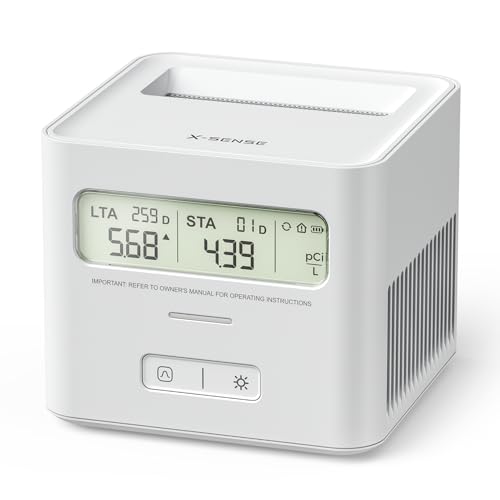
Quiet radon monitor with an LCD showing 1, 7, 30 and 90-day plus long-term averages and up to 24 months of battery life.
Check price on Amazon$53.98 as of Nov 5, 2026 1:55 am GMT+0000 — prices change; see Amazon for current price.| Specification | Details |
|---|---|
| Display | LCD with past 1, 7, 30 and 90-day averages and a long-term cumulative average; one-press backlight |
| Alerts | None by design; no flashing lights or sounds |
| Accuracy claim | Data within 24 hours; 90% consistency with reference results after 7 days |
| Power | Battery; up to 24 months under typical use |
| Data retention | Keeps history through a battery change if power is restored within 4 hours |
| Warranty | 5-year quality warranty and 60-day money-back guarantee |
X-Sense XR0A-SR — LCD 1/7/30/90-day + long-term averages, silent, ~24-month battery, data kept through battery swap
The Only Listing That Promises No Lights or Sounds
Four of the 10 models advertise an audible alarm when radon crosses a threshold. The XR0A-SR goes the other way: its listing says it runs silently with no flashing lights or sounds and shows readings only when someone looks. For a bedroom, a finished basement or a rental where alarms would be a nuisance, that is a feature rather than a gap.
Its display is also the most structured on the shelf for averaging. It shows separate 1, 7, 30 and 90-day averages plus a long-term cumulative figure, which lines up with how radon decisions are actually made: the short windows show spikes and the long window shows the number to act on. Two X-Sense listings are the only ones on the shelf that put a percentage on agreement with reference results; this one claims 90% after 7 days.
It has no connectivity, so history stays on the device. The listing does not name a sensor type or measurement range, and the data-retention feature depends on restoring power within 4 hours during a battery change.
Pros
- Silent operation with on-demand backlight
- Separate 1, 7, 30, 90-day and long-term averages
- Up to 24 months per set of batteries
- 5-year quality warranty
Cons
- No alarm for a sudden rise
- No app or data export
- Sensor type and range not stated in listing
Check X-Sense XR0A-SR price on Amazon
5. AEGTEST HOUND-1008 — Best Alarm Detector With Long Battery Life

Semiconductor radon detector with sound alarm, 0.09 to 1000 pCi/L range and up to 400 days on three AAA batteries.
Check price on Amazon$44.99 as of Nov 4, 2026 5:29 pm GMT+0000 — prices change; see Amazon for current price.| Specification | Details |
|---|---|
| Sensor | Semiconductor sensor |
| Range / units | 0.09 to 1000 pCi/L; switches between pCi/L and Bq/m³ |
| Readings | First result about 12 hours after start, then hourly updates |
| Alerts | Audible alarm plus a level indicator that points to a red zone above the threshold |
| Power | Three AAA batteries included; up to 400 days of battery life |
| Size / model | About 4.45 x 2.28 x 1.08 in; HOUND-1008 |
AEGTEST HOUND-1008 — semiconductor, 0.09–1000 pCi/L, first reading ~12 hrs, hourly updates, alarm, 3xAAA up to 400 days
The Alarm Model That Runs Longest on Replaceable Batteries
Four models on the shelf advertise an audible alarm: three AEGTEST units and the X-Sense XR0B-SR. Two of the AEGTEST alarm models run on a built-in rechargeable battery rated for about 45 days in sleep mode. The HOUND-1008 instead takes three AAA batteries and claims up to 400 days on a set, so it can sit in a basement corner for a full heating season without a charging cable.
It is one of four models that name a semiconductor sensor and one of two that state a full measurement range, 0.09 to 1000 pCi/L. Along with the other AEGTEST models, it gives a first reading in about 12 hours and updates every hour, the fastest first-reading time stated on the shelf; the two X-Sense listings that state a time say 24 hours.
What the listing does not give is a stated history length, connectivity or warranty. A quick first reading is handy for a check after a renovation, but a 12-hour number is still a short-term snapshot; the decision number comes from weeks or months of data.
Pros
- Up to 400 days on replaceable AAA batteries
- Names a semiconductor sensor and a full range
- First reading in about 12 hours, hourly after that
- Audible alarm with visual level indicator
Cons
- No app or export
- History length not stated in listing
- Warranty not stated in listing
Check AEGTEST HOUND-1008 price on Amazon
6. AEGTEST HOUND-2070 — Best Rechargeable Detector With Deep History

Rechargeable 3-in-1 radon, temperature and humidity detector with 504 days of stored history and threshold alarms.
Check price on Amazon$49.99 as of Nov 5, 2026 1:55 am GMT+0000 — prices change; see Amazon for current price.| Specification | Details |
|---|---|
| Sensor | Semiconductor sensor |
| Other sensors | Temperature and humidity on the display |
| History | Up to 504 days stored; 12, 24, 48, 72 and 96-hour views |
| Alerts | Audible and visual alarms above a user-set threshold |
| Power | Rechargeable via USB-C; up to 45 days in sleep mode per charge |
| Units / model | pCi/L or Bq/m³; HOUND-2070 |
AEGTEST HOUND-2070 — semiconductor, radon + temp + humidity, 504-day storage, set-point alarm, USB-C rechargeable
The Only Semiconductor Model That Adds Temperature and Humidity
Four models name a semiconductor sensor: three AEGTEST units and the Forensics Detectors FD-65. Of those four, the HOUND-2070 is the only one that also tracks humidity, and its display shows temperature and humidity next to radon. Five models on the shelf add both readings, but the other four do not name their sensor type.
Its history is also deep. The 2070 and the HOUND-1011S both reference 504 days of data, and the 2070 lets the user set the alarm threshold, which is useful for an alert below the 4 pCi/L action level. Short-window views from 12 to 96 hours help spot short-lived swings.
The power design is the main trade-off. A built-in battery rated for about 45 days in sleep mode means it either lives near an outlet on USB-C or gets charged regularly. The listing does not state a measurement range or warranty.
Pros
- Radon, temperature and humidity on one screen
- Up to 504 days of stored history
- User-set alarm threshold
Cons
- About 45 days per charge in sleep mode
- Range and warranty not stated in listing
- No app or export
Check AEGTEST HOUND-2070 price on Amazon
7. Forensics Detectors FD-65 — Best Rugged Detector With a Color Screen

Semiconductor radon detector with a large color LCD, temperature reading, 10 ft drop-rated housing and 1-year warranty.
Check price on Amazon$79.25 as of Nov 4, 2026 5:29 pm GMT+0000 — prices change; see Amazon for current price.| Specification | Details |
|---|---|
| Sensor | Semiconductor sensor; 20-year sensor life claimed |
| Display | Large color LCD with temperature |
| Housing | ABS housing rated for a 10 ft drop |
| Power | Not stated in listing |
| Size / weight | About 3.15 x 3.15 x 1.57 in; 0.2 lb |
| Model / warranty | FD-65-RADON (part HOUND-1085); 1-year warranty, U.S. support |
Forensics Detectors FD-65 — semiconductor, color LCD + temperature, 10 ft drop rating, 0.2 lb, 1-yr warranty
The Only Listing With a Drop Rating and the Longest Claimed Sensor Life
No other listing on the shelf states a drop rating or a sensor lifespan. The FD-65 claims both: an ABS housing that survives a 10-foot drop and a sensor rated for 20 years. It is also the lightest digital detector that states a weight, at 0.2 pounds, and the only one advertising a color screen. That makes it a reasonable choice for a unit that moves between rooms, a cabin, or the truck of someone who checks several properties.
The manufacturer part number shown on the listing, HOUND-1085, follows the same naming pattern as the AEGTEST HOUND models, which suggests a shared design family; the listing does not say so directly.
The warranty is short next to its 20-year sensor claim. The listing offers 1 year, against the 5-year warranties named on two Airthings and two X-Sense listings. It also does not state power source, range, alarm behavior or how long history is kept, so buyers should check the manual before relying on it for long-term averages.
Pros
- Only drop-rated housing on the shelf
- 20-year sensor life claimed
- Light, compact and color display
Cons
- 1-year warranty
- Power source and range not stated in listing
- Alarm and history not described
Check Forensics Detectors FD-65 price on Amazon
Sensor types: what the listings tell you, and what they leave out
Only four of the 10 models name their sensor type, all as semiconductor sensors. Airthings refers to its own patented radon sensing technology, and the X-Sense listings describe accuracy against reference results without naming the sensor. For a buyer, the sensor label matters less than three things a listing can state: how soon the first reading appears, how the device averages over time and what accuracy it claims.
- Time to first reading. AEGTEST listings state about 12 hours; two X-Sense listings say 24 hours. Airthings listings do not give a figure.
- Averaging windows. Look for both short-term and long-term averages. The long-term average is the number that lines up with EPA’s action level; the short windows show daily swings.
- Stated accuracy. Only the two X-Sense battery models put a percentage on agreement with reference results, 90% and 95% after 7 days. Others use words like “accurate” without numbers.
- Units. All three AEGTEST models switch between pCi/L and Bq/m³; U.S. guidance uses pCi/L.
None of the 10 digital listings claims that the device meets a national measurement-device listing used for real estate tests. That is not a flaw in a home monitor, but it is the reason a consumer detector should not replace a professional test in a sale.
Connectivity: screen only, Bluetooth or Wi-Fi
Screen-only units
Seven of the 10 models have no wireless connection. They are simpler, need no app account and keep data on the device. For a homeowner who checks once a week, a clear screen with long-term averaging is enough.
Bluetooth
Two Airthings models use Bluetooth. Data syncs when a phone is in range, which works for a basement unit near the living space. Both mention an Airthings Hub for round-the-clock online access.
Wi-Fi
One model, the X-Sense XR0A-iR, connects directly to Wi-Fi and sends app notifications. Wi-Fi is the right pick for a rental, a second home or any property where someone needs to know about a rise without being there.
Power and placement
Battery models go anywhere, which matters because the CDC advises placing a radon test in the basement or lowest level of the home, about three feet off the floor and in the middle of the room. Replaceable batteries on this shelf range from AAA sets rated for 400 days to X-Sense units rated for about two years. Rechargeable AEGTEST models are rated for about 45 days per charge in sleep mode, so plan an outlet nearby.
Keep a monitor away from sump pits, floor drains, exterior doors, heating registers and direct sun. After the first few weeks in one spot, a detector can be reset and moved; the CDC recommends testing before converting a basement to a bedroom or office, and a movable monitor makes room-by-room checks easy.
Reading the numbers
The CDC, citing EPA, recommends contacting a licensed professional to install a radon reduction system when radon is at or above 4 pCi/L, and recommends taking action to reduce radon between 2 and 4 pCi/L. It also notes there is no known safe level and that the average indoor level in American homes is about 1.3 pCi/L. Our radon levels chart and our guide to what radon levels should be put those thresholds in context.
Digital detectors show day-to-day swings that can look alarming; as one Airthings listing puts it, radon fluctuates daily and depends on factors such as the weather. Decide on mitigation from the long-term average, not a single spike. When a digital monitor’s long-term average sits at or above 4 pCi/L, confirm with a lab-analyzed or professional test and then plan mitigation.
Colorado notes for Front Range homes
EPA’s Colorado radon zone map places Denver, Jefferson, Arapahoe, Adams, Douglas, Boulder, El Paso, Elbert, Larimer and Weld counties in Zone 1, the highest-potential category, with a predicted average indoor screening level above 4 pCi/L. The map also says every home should be tested regardless of zone, because individual homes vary.
That makes a continuous detector especially useful here. Many Front Range homes have basements, and the CDC notes radon levels are often higher in basements and lower levels. A monitor shows whether a finished basement stays below the action level through the long heating season, and it confirms that a mitigation fan is still doing its job years later. Local patterns are summarized in our Colorado radon levels by zip code guide.
What a detector cannot do
A home detector measures; it does not diagnose or fix. When levels are high, the CDC says lowering radon requires technical knowledge and special skills and that homeowners should rely on a qualified professional. The most common fix is a vent pipe and fan that pulls radon from beneath the house, known as a soil depressurization system. EPA directs homeowners to their state radon program or to the NRPP and NRSB proficiency programs to find credentialed mitigators.
After a system is installed, the CDC says to test again to confirm it works and to consider retesting every two years and after remodeling. A digital detector makes that ongoing check almost effortless. For next steps, see our guides to how to fix radon in a home and the cost of a radon mitigation system, or start at our radon testing hub.
For a home sale, the CDC notes that the EPA recommends a qualified tester. If you are buying or selling on the Front Range, contact us to be connected with a vetted local inspector who can arrange a professional radon test.
References
- Testing Your Home for Radon — Centers for Disease Control and Prevention
- Radon and Your Health — Centers for Disease Control and Prevention
- Reducing Radon Levels in Your Home — Centers for Disease Control and Prevention
- Find a Radon Test Kit or Measurement and Mitigation Professional — U.S. Environmental Protection Agency
- Colorado — EPA Map of Radon Zones — U.S. Environmental Protection Agency
Frequently asked questions
What is the best type of radon detector for a home?
For most homes, a battery-powered digital detector that shows both short-term and long-term averages is the most practical choice. Add Bluetooth or Wi-Fi if you want graphs or alerts on a phone. Decide on mitigation from the long-term average rather than a single daily reading.
Is a Wi-Fi radon detector better than a Bluetooth one?
Wi-Fi lets a detector send alerts when you are away from home, which suits rentals and second homes. Bluetooth syncs only when a phone is nearby unless the detector is paired with a separate hub. Check whether the Wi-Fi model supports 2.4 GHz or 5 GHz networks before buying.
How long does a digital radon detector take to give a reading?
Listings on current models state a first reading in about 12 to 24 hours, with hourly or daily updates after that. Early readings are short-term snapshots. Let the detector run for weeks or months before relying on its long-term average.
Can a digital radon detector replace a professional radon test?
For ongoing home monitoring, yes, it is a practical tool. For a real estate transaction, the EPA recommends hiring a qualified tester, and none of the consumer listings reviewed here claims a professional measurement-device listing. Use the detector to watch levels between professional tests.
Where should a radon detector be placed?
The CDC recommends the basement or lowest level of the home, about three feet off the floor and in the middle of the room. Keep the unit away from drafts, sump pits and heating vents. Move it to a room before converting that space to living area.
Want a professional radon test or a mitigation check as part of a Front Range home purchase or sale? Reach out through our contact page to connect with a vetted local inspector.
Continuous radon detectors
A digital monitor gives you an always-on reading and a long-term average — better than a one-shot kit if you want to track levels over time.
| Product | Why | Buy |
|---|---|---|
 Airthings Corentium Home | Battery, portable; trusted long-term average. | Amazon — $142.99 |
 Ecosense RadonEye RD200 | Fast first reading (~1 hr); app logging. | Amazon — $169.00 |
 Airthings View Plus | Radon + CO2 + PM + VOC in one unit. | Amazon — $329.99 |