What Does a Radon Detector Do: A Plain-Language Guide
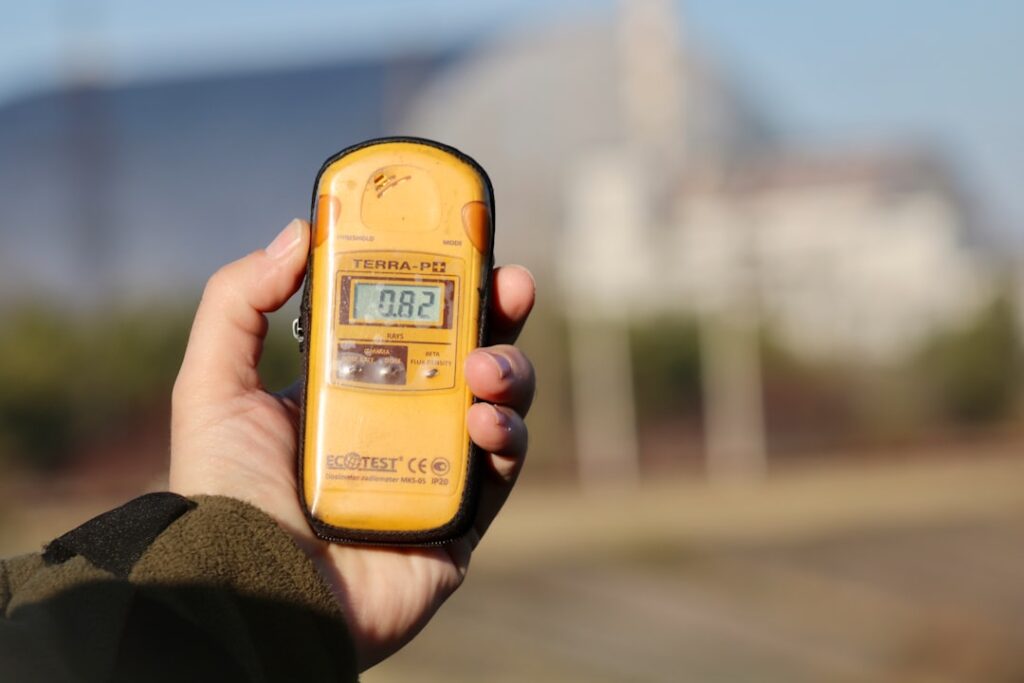
A radon detector measures the concentration of a radioactive gas that the human body cannot otherwise sense. There is no smell, no color, no taste, and no immediate symptom that would alert a homeowner to radon’s presence. Every detector type therefore has to use the physics of radioactive decay — most commonly alpha particle emissions from radon and its decay daughters — to convert an invisible hazard into a number on a screen or a result on a lab report. This guide walks through every consumer and professional detector category, what each one actually measures, and which type is appropriate for which question. The summary reflects EPA, CDPHE, and NRPP guidance current as of 2026.
What Does a Radon Detector Do: The Physical Mechanism
Radon-222 is a radioactive gas with a 3.8-day half-life. When a radon atom decays, it emits an alpha particle — a fast-moving helium nucleus. The radon-decay daughters (polonium, lead, bismuth, in series) also emit alpha or beta particles as they continue down the decay chain. Every consumer and professional radon detector measures some aspect of this decay process.
Two broad detection strategies dominate:
- Particle counting: Detect the alpha or beta particles directly as they are emitted. Active continuous radon monitors and electret ion chambers work this way.
- Decay-product capture: Adsorb radon onto a medium during exposure, then count the resulting decay events at the lab. Activated charcoal canisters and alpha-track detectors work this way.
Both strategies produce the same fundamental measurement — radon concentration in air, reported in picocuries per liter (pCi/L) or becquerels per cubic meter (Bq/m³). They differ in how the measurement is collected, how quickly results are available, and how much temporal detail the device captures. The companion guide what is a radon detector used for covers the use-case decisions.
Activated Charcoal Canisters
The most common short-term DIY kit. A small canister contains activated charcoal granules. When deployed in the home for 2 to 7 days, charcoal adsorbs radon from the surrounding air. After the exposure period, the homeowner seals the canister and mails it to a NRPP-listed laboratory.
How It Measures
The lab places the canister in a gamma counter or similar instrument that counts the gamma rays emitted by the adsorbed radon’s decay daughters. The count over a known counting period, combined with the exposure period and atmospheric conditions, yields the average radon concentration during the exposure.
Strengths and Limits
Inexpensive ($15 to $25 including lab analysis). Adequate accuracy for screening decisions. Limited by short exposure period (does not capture seasonal variation) and by sensitivity to humidity (extreme humidity can affect results).
Alpha-Track Detectors
A long-term passive detector containing a small piece of polycarbonate plastic film. Alpha particles from radon and its decay daughters strike the film and leave microscopic etched tracks. The number of tracks per unit area corresponds to the cumulative radon exposure.
How It Measures
After 90 days to one year of exposure, the homeowner mails the detector to the lab. The lab chemically etches the film to enlarge the alpha tracks, then counts the tracks under a microscope or automated reader. Track density yields the time-averaged radon concentration.
Strengths and Limits
Better representation of annual average radon exposure because of the long sampling period. Cost: $20 to $40 per detector. Slower to produce results because of the long deployment time.
Electret Ion Chamber
A precision passive device with a charged plastic disk (the electret) inside a sealed chamber. Alpha particles from radon ionize the air inside the chamber, and the resulting ions discharge the electret. The voltage drop on the electret over the exposure period is proportional to the radon concentration.
How It Measures
The professional reads the electret voltage before and after deployment with a calibrated voltmeter. The voltage difference, exposure time, and chamber configuration yield the radon concentration.
Strengths and Limits
High accuracy. Often used by professionals for transactional radon measurement. Higher equipment cost than charcoal canisters, lower marginal cost per test. Reading the device requires the calibrated voltmeter — not a DIY-only instrument.
Continuous Radon Monitors (CRMs)
Active electronic detectors that measure and display radon levels hour by hour. Inside the device, an alpha-particle detector (typically a silicon photodiode or a small ionization chamber) counts alpha emissions from radon and its decay daughters that diffuse into the sampling chamber.
How It Measures
The device samples ambient air through a diffusion barrier. The internal chamber accumulates radon at the equilibrium concentration with outside air. The alpha-particle detector counts events; the device’s microprocessor converts counts to pCi/L and displays the running average plus the hour-by-hour trend.
Strengths and Limits
Immediate results. Temporal data shows how radon levels vary by hour. Excellent for confirming closed-house conditions were maintained, for post-mitigation verification, and for tracking the effect of HVAC changes. Cost: $100 to $300 for consumer models; $500 to $2,500 for professional models. EPA’s radon program recognizes both consumer and professional CRMs for measurement.
What Detectors Measure: Radon vs Decay Products
A subtle but important distinction: some detectors measure radon gas concentration directly, while others measure the concentration of radon decay products (also called radon progeny or working levels). For health-risk purposes, the decay products — not radon itself — are what actually damage lung tissue when inhaled.
For typical consumer and home-inspection scenarios, the distinction is negligible. EPA’s 4 pCi/L action level is expressed in terms of radon gas concentration, and the working-level relationship is well-understood for steady-state household conditions. Professional measurement reports almost always express results in pCi/L radon for clarity. CDC’s radon program describes the decay chain and health effects.
Why There Is No “Smoke Alarm” for Radon
Smoke alarms work because combustion particles are abundant, detectable optically or by ionization, and behave predictably. Radon is none of those things. Radon concentrations are typically a few atoms per liter of air — orders of magnitude lower than a smoke event. A real-time low-cost radon alarm requires either a sensitive ionization chamber or a silicon detector with electronic counting, which is exactly what a continuous radon monitor is.
The home-detection-product market has improved substantially in the past five years. Consumer CRMs in the $150 to $300 range now offer accuracy comparable to professional-grade devices from a decade ago. The companion guide what is a radon detector used for covers product comparisons.
Where to Place a Detector
Detector placement follows EPA short-term testing protocols regardless of type.
- Floor level: Lowest occupied floor of the home.
- Height: 2 to 6 feet above the floor.
- Distance from surfaces: At least 4 inches from walls, 12 inches from ceilings, 36 inches from windows or exterior doors.
- Avoid: Kitchens and bathrooms (humidity), garages and porches (not indoor air), directly above HVAC supply registers.
Closed-house conditions begin 12 hours before the test starts and continue throughout the test period.
Choosing a Detector
For routine homeowner screening every 2 to 5 years: an activated charcoal canister kit is the lowest-friction choice.
For real-estate transactions: a CRM operated by a certified inspector or a calibrated charcoal kit deployed by a NRPP-listed measurement professional.
For ongoing year-round monitoring: a consumer CRM that lives on a basement shelf and tracks radon continuously, with monthly review of the data.
For post-mitigation verification: a CRM operated for at least 48 hours after the mitigation system has run.
For long-term annual-average documentation: an alpha-track detector deployed for 90 days to one year.
The pillar overview at radon testing in Colorado for Front Range homeowners covers the broader decision framework.
What Detectors Cannot Do
No detector type identifies the entry point of radon into the home. A high reading tells the homeowner that radon is present at action-level concentrations, but the specific cracks, sump pits, or foundation features that allow entry require a different diagnostic — typically a smoke-stick test conducted by a certified mitigation contractor during the design phase of a sub-slab depressurization system.
Detectors also cannot distinguish source contributions. In a basement that has both soil-gas radon entry and well-water radon entry (radon dissolves in groundwater and can off-gas at fixtures), the detector reports the combined indoor air concentration but cannot allocate which source contributes how much.
Action Levels
- EPA action level: 4 pCi/L (about 148 Bq/m³). Mitigate at or above this concentration.
- WHO recommended action level: 100 Bq/m³ (about 2.7 pCi/L). Lower, with a broader public-health rationale.
- Colorado CDPHE guidance: Follows EPA action level. Roughly half of Colorado homes test above 4 pCi/L.
Smart-Home Integration of Continuous Monitors
Modern consumer CRMs increasingly integrate with smart-home systems. WiFi-enabled devices push radon data to a mobile app, send alert notifications when concentrations exceed user-set thresholds, and store historical data for trend analysis. Some models integrate with broader indoor air-quality platforms that combine radon with CO2, VOCs, particulate matter, humidity, and temperature.
For homeowners who want to understand the year-round behavior of radon in their home, the smart-home integration is genuinely useful. Patterns like winter peaks, weather-correlated variation, and the effect of HVAC schedule changes become visible in ways that a single short-term passive kit cannot reveal.
Calibration and Quality Control
Like any measurement instrument, radon detectors require ongoing calibration. Professional CRMs are typically calibrated annually against a NIST-traceable radon source maintained at certified calibration facilities. Consumer CRMs in the higher-quality range are factory-calibrated to standards that hold for one to two years, with manufacturer recalibration services available.
Passive detectors carry an expiration date on the packaging. Activated charcoal canisters become less reliable as the charcoal ages and loses adsorption capacity. Alpha-track films are similarly age-sensitive. Using an expired kit produces results that should not be trusted for action-level decisions.
How Detectors Reconcile With Older Health-Risk Estimates
EPA’s lung-cancer risk estimates per unit of radon exposure come from epidemiological studies of uranium miners and large residential cohorts. The detectors do not measure health risk directly; they measure radon concentration. The translation from concentration to risk is done through the BEIR VI risk model and updated meta-analyses. CDC’s radon program publishes the U.S.-relevant risk-translation framework.
Detector accuracy interacts with risk estimation indirectly. A 10 percent measurement error at the action level corresponds to roughly a 10 percent uncertainty in the calculated lifetime cancer risk for the household. For decision-making purposes, this is within the noise of personal-risk variables like length of residence and smoking status.
Detectors and the Mitigation Verification Workflow
Radon mitigation systems are designed to reduce indoor radon to below the action level. After installation, a continuous monitor or a fresh passive kit verifies the system is achieving the design goal. The verification test runs for at least 24 hours after the mitigation system has stabilized, with closed-house conditions maintained.
Some homeowners install a low-cost consumer CRM as a permanent fixture after mitigation. This allows immediate detection of fan failure or system performance degradation over the mitigation system’s 10-to-20-year lifespan. The CRM cost amortized over the system lifetime is a few dollars per month — small insurance against silent system failure.
Detectors in Multi-Story or Multi-Zone Homes
Most short-term tests use a single detector on the lowest occupied floor. For larger or multi-story homes, additional detectors on upper floors give a more complete picture. The basement may show 6 pCi/L while the second floor shows 1.5 pCi/L — a 4x difference that is invisible without multi-zone monitoring.
For long-term annual-average monitoring, multiple alpha-track detectors deployed in different rooms produce a spatial radon map of the home. This is useful for homes that have had repeated mitigation interventions or where occupancy patterns put bedrooms at risk of differential exposure.
References
- EPA radon program and detector classification — U.S. Environmental Protection Agency
- CDC radon and health — Centers for Disease Control and Prevention
- CDPHE radon program — Colorado Department of Public Health and Environment
- American Lung Association radon and health — American Lung Association
Front Range homeowners researching long-term radon monitoring or considering professional measurement can connect with a vetted local certified tester through our contact page.
Continuous radon detectors
A digital monitor gives you an always-on reading and a long-term average — better than a one-shot kit if you want to track levels over time.
| Product | Why | Buy |
|---|---|---|
 Airthings Corentium Home Airthings Corentium Home | Battery, portable; trusted long-term average. | Amazon — $149.99 |
 Ecosense RadonEye RD200 Ecosense RadonEye RD200 | Fast first reading (~1 hr); app logging. | Amazon — $160.54 |
 Airthings View Plus Airthings View Plus | Radon + CO2 + PM + VOC in one unit. | Amazon — $279.99 |