Best Drywall Anchors (2026): 7 Picks Compared by Load and Type
The best drywall anchors depend on what you are hanging and what is behind the wall. A picture frame and a loaded bookshelf need very different hardware, and the “75 lb” printed on a box is a best-case number from the seller, not a promise for your wall. Drywall is a gypsum panel with paper faces. It crushes and crumbles under point loads, so an anchor’s job is to spread that load across more of the panel. Below are seven picks covering the main anchor types, from self-drilling nylon screws for everyday shelves to toggle bolts for hollow walls, followed by a buying guide that explains when to skip anchors entirely and find a stud.
Part of our Structure & Exterior guide — start there for the full picture →
As an Amazon Associate we earn from qualifying purchases.
How we compared: we compared 16 current Amazon listings for drywall anchors and anchor kits on what each listing states: anchor type, material, stated load, wallboard thickness, screw size and what is in the box. We did not lab-test any anchor or pull one out of a wall. Eight of the 16 listings come from a single brand, KURUI, in different styles. Load figures are seller claims made without a stated test method, so we treat them as upper limits. Prices and availability change, so check the current listing before buying.
Quick picks: the best drywall anchors by job
| Product | Best for | Key features | Price | Buy |
|---|---|---|---|---|
| E-Z Ancor Twist-N-Lock 75-lb | Everyday shelves and mirrors |
| $13.54as of Oct 20, 2026 5:40 pm GMT+0000 | Buy now →Check current price |
| KURUI Toggle Bolt Kit | Hollow walls, light ceiling items |
| $9.99as of Oct 20, 2026 5:40 pm GMT+0000 | Buy now →Check current price |
| KURUI Zinc Self-Drilling Anchors | Metal screw-in anchors |
| $9.99as of Oct 20, 2026 5:40 pm GMT+0000 | Buy now →Check current price |
| Sunxeke Metal Expansion Kit | Thin 3/8 in wallboard |
| $5.99as of Oct 20, 2026 5:40 pm GMT+0000 | Buy now →Check current price |
| KURUI 270-Piece Assortment | Mixed wall types in one box |
| $9.99as of Oct 21, 2026 4:07 am GMT+0000 | Buy now →Check current price |
| Qualihome Self-Drilling Anchors | Drywall-only, anti-spin grip |
| $7.99as of Oct 20, 2026 5:40 pm GMT+0000 | Buy now →Check current price |
| Lmutexyi Metal Expansion Kit | Smaller holes for renters |
| $5.97as of Oct 20, 2026 5:40 pm GMT+0000 | Buy now →Check current price |
Prices are Amazon’s listed prices as of the time shown and change often; check Amazon for today’s price. As an Amazon Associate we earn from qualifying purchases.
The 7 picks, compared listing by listing
1. E-Z Ancor Twist-N-Lock #8 x 1-1/4″ 75-lb — Best for Everyday Shelves and Mirrors

Self-drilling #8 x 1-1/4 in drywall anchors for 1/2 or 5/8 in drywall, with an audible click when set; 50 pieces.
Check price on Amazon$13.54 as of Oct 20, 2026 5:40 pm GMT+0000 — prices change; see Amazon for current price.Why we like it
- States which drywall thicknesses it fits
- Screws straight in with no pilot hole
- Audible click confirms the anchor is seated
- Sits flush so items do not wobble
| Specification | Details |
|---|---|
| Anchor type | Self-drilling threaded anchor (screw-in) |
| Size | #8 x 1-1/4 in |
| Wallboard | 1/2 in or 5/8 in drywall |
| Stated load | 75 lb in the title; test method not stated |
| Duty | Medium-duty: shelving, mirrors, picture frames |
| Pack | 50 pieces; model 25310 |
E-Z Ancor 25310 — #8 x 1-1/4 in self-drilling, 1/2 or 5/8 in drywall, 75 lb title rating, 50 pack
The Only Self-Drilling Listing That Names Compatible Drywall Thickness
Eight of the 16 listings are self-drilling threaded anchors, the kind you drive into the wall with a screwdriver and then thread a screw into. E-Z Ancor’s Twist-N-Lock is the only one of those eight that tells you which drywall it fits: 1/2-inch or 5/8-inch. That matters because a threaded anchor depends on gripping the gypsum, and thinner panels leave less material to hold.
Five listings on the shelf claim 75 pounds, including this one. None of them states how that number was measured, whether it is a shear load (hanging down the wall) or a pull-out load (straight out), or what safety margin was applied. The listing itself calls these medium-duty anchors and names shelving, mirrors and frames, which is a more useful guide than the number.
The audible click when the anchor seats is a small feature that only this listing mentions. It helps you stop driving before the anchor strips the gypsum, a common reason these anchors spin.
Pros
- Names compatible drywall thicknesses
- No pilot hole needed
- Click feedback reduces overdriving
Cons
- Screws not mentioned in the listing; check the pack
- Load figure has no stated test method
- Not for plaster, tile or masonry
Check E-Z Ancor Twist-N-Lock price on Amazon
2. KURUI Toggle Bolt and Wing Nut Kit — Best for Hollow Walls and Light Ceiling Items

28-piece galvanized steel toggle bolt kit in 1/8, 3/16 and 1/4 in; listing says not for TVs or heavy ceiling loads.
Check price on Amazon$9.99 as of Oct 20, 2026 5:40 pm GMT+0000 — prices change; see Amazon for current price.Why we like it
- Only toggle-bolt kit on the shelf
- Wings spread load behind the panel
- Three sizes for different items
- Listing is candid about what not to hang
| Specification | Details |
|---|---|
| Anchor type | Toggle bolt with spring butterfly wing nut |
| Sizes | 12 x 1/8 in, 6 x 3/16 in, 4 x 1/4 in |
| Material | Steel with galvanized coating |
| Stated load | Not stated; depends on wall condition and install |
| Limits stated | Not recommended for TVs, heavy mounts or heavy ceiling installs |
| Pack | 28 pieces in a clear case |
KURUI TBA24 — toggle bolts in 1/8, 3/16 and 1/4 in, galvanized steel, 28 pieces, no stated load
The Only Toggle Bolts on a Shelf Full of Screw-In Anchors
Of the 16 listings, this is the only toggle-bolt kit. Toggle bolts work differently from every other anchor here. You drill a hole, push the folded wings through, and they spring open behind the drywall. Tightening the bolt clamps the panel between the wings and the item. Because the load spreads across a wider patch of gypsum, toggles are a traditional choice for heavier items on hollow walls and for light fixtures on ceilings.
The listing is unusually cautious, and that is to its credit. It does not state a load figure, says holding performance depends on wall condition and installation, and says plainly that the kit is not recommended for televisions, heavy mounts or heavy ceiling installations. That honesty is more useful than a bold number.
One practical drawback of any toggle bolt: if you remove the bolt, the wings fall inside the wall. You need the item in place when you insert the bolt, and the hole is larger than for screw-in anchors.
Pros
- Spreads load behind the drywall
- Three bolt sizes in one kit
- Galvanized steel resists corrosion
Cons
- No load rating given
- Needs a larger drilled hole
- Wings drop inside the wall if removed
- Small quantity of the largest size
Check KURUI Toggle Bolt Kit price on Amazon
3. KURUI Zinc Self-Drilling Drywall Anchors (116 pcs) — Best Metal Screw-In Anchor

Zinc alloy self-drilling anchors with galvanized screws; listing states up to 50 lb and medium-duty use.
Check price on Amazon$9.99 as of Oct 20, 2026 5:40 pm GMT+0000 — prices change; see Amazon for current price.Why we like it
- Zinc alloy point bites drywall without a pilot hole
- Galvanized steel screws included
- Conservative 50 lb stated figure
- Large 116-piece count
| Specification | Details |
|---|---|
| Anchor type | Self-drilling threaded anchor, metal |
| Material | Zinc alloy anchor; galvanized steel screws |
| Stated load | Up to 50 lb; test method not stated |
| Install | Screwdriver or screw gun with steady pressure |
| Duty | Medium-duty: bathroom accessories, shelves, light fixtures |
| Pack | 116 pieces including screws; model ZDA116 |
KURUI ZDA116 — zinc self-drilling anchors with galvanized screws, 50 lb stated, 116 pieces
The Lowest Load Claim Among the Metal Anchors That State One
Two KURUI listings sell zinc self-drilling anchors, this kit and a smaller 50-piece pack, and only this one states a load. At 50 pounds, it is the most conservative figure among the eight listings that give one. That is not a weakness. A metal threaded anchor holds about as well as the gypsum around it, and a lower claim is closer to what a half-inch panel can usually manage than a big round number.
Metal points drive into drywall more cleanly than nylon ones, which tend to deflect if they hit a stray drywall screw or a dense spot. The listing also notes that performance varies with drywall thickness and installation, which is honest guidance.
The listing does not state the anchor length or screw size, and it does not name the drywall thicknesses the anchor fits. Check the box before you start on 3/8-inch board.
Pros
- Metal point drives cleanly
- Realistic stated load
- Plenty of anchors for a whole house
Cons
- Anchor and screw sizes not stated
- Compatible wallboard thickness not stated
- Can strip if overdriven with a drill
Check KURUI Zinc Anchors price on Amazon
4. Sunxeke Self-Drilling Metal Expansion Kit — Best for Thin 3/8-Inch Wallboard

100-piece zinc-plated steel expansion anchor kit that fits 3/8, 1/2 or 5/8 in gypsum board; 66 lb stated.
Check price on Amazon$5.99 as of Oct 20, 2026 5:40 pm GMT+0000 — prices change; see Amazon for current price.Why we like it
- Names 3/8, 1/2 and 5/8 in wallboard fit
- Ribbed sleeve expands as the screw tightens
- Two anchor lengths for different panels
- Anchor sleeve can stay in for reuse
| Specification | Details |
|---|---|
| Anchor type | Tap-in metal expansion anchor with ribbed sleeve |
| Material | Zinc-plated steel, yellow zinc coating |
| Wallboard | 3/8, 1/2 or 5/8 in gypsum board |
| Stated load | Up to 66 lb; test method not stated |
| Contents | 35 x 12×30 mm anchors, 15 x 12×40 mm anchors, 50 screws in 3 sizes |
| Model | CASU-07-2 |
Sunxeke CASU-07-2 — tap-in metal expansion anchors, 3/8 to 5/8 in board, 66 lb stated, 100 pieces
One of Only Two Kits That Name 3/8-Inch Wallboard
Three listings on the shelf name a compatible drywall thickness. E-Z Ancor names 1/2 and 5/8 inch. Sunxeke and the very similar Tnisesm kit both include 3/8 inch as well. Thin 3/8-inch panels show up on some older walls, in closets and as a second layer over plaster, and they give a threaded nylon anchor little to grip.
These are expansion anchors in the style often called molly bolts. You tap the sleeve in, then tighten the screw, and the ribbed sleeve flares behind the panel. The two anchor lengths let you match the sleeve to the panel thickness, which is how this type is meant to be used. A sleeve that is too long for the panel will not flare properly.
Sunxeke and Tnisesm share the same 66-pound claim and very similar wording. We picked Sunxeke because its listing breaks down exactly how many of each anchor size are in the box.
Pros
- Fits thin 3/8 in board per listing
- Clear breakdown of anchor sizes
- Sleeve stays in the wall for reuse
Cons
- No-wall-damage claim is optimistic
- Needs a hammer and steady alignment
- Load figure has no stated test method
Check Sunxeke Metal Expansion Kit price on Amazon
5. KURUI 270-Piece Plastic Anchor Assortment — Best for Mixed Wall Types

135 ribbed plastic expansion anchors and 135 galvanized wood screws in five sizes, sorted in a clear organizer case.
Check price on Amazon$9.99 as of Oct 21, 2026 4:07 am GMT+0000 — prices change; see Amazon for current price.Why we like it
- Five screw sizes from #6 x 1 in to #8 x 2-2/5 in
- Listing names drywall, concrete, brick and wood
- Ribbed anchors resist spinning
- Organizer case keeps sizes sorted
| Specification | Details |
|---|---|
| Anchor type | Ribbed plastic expansion anchor (pre-drilled hole) |
| Material | Nylon and PE compound anchors; galvanized Phillips screws |
| Sizes | #6 x 1, #7 x 1, #6 x 1-1/5, #8 x 1-3/5 and #8 x 2-2/5 in |
| Surfaces named | Drywall, concrete, brick, wood |
| Stated load | Not stated in listing |
| Pack | 270 pieces (135 anchors, 135 screws) in a case |
KURUI 270-piece kit — ribbed plastic anchors and galvanized screws in 5 sizes, multi-surface, no stated load
The Largest Size Range Among the Plastic Expansion Kits
Three listings are classic ribbed plastic expansion anchors, the kind you push into a drilled hole and expand by driving a screw into them. All three are KURUI kits. This 270-piece version has the most sizes, five, including a long #8 x 2-2/5-inch screw the 160-piece kits lack.
Plastic expansion anchors are the most versatile type here. In masonry and concrete they grip the drilled hole, and in drywall they work for light loads like towel hooks, smoke alarm bases and small frames. They are the weakest choice in drywall for anything heavy, which is probably why none of the three plastic kit listings states a load.
This is the kit to keep in a drawer for small jobs around the house. For a shelf in drywall, pick a self-drilling, expansion or toggle anchor instead.
Pros
- Five sizes cover most small jobs
- Works in masonry and wood as well
- Organized case with matching screws
Cons
- No load rating stated
- Weakest anchor type in drywall
- Needs a drill and correct bit size
Check KURUI 270-Piece Assortment price on Amazon
6. Qualihome Self-Drilling Drywall Anchors — Best Drywall-Only Anti-Spin Grip
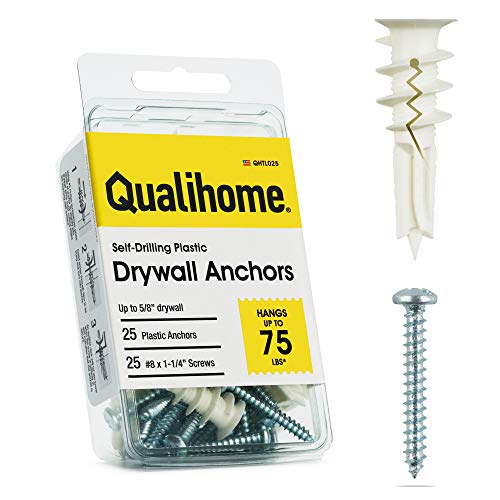
25 self-drilling anchors with matching screws, anti-spin grip, 1-1/4 in, for drywall only; 75 lb stated.
Check price on Amazon$7.99 as of Oct 20, 2026 5:40 pm GMT+0000 — prices change; see Amazon for current price.Why we like it
- Grip design meant to reduce spinning
- Matching screws in every pack
- Clear statement of where not to use it
- Light-to-medium duty guidance
| Specification | Details |
|---|---|
| Anchor type | Self-drilling threaded anchor with anti-spin grip |
| Size | 1-1/4 in |
| Stated load | Up to 75 lb under proper installation conditions |
| Surfaces | Drywall and sheetrock only |
| Not for | Concrete, brick, tile or solid wood |
| Pack | 25 anchors plus 25 screws; model QHSDAP0120 |
Qualihome QHSDAP0120 — 1-1/4 in self-drilling, anti-spin, drywall only, 75 lb stated, 25 sets
The Only Self-Drilling Listing That Says Where Not to Use It
Several self-drilling anchor listings on the shelf suggest they work on many surfaces. Qualihome’s is the only one in that group that says the opposite: drywall and sheetrock only, not concrete, brick, tile or solid wood. That is accurate for this anchor type. A threaded anchor that cuts its own hole in gypsum will not cut into masonry, and driving it into a stud just mangles the threads.
The anti-spin grip addresses the most common failure with self-drilling anchors, which is the anchor spinning in place instead of seating. The listing describes it as reducing spinning during installation rather than eliminating it, a fair choice of words.
The 75-pound figure comes with the qualifier “under proper installation conditions.” The listing frames typical use as light-to-medium duty, which is the better guide.
Pros
- Anti-spin grip
- Honest scope of use
- Screws included
Cons
- Smaller pack than most kits
- Screw size not stated
- Dimensions in the listing read as zero
Check Qualihome Self-Drilling Anchors price on Amazon
7. Lmutexyi Metal Expansion Anchor Kit — Best for Smaller Holes in Rentals

140-piece zinc-plated steel expansion anchor kit in 3 sizes; hammer-set, for hollow drywall away from studs.
Check price on Amazon$5.97 as of Oct 20, 2026 5:40 pm GMT+0000 — prices change; see Amazon for current price.Why we like it
- Three sizes from light to heavier items
- Hammer-set, no drill required
- Listing reminds you to avoid studs
- Smaller holes than plastic anchors, per listing
| Specification | Details |
|---|---|
| Anchor type | Tap-in metal expansion anchor with serrated grip |
| Material | Zinc-plated MN65 steel |
| Sizes | 3 sizes; exact dimensions not stated |
| Stated load | Not stated in listing |
| Install | Hammer and screwdriver; keep anchor straight; hollow drywall only |
| Pack | 140 pieces |
Lmutexyi Anchors01 — zinc-plated steel expansion anchors, 3 sizes, hammer-set, 140 pieces
The Only Expansion Kit That Warns You to Find the Studs First
Four listings on the shelf describe metal anchors you set with a hammer: Lmutexyi, Sunxeke, Tnisesm and a KURUI kit. Lmutexyi’s listing is the only one of those four that tells you to avoid wall studs and use the anchors in hollow drywall. That is the correct use. An expansion anchor needs open space behind the panel to flare, and hammering it into a stud bends it.
The listing also tells you to tap gently and keep the anchor straight to prevent bending, a practical tip for a type that does bend if hit hard. It claims the anchors leave smaller holes than plastic ones, which helps when patching a rental wall before move-out.
It does not give a load figure or the exact sizes of the three anchors, so this is a kit for light-to-medium items where you can judge the load yourself.
Pros
- Clear guidance on hollow-wall use
- No drill needed
- Large piece count
Cons
- No load rating stated
- Exact anchor sizes not listed
- Bends if struck off-angle
Check Lmutexyi Metal Expansion Kit price on Amazon
The four drywall anchor types and what each is for
Every listing on the shelf falls into one of four families. Knowing which is which matters more than the number on the box.
Plastic expansion anchors
The classic ribbed plastic sleeve. Drill a hole, tap it in, drive a screw to expand it. Cheap, versatile across drywall, masonry and wood, but the weakest of the four in drywall. Use them for light items: towel hooks, small frames, smoke alarm bases, cable clips.
Self-drilling threaded anchors
Coarse-threaded nylon or zinc anchors that cut their own hole when you drive them with a screwdriver. Fast and tidy, and the most common type on the shelf (eight of 16 listings). They hold by gripping the gypsum, so they are only as strong as the panel and they fail if they spin. Good for shelves, mirrors and curtain rods in sound 1/2-inch or 5/8-inch drywall.
Metal expansion (molly-style) anchors
Steel sleeves tapped or drilled in, then expanded behind the panel as you tighten the screw. Because they clamp the back of the drywall, they hold better than threaded anchors when sized to the panel thickness. Choose the sleeve length that matches the wall.
Toggle bolts
Spring wings that open behind the panel and spread the load over the widest area. The traditional choice for heavier hollow-wall loads and for light ceiling items, at the cost of a larger hole.
How to read load ratings on anchor listings
Eight of the 16 listings state a load: five at 75 pounds, two at 66 pounds and one at 50 pounds. None states the test method. Keep three points in mind.
- Shear vs pull-out. A mirror hanging flat against the wall loads the anchor in shear, which is the stronger direction. A shelf bracket with a heavy front edge levers the top screw straight out of the wall, which is far weaker. A “75 lb” anchor under a deep shelf may fail at a fraction of that.
- Per anchor vs per item. A rating is per anchor at best. Use several anchors and do not assume the ratings add up neatly, because loads are rarely shared evenly.
- The wall sets the ceiling. Old, damp or crumbly drywall cannot hold what new, dry panels can. If the drywall near a bathroom or exterior wall is soft, an anchor is not the fix. Our guides on mold behind drywall and early signs of mold on drywall explain what soft or stained panels can mean.
A sensible rule many installers use is to plan on a fraction of the stated figure and to go to a stud for anything heavy or anything that people could pull on.
When to skip anchors and use a stud
Some loads should go into framing, not drywall alone:
- TVs and wall mounts. Several listings mention TVs in passing, but the KURUI toggle listing explicitly says not to use it for televisions or heavy mounts. Mount TVs to studs with the hardware the mount maker specifies.
- Furniture anchoring straps. The CPSC advises anchoring TVs, dressers, bookcases and other tip-prone furniture to the wall or floor to protect young children. A tip-over strap should screw into a stud whenever possible, because a child pulling on a dresser applies a sudden outward load. See our furniture anchors guide for options.
- Grab bars and handrails. Anything a person leans on must go into blocking or studs with hardware rated for that use.
- Heavy shelving and cabinets. Kitchen and laundry cabinets belong on studs or a ledger.
Find studs with a stud finder or by locating drywall screws along a vertical line, typically 16 or 24 inches apart. Before drilling near outlets or switches, remember that wiring usually runs vertically from those boxes, and plumbing often runs behind bathroom and kitchen walls.
Older Front Range homes: plaster, asbestos and lead
Many Denver-area neighborhoods have homes built before 1980, and drilling into their walls deserves a moment of thought.
Plaster walls. Lath and plaster is harder and more brittle than drywall. Self-drilling drywall anchors usually will not work, and hammering can crack the plaster. Drill a pilot hole with a masonry bit and use toggles or expansion anchors sized for the wall, or find the studs.
Asbestos. The EPA lists textured paint and patching compounds used on walls and ceilings among the places asbestos may be found in older homes, and it advises not to saw, sand, scrape or drill holes in asbestos-containing materials. A few holes for a picture hook are low disturbance, but larger projects in older homes with original wall texture warrant testing first. Our guide on drywall mud covers joint compound in more detail.
Lead paint. The EPA notes that about three-quarters of U.S. homes built before 1978 still contain some lead-based paint and that renovation, repair or painting in those homes can create dangerous lead dust. Drilling a few holes is minor, but repainting or sanding trim in pre-1978 homes should follow lead-safe practices.
How to install drywall anchors so they hold
- Check behind the wall. Use a stud finder, and avoid the area directly above or below outlets and switches.
- Match the anchor to the load. Light items get plastic or threaded anchors; heavier items get expansion anchors or toggles; very heavy items go to studs.
- Drive by hand at the end. Self-drilling anchors strip easily with a drill. Start with a drill on low speed if you like, then finish by hand until the head is flush.
- Do not overtighten the screw. Overtightening crushes the gypsum around the anchor, which is the most common cause of failure.
- Use more anchors than you think. Spread the load across several points, and add a stud screw where one lines up.
- Patch neatly when you remove them. Our drywall repair guide covers patching anchor holes and larger damage.
When a wall problem needs a professional
Anchors that pull out repeatedly, drywall that feels soft or damp, cracks that radiate from corners of doors and windows, or nail pops that keep returning can signal moisture or framing movement rather than a hardware problem. A home inspector can check moisture levels and look for the source. Our structure and exterior hub covers related topics, and if you are on the Front Range and want a vetted local inspector to look at a suspect wall, get in touch through our contact page.
Frequently asked questions
What is the strongest type of drywall anchor?
In drywall alone, toggle bolts and properly sized metal expansion anchors generally hold more than plastic or self-drilling threaded anchors, because they clamp the back of the panel. For heavy loads, the strongest option is not an anchor at all but a screw into a wall stud.
Are 75 lb drywall anchors really good for 75 pounds?
Treat any stated load as a best case. None of the listings we compared states how the figure was tested, whether it is a shear or pull-out load, or what safety margin applies. A shelf that levers the anchor outward can fail well below the stated number, so plan conservatively and use several anchors.
Can drywall anchors hold a TV?
Mount TVs to studs using the mount maker's hardware. At least one listing we compared, the KURUI toggle kit, explicitly says it is not recommended for televisions or heavy mounts. The CPSC also advises anchoring TVs and tip-prone furniture to protect young children.
Do self-drilling drywall anchors need a pilot hole?
No. Self-drilling anchors cut their own hole in gypsum when you drive them with a screwdriver. They will not drill into studs, masonry or tile, and they can strip if driven too fast with a power drill, so finish by hand until the head sits flush.
What anchors work in plaster walls?
Self-drilling drywall anchors usually do not work in plaster. Drill a pilot hole with a masonry bit and use toggle bolts or expansion anchors sized for the wall thickness, or screw into studs. In older homes, keep the EPA's guidance on asbestos and lead in mind before larger projects.
References
- Childproofing Your Home — U.S. Consumer Product Safety Commission
- Learn About Asbestos — U.S. Environmental Protection Agency
- Protect Your Family from Exposures to Asbestos — U.S. Environmental Protection Agency
- Lead Renovation, Repair and Painting Program — U.S. Environmental Protection Agency